
K.U.A.S. Journal of Humanities and Social Sciences Volume 9, Number 1 July, 2012 Ч Contents Ч Luo Shang criticized and the guidance present age Chi-ch
|
|
|
- 癸 侯
- 9 years ago
- Views:
Transcription
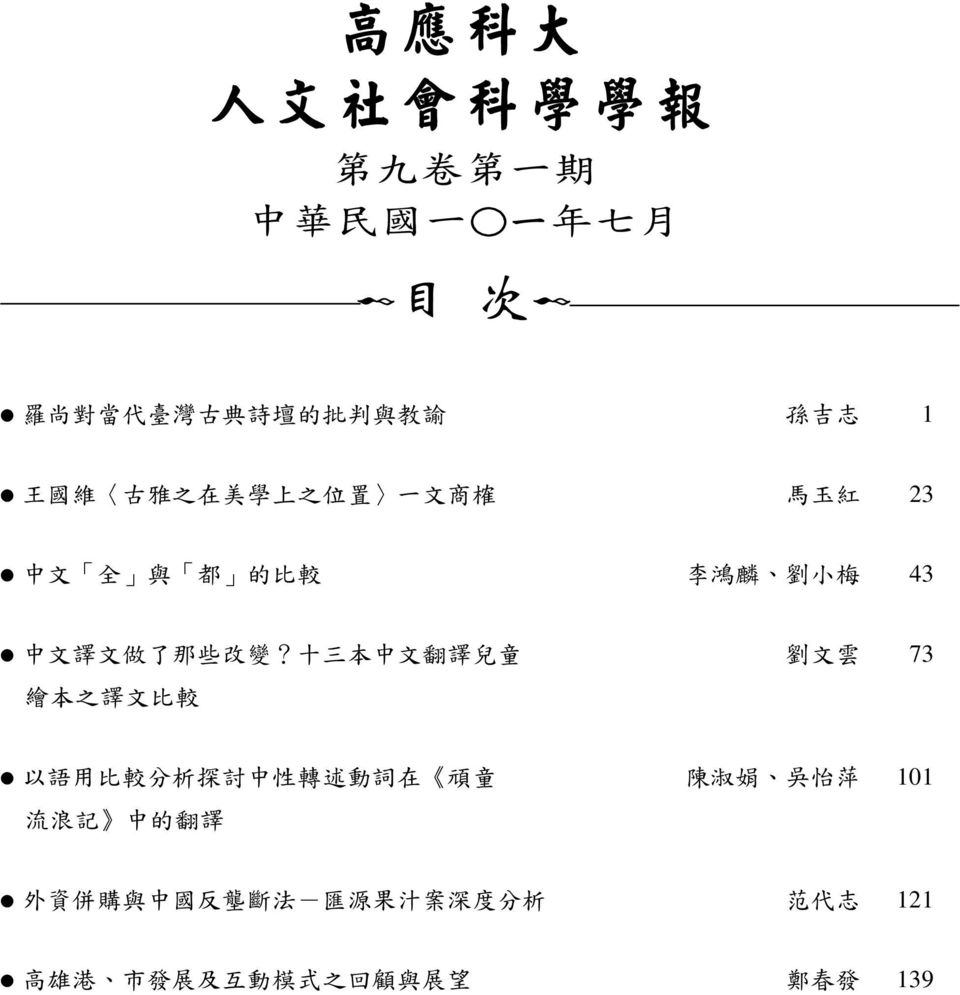
1 高 應 科 大 人 文 社 會 科 學 學 報 第 九 卷 第 一 期 中 華 民 國 一 一 年 七 月 Ч 目 次 Ч 羅 尚 對 當 代 臺 灣 古 典 詩 壇 的 批 判 與 教 諭 孫 吉 志 1 王 國 維 古 雅 之 在 美 學 上 之 位 置 一 文 商 榷 馬 玉 紅 23 中 文 全 與 都 的 比 較 李 鴻 麟 劉 小 梅 43 中 文 譯 文 做 了 那 些 改 變? 十 三 本 中 文 翻 譯 兒 童 劉 文 雲 73 繪 本 之 譯 文 比 較 以 語 用 比 較 分 析 探 討 中 性 轉 述 動 詞 在 頑 童 陳 淑 娟 吳 怡 萍 101 流 浪 記 中 的 翻 譯 外 資 併 購 與 中 國 反 壟 斷 法 - 匯 源 果 汁 案 深 度 分 析 范 代 志 121 高 雄 港 市 發 展 及 互 動 模 式 之 回 顧 與 展 望 鄭 春 發 139
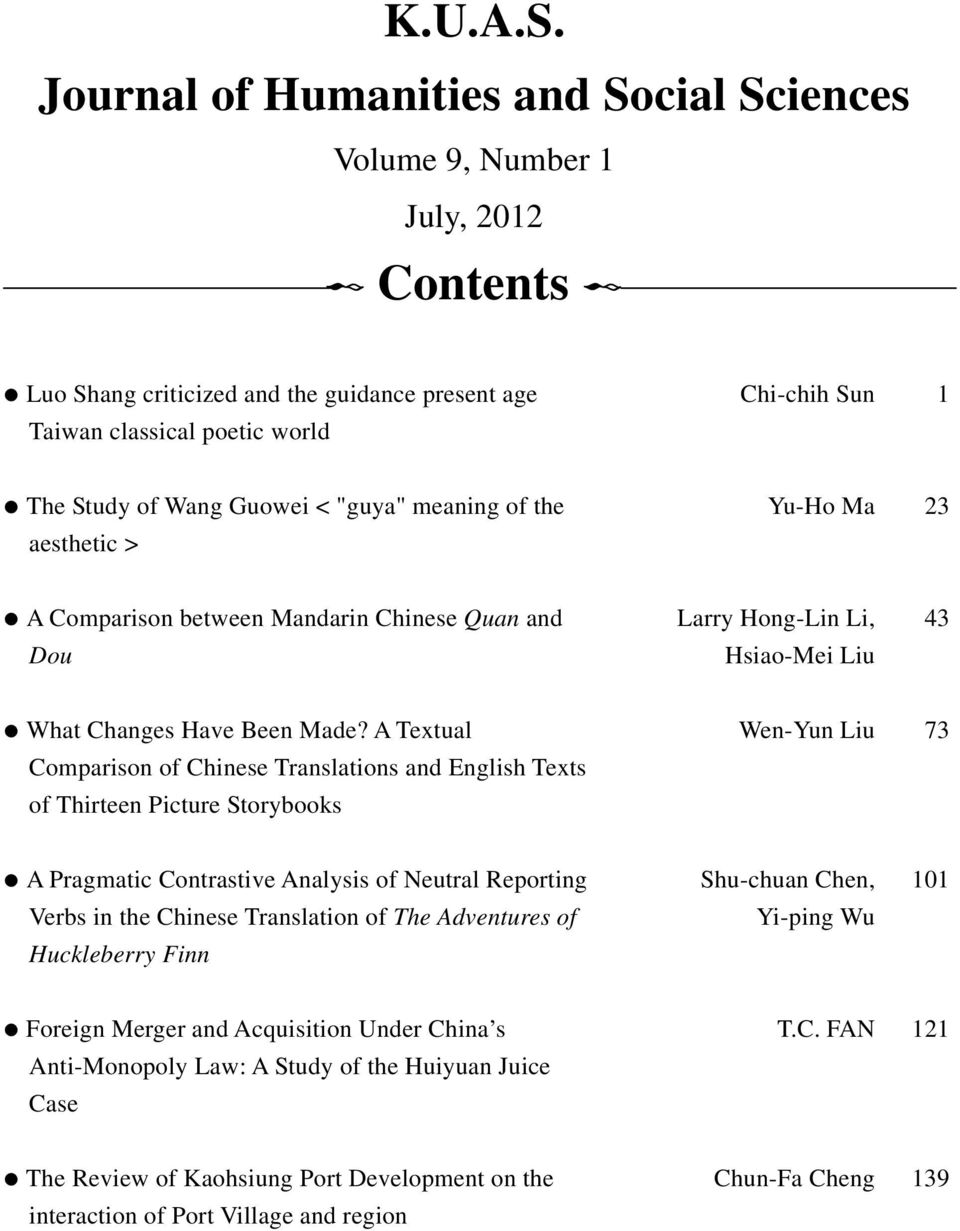
2 K.U.A.S. Journal of Humanities and Social Sciences Volume 9, Number 1 July, 2012 Ч Contents Ч Luo Shang criticized and the guidance present age Chi-chih Sun 1 Taiwan classical poetic world The Study of Wang Guowei < "guya" meaning of the Yu-Ho Ma 23 aesthetic > A Comparison between Mandarin Chinese Quan and Larry Hong-Lin Li, 43 Dou Hsiao-Mei Liu What Changes Have Been Made? A Textual Wen-Yun Liu 73 Comparison of Chinese Translations and English Texts of Thirteen Picture Storybooks A Pragmatic Contrastive Analysis of Neutral Reporting Shu-chuan Chen, 101 Verbs in the Chinese Translation of The Adventures of Yi-ping Wu Huckleberry Finn Foreign Merger and Acquisition Under China s T.C. FAN 121 Anti-Monopoly Law: A Study of the Huiyuan Juice Case The Review of Kaohsiung Port Development on the Chun-Fa Cheng 139 interaction of Port Village and region
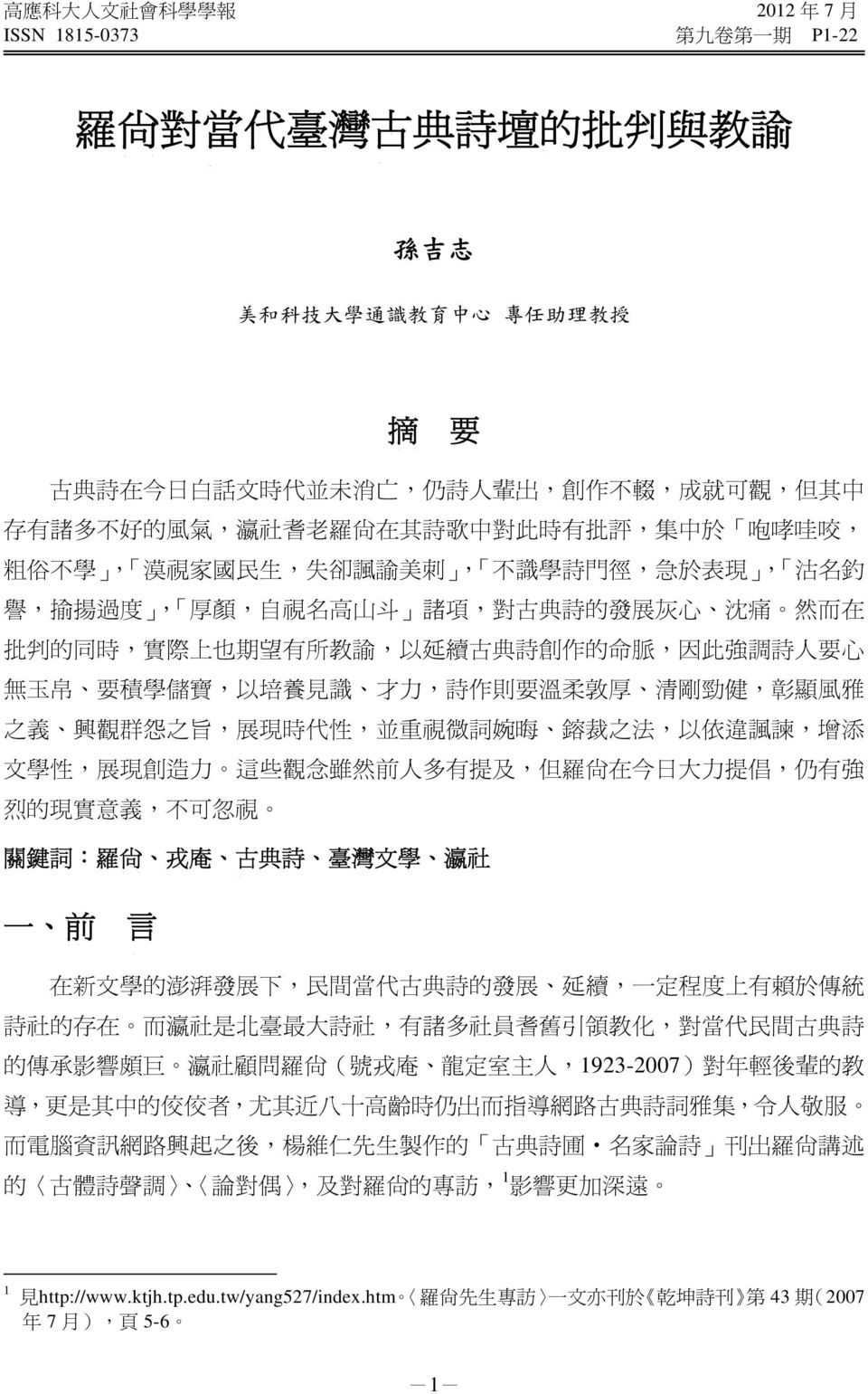
3 2012 年 7 月 ISSN 第 九 卷 第 一 期 P1-22 羅 尚 對 當 代 臺 灣 古 典 詩 壇 的 批 判 與 教 諭 孫 吉 志 美 和 科 技 大 學 通 識 教 育 中 心 專 任 助 理 教 授 摘 要 古 典 詩 在 今 日 白 話 文 時 代 並 未 消 亡, 仍 詩 人 輩 出, 創 作 不 輟, 成 就 可 觀, 但 其 中 存 有 諸 多 不 好 的 風 氣, 瀛 社 耆 老 羅 尚 在 其 詩 歌 中 對 此 時 有 批 評, 集 中 於 咆 哮 哇 咬, 粗 俗 不 學, 漠 視 家 國 民 生, 失 卻 諷 諭 美 刺, 不 識 學 詩 門 徑, 急 於 表 現, 沽 名 釣 譽, 揄 揚 過 度, 厚 顏, 自 視 名 高 山 斗 諸 項, 對 古 典 詩 的 發 展 灰 心 沈 痛 然 而 在 批 判 的 同 時, 實 際 上 也 期 望 有 所 教 諭, 以 延 續 古 典 詩 創 作 的 命 脈, 因 此 強 調 詩 人 要 心 無 玉 帛 要 積 學 儲 寶, 以 培 養 見 識 才 力, 詩 作 則 要 溫 柔 敦 厚 清 剛 勁 健, 彰 顯 風 雅 之 義 興 觀 群 怨 之 旨, 展 現 時 代 性, 並 重 視 微 詞 婉 晦 鎔 裁 之 法, 以 依 違 諷 諫, 增 添 文 學 性, 展 現 創 造 力 這 些 觀 念 雖 然 前 人 多 有 提 及, 但 羅 尚 在 今 日 大 力 提 倡, 仍 有 強 烈 的 現 實 意 義, 不 可 忽 視 關 鍵 詞 : 羅 尚 戎 庵 古 典 詩 臺 灣 文 學 瀛 社 一 前 言 在 新 文 學 的 澎 湃 發 展 下, 民 間 當 代 古 典 詩 的 發 展 延 續, 一 定 程 度 上 有 賴 於 傳 統 詩 社 的 存 在 而 瀛 社 是 北 臺 最 大 詩 社, 有 諸 多 社 員 耆 舊 引 領 教 化, 對 當 代 民 間 古 典 詩 的 傳 承 影 響 頗 巨 瀛 社 顧 問 羅 尚 ( 號 戎 庵 龍 定 室 主 人, ) 對 年 輕 後 輩 的 教 導, 更 是 其 中 的 佼 佼 者, 尤 其 近 八 十 高 齡 時 仍 出 而 指 導 網 路 古 典 詩 詞 雅 集, 令 人 敬 服 而 電 腦 資 訊 網 路 興 起 之 後, 楊 維 仁 先 生 製 作 的 古 典 詩 圃 名 家 論 詩 刊 出 羅 尚 講 述 的 古 體 詩 聲 調 論 對 偶, 及 對 羅 尚 的 專 訪, 1 影 響 更 加 深 遠 1 見 羅 尚 先 生 專 訪 一 文 亦 刊 於 乾 坤 詩 刊 第 43 期 (2007 年 7 月 ), 頁
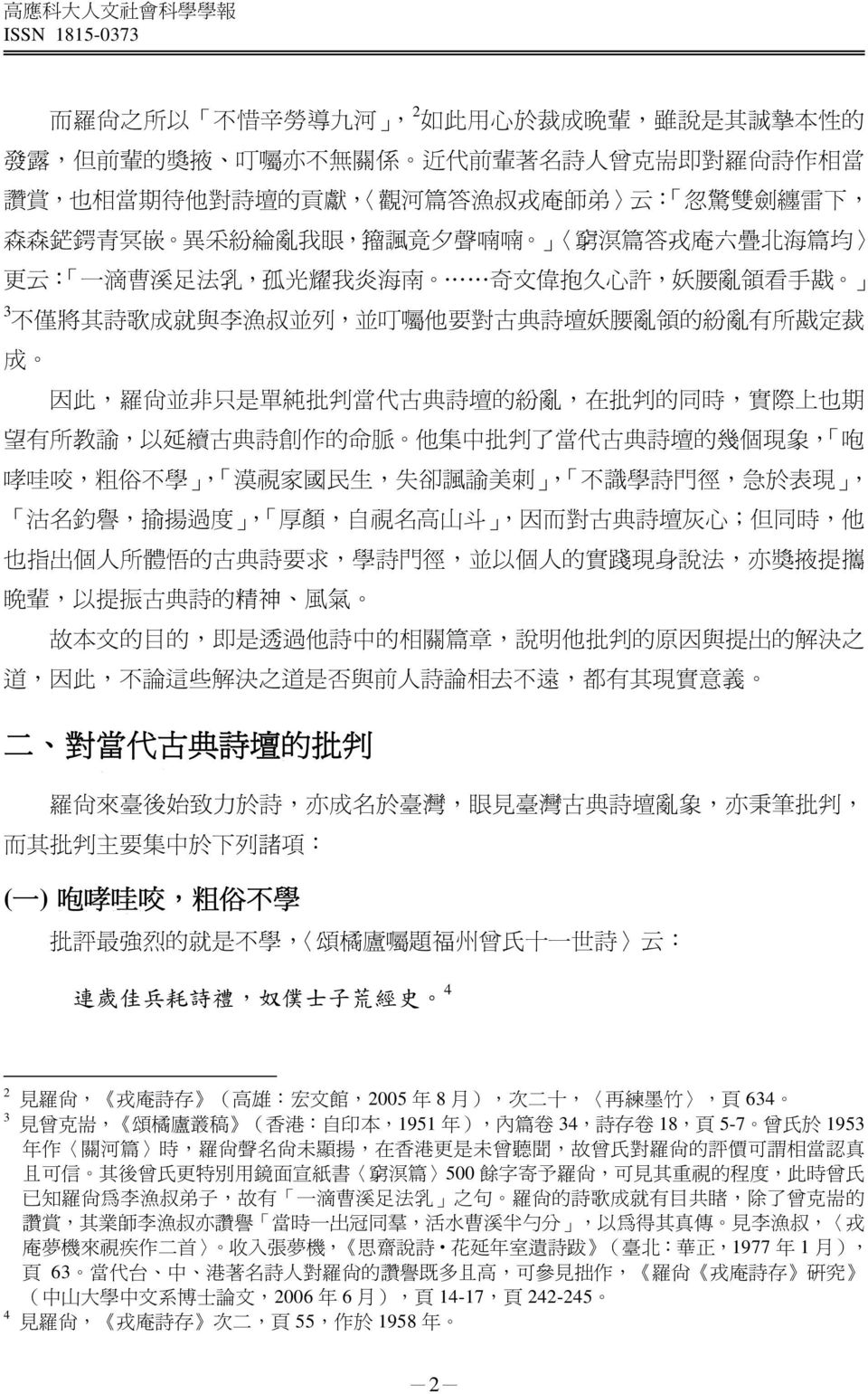
4 ISSN 而 羅 尚 之 所 以 不 惜 辛 勞 導 九 河, 2 如 此 用 心 於 裁 成 晚 輩, 雖 說 是 其 誠 摯 本 性 的 發 露, 但 前 輩 的 獎 掖 叮 囑 亦 不 無 關 係 近 代 前 輩 著 名 詩 人 曾 克 耑 即 對 羅 尚 詩 作 相 當 讚 賞, 也 相 當 期 待 他 對 詩 壇 的 貢 獻, 觀 河 篇 答 漁 叔 戎 庵 師 弟 云 : 忽 驚 雙 劍 纏 雷 下, 森 森 鋩 鍔 青 冥 嵌 異 采 紛 綸 亂 我 眼, 籀 諷 竟 夕 聲 喃 喃 窮 溟 篇 答 戎 庵 六 疊 北 海 篇 均 更 云 : 一 滴 曹 溪 足 法 乳, 孤 光 耀 我 炎 海 南 奇 文 偉 抱 久 心 許, 妖 腰 亂 領 看 手 戡 3 不 僅 將 其 詩 歌 成 就 與 李 漁 叔 並 列, 並 叮 囑 他 要 對 古 典 詩 壇 妖 腰 亂 領 的 紛 亂 有 所 戡 定 裁 成 因 此, 羅 尚 並 非 只 是 單 純 批 判 當 代 古 典 詩 壇 的 紛 亂, 在 批 判 的 同 時, 實 際 上 也 期 望 有 所 教 諭, 以 延 續 古 典 詩 創 作 的 命 脈 他 集 中 批 判 了 當 代 古 典 詩 壇 的 幾 個 現 象, 咆 哮 哇 咬, 粗 俗 不 學, 漠 視 家 國 民 生, 失 卻 諷 諭 美 刺, 不 識 學 詩 門 徑, 急 於 表 現, 沽 名 釣 譽, 揄 揚 過 度, 厚 顏, 自 視 名 高 山 斗, 因 而 對 古 典 詩 壇 灰 心 ; 但 同 時, 他 也 指 出 個 人 所 體 悟 的 古 典 詩 要 求, 學 詩 門 徑, 並 以 個 人 的 實 踐 現 身 說 法, 亦 獎 掖 提 攜 晚 輩, 以 提 振 古 典 詩 的 精 神 風 氣 故 本 文 的 目 的, 即 是 透 過 他 詩 中 的 相 關 篇 章, 說 明 他 批 判 的 原 因 與 提 出 的 解 決 之 道, 因 此, 不 論 這 些 解 決 之 道 是 否 與 前 人 詩 論 相 去 不 遠, 都 有 其 現 實 意 義 二 對 當 代 古 典 詩 壇 的 批 判 羅 尚 來 臺 後 始 致 力 於 詩, 亦 成 名 於 臺 灣, 眼 見 臺 灣 古 典 詩 壇 亂 象, 亦 秉 筆 批 判, 而 其 批 判 主 要 集 中 於 下 列 諸 項 : ( 一 ) 咆 哮 哇 咬, 粗 俗 不 學 批 評 最 強 烈 的 就 是 不 學, 頌 橘 廬 囑 題 福 州 曾 氏 十 一 世 詩 云 : 連 歲 佳 兵 耗 詩 禮, 奴 僕 士 子 荒 經 史 見 羅 尚, 戎 庵 詩 存 ( 高 雄 : 宏 文 館,2005 年 8 月 ), 次 二 十, 再 練 墨 竹, 頁 634 見 曾 克 耑, 頌 橘 廬 叢 稿 ( 香 港 : 自 印 本,1951 年 ), 內 篇 卷 34, 詩 存 卷 18, 頁 5-7 曾 氏 於 1953 年 作 關 河 篇 時, 羅 尚 聲 名 尚 未 顯 揚, 在 香 港 更 是 未 曾 聽 聞, 故 曾 氏 對 羅 尚 的 評 價 可 謂 相 當 認 真 且 可 信 其 後 曾 氏 更 特 別 用 鏡 面 宣 紙 書 窮 溟 篇 500 餘 字 寄 予 羅 尚, 可 見 其 重 視 的 程 度, 此 時 曾 氏 已 知 羅 尚 為 李 漁 叔 弟 子, 故 有 一 滴 曹 溪 足 法 乳 之 句 羅 尚 的 詩 歌 成 就 有 目 共 睹, 除 了 曾 克 耑 的 讚 賞, 其 業 師 李 漁 叔 亦 讚 譽 當 時 一 出 冠 同 羣, 活 水 曹 溪 半 勺 分, 以 為 得 其 真 傳 見 李 漁 叔, 戎 庵 夢 機 來 視 疾 作 二 首 收 入 張 夢 機, 思 齋 說 詩 花 延 年 室 遺 詩 跋 ( 臺 北 : 華 正,1977 年 1 月 ), 頁 63 當 代 台 中 港 著 名 詩 人 對 羅 尚 的 讚 譽 既 多 且 高, 可 參 見 拙 作, 羅 尚 戎 庵 詩 存 研 究 ( 中 山 大 學 中 文 系 博 士 論 文,2006 年 6 月 ), 頁 14-17, 頁 見 羅 尚, 戎 庵 詩 存 次 二, 頁 55, 作 於 1958 年 -2-
5 孫 吉 志 羅 尚 對 當 代 臺 灣 古 典 詩 壇 的 批 判 與 教 諭 時 代 的 兵 革 荒 亂 往 往 影 響 了 詩 書 禮 樂 的 教 化, 這 原 本 無 可 厚 非, 然 而 因 為 詩 禮 經 史 的 荒 疏, 所 以 無 從 培 養 性 情 氣 質 思 想 感 情, 對 詩 歌 的 學 習 也 無 法 洞 中 肯 綮, 只 得 形 象 的 模 仿 所 以 羅 尚 說 : 今 有 一 大 錯, 以 聲 調 格 律 為 傳 統, 故 曰 傳 統 詩 殊 不 知 聲 律 為 文 學 形 式, 而 非 內 容, 內 容 為 思 想 感 情 想 像, 在 詩 為 興 觀 群 怨 思 無 邪, 這 才 是 傳 統, 亦 即 黃 梨 洲 所 謂 千 古 性 情 ( 與 陳 文 銓 書 ) 明 理 以 立 體, 修 辭 立 其 誠, 無 邪 在 其 中 矣 ( 詩 議 ) 5 強 調 傳 統 古 典 詩 的 精 義 在 興 觀 群 怨 思 無 邪, 6 而 非 聲 調 格 律, 若 只 符 合 聲 調 格 律, 仍 不 可 稱 為 古 典 詩 只 有 達 到 興 觀 群 怨 思 無 邪, 體 察 民 情 風 俗 考 見 興 衰 得 失, 才 具 備 了 千 古 不 易 的 性 情, 才 能 上 承 風 騷 傳 統, 下 記 時 代 風 貌 也 就 是 說, 詩 作 要 有 真 誠 實 感 要 本 於 當 世 人 情 而 有 時 代 性 要 有 章 法 條 理, 若 能 如 此, 也 就 能 懂 得 民 生 疾 苦, 並 力 求 文 字 意 涵 的 高 雅, 使 覽 者 興 感 奮 發 因 此 詩 歌 最 忌 俗, 不 僅 忌 諱 意 俗, 也 忌 諱 用 語 淺 俗, 毫 無 雅 韻, 略 無 比 興 詩 人 節 就 抨 擊 了 這 樣 的 現 象 : 詩 人 有 節 事 荒 唐, 做 炮 孤 兒 欠 主 張 昔 日 咆 哮 長 短 打, 今 朝 哇 咬 水 雲 鄉 7 長 短 打, 是 指 詩 句 長 短 不 一, 頗 有 革 新 的 意 圖, 但 加 上 咆 哮, 則 是 批 評 不 識 古 體 聲 律, 率 爾 為 詩, 表 面 上 氣 勢 賁 張, 卻 是 率 意 粗 俗 的 話 語 哇 咬, 指 嘈 雜 之 聲 語 批 評 詩 歌 的 粗 率 淺 俗, 正 是 批 評 不 學 不 深 思 之 過, 即 是 欠 主 張 之 意 而 就 羅 尚 的 觀 點 來 說, 這 與 性 靈 一 說 不 無 關 係, 逭 暑 吟 云 : 5 見 羅 尚, 戎 庵 詩 存 附 錄, 頁 771, 頁 論 語 為 政 載 子 曰 : 詩 三 百, 一 言 以 蔽 之, 曰 : 思 無 邪 思 無 邪, 即 是 思 想 情 性 真 誠, 程 頤 正 作 誠 解 朱 熹 曰 : 凡 詩 之 言 善 者, 可 以 感 發 人 之 善 心 ; 惡 者, 可 以 懲 創 人 之 逸 志 其 用 歸 於 使 人 得 其 情 性 之 正 而 已 然 其 言 微 婉, 且 或 各 因 一 事 而 發, 求 其 直 指 全 體, 則 未 有 若 此 之 明 且 盡 者 程 頤 曰 : 思 無 邪 者, 誠 也 見 朱 熹, 四 書 集 註 ( 臺 北 : 學 海,1989 年 8 月 ), 頁 楊 伯 峻 說 : 思 無 邪 一 語 本 是 詩 經 魯 頌 駉 篇 之 文, 孔 子 借 它 來 評 論 所 有 詩 篇 思 字 在 駉 篇 本 是 無 義 的 語 首 詞, 孔 子 引 用 它 卻 當 思 想 解, 自 是 斷 章 取 義 俞 樾 曲 園 雜 纂 說 項 說 這 也 是 語 辭, 恐 不 合 孔 子 原 意 見 楊 伯 峻, 論 語 譯 注 ( 臺 北 : 漢 京,1987 年 1 月 ), 頁 11 7 見 羅 尚, 戎 庵 二 十 一 世 紀 詩 存 ( 高 雄 : 宏 文 館,2008 年 9 月 ), 頁 作 於 2001 年, 原 詩 是 律 詩 -3-
6 ISSN 性 靈 淺 語 嫌 鄰 俗, 翰 藻 沈 思 在 不 爭 8 姑 不 論 羅 尚 對 袁 枚 性 靈 說 的 評 價 精 準 與 否, 他 以 文 選 選 文 的 標 準 事 出 於 沈 思, 義 歸 乎 翰 藻 批 評 性 靈 詩 風 的 淺 語 鄰 俗, 事 實 上 也 批 評 了 部 分 作 者, 假 借 袁 枚 性 靈 說 的 詩 寫 性 情, 惟 吾 所 適 矢 口 而 成, 9 而 行 咆 哮 哇 咬 之 實, 不 肯 用 心 於 博 習 沈 思, 使 義 歸 於 翰 藻, 因 而 失 卻 詩 韻 詩 質 暮 秋 偶 成 絕 句 亦 云 : 正 宗 才 力 自 堂 堂, 出 口 傷 人 欠 主 張 詩 到 性 靈 真 末 路, 大 家 終 是 屬 漁 洋 10 袁 枚 曾 云 : 本 朝 古 文 之 有 方 望 溪, 猶 詩 之 有 阮 亭, 俱 為 一 代 正 宗, 而 才 力 自 薄 近 人 尊 之 者, 詩 文 必 弱 ; 詆 之 者, 詩 文 必 粗 11 主 要 批 評 王 漁 洋 偏 重 神 韻, 不 見 個 人 性 靈, 但 也 等 於 間 接 承 認 漁 洋 之 詩 尚 雅 羅 尚 此 詩 雖 然 批 評 了 袁 枚 的 一 代 正 宗, 才 力 自 薄 之 論, 但 亦 抨 擊 了 欠 主 張 的 咆 哮 哇 咬 之 作, 藉 口 性 靈 豪 邁 氣 力, 卻 全 無 雅 致 詩 韻 詩 質, 只 落 得 粗 俗 不 堪 偶 題 十 四 韻 中 的 抨 擊 感 慨 更 強 烈 : 醉 客 延 醒 客, 庸 才 作 上 才 有 誰 尊 趙 翼, 多 是 許 袁 枚 12 趙 翼 著 甌 北 詩 話, 其 小 引 中 自 言 撰 書 旨 趣, 是 因 晚 年 無 事, 取 諸 家 全 集, 再 三 展 玩, 始 知 其 真 才 分 真 境 地 因 竊 自 愧 悔, 使 數 十 年 前, 早 從 此 尋 繹, 得 識 各 家 獨 至 之 處, 與 之 相 上 下, 其 才 高 者 可 以 擴 吾 之 才, 其 功 深 者 可 以 進 吾 之 功, 必 將 挫 籠 參 會, 自 成 一 家 因 念 世 之 有 才 者 何 限, 度 亦 如 余 之 輕 心 掉 過, 必 待 晚 而 始 知, 則 何 如 以 余 晚 年 所 見, 使 諸 才 人 早 見 及 之, 可 以 省 數 十 年 之 孰 視 無 睹 是 於 余 見 羅 尚, 戎 庵 詩 存, 次 十 九, 頁 614 作 於 1992 年 見 袁 枚, 隨 園 詩 話 ( 臺 北 : 漢 京,1984 年 2 月 ), 卷 一,6 條, 頁 3; 卷 三,21 條, 頁 76 袁 枚 的 性 靈 說 不 僅 不 廢 學, 還 相 當 重 視 博 習 與 功 力 琢 磨, 他 在 續 詩 品 博 習 云 : 萬 卷 山 積, 一 篇 吟 成 詩 之 與 書, 有 情 無 情 鐘 鼓 非 樂, 捨 之 何 鳴! 不 關 學, 終 非 正 聲 見 司 空 圖, 袁 枚 著, 佚 名 集 解, 詩 品 集 解 ( 臺 北 : 清 流,1972 年 3 月 ), 頁 147 隨 園 詩 話 卷 二,44 條, 云 : 後 之 人 未 有 不 學 古 人 而 能 為 詩 者 也 卷 五,33 條, 云 : 詩 之 必 根 于 學, 所 謂 不 從 糟 粕, 安 得 精 英 是 也 40 條, 引 葉 書 山 云 : 人 功 未 極, 則 天 籟 亦 無 因 而 至 雖 云 天 籟, 亦 須 從 人 功 求 之 卷 六,22 條, 云 : 用 巧 無 斧 鑿 痕, 用 典 無 填 砌 痕, 此 是 晚 年 成 就 之 事 若 初 學 者, 正 要 他 肯 雕 刻, 方 去 費 心 ; 肯 用 典, 方 去 讀 書 見 隨 園 詩 話 頁 49, 頁 146, 頁 149, 頁 176 這 些 都 可 見 袁 枚 重 學 的 態 度, 要 求 由 學 以 成 正 聲 以 成 天 籟, 不 學 則 無 以 為 詩 見 羅 尚, 戎 庵 二 十 一 世 紀 詩 存, 頁 88, 作 於 2004 年 羅 尚 對 性 靈 說 並 非 完 全 否 定, 仍 以 為 近 情, 和 湘 潭 白 石 詩 社 八 傻 歌 云 : 神 韻 性 靈 猶 近 情 見 羅 尚, 戎 庵 詩 存, 次 十 八, 頁 569, 作 於 1991 年 見 袁 枚, 隨 園 詩 話 卷 二,39 條, 頁 48 見 羅 尚, 戎 庵 二 十 一 世 紀 詩 存, 頁 102, 作 於 2005 年 -4-
7 孫 吉 志 羅 尚 對 當 代 臺 灣 古 典 詩 壇 的 批 判 與 教 諭 雖 不 能 有 所 進, 而 於 諸 才 人 實 大 有 所 益 也 13 可 見 羅 尚 贊 同 趙 翼 廣 博 學 習 一 流 詩 人 作 品 的 詩 學 態 度, 不 許 袁 枚 性 靈 說, 當 然 更 是 抨 擊 當 代 詩 壇 多 有 不 學 粗 俗 的 現 象 ( 二 ) 漠 視 家 國 民 生, 失 卻 諷 諭 美 刺 因 為 沒 有 千 古 性 情, 沒 有 宏 闊 的 視 野, 自 然 不 會 關 懷 家 國 民 生, 失 卻 古 典 詩 的 風 雅 傳 統, 冬 日 雜 感 云 : 海 內 遺 民 望, 來 蘇 凍 餒 深 未 諳 興 禮 樂, 所 得 是 荒 淫 禍 已 臨 縣 目, 詩 猶 競 捧 心 雅 言 何 處 有, 伏 枕 聽 纏 霖 14 此 詩 作 於 政 府 渡 臺 初 期, 臺 灣 各 項 建 設 尚 未 復 原, 外 又 有 中 共 進 逼, 情 勢 危 急 頷 聯 批 評 政 府 的 政 策 作 為, 點 出 了 古 典 詩 發 展 艱 困 的 外 在 條 件 古 典 詩 的 發 展 有 時 需 要 政 府 的 協 助, 但 政 府 不 僅 不 興 禮 樂 教 化, 缺 乏 鼓 勵, 15 更 施 行 戒 嚴, 以 國 家 機 器 介 入 管 控 文 壇, 審 核 報 章 雜 誌 媒 體, 讓 作 者 不 敢 自 由 發 聲, 進 入 白 色 恐 怖 時 期, 文 風 自 然 不 盛, 古 典 詩 的 發 展 也 受 到 限 制 後 二 聯 抨 擊 籠 罩 在 白 色 恐 怖 之 下 的 古 典 詩, 漠 視 家 國 危 殆, 了 無 諷 諭 美 刺, 失 卻 古 典 詩 的 精 神 實 質, 令 人 慨 嘆 縣 目, 指 亡 國 之 禍, 伍 子 胥 將 死 時, 曰 : 樹 吾 墓 上 以 梓, 令 可 為 器 抉 吾 眼 置 之 吳 東 門, 以 觀 越 之 滅 吳 也 16 中 共 進 逼, 國 家 正 臨 危 急 存 亡 之 秋, 一 如 伍 子 胥 懸 目 以 觀 越 之 滅 吳 捧 心, 指 模 仿 抄 襲 而 無 實 質, 莊 子 天 運 云 : 西 施 病 心 而 矉 其 里, 其 里 之 醜 人 見 而 美 之, 歸 亦 捧 心 而 矉 其 里 其 里 之 富 人 見 之, 堅 閉 門 而 不 出 ; 貧 人 見 之, 挈 妻 子 而 去 走 彼 知 矉 美 而 不 知 矉 之 所 以 美 17 在 國 家 存 亡 之 秋, 古 典 詩 卻 不 能 擔 負 起 振 聾 發 聵 的 責 任, 了 無 時 代 性, 自 然 要 哀 嘆 雅 言 何 處 有 了 北 臺 的 批 判 亦 同, 但 書 寫 較 為 隱 晦 : 宿 雨 收 東 海, 華 燈 爛 北 臺 且 尋 今 夕 夢, 休 抱 百 年 哀 急 節 翻 紅 袖, 纖 13 見 趙 翼, 甌 北 詩 話 小 引 收 入 郭 紹 虞 編 選, 富 壽 蓀 校 點, 清 詩 話 續 編 ( 上 海 : 上 海 古 籍,1983 年 12 月 ), 頁 見 羅 尚, 戎 庵 詩 存 次 二, 頁 31, 作 於 1955 年 15 臺 灣 全 志 ( 文 化 志 一 文 學 篇 ) 指 出 戰 後 古 典 詩 創 作 與 活 動 之 邊 緣 化, 與 政 府 的 文 藝 政 策 息 息 相 關 主 因 有 三 : 一, 經 濟 資 本 的 分 配 明 顯 傾 向 新 文 學 二, 以 推 動 言 文 一 致 的 國 語 運 動 及 新 文 學 創 作, 宣 傳 光 復 大 陸 反 共 抗 俄, 較 古 典 詩 更 具 傳 播 效 益 三, 言 文 分 離 使 得 古 典 詩 閱 讀 與 寫 作 成 為 特 殊 技 藝, 創 作 與 活 動 人 口 減 少 參 見 江 寶 釵, 臺 灣 全 志 ( 文 化 志 一 文 學 篇 ) ( 臺 北 : 國 史 館 臺 灣 文 獻 館,2009 年 6 月 ), 頁 見 司 馬 遷 著, 楊 家 駱 主 編, 新 校 本 史 記 三 家 注 ( 臺 北 : 鼎 文,1993 年 10 月 ), 頁 見 郭 慶 藩 編, 王 孝 魚 整 理, 莊 子 集 釋 ( 臺 北 : 國 文 天 地,1991 年 10 月 ), 頁

8 ISSN 歌 送 綠 醅 嘔 心 酬 盛 世, 耗 盡 過 江 才 18 宿 雨 暗 指 八 二 三 砲 戰, 砲 戰 一 結 束, 北 臺 就 呈 現 歌 舞 昇 平 通 宵 達 旦 的 荒 淫 景 象, 憂 患 生 聚 全 然 不 見, 顯 見 政 府 對 於 禮 樂 教 化 的 漠 視 末 二 句 則 指 責 當 時 詩 壇, 雖 然 白 色 恐 怖 籠 罩, 但 就 算 嘔 心 歌 詠 盛 世, 耗 盡 精 力, 對 國 家 民 生 又 有 何 裨 益? 更 何 況 那 又 算 什 麼 盛 世? 把 民 生 凋 弊 國 步 艱 難 歌 詠 成 盛 世, 猶 如 畫 師 妙 手 繪 製 的 太 平 圖, 更 使 古 典 詩 淪 為 邀 名 的 工 具 全 詩 從 反 面 歡 樂 處 立 言, 反 更 見 胸 中 塊 壘, 充 滿 憾 恨 沈 痛, 而 又 無 奈 在 政 府 漠 視, 甚 至 打 壓, 詩 壇 沈 默 之 下, 羅 尚 對 於 古 典 詩, 自 然 有 文 孝 今 所 薄, 深 藏 宜 入 壁 19 的 慨 嘆 了 ( 三 ) 不 識 學 詩 門 徑, 急 於 表 現 不 學 粗 俗 的 詩 壇 現 象, 與 不 知 學 詩 門 徑 急 於 表 現 有 一 定 關 係 除 了 個 人 性 情 的 琢 鍊, 透 過 學 習 門 徑 充 實 書 卷, 對 詩 作 內 質 必 有 提 升 感 興 七 首 云 : 慢 說 李 杜 高 岑 王, 孟 韓 元 白 皆 騰 驤 義 山 才 調 勝 工 部, 精 純 評 語 誰 敢 當 妙 極 機 神 中 規 矩, 婉 晦 昭 晰 各 有 理 會 作 律 體 五 七 言, 去 詩 雲 月 八 千 里 ( 自 注 : 義 山 才 調 勝 子 美 藥 樓 之 言 ) 20 此 詩 批 評 主 要 集 中 於 末 二 句, 認 為 大 多 數 當 代 臺 灣 古 典 詩 人 只 致 力 於 五 七 言 律 絕, 不 知 古 體 詩 的 重 要 性, 不 從 古 體 入 手, 也 就 不 能 有 更 高 的 成 就 劉 熙 載 藝 概 云 : 善 古 詩 必 屬 雅 材 俗 意 俗 字 俗 調, 苟 犯 其 一, 皆 古 之 棄 也 21 此 古 詩 即 古 體 詩, 意 謂 若 能 從 古 體 詩 入 手, 較 能 避 免 俗 意 俗 字 俗 調, 而 有 雅 致 情 韻 羅 尚 之 說 則 又 更 深 一 層, 他 以 為 能 從 古 體 詩 中 習 得 波 瀾 變 化 的 契 機 規 矩 神 氣 情 韻, 以 及 婉 晦 昭 晰 的 適 切 表 達, 畢 竟 僅 從 律 體 中 學 習, 往 往 過 於 侷 限, 不 易 有 開 張 之 勢 而 同 樣 的 批 評 早 在 渡 臺 初 期 即 曾 有 大 老 明 確 指 出, 李 漁 叔 三 臺 詩 話 記 : 江 都 陳 含 光 丈 嘗 言 : 臺 地 諸 公, 似 皆 致 力 近 體, 意 以 為 禮 儀 筐 篚 之 用, 質 以 建 安 元 嘉 見 羅 尚, 戎 庵 詩 存 次 二, 頁 64, 作 於 1959 年, 八 二 三 砲 戰 次 年 見 羅 尚, 戎 庵 詩 存 次 三, 候 館 小 集 吳 天 聲 出 示 圍 爐 課 讀 圖 及 散 原 點 定 詩 卷 二 疊 壁 字 韻, 頁 90, 作 於 1962 年 見 羅 尚, 戎 庵 二 十 一 世 紀 詩 存 頁 33-34,2001 年 孟 夏 作 見 劉 熙 載, 藝 概 詩 概 ( 臺 北 : 漢 京,1985 年 9 月 ), 頁 71 葉 燮 原 詩 內 篇 上 亦 云 : 古 詩 要 照 應, 要 起 伏 析 之 爲 句 法, 總 之 爲 章 法 此 三 家 村 詞 伯 相 傳 久 矣, 不 可 謂 稱 詩 者 獨 得 之 秘 也 可 見 古 體 詩 在 詩 歌 章 法 句 法 的 照 應 起 伏 上 確 有 一 定 學 習 成 效 見 丁 福 保 編, 清 詩 話 ( 臺 北 : 木 鐸,1988 年 9 月 ), 頁
9 孫 吉 志 羅 尚 對 當 代 臺 灣 古 典 詩 壇 的 批 判 與 教 諭 開 元 大 歷 或 不 暇 稱 也 云 云 此 為 近 日 風 氣 如 此 22 對 臺 地 詩 人 作 詩 喜 作 五 七 言 律 體 的 風 氣 提 出 糾 正 至 於 李 氏 所 云 近 日 風 氣 如 此, 是 正 確 的, 衡 諸 日 治 時 期, 如 林 幼 春 丘 逢 甲 等, 古 體 詩 作 仍 不 在 少 數, 且 關 懷 社 會 民 生, 不 止 於 禮 儀 筐 篚 之 用 不 識 學 詩 門 徑 的 問 題, 不 僅 只 是 不 從 古 體 詩 入 手, 還 有 不 重 視 學 習, 不 積 學 儲 寶 的 問 題, 再 酬 夢 機 云 : 昔 年 擁 立 詩 七 賢, 曹 劉 顏 謝 鮑 徐 庾 顧 視 乾 號 濕 哭 輩, 不 信 文 章 有 規 矩 未 能 儲 寶 抽 神 思, 螳 臂 要 發 千 鈞 弩 二 百 年 後 必 訕 笑, 天 缺 東 南 尚 未 補 釣 世 盲 聾 天 下 人, 惟 己 是 聞 毒 踰 蠱 文 區 八 體 非 一 途, 要 不 可 為 獸 率 舞 23 只 憑 個 人 才 氣 性 情 作 詩, 不 努 力 擴 充 個 人 學 識 見 聞, 不 信 文 章 有 規 矩, 惟 己 是 聞, 自 然 要 落 入 乾 號 濕 哭 獸 率 舞 之 境 但 這 又 與 元 稹 白 居 易 的 淺 白, 袁 枚 的 矢 口 而 成 不 同 金 王 若 虛 云 : 樂 天 之 詩, 情 致 曲 盡, 入 人 肝 脾, 隨 物 賦 形, 所 在 充 滿, 殆 與 元 氣 相 侔 至 長 韻 大 篇, 動 數 百 千 言, 而 順 適 愜 當, 句 句 如 一, 無 爭 張 牽 強 之 態 此 豈 撚 斷 吟 鬚 悲 鳴 口 吻 者 之 所 能 至 哉! 而 世 或 以 淺 易 輕 之, 蓋 不 足 與 言 矣 24 要 能 順 適 愜 當, 情 致 曲 盡, 若 對 人 情 沒 有 深 刻 的 體 會, 沒 有 書 卷 章 法 以 容 俗 於 雅, 是 無 法 做 到 的 清 葉 燮 亦 云 : 元 稹 作 意 勝 於 白 ( 居 易 ), 不 及 白 舂 容 暇 豫 白 俚 俗 處 而 雅 亦 在 其 中, 終 非 庸 近 可 擬 又 說 : 其 ( 白 居 易 ) 五 言 排 律, 屬 對 精 緊, 使 事 嚴 切, 章 法 變 化 中, 條 理 井 然, 讀 之 使 人 惟 恐 其 竟, 杜 甫 後 不 多 得 者 25 可 見 元 白 的 學 問 根 柢 深 厚, 其 詩 能 夠 意 稱 文 逮, 藝 術 形 象 鮮 明, 絕 不 同 於 沒 有 書 卷 率 爾 為 之 的 作 品 可 見 積 學 儲 寶 與 神 思 抒 發 有 莫 大 關 係 再 者, 所 學 不 足 而 又 急 於 求 名 表 現 自 我 的 現 象, 也 是 羅 尚 所 批 評 的, 浮 雲 云 : 韓 云 內 不 足, 急 於 表 身 段 霈 然 有 多 餘, 厥 聞 四 馳 煥 26 他 認 為 只 要 積 學 儲 寶 充 足, 創 作 自 能 不 同 凡 響, 而 聲 名 鵲 起 見 李 漁 叔 三 臺 詩 話, 收 入 李 正 三, 李 知 灝, 吳 東 晟 輯 錄, 臺 灣 近 百 年 詩 話 輯 ( 臺 北 : 文 史 哲,2006 年 4 月 ), 頁 246 見 羅 尚, 戎 庵 詩 存 次 二 十, 頁 , 作 於 1993 年 王 若 虛, 滹 南 詩 話 卷 一 見 丁 福 保 輯, 歷 代 詩 話 續 編 ( 臺 北 : 木 鐸,1988 年 8 月 ), 頁 見 葉 燮, 原 詩 卷 四, 外 篇 下 收 入 於 丁 福 保 編, 清 詩 話, 頁 604 見 羅 尚, 戎 庵 二 十 一 世 紀 詩 存, 頁 74, 作 於 2003 年 -7-
10 ISSN ( 四 ) 沽 名 釣 譽, 互 相 揄 揚 過 度 沽 名 釣 譽, 或 依 靠 互 相 揄 揚 吹 捧, 而 得 名 聲 的 現 象, 也 在 羅 尚 批 評 之 列, 偶 題 十 四 韻 云 : 剿 襲 成 時 尚, 沽 名 互 挽 推 27 沒 有 創 造 力, 於 是 剿 襲 竄 改 前 人 詩 句, 然 後 互 相 推 許, 以 成 就 名 聲 雖 然 當 一 方 以 詩 相 示, 期 望 品 評 時, 或 一 方 請 對 方 為 個 人 詩 集 做 序 時, 就 人 情 之 常 而 言, 不 會 有 負 面 的 評 價, 即 如 羅 尚 為 人 作 序 與 人 唱 和, 亦 不 免 有 所 讚 揚, 但 若 動 輒 即 云 傳 世 之 作 杜 陵 遺 響, 就 不 免 揄 揚 過 度 了 更 有 甚 者, 隨 便 以 桂 冠 詩 人 的 名 號 贈 人 贈 己, 俠 廬 索 和 韻 六 首 ( 其 五 ) 云 : 莫 辨 妖 祥 論 桂 冠, 厭 聞 哇 咬 滿 騷 壇 父 狂 子 妄 俱 兒 戲, 薰 盡 蕕 彰 累 大 官 腹 儉 自 卑 塗 面 舞, 眼 饞 尋 臭 剝 痂 餐 已 知 詩 賤 因 人 賤, 我 輩 堂 堂 夢 自 安 28 此 詩 抨 擊 年 選 出 十 位 桂 冠 詩 人 的 荒 唐 事 蹟 當 時 國 際 桂 冠 詩 人 聯 盟 (United Poets-Laureate International, 簡 稱 UPLI,1963 年 創 立 於 菲 律 賓 馬 尼 拉 ) 主 席 余 松 (Dr. Amado M. Yuzon) 來 臺, 由 曾 今 可 何 志 浩 接 待, 先 後 選 出 十 位 國 際 桂 冠 詩 人,1963 年 的 于 右 任 魏 清 德 林 熊 祥 梁 寒 操, 亦 包 含 曾 何 二 人,1964 年 又 選 出 李 鴻 文 彭 醇 士 張 默 君 吳 夢 周 29 事 定, 騷 壇 一 片 嘩 然, 究 其 原 因 : 其 一, 桂 冠 詩 人 的 名 號 何 等 之 高, 而 今 竟 如 此 輕 率 予 人, 標 準 何 在? 其 二, 桂 冠 詩 人 原 來 難 得, 常 數 十 年 而 得 一 人, 如 今 竟 於 一 二 年 間 而 得 十 人, 人 情 相 授, 何 其 可 哀! 30 其 三, 其 中 詩 名 甚 高 可 成 一 家 者, 僅 彭 醇 士 而 已, 如 梁 寒 操 于 右 任 魏 清 德, 雖 有 詩 名, 但 遠 不 及 李 漁 叔 賈 景 德 等, 而 曾 何 則 又 更 下 之, 卻 皆 因 自 相 授 受 而 名 列 其 中, 所 謂 名 流, 品 格 不 過 爾 爾 故 羅 尚 強 烈 抨 擊 腹 儉 自 卑 塗 面 舞, 眼 饞 尋 臭 剝 痂 餐, 詩 賤 見 羅 尚, 戎 庵 二 十 一 世 紀 詩 存, 頁 102, 作 於 2005 年 見 羅 尚, 戎 庵 詩 存, 次 四, 頁 138 作 於 1964 年 參 見 曾 今 可, 臺 灣 的 桂 冠 詩 人, 臺 灣 風 物 13 卷 7 期 (1964 年 2 月 ), 頁 6-8; 曾 今 可, 臺 灣 的 桂 冠 詩 人 林 熊 祥 先 生, 臺 灣 風 物,15 卷 3 期 (1965 年 8 月 ), 頁 曾 氏 於 文 中 極 力 撇 清, 說 不 是 他 個 人 的 安 排 但 他 主 其 事, 又 不 推 拒, 故 傳 聞 曾 何 二 人 自 相 授 受, 甚 囂 塵 上, 恐 非 空 穴 來 風 南 山 子 ( 黃 鶴 仁 先 生 ) 編 輯 的 電 子 報 詩 訊 0016 期 ( ) 載 : ( 張 夢 機 ) 教 授 言, 往 時 舉 桂 冠 詩 人, 菲 律 賓 十 數 年 舉 一 人, 而 臺 疆 一 年 可 十 產 此 事 亦 得 張 師 面 告, 其 時 2008 年 6 月 18 日 -8-
11 孫 吉 志 羅 尚 對 當 代 臺 灣 古 典 詩 壇 的 批 判 與 教 諭 因 人 賤, 語 雖 不 雅, 可 見 古 典 詩 壇 荒 唐 好 名 如 此 之 甚 31 當 時 于 右 任 李 鴻 文 彭 醇 士 皆 身 居 高 位, 故 詩 中 有 累 大 官 一 語 ( 五 ) 厚 顏, 自 視 名 高 山 斗 這 些 詩 壇 的 亂 象, 在 羅 尚 看 來, 其 內 在 原 因 常 是 厚 顏, 自 視 名 高 山 斗, 夜 雨 吟 云 : 海 涵 地 負 高 芳 躅, 蟬 噪 蛙 喧 仗 厚 顏 金 縷 曲 云 : 巨 刃 摩 天 手, 薄 風 騷, 文 光 萬 丈, 幾 時 還 有? 糞 火 柴 煙 元 好 問, 最 恨 當 時 群 醜 都 自 誷, 名 高 山 斗 道 喪 詩 亡 關 氣 數, 問 何 人, 舊 學 長 相 守? 遙 敬 汝, 三 杯 酒 32 海 涵 地 負, 指 曾 克 耑, 是 近 代 詩 壇 大 家, 自 署 其 樓 名 為 涵 負, 有 涵 負 樓 詩 ( 後 併 入 頌 橘 廬 叢 稿 ) 夜 雨 吟 中 以 對 比 的 方 式 突 顯 呈 現 臺 灣 部 分 詩 人 無 視 大 家 的 存 在, 沒 有 自 知 之 明, 厚 顏 喧 噪, 而 這 也 顯 出 他 們 的 詩 歌 評 鑑 力 低 落, 對 詩 藝 的 不 解, 不 知 藏 拙 金 縷 曲 更 引 金 元 好 問 論 詩 三 首 其 一 : 坎 井 鳴 蛙 自 一 天, 江 山 放 眼 更 超 然, 情 知 春 草 池 塘 句, 不 到 柴 煙 糞 火 邊 33 批 評 這 些 猶 如 坎 井 鳴 蛙 的 詩 人, 眼 光 短 淺, 詩 作 有 如 糞 火 柴 煙, 沒 有 高 遠 情 懷, 卻 自 恃 名 高 山 斗, 自 鳴 得 意 因 此 羅 尚 大 嘆 道 喪 詩 亡 關 氣 數, 對 於 無 人 承 續 舊 學, 相 當 感 慨 這 裡 所 謂 的 舊 學, 並 非 指 舊 有 的 學 術, 而 是 指 可 為 詩 歌 創 作 儲 寶 的 書 卷 ( 六 ) 對 古 典 詩 壇 灰 心 面 對 臺 灣 古 典 詩 壇 各 種 環 環 相 扣 的 紛 亂, 羅 尚 到 了 晚 年, 灰 心 沈 痛 滄 桑 感 顯 得 更 加 強 烈, 有 感 偶 成 云 : 亂 鴉 爭 樹 噪 黃 昏, 記 得 潮 高 鹿 耳 門 三 百 年 間 如 曉 夢, 再 難 招 返 是 詩 魂 癸 未 上 元 南 州 學 人 陳 文 銓 孫 吉 志 戾 止 不 相 見 十 餘 載 矣 潔 樽 敘 舊 作 海 山 旗 鼓 詩 相 贈 云 : 年, 臺 灣 煤 業 鉅 子 李 建 興 亦 得 國 際 桂 冠 詩 人 獎 1974 年 國 際 桂 冠 詩 人 協 會 頒 贈 紀 念 桂 冠 32 見 羅 尚, 戎 庵 二 十 一 世 紀 詩 存, 頁 57, 作 於 2002 年 ; 頁 27-28, 作 於 2001 年 33 見 葉 慶 炳 等 編, 元 好 問 研 究 資 料 彙 編 ( 臺 北 : 文 建 會,1990 年 12 月 ), 頁
12 ISSN 艱 虞 叔 世 今 非 昔, 魯 莽 文 章 意 也 灰 34 亂 鴉 爭 樹 形 容 古 典 詩 壇 的 紛 亂 滿 耳 清 音 不 聞, 黃 昏 則 加 深 了 蒼 涼 情 調, 彷 彿 古 典 詩 走 到 了 日 落 西 山 之 境 ; 潮 高 鹿 耳 門 是 藉 鄭 成 功 復 臺 時 的 情 景 代 指 臺 灣 古 典 詩 興 盛 時 期, 人 才 輩 出, 詩 風 鼎 盛, 成 就 斐 然, 兩 相 對 照, 今 昔 滄 桑 之 感 興 衰 之 慨 油 然 而 生 面 對 衰 落 的 詩 運, 魯 莽 文 章 的 橫 行, 回 想 從 前 的 璀 璨, 自 然 要 覺 得 詩 魂 難 以 招 返, 顯 得 心 灰 意 冷, 相 當 抑 鬱 如 此 抑 鬱, 大 概 可 歸 於 兩 個 原 因, 其 一, 對 於 曾 克 耑 妖 腰 亂 領 看 手 戡 的 託 囑, 無 法 實 現 的 心 酸 愧 疚, 金 縷 曲 云 : 亂 領 妖 腰 戡 不 盡, 敢 告 騎 龍 橘 叟 浮 雲 云 : 相 看 都 老 矣, 未 副 囑 戡 亂 小 立 吟 蒼 茫, 詩 成 擲 筆 歎 35 曾 克 耑 於 1975 年 去 世 時, 羅 尚 作 聞 頌 橘 先 生 耗 云 : 亂 領 妖 腰 戡 未 盡, 孤 光 耀 海 更 誰 看 墨 堂 逝 後 斯 人 逝, 誰 障 橫 流 息 萬 囂 36 墨 堂, 是 李 漁 叔 的 號, 李 氏 逝 世 於 1972 年 亂 領 句 雖 然 與 金 縷 曲 字 句 只 差 一 字, 但 由 未 變 成 不, 卻 道 盡 了 古 典 詩 時 代 的 沒 落, 宛 如 浮 雲 隨 風 消 散 變 滅, 自 己 亦 年 華 老 大, 無 力 於 撥 亂 反 正, 似 乎 有 種 了 無 希 望 的 蒼 茫 慨 嘆 感 傷 其 二, 這 樣 的 抑 鬱 與 耆 舊 老 去 後 賢 未 立 有 莫 大 的 關 係, 左 海 云 : 左 海 吟 詩 社, 滄 桑 五 十 年 無 多 耆 舊 在, 未 見 火 薪 傳 秋 暮 指 南 宮 雅 集 云 : 故 舊 相 看 都 老 矣, 新 潮 入 聽 正 譁 然 37 耆 舊 老 去, 薪 火 卻 仍 未 見 相 傳, 如 此 下 去, 必 然 無 以 為 繼, 所 以 感 慨 萬 千 然 而 羅 尚 即 使 在 如 此 茫 然 之 中, 仍 然 抱 持 希 望, 偶 成 絕 句 云 : 聽 雨 聽 風 又 一 年, 悲 歡 離 合 古 難 全 詩 壇 也 有 滄 桑 感, 鳴 鳳 翔 霄 看 後 賢 見 羅 尚, 戎 庵 二 十 一 世 紀 詩 存, 頁 42, 作 於 2001 年 ; 頁 61, 作 於 2003 年 見 羅 尚, 戎 庵 二 十 一 世 紀 詩 存, 頁 27-28, 作 於 2001 年 ; 頁 74-75, 作 於 2003 年 見 羅 尚, 戎 庵 詩 存 次 六, 頁 258 見 羅 尚, 戎 庵 二 十 一 世 紀 詩 存, 頁 67, 頁 77, 二 詩 都 作 於 2003 年 -10-
13 孫 吉 志 羅 尚 對 當 代 臺 灣 古 典 詩 壇 的 批 判 與 教 諭 後 賢 云 : 墮 露 添 流 理 所 然, 電 光 磨 礪 祝 龍 泉 騷 魂 九 逝 招 清 些, 絕 望 名 賢 望 後 賢 38 從 詩 壇 也 有 滄 桑 感 絕 望 名 賢 中 可 見 相 當 沈 重 的 莫 可 奈 何 之 感, 但 即 使 如 此, 仍 然 不 失 對 於 古 典 詩 的 熱 愛, 而 重 燃 希 望, 期 望 後 賢 鳴 鳳 翔 霄, 為 古 典 詩 壇 大 開 新 運 這 與 他 在 此 時 仍 不 停 引 導 後 學 有 相 當 大 的 關 係 三 對 當 代 古 典 詩 壇 的 教 諭 批 判 雖 多, 但 羅 尚 所 做 的 乃 是 建 設 性 的 破 壞, 在 批 判 的 同 時, 也 提 出 諸 多 重 要 觀 念, 以 引 導 後 學, 可 以 數 點 分 論 : ( 一 ) 對 詩 與 詩 人 的 要 求 羅 尚 甚 為 重 視 詩 人 的 品 格 與 才 學, 以 及 詩 歌 的 風 雅 傳 統, 詞 人 風 骨 云 : 詩 要 溫 柔 氣 要 豪, 義 兼 風 雅 視 離 騷 心 無 玉 帛 詞 方 妙, 腹 有 經 書 品 自 高 39 首 聯 是 以 對 詩 歌 的 要 求 為 主, 兼 及 詩 人 溫 柔 是 溫 柔 敦 厚 的 縮 寫, 禮 記 經 解 云 : 溫 柔 敦 厚, 詩 教 也 鄭 玄 疏 解 說 : 溫 謂 顏 色 溫 潤, 柔 謂 情 性 和 柔, 詩 依 違 諷 諫, 不 切 指 事 情, 故 曰 溫 柔 敦 厚 是 詩 教 也 40 儒 家 詩 教 以 為 從 詩 人 創 作 之 起 就 應 當 秉 持 溫 柔 敦 厚 的 情 性, 只 有 將 溫 柔 敦 厚 的 情 性 透 過 表 現 手 法 灌 注 於 詩 文 字, 才 能 透 過 感 染 之 力, 造 就 優 雅 平 和 寬 容 體 貼 的 情 性 民 風 而 溫 柔 並 非 柔 弱, 仍 要 有 豪 傑 見 羅 尚, 戎 庵 二 十 一 世 紀 詩 存, 頁 52, 作 於 2002 年 : 頁 66, 作 於 2003 年 見 羅 尚, 戎 庵 二 十 一 世 紀 詩 存, 頁 97-98, 作 於 2005 年 見 阮 元 校 勘, 十 三 經 注 疏 禮 記 注 疏 ( 臺 北 : 新 文 豐,1988 年 7 月 ), 頁 845 禮 記 經 解 云 : 溫 柔 敦 厚, 詩 教 也 詩 之 失, 愚 溫 柔 敦 厚 而 不 愚, 則 深 於 詩 者 也 蔡 英 俊 認 為 溫 柔 敦 厚 一 詞 所 蘊 含 的 原 始 理 念 應 是 : 美 感 教 育 足 以 造 就 優 雅 平 和 寬 容 體 貼 的 情 性 因 此 鄭 玄 疏 解 禮 記 經 解 這 段 文 字 時 有 誤, 因 為 如 此 解 釋, 溫 柔 敦 厚 就 成 為 詩 人 寫 作 時 的 準 則, 而 不 再 是 指 作 品 對 讀 者 的 感 染 與 效 用 且 在 這 此 觀 點 引 導 下, 唐 宋 以 後 的 詩 學 對 溫 柔 敦 厚 的 說 解, 遂 從 讀 者 的 教 化 立 場 轉 移 到 詩 人 創 作 的 原 則, 並 且 引 進 比 興 詩 史 等 觀 念, 從 而 架 構 出 傳 統 詩 學 中 一 套 極 為 特 殊 的 詮 釋 系 統, 值 得 我 們 進 一 步 辯 析 清 楚 見 蔡 英 俊, 比 興 物 色 與 情 景 交 融 ( 臺 北 : 大 安,1990 年 8 月 ), 頁 蔡 氏 從 感 染 力 的 觀 點 說 明 禮 記 經 解 溫 柔 敦 厚, 基 本 上 是 正 確 的, 但 卻 忽 略 了 這 些 都 是 儒 家 典 籍, 若 從 孟 子 提 出 的 以 意 逆 志 知 人 論 世 觀 點 來 看, 作 品 能 感 發 人 使 人 溫 柔 敦 厚, 則 作 品 的 風 格 必 是 溫 柔 敦 厚, 作 品 的 風 格 溫 柔 敦 厚, 則 詩 人 的 精 神 必 也 是 溫 柔 敦 厚, 如 此 才 能 使 作 品 具 有 溫 柔 敦 厚 的 感 染 力 量 故 鄭 玄 雖 從 詩 人 創 作 的 角 度 立 論, 但 仍 未 偏 離 詩 教 的 精 神 -11-

14 ISSN 之 氣 清 剛 勁 健, 依 違 諷 諫, 以 發 生 民 之 怨 悱, 傳 達 四 方 之 心, 彰 顯 風 雅 之 義 興 觀 群 怨 之 旨 41 次 聯 是 互 文, 主 要 要 求 詩 人 的 修 養, 兼 及 詩 歌 內 涵 修 辭 心 無 利 祿 虛 名, 詩 歌 即 無 干 求 習 氣 ; 腹 有 詩 書 經 史, 修 辭 即 能 博 依 曼 妙 羅 尚 自 述 詩 兵 間 云 : 兵 間 十 載 鑄 詩 魂, 手 造 山 河 一 段 春 我 豈 干 衣 黃 仲 則, 拗 蓮 搗 麝 汝 何 人 碧 山 云 : 玉 霜 寒 月 鍊 秋 魂, 猶 怨 癡 頑 損 道 根 是 我 往 來 諸 相 外, 不 曾 投 止 嘆 無 門 42 引 黃 仲 則 的 干 衣 習 氣 佛 教 諸 相 非 相 之 論, 來 表 明 個 人 的 心 跡 舉 措, 用 語 高 雅 明 白 而 無 淺 俗 之 感, 頗 能 傳 達 個 人 的 節 操 博 習 之 功, 可 見 羅 尚 提 出 的 要 求 並 非 空 論 43 風 雅 溫 柔 敦 厚 博 習 節 操 都 是 羅 尚 論 詩 與 詩 人 的 主 要 概 念, 時 以 不 同 面 貌 展 現 於 詩 中, 如 論 詩 云 : 四 始 窮 人 事, 離 騷 入 鬼 神 開 張 因 二 氏, 忠 愛 範 千 春 義 不 關 民 命, 名 空 駭 世 聞 有 才 堪 述 作, 此 路 遠 功 勛 一 字 嚴 褒 貶, 多 師 是 典 墳 聲 容 觀 運 會, 何 苦 唐 宋 分 44 不 僅 強 調 詩 作 要 言 志 抒 發 民 情, 也 要 求 要 博 習 一 字 二 句, 嚴 予 褒 貶, 則 不 能 有 干 求 之 心, 典 墳 多 師, 即 是 博 習, 與 心 無 玉 帛 腹 有 經 書 同 義 四 始, 即 詩 大 序 所 言 的 風 大 雅 小 雅 頌, 即 詩 經 45 羅 尚 以 為 詩 經 楚 辭 的 興 觀 群 怨 忠 愛 之 心 人 倫 之 道 皆 是 千 秋 典 範, 亦 規 範 了 後 世 的 創 作 與 評 論 故 若 詩 作 不 能 傳 達 生 民 悲 歡 怨 悱, 即 使 享 有 高 名 亦 屬 枉 然 義 不 關 民 命 即 窮 人 事 之 意, 41 論 語 陽 貨 載 子 曰 : 小 子! 何 莫 學 夫 詩? 詩 可 以 興, 可 以 觀, 可 以 群, 可 以 怨 邇 之 事 父, 遠 之 事 君 多 識 於 鳥 獸 草 木 之 名 見 朱 熹, 四 書 集 註, 頁 見 羅 尚, 戎 庵 詩 存 次 二, 頁 23, 作 於 1956 年 ; 次 二, 頁 33, 作 於 參 見 拙 作, 羅 尚 戎 庵 詩 存 研 究, 頁 見 羅 尚, 戎 庵 詩 存 次 四, 頁 144, 作 於 1964 年 和 葯 樓 茗 飲 歌 韻 亦 云 : 分 別 宋 唐 最 無 謂, 那 須 刻 至 嚴 貶 褒 見 羅 尚, 戎 庵 二 十 一 世 紀 詩 存, 頁 29, 作 於 2001 年 45 詩 大 序 曰 : 風 者, 風 也, 風 以 動 之, 教 以 化 之 詩 者, 志 之 所 之 也, 在 心 為 志, 發 言 為 詩 上 以 風 化 下, 下 以 風 刺 上, 主 文 而 譎 諫, 言 之 者 無 罪, 聞 之 者 足 以 誡, 故 曰 風 是 以 一 國 之 事, 繫 一 人 之 本, 謂 之 風 ; 言 天 下 之 事, 形 四 方 之 風, 謂 之 雅 雅 者, 正 也, 言 王 政 之 所 由 廢 興 也 政 有 小 大, 故 有 小 雅 焉, 有 大 雅 焉 頌 者, 美 盛 德 之 形 容, 以 其 成 功 告 於 神 明 者 也 是 謂 四 始, 詩 之 至 也 見 鄭 玄, 毛 詩 鄭 箋 ( 臺 北 : 新 興,1990 年 8 月 ), 頁 1-12-
15 孫 吉 志 羅 尚 對 當 代 臺 灣 古 典 詩 壇 的 批 判 與 教 諭 強 調 詩 作 應 當 抒 發 民 情 物 理 風 俗 美 惡, 徒 事 空 言 徒 然 分 別 唐 宋, 皆 與 言 志 民 命 無 關 46 答 蔡 念 璧 可 為 此 說 的 最 佳 註 解 : 歛 手 名 場 共 有 心, 此 時 難 寶 口 如 金 言 談 不 幸 能 千 古, 請 為 蒼 生 更 苦 吟 絕 句 亦 云 : 十 年 蒿 目 對 艱 危, 方 寸 仍 須 付 小 詩 終 得 有 情 吟 宛 轉, 不 妨 文 字 已 亡 時 47 在 極 權 專 制 時 代 作 詩 批 判 當 局 有 其 危 險, 可 能 身 陷 文 字 獄, 甚 至 遭 到 殺 身 之 禍, 若 不 追 名 逐 利, 只 苦 了 作 者, 但 這 也 是 豪 傑 之 氣 另 一 種 面 向 的 展 現 羅 尚 認 為 作 者 有 其 天 職, 即 是 真 誠 實 感 於 時 代 動 盪 民 情 哀 樂 政 治 風 波, 將 之 寄 託 於 興 觀 群 怨, 傳 之 於 千 載 之 後, 使 後 之 覽 者, 有 感 於 斯 文, 有 志 於 恢 復 民 生 安 樂, 使 風 俗 淳 厚 這 也 是 詩 歌 之 道 的 極 致 表 現 豪 傑 之 氣 的 展 現, 在 修 辭 上 還 有 另 一 番 姿 彩, 偶 成 云 : 五 十 年 來 太 苦 辛, 星 沈 海 底 海 揚 塵 縱 橫 意 氣 凌 雲 筆, 方 駕 曹 劉 盼 有 人 又 玄 詞 云 : 劍 芒 能 慷 慨, 詞 筆 總 芊 眠 江 湖 云 : 莫 嫌 光 景 似 奔 輪, 思 入 風 雲 筆 有 神 清 剛 云 : 述 時 序 志 古 今 詩, 眼 處 心 生 絕 妙 詞 四 美 不 臻 劉 越 石, 清 剛 在 骨 更 無 疑 靈 犀 詞 亦 云 : 46 讀 嶺 雅 十 五 期 知 荔 莊 吳 天 任 已 作 古 自 注 云 : 學 唐 學 宋, 與 言 志 無 涉, 後 之 讀 者, 將 有 感 於 斯 文, 而 非 感 於 似 唐 似 宋 見 羅 尚, 戎 庵 詩 存 次 十 九,, 頁 612 春 興 後 篇 中 亦 云 有 詩 無 事 等 兒 嬉, 見 羅 尚, 戎 庵 詩 存 次 十 三, 頁 見 羅 尚, 戎 庵 詩 存 次 二, 頁 54, 作 於 1958 年 次 四, 頁 166, 作 於 1966 年 -13-
16 ISSN 人 生 只 合 有 情 痴, 一 點 靈 犀 萬 首 詩 48 所 謂 縱 橫 意 氣 凌 雲 筆 曹 劉 慷 慨 風 雲 清 剛, 49 共 同 的 面 向 都 是 氣 要 豪, 主 要 的 內 涵 可 歸 納 為 : 有 江 關 故 國 之 思, 定 亂 扶 衰 之 志, 有 時 代 性, 有 風 雅 傳 統, 情 意 真 切, 感 受 深 刻, 才 能 文 辭 繁 茂, 才 能 突 顯 其 凌 雲 縱 橫 的 氣 勢, 一 如 建 安 風 骨 劉 熙 載 也 說 : 詩 質 要 如 銅 牆 鐵 壁, 氣 要 如 天 風 海 濤 50 這 天 風 海 濤 的 磅 礡 氣 勢, 銅 牆 鐵 壁 的 勁 健 質 地, 一 一 煥 發 大 丈 夫 的 光 彩, 形 象 鮮 明, 不 僅 是 羅 尚 的 自 我 要 求, 也 是 他 對 晚 輩 的 期 許 ( 二 ) 學 詩 門 徑 1. 博 習 儲 寶 羅 尚 認 為 學 詩 門 徑 首 重 博 習, 從 他 早 期 的 相 關 詩 論, 到 晚 期 戎 庵 二 十 一 世 紀 詩 存 中 的 詩 論, 都 無 二 致, 51 但 到 了 晚 期 更 加 著 重 博 習, 或 許 與 對 晚 輩 的 教 導 有 關, 52 感 興 七 首 云 : 讀 書 萬 卷 筆 有 神, 思 飄 律 中 以 為 寶 感 興 二 首 云 : 吾 道 則 不 孤, 經 史 為 之 根 撐 腸 五 千 卷, 神 思 得 泉 源 和 葯 樓 楊 維 仁 讀 花 延 年 室 酬 唱 韻 云 : 不 薄 今 詩 厚 古 詩, 多 君 翰 藻 出 沈 思 見 羅 尚, 戎 庵 二 十 一 世 紀 詩 存, 頁 43, 作 於 2001 年 ; 頁 53, 作 於 2002 年 ; 頁 130, 作 於 2007 年 ; 頁 131, 作 於 2007 年 ; 頁 63, 作 於 2003 年 杜 甫 戲 為 六 絕 句 云 : 庾 信 文 章 老 更 成, 淩 雲 健 筆 意 縱 橫 杜 甫 元 好 問 論 詩 三 十 首 云 : 曹 劉 坐 嘯 虎 生 風, 四 海 無 人 角 兩 雄 可 惜 并 州 劉 越 石, 不 教 橫 槊 建 安 中 自 題 中 州 集 後 云 : 鄴 下 曹 劉 氣 儘 豪 見 郭 紹 虞 解 箋, 杜 甫 戲 為 六 絕 句 集 解 元 好 問 論 詩 三 十 首 小 箋 ( 臺 北 : 木 鐸,1988 年 9 月 ), 頁 11, 頁 庾 信 老 年 之 作 因 有 江 關 故 國 之 思, 而 顯 其 縱 橫 凌 雲 之 健 筆 ; 曹 劉 之 作 則 是 建 安 風 骨 的 代 表 鍾 嶸 詩 品 總 論 云 : 郭 景 純 用 雋 上 之 才, 變 創 其 體 劉 越 石 仗 清 剛 之 氣, 贊 成 厥 美 見 鍾 嶸 著, 陳 延 傑 注, 詩 品 注 ( 臺 北 : 里 仁,1992 年 5 月 ), 頁 2 劉 熙 載 藝 概 詩 概 云 : 劉 越 石 詩 定 亂 扶 衰 之 志, 郭 景 純 詩 除 殘 去 穢 之 情, 第 以 清 剛 儁 上 目 之, 殆 猶 未 覘 厥 蘊 見 劉 熙 載, 藝 概, 頁 54 可 見 劉 熙 載 不 僅 欣 賞 劉 琨 的 清 剛, 更 以 為 其 清 剛 之 氣 的 根 本 是 定 亂 扶 衰 之 志 四 美 不 臻, 語 出 劉 琨 答 盧 諶 : 音 以 賞 奏, 味 以 殊 珍 文 以 明 言, 言 以 暢 神 之 子 之 往, 四 美 不 臻 澄 醪 覆 觴, 絲 竹 生 塵 素 卷 莫 啟, 幄 無 談 賓 既 孤 杖 德, 又 闕 我 鄰 見 沈 德 潛, 古 詩 源 箋 注 ( 臺 北 : 華 正,1990 年 9 月 ), 頁 見 劉 熙 載, 藝 概 詩 概, 頁 83 羅 尚 早 期 有 關 博 習 的 詩 論, 可 參 見 拙 作, 羅 尚 戎 庵 詩 存 研 究, 頁 羅 尚 在 2002 年 開 始 指 導 網 路 古 典 詩 詞 雅 集 -14-
17 孫 吉 志 羅 尚 對 當 代 臺 灣 古 典 詩 壇 的 批 判 與 教 諭 紅 桑 行 酬 葯 樓 教 授 云 : 竅 門 原 本 在 書 卷, 功 深 名 遠 非 偶 然 金 針 度 人 不 知 倦, 天 台 嶽 麓 通 風 煙 詩 卷 永 留 天 地 間 云 : 典 墳 在 手 求 深 造, 功 利 於 心 只 等 閑 53 強 調 博 習, 不 僅 是 受 文 心 雕 龍 神 思 杜 甫 的 影 響, 54 與 個 人 的 實 踐 對 當 代 古 典 詩 壇 的 批 判, 都 有 莫 大 關 係, 極 有 現 實 意 義 博 習, 亦 不 論 今 詩 古 詩, 不 論 詩 書 經 史, 都 能 增 廣 見 聞 培 養 見 識 才 力, 是 作 詩 的 秘 訣, 更 重 要 的 是, 積 學 儲 寶 是 神 思 的 泉 源 55 而 且 積 學 儲 寶 還 可 使 氣 勢 強 盛 通 暢, 遣 興 云 : 氣 盛 言 斯 暢, 功 深 業 自 勤 浮 雲 云 : 腹 笥 蘊 萬 卷, 下 筆 氣 該 貫 駢 文 云 : 各 領 風 騷 代 有 人, 書 多 氣 盛 筆 通 神 駢 文 綺 帛 追 飛 盡, 庾 信 徐 陵 現 後 身 56 功 深, 則 能 培 養 出 作 家 個 人 優 異 的 見 識 才 力 精 神 高 度 審 美 境 界, 秉 筆 撝 53 見 羅 尚, 戎 庵 二 十 一 世 紀 詩 存, 頁 35, 作 於 2001 年 ; 頁 41-42, 作 於 2001 年 ; 頁 87, 作 於 2004 年 ; 頁 107, 作 於 2005 年 ; 頁 120, 作 於 2006 年 54 文 心 雕 龍 神 思 : 積 學 以 儲 寶, 酌 理 以 富 才, 研 閱 以 窮 照, 馴 致 以 繹 辭 見 劉 勰 撰, 詹 鍈 義 證, 文 心 雕 龍 義 證 ( 上 海 : 上 海 古 籍,1989 年 8 月 ), 頁 杜 甫 奉 贈 韋 左 丞 丈 二 十 二 韻 : 讀 書 破 萬 卷, 下 筆 如 有 神 見 仇 兆 鰲, 杜 詩 詳 注 ( 臺 北 : 里 仁,1980 年 7 月 ), 頁 74 杜 甫 戲 為 六 絕 句 云 : 不 薄 今 人 愛 古 人, 清 詞 麗 句 必 為 鄰 別 裁 偽 體 親 風 雅, 轉 益 多 師 是 汝 師 見 郭 紹 虞 解 箋, 杜 甫 戲 為 六 絕 句 集 解 元 好 問 論 詩 三 十 首 小 箋, 頁 36, 頁 45 嚴 羽 亦 云 : 詩 有 別 材, 非 關 書 也 ; 詩 有 別 趣, 非 關 理 也 然 非 多 讀 書 多 窮 理, 則 不 能 極 其 至 見 嚴 羽 著, 郭 紹 虞 校 釋, 滄 浪 詩 話 校 釋 ( 臺 北 : 里 仁,1987 年 4 月 ), 頁 筆 者 訪 問 羅 尚 時, 他 曾 引 亞 里 士 多 德 的 話 說 : 凡 是 可 以 想 像 的, 都 是 記 憶 中 的 東 西, 這 就 是 中 國 人 講 的 要 讀 書, 沒 有 讀 書 就 什 麼 都 不 用 談 亞 里 士 多 德 言 : 記 憶 和 想 像 屬 於 心 靈 的 同 一 部 分 一 切 可 以 想 像 的 東 西 本 質 上 都 是 記 憶 裡 的 東 西 引 自 於 亞 里 士 多 德 等 著, 論 形 象 思 維 ( 臺 北 : 里 仁,1985 年 1 月 ), 頁 見 羅 尚, 戎 庵 二 十 一 世 紀 詩 存, 頁 65, 作 於 2003 年 ; 頁 74, 作 於 2003 年 ; 頁 86, 作 於 2004 年 -15-

18 ISSN 文 實 則 能 不 受 遏 抑, 滔 滔 不 絕, 即 是 氣 盛 57 故 說 勤 學 則 功 深, 功 深 則 氣 盛, 氣 盛 則 文 字 暢 達, 甚 至 可 與 前 輩 大 家 的 成 就 匹 敵, 而 得 高 名, 實 至 名 歸 這 也 就 是 客 至 談 詩 記 趣 中 說 的 : 立 名 當 務 實, 實 至 揚 令 問 58 若 無 真 才 實 學, 而 想 藉 相 互 吹 捧 黨 同 伐 異 來 得 世 譽, 只 讓 人 見 到 心 胸 氣 度 見 識 的 拙 劣 罷 了, 畢 竟 高 名 不 是 沽 能 得, 雅 俗 仙 凡 一 目 知 59 至 於 除 了 經 史 之 外, 羅 尚 還 認 為 可 學 哪 些 大 家? 與 陳 文 銓 書 說 得 最 為 明 白 詳 盡 : 七 絕 一 體, 僕 意 在 定 庵 之 孤 峭, 漁 洋 之 神 韻, 義 山 之 深 沈, 杜 牧 之 豪 縱, 劉 禹 錫 之 感 慨, 而 總 結 於 太 白 龍 標 渾 厚 闊 大 能 如 此 治, 出 一 家 數, 至 低 限 度, 亦 不 落 流 滑 如 元 白 五 律 當 學 盛 唐 七 律 當 由 杜 入 義 山 七 古 當 學 韓 退 之, 歐 梅 蘇 黃 七 古 皆 韓 也, 學 杜 初 步 在 了 解 其 章 法, 觀 其 承 應 之 法, 賦 比 興 之 運 用, 意 稱 物 文 逮 意 為 何, 曲 盡 其 妙 能 曲 盡 其 妙, 文 成 法 立, 非 有 定 法, 唯 其 是 耳 60 除 了 說 明 可 學 習 的 門 徑 外, 也 透 露 了 幾 點 意 義 : 第 一, 強 調 學 習 杜 甫, 但 學 杜 主 要 在 學 習 情 理 章 法 賦 比 興 的 結 合 運 用 曲 盡 其 妙, 而 後 展 現 個 人 風 貌 ; 第 二, 大 體 上 比 較 傾 向 渾 厚 豪 壯 健 崛 駿 爽 的 詩 風, 尤 以 七 古 為 最, 61 七 律 則 偏 向 沈 鬱 頓 挫 第 三, 未 談 及 五 古, 但 五 古 可 由 選 體 入 手, 並 學 習 杜 甫 62 第 四, 亦 未 談 及 五 絕, 此 因 強 調 渾 厚 豪 壯 健 崛 駿 爽 的 詩 風, 要 在 五 絕 短 短 二 十 字 中 表 現, 便 顯 得 侷 促, 不 易 發 揮, 故 未 談 及, 若 是 空 靈 自 然 一 派, 則 較 亦 措 筆 而 羅 尚 談 博 習, 個 人 讀 書 亦 甚 辛 勤, 即 使 至 於 暮 年, 亦 不 停 廢, 感 興 七 首 云 : 思 鄉 懷 古 將 何 如, 暮 年 能 讀 回 頭 書 杜 詩 韓 文 枕 上 背, 人 一 己 百 事 有 諸 壬 午 秋 興 云 : 無 翼 而 飛 愧 此 聲, 暮 年 精 進 坐 書 城 遣 興 云 : 把 杯 吟 57 韓 愈 答 李 翊 書 云 : 氣, 水 也, 言, 浮 物 也 ; 水 大 而 物 之 浮 者 小 大 畢 浮 氣 之 與 言 猶 是 也, 氣 盛 則 言 之 短 長 與 聲 之 高 下 者 皆 宜 見 韓 愈 撰, 馬 其 昶 校 注, 韓 昌 黎 文 集 校 注 ( 臺 北 : 世 界, 1992 年 5 月 ), 頁 見 羅 尚, 戎 庵 詩 存 次 二, 頁 見 羅 尚, 戎 庵 詩 存 次 廿 五, 海 上 雜 詩 寄 藥 樓 ( 張 夢 機 ) 教 授, 頁 見 羅 尚, 戎 庵 詩 存 附 錄, 頁 師 範 大 學 南 廬 吟 社 眾 學 士 見 過 亦 云 : 一 篇 寄 意 謝 諸 子, 有 志 請 學 高 與 岑 秋 風 邊 塞 氣 豪 壯, 玉 聲 雲 骨 世 所 欽 見 羅 尚, 戎 庵 詩 存 次 六, 頁 學 岑 參 高 適, 主 要 學 其 豪 壯 沈 雄 玉 聲 雲 骨, 避 免 流 於 嘈 雜 藻 飾, 以 及 神 韻 派 末 流 的 闃 寂 62 詩 議 說 : 事 出 於 沈 思, 義 歸 於 翰 藻, 文 章 之 大 法, 牢 籠 昭 明 文 選 全 部 各 篇 詩 文 不 刊 之 大 法 見 在, 不 勞 再 立 法 說 法, 信 口 雌 黃 見 嶺 雅 ( 香 港 : 鳴 社 )24 期 (1997 年 6 月 ), 頁 85 收 入 羅 尚, 戎 庵 詩 存 附 錄, 頁

19 孫 吉 志 羅 尚 對 當 代 臺 灣 古 典 詩 壇 的 批 判 與 教 諭 杜 律, 欹 案 背 韓 文 腐 草 無 螢 火, 長 謠 寄 白 雲 尋 詩 云 : 盡 日 尋 詩 不 得 詩, 偶 然 還 有 自 來 時 讀 書 感 物 無 遺 憾, 不 數 微 之 與 退 之 又 玄 詞 : 大 夢 浮 生 八 五 年, 弓 刀 早 已 換 吟 鞭 高 華 婉 麗 兼 揮 斥, 子 美 功 深 得 又 玄 63 在 在 顯 示 讀 書 之 勤 及 博 習 之 功 2. 修 辭 之 法 微 辭 婉 晦 與 鎔 裁 對 於 如 何 修 辭 鎔 措 情 理, 羅 尚 偏 好 微 詞 婉 晦 鎔 裁 之 法, 西 江 月 云 : 我 是 蓬 山 長 老, 無 為 無 所 不 為 文 章 得 意 怒 而 飛, 最 愛 微 詞 婉 晦 乙 酉 歲 暮 欣 逢 八 四 賤 辰 怡 然 有 作 云 : 翰 藻 難 為 老 斫 輪, 微 辭 婉 晦 見 精 純 偶 題 十 四 韻 云 : 要 使 文 隨 意, 何 須 句 奪 胎 遺 山 稱 古 雅, 慧 地 說 鎔 裁 64 微 辭 婉 晦, 是 用 曲 隱 之 筆 傳 情 達 意, 並 兼 有 比 興 之 文 學 性, 與 溫 柔 敦 厚 依 違 諷 諫 不 無 關 係, 尤 其 在 白 色 恐 怖 時 代, 避 免 罹 禍 的 最 好 方 式 便 是 不 切 指 事 情 文 心 雕 龍 徵 聖 云 : 正 言 所 以 立 辯, 體 要 所 以 成 辭 ; 辭 成 無 好 異 之 尤, 辯 立 有 斷 辭 之 美 雖 精 義 曲 隱, 無 傷 其 正 言 ; 微 辭 婉 晦, 不 害 其 體 要 體 要 與 微 辭 偕 通, 正 言 共 精 義 並 用 ; 聖 人 之 文 章, 亦 可 見 也 65 正 指 出 婉 晦 曼 妙 之 文 益 使 辭 致 姱 美, 不 僅 不 會 妨 礙 顯 明 的 正 言, 且 能 相 得 益 彰, 66 以 達 精 純 境 地 鎔 裁 則 不 只 可 顯 現 作 者 的 情 理 書 卷 創 造 力, 亦 可 避 免 奪 胎 換 骨 的 剽 竊 之 譏, 67 而 有 古 雅 之 風 貌, 這 與 轉 益 多 師 之 意 相 近, 同 樣 也 避 免 了 晦 澀 難 解 的 批 評, 和 63 見 羅 尚, 戎 庵 二 十 一 世 紀 詩 存, 頁 33, 作 於 2001 年 ; 頁 54-55, 作 於 2002 年 ; 頁 65, 作 於 2003 年 ; 頁 128, 作 於 2007 年 ; 頁 127, 作 於 2007 年 64 見 羅 尚, 戎 庵 二 十 一 世 紀 詩 存, 頁 110, 頁 111, 頁 , 皆 作 於 2005 年 65 見 劉 勰 撰, 詹 鍈 義 證, 文 心 雕 龍 義 證, 頁 黃 侃 云 : 正 言 者, 求 辨 之 正, 而 淵 深 之 論, 適 使 辨 理 堅 強 體 要 者, 制 辭 之 成 ; 而 婉 妙 之 文, 益 使 辭 致 姱 美, 非 獨 顯 隱 不 相 妨 礙, 惟 其 能 隱, 所 以 為 顯 也 見 黃 侃, 文 心 雕 龍 札 記 ( 臺 北 : 文 史 哲,1973 年 6 月 ), 頁 文 心 雕 龍 鎔 裁 云 : 蹊 要 所 司, 職 在 鎔 裁, 檃 括 情 理, 矯 揉 文 采 也 規 範 本 體 謂 之 鎔, 剪 截 浮 詞 謂 之 裁 裁 則 蕪 穢 不 生, 鎔 則 綱 領 昭 暢 見 劉 勰 撰, 詹 鍈 義 證, 文 心 雕 龍 義 證, 頁 王 若 虛 說 : 魯 直 論 詩, 有 奪 胎 換 骨, 點 鐵 成 金 之 喻, 世 以 為 名 言, 以 予 觀 之, 特 剽 竊 之 黠 者 並 說 : 山 谷 之 詩, 有 奇 而 無 妙, 有 斬 絕 而 無 橫 放, 鋪 張 學 問 以 為 富, 點 化 陳 腐 以 為 新, 而 渾 然 天 成, 如 肺 肝 中 流 出 者, 不 足 也 見 王 若 虛, 滹 南 詩 話 卷 三, 卷 二 見 丁 福 保 輯, 歷 代 詩 話 續 編, 頁 529, 頁
20 ISSN 葯 樓 茗 飲 歌 韻 云 : 子 美 攻 書 破 萬 卷, 子 瞻 金 鐵 同 冶 銷 盧 仝 七 碗 近 牛 飲, 煎 之 不 計 葉 與 苞 其 詩 晦 澀 費 解 讀, 頗 疑 腹 與 腸 俱 枵 68 正 是 批 評 食 古 不 化, 不 知 鎔 裁, 創 造 力 不 足 ( 三 ) 對 晚 輩 的 獎 掖 提 攜 除 了 早 年 (1970) 應 張 夢 機 老 師 的 邀 請, 指 導 臺 灣 省 立 臺 北 師 範 專 科 學 校 ( 今 國 立 臺 北 教 育 大 學 ) 青 鳥 詩 社 輔 導 文 化 大 學 詩 學 研 究 所 所 成 立 的 臺 北 大 專 青 年 詩 社, 羅 尚 晚 年 仍 應 網 路 古 典 詩 詞 雅 集 之 請, 講 解 古 詩 聲 調 譜 作 法, 雅 集 每 次 集 會 都 參 與, 熱 心 指 導, 又 慨 贈 家 中 大 部 分 藏 書, 深 寄 期 望 於 後 進, 高 誼 可 佩, 可 見 在 詩 壇 也 有 滄 桑 感 魯 莽 文 章 意 也 灰 的 感 慨 中, 羅 尚 仍 不 忘 提 攜 晚 輩, 深 切 期 望 後 進 能 方 駕 曹 劉 暮 秋 偶 成 絕 句 亦 云 : 白 頭 辛 苦 闢 狂 禪, 意 在 莊 騷 儒 俠 仙 緩 緩 經 營 千 古 事, 窮 高 樹 表 接 來 賢 69 白 頭 不 息, 苦 闢 狂 禪, 窮 高 樹 表, 以 接 來 賢, 可 見 用 心 良 深 而 這 良 深 的 用 心 都 在 期 望 後 後 起 之 秀 能 融 通 各 家, 既 有 儒 家 風 雅 傳 統, 又 有 豪 邁 慷 慨 超 越 世 俗, 不 受 塵 埃 的 情 懷 挽 春 吟 更 叮 囑 云 : 吾 道 安 之 問 鬼 神, 柴 煙 糞 火 滿 關 津 百 年 家 國 無 窮 事, 一 代 曹 劉 要 有 人 鳳 起 蛟 騰 光 射 斗, 山 崩 川 絕 海 揚 塵 功 深 韓 杜 諸 來 哲, 同 挽 詩 壇 已 逝 春 70 期 待 諸 來 賢 不 斷 精 進, 能 功 深 韓 杜, 博 通 詩 書 經 史, 傳 達 生 民 之 情 家 國 之 狀, 重 現 建 安 風 骨 此 外, 羅 尚 對 晚 輩 也 多 加 獎 掖, 諸 網 路 詩 友 見 過 作 詩 相 迎 云 : 更 於 何 處 去 尋 詩, 海 嶽 英 靈 悉 在 茲 秋 菊 春 蘭 香 不 斷, 高 岑 元 白 喜 同 時 江 河 不 廢 與 時 新, 挽 轉 人 間 已 逝 春 香 火 東 寧 三 百 載, 諸 君 才 調 世 無 倫 見 羅 尚, 戎 庵 二 十 一 世 紀 詩 存, 頁 29, 作 於 2001 年 見 羅 尚, 戎 庵 二 十 一 世 紀 詩 存, 頁 90, 作 於 2004 年 見 羅 尚, 戎 庵 二 十 一 世 紀 詩 存, 頁 , 作 於 2005 年 見 羅 尚, 戎 庵 二 十 一 世 紀 詩 存, 頁 48, 作 於 2002 年 -18-
21 孫 吉 志 羅 尚 對 當 代 臺 灣 古 典 詩 壇 的 批 判 與 教 諭 高 吟 高 岑 元 白 喜 同 時 諸 君 才 調 世 無 倫, 可 見 羅 尚 看 到 諸 後 進, 認 為 後 繼 有 人, 欣 喜 非 常 的 神 情 而 這 幾 乎 是 他 談 到 後 起 之 秀 的 基 調, 高 雄 曾 人 口 詞 長 北 來 多 年 不 見 約 網 路 詩 友 楊 維 仁 李 正 發 相 陪 作 小 集 云 : 不 見 茶 山 久, 都 門 把 酒 杯 世 衰 吾 輩 老, 詩 讓 後 賢 裁 二 妙 松 爭 勁, 三 秋 菊 正 開 山 阿 叢 桂 在, 歸 隱 已 安 排 和 葯 樓 楊 維 仁 讀 花 延 年 室 酬 唱 韻 云 : 不 薄 今 詩 厚 古 詩, 多 君 翰 藻 出 沈 思 無 慙 四 海 存 知 己, 連 類 龍 鸞 德 祐 時 楊 維 仁 詞 長 李 佩 玲 詞 長 寒 天 連 袂 見 過 云 : 苦 寒 之 日 感 能 來, 奉 敬 蔘 茶 兩 大 杯 季 世 詩 壇 君 等 在, 東 寧 累 代 盛 雄 才 相 識 而 還 有 歲 年, 翔 霄 鳴 鳳 視 群 賢 老 來 真 覺 交 遊 少, 濕 哭 乾 號 滿 耳 邊 哀 樂 中 年 富 有 詩, 編 成 集 子 莫 遲 遲 流 傳 異 代 看 今 日, 騰 實 飛 聲 絕 妙 詞 新 聲 云 : 淡 水 屯 山 代 有 人, 後 來 英 傑 筆 傳 神 聯 珠 唱 玉 光 瀛 社, 不 廢 江 河 日 日 新 72 盛 誇 後 起 之 秀 不 廢 江 河 日 日 新, 又 說 自 己 可 以 歸 隱 了, 可 見 羅 尚 的 喜 悅 但 其 中 也 有 提 醒, 要 博 習 要 多 作 詩, 編 成 詩 集, 以 流 傳 後 代 四 結 語 雖 然 與 現 代 文 學 相 較, 古 典 詩 屬 於 舊 體 文 學, 有 其 固 定 形 式, 不 若 現 代 文 學 的 形 式 自 由, 但 這 並 不 並 表 示 古 典 詩 在 今 日 就 會 走 向 消 亡, 相 反 的, 只 要 是 優 秀 的 作 者, 仍 能 從 內 涵 風 格 上 樹 立 個 人 獨 特 的 精 神 氣 質, 富 含 時 代 精 神, 而 又 不 流 於 喧 囂 嘈 雜, 從 而 展 現 古 典 詩 的 當 代 文 化 意 義 本 文 藉 著 羅 尚 的 詩 歌 理 解 了 部 分 當 代 古 典 詩 與 詩 壇 的 弊 病 : 第 一, 是 連 歲 兵 燹 72 見 羅 尚, 戎 庵 二 十 一 世 紀 詩 存, 頁 77, 作 於 2003 年 ; 頁 87, 作 於 2004 年 ; 頁 125, 作 於 2006 年 ; 頁 , 作 於 2006 年 -19-
22 ISSN 士 子 荒 疏 經 史, 且 誤 會 符 合 聲 調 格 律 即 是 古 典 詩 追 求 矢 口 而 成 的 性 靈, 殊 不 知 古 典 詩 的 精 髓 在 於 興 觀 群 怨 思 無 邪 的 千 古 性 情, 因 此 寫 就 咆 哮 哇 咬 粗 俗 不 學 的 魯 莽 文 章 第 二, 政 府 不 興 禮 樂, 又 有 白 色 恐 怖 的 箝 制, 加 上 詩 人 缺 乏 宏 闊 的 視 野, 不 諳 比 興 博 依, 因 此 詩 歌 中 就 少 有 關 懷 家 國 民 生 之 作, 淪 為 追 求 表 面 美 感 歌 詠 盛 世, 失 卻 諷 諭 美 刺 的 風 雅 傳 統 第 三, 積 學 儲 寶 不 足, 不 識 詩 學 門 徑, 又 急 於 表 現, 故 多 從 律 體 入 手, 不 知 從 古 體 入 手, 可 習 得 波 瀾 變 化 的 契 機 規 矩 神 氣 情 韻, 婉 晦 昭 晰 的 適 切 表 達, 避 免 俗 意 俗 字 俗 調, 而 有 雅 致 情 韻, 因 此 詩 歌 成 就 有 所 侷 限 第 四, 動 輒 互 相 讚 譽 傳 世 之 作 杜 陵 遺 響, 甚 至 輕 便 以 桂 冠 詩 人 名 號 贈 人 贈 己, 可 謂 黨 同 伐 異, 沽 名 釣 譽, 揄 揚 過 度 第 五, 好 名 過 度, 沒 有 自 知 之 明, 以 致 厚 顏 自 視 名 高 山 斗 這 些 弊 病 環 環 相 扣, 影 響 頗 巨, 且 耆 舊 逐 漸 凋 零, 後 起 之 秀 尚 待 琢 磨, 都 令 人 憂 心 古 典 詩 壇 的 發 展 羅 尚 面 對 這 些 弊 病 時 並 未 絕 望, 更 長 年 提 攜 裁 成 後 進, 教 導 古 體 詩 聲 調 及 作 法, 強 調 詩 人 要 心 無 玉 帛 沒 有 干 求 習 氣, 如 此 才 有 高 格 調 的 詩 品 ; 要 博 習 積 學 儲 寶, 以 增 廣 見 聞 培 養 見 識 才 力, 從 而 使 氣 勢 強 盛 通 暢, 神 思 不 絕, 這 是 作 詩 的 金 針 秘 訣 ; 要 胸 懷 天 下 蒼 生, 情 意 真 切, 品 格 學 識 兼 備 詩 則 要 溫 柔 敦 厚 清 剛 勁 健, 以 發 生 民 之 怨 悱, 傳 達 四 方 之 心, 彰 顯 風 雅 之 義 興 觀 群 怨 之 旨, 展 現 時 代 性, 尤 其 強 調 微 詞 婉 晦 鎔 裁 之 法, 可 以 依 違 諷 諫, 增 添 文 學 性, 展 現 創 造 力, 以 達 於 精 純 之 境 這 些 觀 念 雖 然 前 人 多 有 提 及, 但 羅 尚 在 今 日 大 力 提 倡, 仍 有 強 烈 的 現 實 意 義, 不 可 忽 視, 亦 可 見 其 殷 切 期 望, 期 待 後 起 之 秀 能 方 駕 曹 劉, 江 河 日 新, 光 耀 詩 壇 引 用 文 獻 [1] 丁 福 保 編, 清 詩 話, 臺 北 : 木 鐸,1988 年 9 月 [2] 丁 福 保 輯, 歷 代 詩 話 續 編, 臺 北 : 木 鐸,1988 年 8 月 [3] 仇 兆 鰲, 杜 詩 詳 注, 臺 北 : 里 仁,1980 年 7 月 [4] 司 空 圖 袁 枚 著, 佚 名 集 解, 詩 品 集 解, 臺 北 : 清 流,1972 年 3 月 [5] 司 馬 遷 著, 楊 家 駱 主 編, 新 校 本 史 記 三 家 注, 臺 北 : 鼎 文,1993 年 10 月 [6] 朱 熹, 四 書 集 註, 臺 北 : 學 海,1989 年 8 月 [7] 江 寶 釵, 臺 灣 全 志 ( 文 化 志 一 文 學 篇 ), 臺 北 : 國 史 館 臺 灣 文 獻 館,2009 年 6 月 [8] 李 正 三 等 輯 錄, 臺 灣 近 百 年 詩 話 輯, 臺 北 : 文 史 哲,2006 年 4 月 -20-
23 孫 吉 志 羅 尚 對 當 代 臺 灣 古 典 詩 壇 的 批 判 與 教 諭 [9] 沈 德 潛, 古 詩 源 箋 注, 臺 北 : 華 正,1990 年 9 月 [10] 阮 元 校 勘, 十 三 經 注 疏 禮 記 注 疏, 臺 北 : 新 文 豐,1988 年 7 月 [11] 亞 里 士 多 德 等 著, 論 形 象 思 維, 臺 北 : 里 仁,1985 年 1 月 [12] 孫 吉 志, 羅 尚 戎 庵 詩 存 研 究, 中 山 大 學 中 文 系 博 士 論 文,2006 年 6 月 [13] 袁 枚, 隨 園 詩 話, 臺 北 : 漢 京,1984 年 2 月 [14] 張 夢 機, 思 齋 說 詩, 臺 北 : 華 正,1977 年 1 月 [15] 郭 紹 虞 解 箋, 杜 甫 戲 為 六 絕 句 集 解, 臺 北 : 木 鐸,1988 年 9 月 [16] 郭 紹 虞 編 選, 富 壽 蓀 校 點, 清 詩 話 續 編, 上 海 : 上 海 古 籍,1983 年 12 月 [17] 郭 慶 藩 編, 王 孝 魚 整 理, 莊 子 集 釋, 臺 北 : 國 文 天 地,1991 年 10 月 [18] 曾 克 耑, 頌 橘 廬 叢 稿, 香 港 : 自 印 本,1951 年 [19] 黃 侃, 文 心 雕 龍 札 記, 臺 北 : 文 史 哲,1973 年 6 月 [20] 楊 伯 峻, 論 語 譯 注, 臺 北 : 漢 京,1987 年 1 月 [21] 葉 慶 炳 等 編, 元 好 問 研 究 資 料 彙 編, 臺 北 : 文 建 會,1990 年 12 月 [22] 劉 熙 載, 藝 概, 臺 北 : 漢 京,1985 年 9 月 [23] 劉 勰 撰, 文 心 雕 龍 義 證, 詹 鍈 義 證, 上 海 : 上 海 古 籍,1989 年 8 月 [24] 蔡 英 俊, 比 興 物 色 與 情 景 交 融, 臺 北 : 大 安,1990 年 8 月 [25] 鄭 玄, 毛 詩 鄭 箋, 臺 北 : 新 興,1990 年 8 月 [26] 鍾 嶸 著, 陳 延 傑 注, 詩 品 注, 臺 北 : 里 仁,1992 年 5 月 [27] 羅 尚, 戎 庵 二 十 一 世 紀 詩 存, 高 雄 : 宏 文 館,2008 年 9 月 [28] 羅 尚, 戎 庵 詩 存, 高 雄 : 宏 文 館,2005 年 8 月 [29] 嚴 羽 著, 郭 紹 虞 校 釋, 滄 浪 詩 話 校 釋, 臺 北 : 里 仁,1987 年 4 月 [30] 南 山 子 ( 黃 鶴 仁 先 生 ) 編 輯 詩 訊 0016 期 ( ) [31] 曾 今 可, 臺 灣 的 桂 冠 詩 人, 臺 灣 風 物 13 卷 7 期 (1964 年 2 月 ) [32] 曾 今 可, 臺 灣 的 桂 冠 詩 人 林 熊 祥 先 生, 臺 灣 風 物 15 卷 3 期 (1965 年 8 月 ) [33] 楊 維 仁 等, 羅 尚 先 生 專 訪, 乾 坤 詩 刊 43 期 (2007 年 7 月 ) -21-
24 ISSN Luo Shang criticized and the guidance present age Taiwan classical poetic world Chi-chih Sun Assistant Professor, General Education Center, Meiho University Abstract The classical poem has not withered away in today vernacular literature time. There are still many poets, whose creations continuously show up. Their achievements are significant, but still provoked some criticism. In the Ying society, Luo Shang criticized frequently in the poems. His criticisms are as follows - being a vulgar study, ignoring the people daily life not praising sincerely or not satirizing properly, taking short-cut and not following the regular routines, seeking fames, or caring for fames excessively, and considering oneself as a highly respected person. He was disappointed in the classical poem's development. However, while he was criticizing, in fact he also expected that he could guide the development of the classical poem. He stressed that a poet should not be greedy and must continue learning to enhance his experience and ability. A good poem should be tender and strong, clear and powerful, elegant and stylish, showing the public resentment and common beliefs. Moreover, to polish the literary criticism, a poet should use modest and creative ways to criticize. Although all of these ideas advocated by Luo Shang had been mentioned by other scholars, they are still very meaningful and should not be neglected. Key word: Luo Shang, Rong-an, classical poem, Taiwan literature, Ying society -22-
25 2012 年 7 月 ISSN 第 九 卷 第 一 期 P23-42 王 國 維 古 雅 之 在 美 學 上 之 位 置 一 文 之 商 榷 馬 玉 紅 陸 軍 專 科 學 校 兼 任 助 理 教 授 摘 要 一 九 七 年, 王 國 維 撰 古 雅 之 在 美 學 上 之 位 置, 文 中 推 繹 康 德 之 天 才 論 先 驗 形 式 論 後, 繼 而 提 出 古 雅 一 詞, 以 為 一 切 文 藝 美 之 統 稱 古 雅 就 字 義 而 言, 古 有 古 樸 古 拙 之 義 ; 雅 有 典 雅 雅 致 雅 正... 等 意 趣, 然 而 王 國 維 卻 從 西 方 形 式 視 角 論 述 優 美 崇 高 與 古 雅 之 關 係, 且 賦 予 其 全 新 內 涵 研 究 發 現 王 國 維 之 古 雅 說, 雖 有 其 勝 擅, 亦 有 欠 缺 周 至 之 處 此 中 矛 盾, 實 因 王 氏 為 彌 合 康 德 美 術 出 於 天 才 製 作 之 缺 憾, 而 欲 以 古 雅 一 詞, 以 為 非 天 才 者 在 文 藝 上 之 追 求 境 域, 庸 詎 知 古 雅 即 優 美, 以 致 誤 增 古 雅 形 式, 是 以 本 文 將 分 別 自 王 氏 古 雅 之 內 容 及 近 人 之 相 關 研 究, 分 析 討 論, 以 觀 其 確 切 意 義 關 鍵 詞 : 古 雅 優 美 崇 高 第 一 形 式 第 二 形 式 一 前 言 一 九 七 年, 王 國 維 ( 靜 安 ) 撰 古 雅 之 在 美 學 上 之 位 置, 文 中 推 繹 康 德 之 天 才 論 先 驗 形 式 論 後, 繼 而 提 出 古 雅 一 詞, 以 為 一 切 文 藝 美 之 統 稱 所 謂 古 雅, 自 語 義 言 之, 古 有 古 樸 古 拙 高 古 之 義 ; 雅 有 典 雅 雅 致 雅 正... 等 意 趣 1 而 欲 致 此 風 格, 作 家 必 須 淵 博 以 學 識, 涵 養 以 品 性 然 王 靜 安 捨 其 字 義 分 析, 而 援 西 學 以 解 中 學, 賦 予 中 西 形 式 論 以 新 的 內 涵, 然 此 中, 存 在 諸 多 矛 盾, 觀 古 雅 之 在 美 學 上 之 位 置 一 文, 計 八 小 段 : 1 所 謂 古 雅, 自 語 義 言 之 : 古 者, 大 抵 有 二 義 : 一 則 就 時 間 而 言, 或 指 久 遠 的, 或 指 古 代 ; 一 則 就 格 調 而 言, 如 古 淡 古 樸 古 拙 蒼 古 高 古 復 古 等 雅 者, 亦 有 數 義 : 一 雅 即 正, 如 雅 言 即 正 言 ; 雅 聲 即 正 聲 故 知, 雅 有 正 規 正 統 純 正 精 純 雅 正 之 意 二 特 指 一 種 詩 體, 如 毛 詩 序 : 詩 有 六 義 焉, 一 曰 風, 二 曰 賦, 三 曰 比, 四 曰 興, 五 曰 雅, 六 曰 頌 ([ 漢 ] 鄭 玄 箋,[ 唐 ] 孔 穎 達 疏 : 詩. 大 序 ) 三 指 風 格, 如 典 雅 雅 致 雅 正 文 雅... 等 -23-
26 ISSN 首 段, 靜 安 : 自 康 德 百 餘 年 來, 學 者 咸 視 美 術 者, 天 才 之 製 作, 此 者 與 事 實 不 盡 相 符 何 則? 靜 安 : 一 切 文 藝 之 製 作, 非 全 然 出 於 天 才 之 手 有 非 天 才 製 作 之 美 術 品, 其 中 不 乏 美 之 質 素, 其 性 質 與 天 才 之 製 作 者 同, 故 以 古 雅 名 之 二 段, 先 言 美 之 性 質 超 乎 利 害, 不 具 功 用 ; 後 言 美 之 種 類 : 優 美 與 宏 壯, 而 此 兩 者 之 異, 在 於 對 象 形 式 之 和 諧 與 否 三 段, 謂 : 一 切 之 美, 皆 形 式 之 美 優 美, 在 於 對 象 形 式 之 對 稱 與 調 和 ; 宏 壯, 則 在 於 對 象 之 無 形 式, 又 謂 : 繪 畫 音 樂 建 築 之 美, 皆 出 於 形 式 詩 歌 戲 曲 小 說 之 美, 雖 兼 存 材 質 之 意 義, 然 因 此 材 質 最 適 於 喚 起 美 情, 亦 應 視 之 為 形 式 故 云 : 美 存 於 對 象 之 形 式, 而 非 材 質 優 美 宏 壯, 乃 第 一 形 式 之 美 ; 古 雅, 則 屬 第 二 形 式 之 美, 即 形 式 之 形 式 美 四 段, 謂 古 雅 之 致, 存 於 藝 術 而 不 存 於 自 然 第 一 形 式 之 美, 必 經 第 二 形 式 表 出, 方 為 藝 術 之 美 ; 又 謂 : 即 同 一 形 式, 因 其 表 出 者 之 不 同, 遂 有 雅 與 俗 之 殊, 真 本 與 摹 本 之 異, 溫 厚 與 刻 露 之 別 五 段, 列 舉 第 二 形 式, 如 鐘 鼎 摹 印 碑 帖 書 籍, 以 及 繪 畫 之 筆 情 墨 趣, 神 韻 氣 味 等, 俱 屬 第 二 形 式 之 美 六 段, 謂 優 美 宏 壯 屬 先 天 的, 普 遍 的, 必 然 的 ; 古 雅 則 為 後 天 的, 經 驗 的, 特 別 的, 偶 然 的 七 段, 謂 第 一 形 式 之 優 美 宏 壯, 須 待 天 才 捕 攫 ; 古 雅, 則 須 藉 修 養 致 之 末 段, 謂 古 雅 含 優 美 宏 壯 之 原 質, 可 謂 之 低 度 之 優 美, 或 低 度 之 宏 壯 又 謂 : 古 雅 可 由 修 養 得 之, 且 其 價 值 在 使 人 入 縹 緲 寗 靜 之 域, 故 可 為 美 育 普 及 之 津 梁 觀 全 文 之 論 述, 所 述 及 要 義 有 三 : 一 美 ( 古 雅 ) 在 於 形 式, 二 優 美 宏 壯 ( 第 一 形 式 ) 與 古 雅 ( 第 二 形 式 ) 之 差 異, 三 古 雅 在 美 學 上 之 位 置 而 靜 安 所 謂 古 雅, 或 指 古 代 藝 術, 或 指 雅 緻 之 作, 或 指 技 藝 中 之 筆 情 墨 趣, 或 指 藝 評 之 神 韻 氣 味 等, 乃 形 式 之 形 式, 第 二 形 式 之 美, 故 古 雅 為 後 天 的, 經 驗 的, 可 由 修 養 致 之 然 而 深 入 研 究 後, 發 現 此 中 有 若 干 矛 盾 又 近 人 論 及 靜 安 古 雅 說, 亦 有 諸 多 揣 想 聚 訟, 使 優 美 宏 壯 與 古 雅 益 加 不 易 區 分 是 以 本 文 研 究 重 點 有 二 : 一 釋 解 靜 安 古 雅 說 之 內 容 ; 二 評 述 靜 安 古 雅 說 及 近 人 相 關 論 述, 以 觀 其 確 切 意 義 二 王 國 維 古 雅 說 之 內 涵 如 前 言, 古 雅 之 在 美 學 上 之 位 置 一 文 論 說 重 點 有 三 : 一 論 述 美 在 於 形 式 ; 其 次, 闡 述 優 美 宏 壯 與 古 雅 之 不 同 ; 三 說 明 古 雅 在 美 學 上 之 位 置, 茲 申 言 之 : -24-
27 馬 玉 紅 王 國 維 古 雅 之 在 美 學 上 之 位 置 一 文 之 商 榷 ( 一 ) 美 在 於 形 式 何 以 美 存 在 於 形 式, 而 非 他? 王 靜 安 謂 : 一 切 之 美, 皆 形 式 之 美 也 就 美 之 自 身 言 之, 則 一 切 優 美 皆 存 於 形 式 之 對 稱 變 化 及 調 和 至 宏 壯 之 對 象, 汗 德 ( 按, 康 德 ) 雖 謂 之 無 形 式, 然 以 此 種 無 形 式 之 形 式 能 喚 起 宏 壯 之 情, 故 謂 之 形 式 之 一 種, 無 不 可 也 2 靜 安 以 為 無 論 自 然 或 人 為 藝 術, 一 切 美 皆 出 於 形 式 美 何 則? 美 之 為 美, 存 於 對 象 之 形 式 合 乎 人 之 先 驗 形 式 3, 而 美 之 為 物 有 二 : 一 為 優 美, 一 為 宏 壯 優 美, 存 於 形 式 之 調 和 ; 宏 壯, 存 於 形 式 之 無 限 人 於 優 美 中, 不 涉 利 害, 而 沈 浸 於 此 對 象 之 和 諧 形 式 中, 如 欣 賞 自 然 或 藝 術 中 之 美 ; 若 宏 壯, 則 在 其 形 式 之 宏 偉, 超 乎 人 力 所 馭 之 範 圍, 如 觀 高 山 大 川 烈 風 雷 雨 偉 大 藝 術 ; 此 時, 吾 人 之 意 志 為 對 象 形 式 所 屈, 於 是 頓 生 敬 仰 及 讚 嘆 之 情 靜 安 又 謂 : 建 築 雕 刻 音 樂 之 美 之 存 於 形 式 固 不 俟 論, 即 圖 畫 詩 歌 之 美 之 兼 存 於 材 質 之 意 義 者, 亦 以 此 等 材 質 適 於 喚 起 美 情 故, 故 亦 得 視 為 一 種 之 形 式 焉 4 建 築 雕 塑 和 音 樂 之 美 在 其 形 式, 眾 所 週 知 ; 而 圖 畫 文 學 非 獨 形 式, 亦 兼 存 材 質 ( 內 容 ) 意 義 ; 若 此, 何 以 美 獨 存 於 形 式 而 非 材 質? 靜 安 謂 : 如 觀 釋 迦 與 馬 利 亞 莊 嚴 圓 滿 之 相, 吾 人 亦 得 離 其 材 質 之 意 義, 而 感 無 限 之 快 樂, 生 無 限 之 欽 仰 5 即 吾 人 所 觀 釋 迦 與 馬 利 亞 之 畫 像, 而 心 生 美 感, 非 僅 因 其 宗 教 題 材 之 故, 乃 畫 像 之 莊 嚴 圓 滿 之 形 式 所 致 詩 歌 戲 曲 小 說 之 美, 亦 然 何 以 得 見? 蘇 珊. 朗 格 (Susanne Langer) 曾 云 : 藝 術 內 容 自 經 驗 中 抽 繹 而 生, 構 思 時, 須 忠 於 藝 術 自 身 結 構 及 經 驗 邏 輯 6 即 藝 術 內 容 已 非 材 料 內 容, 乃 經 鎔 鑄 剪 裁 後 之 形 式 化 的 內 容, 故 應 視 之 為 形 式 足 知, 形 式 非 徒 表 象 之 樣 式, 亦 有 意 義 ( 內 容 ) 之 形 式 古 雅 之 美, 亦 存 於 形 式 靜 安 : 王 國 維, 古 雅 之 在 美 學 上 之 位 置, 王 觀 堂 先 生 全 集 ( 臺 北 : 文 華 出 版 公 司,1968 年 ), 冊 五, 頁 1832 康 德 謂 : 美 者 非 存 於 事 物 自 身, 而 存 於 吾 人 悟 性 之 先 驗 形 式 吾 人 於 觀 審 中, 由 於 對 象 形 式 合 於 吾 人 之 主 觀 目 的, 而 心 生 滿 足 愉 悅 要 之, 美 即 對 象 之 形 式, 合 乎 吾 人 之 主 觀 認 識 形 式, 故 一 切 之 美, 皆 先 驗 的 時 空 之 美 [ 德 ] 康 德 著, 宗 白 華 譯 : 判 斷 力 批 判 ( 北 京 : 商 務 印 書 館,1987 年 ), 頁 74 同 註 2, 頁 1832 同 註 2, 頁 1833 見 陸 揚 主 編, 二 十 世 紀 西 方 美 學 經 典 文 本 ( 卷 二 ) ( 上 海 : 復 旦 大 學 出 版 社,2000 年 ), 頁
28 ISSN 一 切 形 式 之 美, 又 不 可 無 他 形 式 以 表 之, 惟 經 過 此 第 二 之 形 式, 斯 美 者 愈 增 其 美, 而 吾 人 之 所 謂 古 雅, 即 此 第 二 種 之 形 式 即 形 式 之 無 優 美 與 宏 壯 之 屬 性 者, 亦 因 此 第 二 形 式 故, 而 得 一 種 獨 立 之 價 值, 故 古 雅 者, 可 謂 之 形 式 之 美 之 形 式 之 美 也 7 又 言 : 故 古 雅 之 致 存 於 藝 術 而 不 存 於 自 然 以 自 然 但 經 過 第 一 形 式, 而 藝 術 則 必 就 自 然 中 固 有 之 某 形 式, 或 所 自 創 造 之 新 形 式, 而 以 第 二 形 式 表 出 之 8 即 謂 一 切 美 皆 形 式, 優 美 與 宏 壯 如 是, 古 雅 亦 如 是 優 美 宏 壯 存 於 自 然 或 藝 術 之 中, 而 古 雅 不 存 於 自 然, 但 存 於 藝 術, 故 謂 優 美 與 宏 壯 為 第 一 形 式 ; 古 雅 則 屬 第 二 形 式, 即 形 式 之 形 式 而 美 之 形 式, 惟 經 第 二 形 式 ( 古 雅 ) 之 表 出, 斯 能 彰 顯 其 自 身 美 感 可 知, 第 二 形 式 有 異 於 第 一 形 式 ( 二 ) 優 美 宏 壯 與 古 雅 之 差 異 靜 安 以 為 古 雅 有 異 於 優 美 宏 壯, 而 兩 者 之 殊, 為 何? 靜 安 則 自 美 之 存 在 形 式, 舉 例 明 之 1. 優 美 宏 壯 ( 第 一 形 式 ) 與 古 雅 ( 第 二 形 式 ) 之 存 在 形 式 自 藝 術 內 容 與 風 格 言 之, 靜 安 以 詩 詞 為 例, 謂 : 夜 闌 更 秉 ( 按 炳 ) 燭 9, 相 對 如 夢 寐 ( 杜 甫 羌 村 詩 ) 之 於 今 宵 剩 把 銀 釭 照, 猶 恐 相 逢 是 夢 中 ( 晏 幾 道 鷓 鴣 天 詞 ), 願 言 思 伯, 甘 心 首 疾 ( 詩 衛 風 伯 兮 ) 之 於 衣 帶 漸 寬 終 不 悔, 為 伊 消 得 人 憔 悴 ( 歐 陽 修 蝶 戀 花 詞 ), 其 第 一 形 式 同 而 前 者 溫 厚, 後 者 刻 露 者, 其 第 二 形 式 異 也 10 何 以 此 四 句 詩 或 詞, 第 一 形 式 同, 第 二 形 式 則 異? 觀 杜 詩 與 晏 詞, 所 述 及 之 內 容 無 非 是 重 逢 ; 而 伯 兮 與 蝶 戀 花 之 內 容, 則 無 非 是 思 念, 故 謂 第 一 形 式 同 : 然 彼 等 表 出 之 形 式, 則 異 於 是, 有 所 謂 雅 俗 之 殊, 風 格 之 別 據 此, 靜 安 謂 : 7 8 同 註 2, 頁 1833 同 註 2, 頁 秉 燭 按 原 典 應 作 炳 燭, 意 指 點 燭 10 同 註 2, 頁
29 馬 玉 紅 王 國 維 古 雅 之 在 美 學 上 之 位 置 一 文 之 商 榷 凡 吾 人 所 加 於 雕 刻 書 畫 之 品 評, 曰 神 曰 韻 曰 氣 曰 味, 皆 就 第 二 形 式 言 之 者 多, 而 就 第 一 形 式 言 之 者 少, 文 學 亦 然 11 意 即 藝 評 中 所 謂 神 韻 氣 味... 等, 人 所 感 知 的 美, 皆 屬 於 第 二 形 式 之 美 自 藝 術 佈 置 與 技 法 言 之, 靜 安 : 繪 畫 中 之 佈 置, 屬 於 第 一 形 式, 而 使 筆 使 墨, 則 屬 於 第 二 形 式 凡 以 筆 墨 見 賞 於 吾 人 者, 實 賞 其 第 二 形 式 也 此 以 低 度 之 美 術 ( 如 法 書 等 ) 為 尤 甚 三 代 之 鐘 鼎, 秦 漢 之 摹 印, 漢 魏 六 朝 唐 宋 之 碑 帖, 宋 元 之 書 籍 等, 其 美 之 大 部 實 存 於 第 二 形 式 12 以 自 然 但 經 過 第 一 形 式, 藝 術 則 必 就 自 然 中 固 有 之 形 式, 或 所 自 創 造 之 新 形 式 13 凡 藝 術 者, 皆 美 的 形 式 之 模 仿 而 形 式 中, 如 繪 畫 之 構 置, 係 出 於 自 然 中 之 固 有 形 式, 或 藝 術 家 自 創 之 形 式, 故 屬 第 一 形 式, 而 筆 墨 則 屬 人 為 之 技 巧, 故 為 第 二 形 式 由 此 觀 之, 靜 安 所 謂 第 一 形 式, 其 義 有 四 : 或 指 自 然 固 有 之 形 式, 或 指 詩 詞 之 內 容, 或 指 繪 畫 之 佈 置, 或 指 作 家 自 創 之 新 形 式 ; 所 謂 第 二 形 式, 則 見 於 藝 術 風 格 或 技 法 之 中 2. 優 美 宏 壯 與 古 雅 之 分 判 原 則 至 於, 第 一 形 式 之 優 美 宏 壯 與 第 二 形 式 之 古 雅 如 何 判 別? 靜 安 自 三 方 面 言 之 自 先 天 與 後 天 言 之, 靜 安 : 優 美 及 宏 壯 之 判 斷 之 為 先 天 的 判 斷, 自 汗 德 之 判 斷 力 批 評 後, 殆 無 反 對 之 者 此 等 判 斷 既 為 先 天 的, 故 亦 普 遍 的 必 然 的 也 故 古 雅 之 判 斷, 後 天 的 也, 經 驗 的 也, 故 亦 特 別 的 也, 偶 然 的 也 14 即 謂 優 美 及 宏 壯 之 判 斷, 即 先 驗 的 15, 普 遍 的, 必 然 的 古 雅 則 與 之 相 反, 乃 後 天 的, 經 驗 的 究 其 原 因, 實 因 古 雅 之 致, 不 存 於 自 然, 而 存 於 藝 術, 其 製 作, 但 由 於 人 同 註 2, 頁 1835 同 註 2, 頁 同 註 2, 頁 1833 同 註 2, 頁 1836 先 驗 (A priori; 又 譯 : 先 天 ) 近 代 西 方 傳 統 中, 認 為 先 驗 指 無 需 經 驗 或 先 於 經 驗 獲 得 的 知 識 它 通 常 與 後 驗 知 識 相 比 較 後 驗 意 指 在 經 驗 之 後, 需 要 經 驗 -27-
30 ISSN 之 經 驗 學 習 而 生 自 必 然 與 變 異 言 之, 靜 安 謂 : 古 雅 之 判 斷, 因 時 空 而 異 彼 謂 : 若 古 雅 之 判 斷 則 不 然, 由 時 之 不 同, 而 人 之 判 斷 之 也 各 異 吾 人 所 斷 為 古 雅 者, 實 由 吾 人 今 日 之 位 置 斷 之 古 代 之 遺 物 無 不 雅 於 近 世 之 製 作, 古 代 之 文 學 雖 至 拙 劣, 自 吾 人 讀 之 無 不 古 雅 者, 若 自 古 人 之 眼 觀 之, 殆 不 然 矣 16 若 古 代 鐘 鼎 摹 印 碑 帖, 置 於 今 日, 昔 之 不 美 者, 亦 能 由 時 空 之 變 異, 使 之 實 用 價 值 銳 減, 而 審 美 價 值 反 增 故 謂 古 雅 者, 因 時 空 而 異, 乃 特 別 的, 偶 然 的, 非 絕 對 之 美 自 天 分 與 人 力 言 之, 靜 安 : 美 術 者, 天 才 之 製 作 也 此 汗 德 ( 按 : 康 德 ) 以 來, 百 餘 年 間, 學 者 之 定 論 也 然 天 下 之 物, 有 決 非 真 正 之 美 術 品, 又 決 非 利 用 品 者 又 其 製 作 之 人, 決 非 必 為 天 才, 而 吾 人 之 視 之 也, 若 與 天 才 所 製 作 之 美 術 無 異 者, 無 以 名 之, 名 之 曰 古 雅 17 藝 術 中 古 雅 之 部 分, 不 必 盡 俟 天 才, 而 亦 得 以 人 力 致 之 苟 其 人 格 誠 高, 學 問 誠 博, 則 雖 無 藝 術 上 之 天 才 者, 其 製 作 亦 不 失 為 古 雅 而 其 觀 藝 術 也, 雖 不 能 喻 其 優 美 及 宏 壯 之 部 分, 猶 能 喻 其 古 雅 之 部 分 18 又 若 夫 優 美 及 宏 壯, 則 非 天 才 殆 不 能 捕 攫 之 而 表 出 之 今 古 第 三 流 以 下 之 藝 術 家, 大 抵 能 雅 而 不 能 美 且 壯 者, 職 是 故 也 19 靜 安 以 為 優 美 及 宏 壯 之 作 非 天 才 不 能 為 之, 古 雅 則 不 然, 其 負 於 天 分 者 十 之 二 三, 而 負 於 人 力 者 十 之 七 八 20 其 製 作 雖 無 以 與 天 才 之 優 美 宏 壯 相 媲 美, 然 不 失 其 美 靜 安 以 詩 畫 作 家 為 例, 謂 : 同 註 2, 頁 1836 同 註 2, 頁 同 註 2, 頁 同 註 2, 頁 1837 同 註 2, 頁
31 馬 玉 紅 王 國 維 古 雅 之 在 美 學 上 之 位 置 一 文 之 商 榷 宋 之 山 谷, 明 之 青 邱 歷 下, 國 朝 之 新 城 等, 其 去 文 學 上 之 天 才 蓋 遠, 徒 以 有 文 學 上 之 修 養 故, 其 所 作 遂 帶 一 種 典 雅 之 性 質 而 後 之 無 藝 術 上 之 天 才 者, 亦 以 其 典 雅 故, 遂 與 第 一 流 之 文 學 家 等 類 而 觀 之 21 國 朝 之 王 翬, 彼 固 無 藝 術 上 之 天 才, 但 以 用 力 甚 深 之 故, 故 摹 古 則 優 而 自 運 則 劣 22 是 謂 宋 之 山 谷 ( 黃 庭 堅, ), 出 於 蘇 軾 之 門, 乃 蘇 門 四 學 士 之 一 然 觀 蘇 詩 之 波 瀾 壯 闊, 才 氣 橫 溢 ; 黃 詩 則 專 力 於 形 式 技 巧, 刻 意 求 奇 黃 詩 雖 不 及 蘇 詩, 但 不 乏 雅 緻 而 明 之 青 邱 ( 高 啟, ), 其 詩 歌, 取 法 眾 體, 雖 未 能 熔 鑄, 然 不 失 清 新 超 拔 又 謂 : 歷 下 ( 李 攀 龍, ) 唱 言 文 必 秦 漢, 詩 必 盛 唐, 且 謂 : 文 自 西 京 ( 指 漢 代 ), 詩 自 天 寶 ( 指 唐 代 ) 而 下, 俱 無 足 觀 ( 明 史. 李 攀 龍 傳 ) 是 以, 歷 下 為 文 琢 字, 力 在 求 古 清 之 新 城 ( 王 士 禎, ), 其 人 品 學 問, 譽 滿 當 時, 其 詩 作 雖 非 達 神 韻 之 境, 卻 古 澹 自 然, 清 新 蘊 藉 觀 此 四 人, 誠 不 能 與 天 才 相 類, 但 以 其 有 人 品 才 學 與 修 養 故, 其 製 作 亦 含 古 雅 之 價 值 而 清 之 畫 家 王 翬 ( 王 石 谷, ), 亦 然 彼 以 摹 擬 見 長, 故 能 集 傳 統 筆 墨 而 大 成, 其 所 作 雖 去 天 才 尚 遠, 然 不 減 其 美 故 天 才 負 於 天 分, 創 造 優 美 壯 美 ; 二 三 流 藝 術 家 則 倚 賴 後 天 修 習, 表 現 古 雅 然 靜 安 於 文 學 小 言 亦 云 : 天 才 者, 又 須 濟 之 以 學 問, 帥 之 以 德 性, 始 能 產 真 正 之 大 文 學 23 藝 術 創 作 所 藉 者, 除 天 才 外, 又 需 莫 大 之 修 養 先 天 之 才 賦, 又 加 之 於 後 天 之 學 習, 始 能 生 第 一 流 之 作 家 ( 三 ) 古 雅 在 美 學 上 之 位 置 至 於, 古 雅 於 美 學 上 之 價 值 為 何? 靜 安 則 自 四 方 面 言 之 1. 易 自 然 之 不 美 為 藝 術 美 靜 安 : 茅 茨 土 階, 與 夫 自 然 中 尋 常 瑣 屑 之 景 物,... 一 經 藝 術 家 之 手, 而 遂 覺 有 不 可 言 之 趣 味 此 等 趣 味, 不 自 第 一 形 式 得 之, 而 自 第 二 形 式 得 之 無 疑 同 註 2, 頁 1837 同 註 2, 頁 1837 王 國 維, 文 學 小 言. 七, 王 觀 堂 先 生 全 集 ( 臺 北 : 文 華 出 版 公 司,1968 年 ), 冊 五, 頁
32 ISSN 也 24 即 不 美 之 第 一 形 式 但 經 藝 術 家 之 裝 點, 而 有 無 窮 興 味 此 等 趣 味, 必 以 第 二 形 式 表 之, 方 能 成 其 美 故 謂 : 雖 第 一 形 式 之 本 不 美 者, 得 由 其 第 二 形 式 之 美 ( 雅 ), 而 得 一 種 獨 立 之 價 值 低 度 的 優 美 與 低 度 的 宏 壯 其 次, 靜 安 : 可 愛 玩 而 不 可 利 用 者, 一 切 美 術 品 之 公 性 也 優 美 與 宏 壯 然, 古 雅 亦 然 而 以 吾 人 之 玩 其 物 也, 無 關 於 利 用 故, 遂 使 吾 人 超 出 乎 利 害 之 範 圍 外, 而 惝 恍 於 縹 緲 寧 靜 之 域 26 又 謂 : 優 美 之 形 式, 使 人 心 和 平 ; 古 雅 之 形 式, 使 人 心 休 息, 故 亦 可 謂 之 低 度 之 優 美 宏 壯 之 形 式 常 以 不 可 抵 抗 之 勢 力 喚 起 人 欽 仰 之 情, 古 雅 之 形 式 則 以 不 習 於 世 俗 之 耳 目 故, 而 喚 起 一 種 之 驚 訝 驚 訝 者, 欽 仰 之 情 之 初 步, 故 雖 謂 古 雅 為 低 度 之 宏 壯, 亦 無 不 可 也 故 古 雅 之 位 置, 可 謂 在 優 美 與 宏 壯 之 閒, 而 兼 有 此 二 者 之 性 質 也 27 即 吾 人 觀 美, 但 沈 浸 於 對 象 的 形 式, 而 無 涉 及 利 害, 遂 能 忘 物 我 之 關 係, 而 入 超 然 純 粹 之 境, 此 一 切 美 之 公 性, 優 美 宏 壯, 然 ; 古 雅, 亦 然 故 知, 古 雅 之 質 性 兼 有 優 美 宏 壯 之 原 質, 不 徒 能 淨 化 人 心, 使 人 休 息, 亦 可 使 人 驚 訝, 故 謂 之 低 度 的 優 美, 可 ; 謂 之 低 度 的 宏 壯, 亦 可 3. 第 一 形 式 之 彌 縫 靜 安 又 言 : 雖 最 優 美 最 宏 壯 之 文 學 中, 往 往 書 有 陪 襯 之 篇, 篇 有 陪 襯 之 章, 章 有 陪 襯 之 句, 句 有 陪 襯 之 字 一 切 藝 術, 莫 不 如 是 此 等 神 興 枯 涸 之 處, 非 同 註 2, 頁 1834 同 註 2, 頁 1834 同 註 2, 頁 1838 同 註 2, 頁
33 馬 玉 紅 王 國 維 古 雅 之 在 美 學 上 之 位 置 一 文 之 商 榷 以 古 雅 彌 縫 之 不 可 28 即 天 才 之 作, 亦 非 通 篇 神 品, 往 往 有 屬 人 為 技 巧 之 部 分 古 雅 即 此 等 技 巧 之 美, 於 天 才 之 作 中, 具 陪 襯 彌 縫 之 作 用 故 云 : 優 美 及 宏 壯 必 與 古 雅 合, 然 後 得 顯 其 固 有 之 價 值 不 過 優 美 及 宏 壯 之 原 質 愈 顯, 則 古 雅 之 原 質 愈 蔽 然 吾 人 所 以 感 如 此 之 美 且 壯 者, 實 以 表 出 之 之 雅 故, 即 以 其 美 之 第 一 形 式, 更 以 雅 之 第 二 形 式 表 出 之 故 也 29 按 靜 安 之 意, 在 藝 術 之 中, 優 美 宏 壯 往 往 是 以 古 雅 之 形 式 表 出, 而 後 其 美 方 顯 故 謂 : 在 藝 術 的 呈 顯 上, 第 二 形 式 為 第 一 形 式 不 可 或 缺 之 條 件 ; 古 雅 有 其 獨 立 之 價 值, 不 容 取 代 4. 美 育 普 及 之 津 梁 靜 安 亦 謂 : 以 古 雅 之 能 力, 能 由 修 養 得 之, 故 可 為 美 育 普 及 之 津 梁 雖 中 智 以 下 之 人, 不 能 創 造 優 美 及 宏 壯 之 物 者, 亦 得 由 修 養 而 有 古 雅 之 創 造 力 又 雖 不 能 喻 優 美 及 宏 壯 之 價 值 者, 亦 得 於 優 美 宏 壯 中 之 古 雅 之 原 質, 或 於 古 雅 之 製 作 物 中 得 其 直 接 之 慰 藉 故 古 雅 之 價 值, 自 美 學 上 觀 之, 誠 不 能 及 優 美 及 宏 壯, 然 自 其 教 育 眾 庶 之 效 言 之, 則 雖 謂 其 範 圍 較 大 成 效 較 著 可 也 30 此 謂 古 雅 之 能 力, 可 由 後 天 教 育 得 之, 使 中 智 以 下 之 人, 藉 由 修 養 亦 能 創 造 古 雅 之 美 ; 或 藉 由 欣 賞 古 雅 之 作, 涵 養 美 情, 暫 得 和 平 之 心 情 故 古 雅 之 價 值, 誠 不 及 優 美 及 宏 壯, 然 於 一 般 眾 庶, 其 成 效 不 可 不 謂 之 大 由 是 觀 之, 靜 安 之 古 雅 說, 有 五 要 義 : 就 質 性 言 之, 古 雅 之 質 性 與 優 美 宏 壯 同, 皆 為 可 愛 玩 而 不 可 利 用 者 就 形 式 類 屬 言 之, 古 雅 即 第 二 形 式, 即 形 式 之 形 式, 第 一 形 式 之 摹 仿 就 差 異 言 之, 古 雅 乃 後 天 的 偶 然 的 變 異 的 人 力 的 技 術 的 經 驗 的 就 存 在 形 式 言 之, 古 雅 或 指 古 代 藝 術, 或 為 藝 術 技 法, 或 屬 藝 術 風 格, 其 存 在 於 藝 術, 而 不 存 於 自 然 就 審 美 價 值 言 之, 古 雅 兼 有 優 美 宏 壯 之 質 同 註 2, 頁 1838 同 註 2, 頁 1834 同 註 2, 頁
34 ISSN 性, 可 使 人 休 息, 亦 可 使 人 驚 訝, 屬 低 度 的 優 美, 或 低 度 的 宏 壯, 見 下 表 表 1 王 國 維 論 優 美 宏 壯 與 古 雅 自 質 性 言 之 自 形 式 類 屬 言 之 自 差 異 言 之 自 存 在 形 式 言 之 優 美 宏 壯 1. 可 愛 玩 而 不 可 利 用 者 2. 一 切 美 皆 形 式 美 第 一 形 式 先 天 的 普 遍 的 必 然 的 存 乎 自 然 藝 術 之 中 譬 如 : 1. 自 然 固 有 之 形 式, 如 自 然 中 之 高 山 大 川 烈 風 雷 雨 如 茅 茨 土 階 2. 藝 術 中 偉 大 之 宮 室 悲 慘 之 雕 刻 像 歷 史 畫 戲 曲 小 說 等 皆 是 3. 作 家 自 創 之 新 形 式 4. 繪 畫 中 之 佈 置 5. 詩 詞 之 題 材 古 雅 與 優 美 宏 壯 同 1. 第 二 形 式 2. 形 式 之 形 式 後 天 的 偶 然 的 變 異 的 人 力 的 技 術 的 經 驗 的 僅 限 於 藝 術, 譬 如 : 1. 古 代 藝 術 2. 藝 術 風 格, 如 溫 厚 刻 露 3. 藝 術 表 出 之 技 法, 如 繪 畫 之 筆 墨 自 製 作 者 言 之 天 才 所 製 作 之 藝 術 品 非 天 才 所 製 作 之 藝 術 品 自 審 美 價 值 言 之 1. 優 美 使 人 和 平 2. 宏 壯 使 人 欽 仰 古 雅 使 人 休 息, 亦 能 使 人 驚 訝 三 近 人 論 王 國 維 之 古 雅 近 人 論 及 靜 安 古 雅 說, 於 第 一 形 式 與 第 二 形 式 之 殊 異, 有 諸 多 揣 想 聚 訟 佛 雛 王 國 維 詩 學 研 究 (1987): 靜 安 之 第 一 形 式, 其 義 有 三 : 一 自 然 中 固 有 之 形 式, 即 美 的 原 型 ; 二 藝 術 家 心 中 所 造 之 新 形 式, 然 尚 未 表 出 者 ; 三 藝 術 家 自 創 之 新 形 式, 且 已 表 出 者, 可 為 後 學 者 之 藍 本 至 於 第 二 形 式, 則 有 四 義 : 一 化 美 的 第 一 形 式, 為 藝 術 美 之 形 式 ; 二 易 不 美 之 第 一 形 式 為 審 美 之 對 象 ; 三 以 成 功 之 藝 術 為 範 式, 而 與 以 再 現 者 ; 四 作 為 藝 術 媒 介 獨 有 的 美 之 表 現 形 式 31 黃 霖 近 代 文 學 批 評 史 (1987): 第 一 形 式, 意 指 美 之 存 在 形 式, 可 分 自 然 與 藝 術 兩 類 又 言 : 不 同 材 質 有 不 同 形 式, 而 形 式 非 材 質, 美 則 皆 形 式 易 言 之, 第 一 形 式 近 乎 藝 術 種 類, 乃 至 體 裁 第 二 形 式, 則 為 藝 術 風 貌, 或 美 學 風 格 32 聶 振 斌 王 國 維 美 學 述 評 (1997): 第 一 形 式, 即 自 然 或 藝 術 中 優 美 宏 壯 之 形 佛 雛, 王 國 維 詩 學 研 究 ( 北 京 : 北 京 大 學 出 版 社,1987 年 ), 頁 94 見 王 運 熙 顧 易 生 主 編, 中 國 文 學 批 評 通 史 ( 上 海 : 上 海 古 籍 出 版 社,1996 年 ), 頁
35 馬 玉 紅 王 國 維 古 雅 之 在 美 學 上 之 位 置 一 文 之 商 榷 式 ; 第 二 形 式, 即 藝 術 形 式 要 之, 雅 即 人 為 雕 飾 之 美 的 形 式 33 李 鐸 中 國 古 代 文 論 教 程 (2000): 靜 安 之 第 一 形 式, 即 藝 術 所 表 現 的 內 容 又 云 : 第 一 形 式, 乃 天 才 所 創 作 之 藝 術, 即 康 德 所 謂 優 美 宏 壯 34, 故 按 索 緒 爾 之 語 言 學 釋 之 : 第 一 形 式 與 所 指 (Signfie) 相 類 35 所 指, 即 符 號 之 生 成 意 義 又 靜 安 之 第 二 形 式, 即 人 工 雕 琢 之 形 式, 非 天 才 所 製 作 之 藝 術 品, 然 不 失 為 美 之 一 種 36, 故 按 索 緒 爾 之 語 言 學 釋 之, 第 二 形 式 與 能 指 (Signifiant) 似 之 37 能 指, 即 符 號 之 結 構 38 辛 剛 國 一 切 之 美 皆 形 式 之 美 王 國 維 論 古 雅 (2003): 第 一 形 式, 指 原 生 的 自 然, 或 藝 術 種 類 第 二 形 式, 即 藝 術 表 出 之 形 式 39 張 青 運 王 國 維 美 學 範 疇 論 (2003): 第 一 形 式, 即 作 家 對 生 活 之 真 實 體 驗 與 深 刻 洞 察 第 二 形 式, 即 藝 術 之 範 式 技 巧, 作 家 風 格, 或 文 化 傳 統 40 許 琦 古 雅 之 在 美 學 上 之 位 置 和 機 械 複 製 時 代 的 藝 術 品 的 比 較 (2005): 第 一 形 式 可 視 為 藝 術 載 體 第 二 形 式 則 為 對 象 之 外 觀 41 觀 上 述 諸 家 之 說 [ 表 2], 佛 雛 之 解 析, 較 能 賅 括 靜 安 形 式 說 的 諸 多 含 義 至 於, 以 種 類 體 裁 載 體 言 第 一 形 式, 則 非 靜 安 之 意, 何 則? 所 謂 體 裁, 即 一 切 藝 術 作 品 的 種 類 和 樣 式, 如 文 學 體 裁 是 指 文 學 作 品 的 具 體 樣 式, 簡 稱 文 體, 常 見 的 有 詩 歌 小 說 散 文 戲 劇 寓 言 等 而 所 謂 載 體, 指 物 質 資 訊 和 文 化 等 的 運 載 物, 在 特 定 領 域 中 可 以 有 不 同 含 義 : 如 文 學 載 體, 即 指 文 學 作 品 的 承 載 形 式 傳 播 媒 介 靜 安 曾 云 : 三 代 之 鐘 鼎, 秦 漢 之 摹 印, 漢 魏 六 朝 唐 宋 之 碑 帖, 其 美 之 大 部 實 存 於 第 二 形 式 42 因 此, 以 種 類 體 裁 載 體 指 稱 第 一 形 式, 顯 然 不 符 觀 以 上 論 者 之 言, 多 按 靜 安 文 意 加 以 申 論, 而 未 指 其 缺 誤 若 此, 優 美 宏 壯 與 古 雅 益 加 不 易 區 分 此 中 矛 盾, 則 在 靜 安 之 立 說 全 本 於 德 國 古 典 唯 心 哲 學, 而 以 唯 心 釋 說 吾 人 之 認 識, 以 是 否 決 事 物 之 客 觀 存 在 形 式 所 資 以 心 識 辨 別 之 根 據 故 一 則 說 自 聶 振 斌, 王 國 維 美 學 述 評 ( 瀋 陽 : 遼 寧 大 學 出 版 社,1997 年 ), 頁 李 鐸 編 著, 中 國 古 代 文 論 教 程 ( 北 京 : 北 京 大 學 出 版 社,2000 年 ), 頁 同 註 33, 頁 414 同 註 33, 頁 同 註 33, 頁 414 語 言 符 號 sign 可 分 為 能 指 (signifier) 與 所 指 (signified), 前 者 即 具 有 指 涉 功 能 的 符 號, 後 者 即 被 指 涉 之 事 物 或 觀 念 辛 剛 國, 一 切 之 美 皆 形 式 之 美 王 國 維 論 古 雅, 齊 魯 學 刊 第 六 期 (2003 年 ), 頁 30 張 青 運, 王 國 維 美 學 範 疇 論, 南 通 師 範 學 院 學 報 ( 哲 學 社 會 科 學 版 )2003 年 3 月, 頁 104 許 琦, 古 雅 之 在 美 學 上 之 位 置 和 機 械 複 製 時 代 的 藝 術 品 的 比 較, 藝 術 百 家 2005 年 第 2 期 頁 85 同 註 2, 頁
36 ISSN 然 中 之 不 美, 為 第 一 形 式 ; 一 則 又 視 優 美 宏 壯 為 第 一 形 式 此 外, 靜 安 之 於 康 德 天 才 說 之 解 讀, 亦 有 過 度 之 嫌 竊 謂 : 所 謂 第 一 形 式, 即 自 然 中 客 觀 存 在 之 形 式, 未 經 人 為 創 構 之 形 式 所 謂 第 二 形 式, 即 吾 人 心 識 所 生 之 形 式, 或 為 一 切 人 為 之 形 式, 而 靜 安 之 古 雅, 不 出 優 美 之 範 疇, 見 下 方 論 析 表 2 近 人 論 第 一 形 式 與 第 二 形 式 佛 雛 黃 霖 第 一 形 式 說 第 二 形 式 說 出 處 1. 自 然 中 固 有 之 形 式 2. 作 家 所 創 之 新 形 式, 然 尚 未 表 出 者 3. 作 家 所 創 之 新 形 式, 且 已 表 出 者 即 美 之 形 式, 或 指 藝 術 種 類 體 裁 聶 振 斌 自 然 或 藝 術 之 優 美 宏 壯 形 式 李 鐸 辛 剛 國 張 青 運 1. 藝 術 所 表 現 的 內 容 2. 天 才 所 製 作 之 藝 術 品, 即 康 德 所 謂 優 美 宏 壯 3. 與 所 指 (Signfie) 相 類, 即 符 號 之 生 成 意 義 1. 原 生 的 自 然 2. 藝 術 種 類 即 作 家 對 生 活 之 真 實 體 驗 與 深 刻 洞 察 1. 使 美 的 第 一 形 式, 轉 化 為 藝 術 美 之 形 式 2. 使 本 來 不 美 的 第 一 形 式 亦 能 進 入 藝 術, 以 為 審 美 對 象 王 國 維 詩 學 研 究 3. 以 成 功 之 藝 術 為 範 式, 而 予 以 (1987), 頁 94 再 現 者 4. 藝 術 表 現 媒 介 獨 有 的 美 的 形 式 藝 術 風 貌 美 學 風 格 近 代 文 學 批 評 史 (1987), 頁 821 藝 術 形 式, 即 人 為 雕 飾 之 美 的 形 式 1. 人 工 雕 琢 之 形 式 2. 非 天 才 者 所 作 之 藝 術 品 3. 與 索 緒 爾 之 能 指 (Signifiant) 似 之, 即 符 號 之 結 構 藝 術 表 出 之 形 式 許 琦 藝 術 載 體 對 象 之 外 觀 藝 術 之 形 式 技 巧 作 家 風 格 及 文 化 傳 統 王 國 維 美 學 述 評 (1997), 頁 中 國 古 代 文 論 教 程 (2000), 頁 一 切 之 美 皆 形 式 之 美 王 國 維 論 古 雅 (2003), 頁 30 王 國 維 美 學 範 疇 論 (2003), 頁 104 古 雅 之 在 美 學 上 之 位 置 和 機 械 複 製 時 代 的 藝 術 品 的 比 較 (2005), 頁 85 四 王 國 維 古 雅 說 之 述 評 如 前 述, 靜 安 之 古 雅 說, 有 其 勝 擅, 亦 有 欠 缺 周 至 之 處, 茲 就 靜 安 古 雅 說 之 勝 處 及 矛 盾, 述 評 於 下 ( 一 ) 古 雅 說 之 勝 處 王 靜 安 之 古 雅 之 在 美 學 上 之 位 置, 全 文 三 千 餘 字, 不 啻 為 康 德 理 論 之 演 繹, 抑 -34-
37 馬 玉 紅 王 國 維 古 雅 之 在 美 學 上 之 位 置 一 文 之 商 榷 亦 傳 統 雅 正 說 之 生 發 傳 統 文 論 以 為 欲 致 古 雅, 詩 人 非 獨 表 之 以 古 樸 雅 正 之 詩 風, 且 須 師 古 通 今, 涵 養 道 德 據 此, 靜 安 以 古 雅 代 優 美 宏 壯, 而 謂 : 一 般 庶 眾, 經 由 學 習 與 養 成, 其 所 作, 可 與 天 才 之 製 作 者 無 異 靜 安 之 古 雅 說, 不 離 人 生, 更 專 言 修 養 之 重 要, 此 與 康 德 美 學 有 別, 何 則? 如 康 德 等 自 知 識 學 論 美, 而 謂 美 係 吾 人 先 驗 之 純 粹 形 式 ; 靜 安 則 由 西 方 美 之 形 式 出, 將 其 推 至 美 之 理 想, 而 嚮 往 一 種 古 樸 43 高 遠 雅 正 之 境, 此 雖 與 德 國 古 典 美 學 不 同, 卻 與 西 方 古 典 之 精 神 若 出 一 轍, 此 即 靜 安 獨 具 慧 眼 之 所 在 況 美 之 為 物, 非 抽 象 之 概 念, 乃 無 間 實 踐 之 結 果, 其 繫 乎 吾 人 對 宇 宙 及 人 生 真 理 之 探 索, 故 未 有 不 經 外 力 陶 鑄, 而 能 工 者 ; 未 有 不 由 深 養, 而 能 雅 者 是 以, 摹 古 師 古 之 真 義, 係 學 習 古 人 對 自 然 人 生 之 觀 照 方 式, 及 反 身 自 省 之 能 力, 而 非 學 古 人 之 皮 貌 ; 厥 後, 博 富 其 學, 涵 養 以 德, 始 克 有 雅 潔 之 文 境 及 人 格 ( 二 ) 古 雅 說 之 矛 盾 至 於, 靜 安 之 古 雅 說, 待 商 榷 者, 余 意 以 為 有 三 : 1. 混 同 第 一 形 式 靜 安 以 為 不 美 之 第 一 形 式, 如 自 然 中 之 尋 常 景 物, 一 經 藝 術 家 之 手, 而 得 一 種 獨 立 之 價 值 44 此 中 不 美 之 第 一 形 式, 應 指 自 然 固 有 之 形 貌 然 靜 安 又 謂 : 凡 屬 於 美 之 對 象 者, 皆 形 式 而 非 材 質 也 而 一 切 形 式 之 美, 又 不 可 無 他 形 式 以 表 之, 惟 經 過 此 第 二 之 形 式, 斯 美 者 愈 增 其 美, 而 吾 人 之 所 謂 古 雅, 即 此 第 二 種 之 形 式 45 在 此, 美 之 對 象 皆 形 式 而 非 材 質, 無 疑 是 指 美 的 形 式 ( 優 美 宏 壯 ), 而 非 指 自 然 之 形 式 若 此, 何 以 又 言 一 切 形 式 之 美, 又 不 可 無 他 形 式 以 表 之, 優 美 宏 壯 係 對 象 之 形 式 美, 又 何 須 假 他 形 式 ( 古 雅 ) 表 之? 此 其 一 靜 安 又 謂 : 古 雅 之 致 存 於 藝 術 而 不 存 於 自 然 以 自 然 但 經 過 第 一 形 式, 而 藝 術 則 必 就 自 然 中 固 有 之 某 形 式, 或 所 自 創 造 之 新 形 式, 而 以 第 二 形 式 表 出 之 46 是 謂 古 雅 不 存 於 自 然, 而 自 然 又 須 經 第 一 形 式 而 成 其 美, 故 此 中 第 一 形 式, 係 指 優 美 宏 壯 ; 而 自 創 造 之 新 形 式, 而 以 第 二 形 式 表 出, 此 新 形 式, 若 非 第 一 形 式 ( 優 美 宏 壯 ) 者 何? 誠 如 前 言, 靜 安 既 視 自 然 中 不 美 之 形 式 為 第 一 形 式, 何 以 又 視 優 美 宏 壯 為 第 一 形 式, 豈 不 自 相 牴 牾? 此 其 二 此 非 指 狹 義 之 古 典 主 義, 而 是 西 方 藝 術 所 戮 力 追 求 的 完 美 精 神 同 註 2, 頁 1834 同 註 2, 頁 1833 同 註 2, 頁
38 ISSN 靜 安 又 言 : 優 美 及 宏 壯 必 與 古 雅 合, 然 後 得 顯 其 固 有 之 價 值... 然 吾 人 所 以 感 如 此 之 美 且 壯 者, 實 以 表 出 之 雅 故, 即 以 其 美 之 第 一 形 式, 更 以 雅 之 第 二 形 式 表 出 之 故 也 47 言 下 之 意, 第 一 形 式 ( 優 美 及 宏 壯 ) 須 經 第 二 形 式 ( 古 雅 ) 之 創 造, 斯 可 為 藝 術 美 此 中, 又 否 決 作 為 一 種 藝 術 美 之 優 美 宏 壯, 豈 不 扞 格, 此 其 三 2. 混 淆 先 天 判 斷 與 先 天 稟 賦 靜 安 謂 : 中 智 以 下 之 人, 不 能 創 造 優 美 及 宏 壯 之 物 者 48 若 夫 優 美 及 宏 壯, 則 非 天 才 殆 不 能 捕 攫 之 而 表 出 之 49 此 已 然 預 設 第 一 形 式 非 天 才 莫 能 及 之, 不 甚 妥 善, 何 則? 優 美 及 宏 壯, 乃 美 之 類 別 種 類, 非 天 才 者 特 有 之 一 種 表 出 形 式, 誠 如 靜 安 所 言 : 優 美 宏 壯, 乃 對 象 形 式 合 乎 人 之 主 觀 形 式, 一 切 優 美 皆 存 於 形 式 之 對 稱 變 化 及 調 和, 宏 壯 則 在 其 對 象 形 式 之 無 限 然 既 為 美, 則 人 人 所 感 知 者 必 同, 豈 獨 優 美 宏 壯 之 判 斷 為 先 天 的 判 斷, 而 古 雅 之 判 斷 為 後 天 的 判 斷? 又 美 者, 係 人 之 審 美 判 斷 ; 而 天 才 者, 係 先 天 之 稟 賦, 兩 者 非 屬 一 類, 前 者 普 遍 的, 後 者 特 殊 的, 不 可 等 同, 若 藝 術 中 偉 大 之 宮 室 悲 慘 之 雕 刻 像... 等, 所 生 發 之 崇 高 與 悲 憫, 則 人 心 所 同, 此 非 天 才 之 專 擅 再 者, 康 德 : 美 的 藝 術, 即 天 才 的 產 物 50 是 因 天 才 有 四 特 徵 : 一 獨 創 性 : 即 天 才 與 摹 仿 相 對 立, 51 藝 術 非 一 味 摹 仿 自 然, 須 憑 藉 天 才 之 力 而 後 可, 故 天 才 能 創 造 第 二 自 然 二 典 範 性 : 即 天 才 之 作, 具 啟 發 性, 不 可 摹 仿, 不 可 傳 授, 但 可 為 後 繼 者 之 範 例 或 評 判 之 法 則 52 三 神 秘 性 : 即 天 才 之 作, 受 之 於 天 性, 不 可 描 述, 不 受 控 制, 亦 無 以 由 科 學 闡 明 成 因 53 四 法 規 性 : 即 大 自 然 須 假 天 才 之 力 為 藝 術 而 非 為 科 學 立 法 54 靜 安 之 天 才 說 多 祖 述 康 德 之 學 說, 如 言 天 才 之 事 業, 彼 謂 : 美 術 者, 天 才 之 製 作 也 55 文 學 者, 但 為 天 才 游 戲 之 事 業 56 由 是 靜 安 將 康 德 天 才 之 四 項 天 生 稟 賦 等 同 於 美 之 先 天 感 知, 而 謂 : 若 夫 優 美 及 宏 壯, 則 非 天 才 殆 不 同 註 2, 頁 1834 同 註 2, 頁 1839 同 註 2, 頁 [ 德 ] 康 德 著, 宗 白 華 譯 : 判 斷 力 批 判 ( 北 京 : 商 務 印 書 館,1987 年 ), 頁 同 註 49, 頁 154 同 註 49, 頁 153 同 註 49, 頁 同 註 49, 頁 154 同 註 2, 頁 1830 同 註 22, 頁
39 馬 玉 紅 王 國 維 古 雅 之 在 美 學 上 之 位 置 一 文 之 商 榷 能 捕 攫 之 而 表 出 之 足 知, 靜 安 於 此 有 誤 讀 之 象 3. 溢 增 古 雅 形 式 按 靜 安 之 意, 古 雅 係 指 非 優 美 宏 壯 之 古 代 藝 術, 舉 凡 一 切 雅 致 之 作, 吾 人 見 之, 遂 生 驚 訝 或 文 雅 之 情, 皆 可 謂 之 古 雅 此 者, 無 疑 視 一 切 文 藝 之 美, 除 優 美 宏 壯 外, 皆 歸 於 古 雅, 不 妥 者 有 三 : 在 西 方 美 學 中, 美 有 廣 狹 二 義 : 狹 義 美, 指 一 見 ( 聽 ) 即 感 愉 快 者, 如 秀 美 ( 優 美 ); 廣 義 美, 則 指 凡 具 欣 賞 價 值 者, 如 秀 美 崇 高 悲 壯 滑 稽 荒 謬 怪 誕 等 皆 是 57 而 古 雅, 自 語 義 言 之, 古 有 古 樸 古 拙 高 古 之 義 ; 雅 有 典 雅 雅 致 雅 正... 等 意 趣 因 此, 傳 統 古 雅 一 詞, 實 與 西 方 優 美 ( 秀 美 ) 同 類, 此 其 一 再 者, 果 一 切 文 藝 之 美, 皆 按 靜 安 之 說 分 為 優 美 宏 壯 古 雅, 而 優 美 宏 壯 與 古 雅 之 分 判, 在 先 天 與 後 天, 普 遍 與 偶 然, 先 驗 與 經 驗 之 別, 據 此 以 觀, 司 空 圖 詩 品 中 之 二 十 四 種 詩 風, 如 雄 渾 沖 淡 纖 穠 沉 著 高 古 典 雅... 等, 則 吾 人 又 如 何 界 分 何 者 出 於 先 驗, 何 者 出 於 經 驗? 又 何 者 為 普 遍 的, 何 者 為 偶 然 的 靜 安 無 疑 視 天 才 與 優 美 宏 壯 為 同 義 詞, 以 致 混 同 天 才 質 性 與 美 的 屬 性, 此 其 二 又 靜 安 : 無 藝 術 上 之 天 才 者 亦 以 其 典 雅 故, 遂 與 第 一 流 之 文 學 家 等 類 而 觀 之 58, 即 謂 中 士 之 材, 但 經 學 習, 其 所 作 不 乏 典 雅 之 質 素, 故 可 同 於 天 才 之 作 然 既 為 學 習, 則 係 師 法 第 一 製 作 優 美 宏 壯 而 來, 而 非 另 創 一 美 若 此, 而 謂 第 二 形 式 之 美 ( 雅 ), 有 其 獨 立 之 價 值, 豈 不 乖 謬, 此 其 三 繼 靜 安 一 九 七 年 古 雅 之 在 美 學 上 之 位 置 後, 次 年 人 間 詞 話 發 表, 文 謂 : 無 我 之 境 與 有 我 之 境, 一 優 美, 一 宏 壯 59 文 中 僅 提 及 優 美 宏 壯, 而 未 言 古 雅 可 見 優 美 宏 壯 乃 美 的 兩 大 範 疇 ; 於 優 美 宏 壯 之 外, 再 言 形 式 之 形 式 ( 古 雅 ), 難 免 予 人 有 為 蛇 謀 足 之 嫌 綜 上 所 述, 靜 安 古 雅 說, 無 可 諱 言, 有 其 矛 盾 之 處, 茲 列 表 以 觀 其 義 界, 既 知 靜 安 此 說 之 良 窳 劉 昌 元, 西 方 美 學 導 論 ( 臺 北 : 聯 經 出 版 事 業 公 司,1989 年 ), 頁 66 同 註 2, 頁 王 國 維 著, 徐 調 孚 校 注, 人 間 詞 話 ( 臺 北 : 漢 京 文 化 事 業 有 限 公 司,1980 年 ), 頁 2-37-
40 ISSN 表 3 王 國 維 論 第 一 形 式 與 第 二 形 式 形 式 分 類 釋 義 原 文 出 處 頁 數 第 一 形 式 : 優 美 宏 壯 第 二 形 式 : 古 雅 作 家 自 創 之 新 形 式 自 然 固 有 之 形 式 如 茅 茨 土 階 以 自 然 但 經 過 第 一 形 式, 藝 術 則 必 就 自 然 中 固 有 之 形 式, 或 所 自 創 造 之 新 形 式 雖 第 一 形 式 之 本 不 美 者, 得 由 其 第 二 形 式 之 美 ( 雅 ) 而 得 一 種 獨 立 之 價 值 繪 畫 中 之 佈 置 繪 畫 中 之 佈 置, 屬 於 第 一 形 式 具 優 美 宏 壯 屬 性 之 自 然 藝 術 題 材 1. 形 式 之 形 式 2. 無 優 美 與 宏 壯 之 屬 性 者 藝 術 風 格, 如 溫 厚 刻 露 藝 術 表 出 之 技 法, 如 繪 畫 之 筆 墨 古 雅, 非 天 才 之 製 作 者 優 美... 自 然 及 藝 術 中 普 通 之 美, 皆 此 類 也 宏 壯... 如 自 然 中 之 高 山 大 川 烈 風 雷 雨, 藝 術 中 偉 大 之 宮 室 悲 慘 之 雕 刻 像, 歷 史 畫 戲 曲 小 說 等 皆 是 也 夜 闌 更 秉 燭, 相 對 如 夢 寐 ( 杜 甫 羌 村 詩 ) 之 於 今 宵 剩 把 銀 江 照, 猶 恐 相 逢 是 夢 中 ( 晏 幾 道 鷓 鴣 天 詞 )..., 其 第 一 形 式 同 古 雅, 即 此 第 二 種 之 形 式 即 形 式 之 無 優 美 與 宏 壯 之 屬 性 者,... 故 古 雅 者, 可 謂 之 形 式 之 美 之 形 式 之 美 也 前 者 溫 厚, 後 者 刻 露 也, 其 第 二 形 式 異 也 使 筆 使 墨, 則 屬 於 第 二 形 式 今 古 第 三 流 以 下 之 藝 術 家, 大 抵 能 雅 而 不 能 美 且 壯 者, 職 是 故 也 古 雅, 頁 1833 古 雅, 頁 1834 古 雅, 頁 1834 古 雅, 頁 古 雅, 頁 古 雅, 頁 1833 古 雅, 頁 1834 古 雅, 頁 1834 古 雅, 頁 1837 表 4 本 文 對 第 一 形 式 與 第 二 形 式 之 釋 義 第 一 形 式 自 然 固 有 之 形 式, 未 經 人 為 感 知 或 創 構 之 形 式 第 二 形 式 1. 吾 人 心 識 所 生 之 形 式 2. 一 切 人 為 之 形 式 ( 含 不 美 者 ) 3. 藝 術 形 式 ( 含 內 容 佈 置 技 法 ) 第 一 形 式 與 第 二 形 式 ( 第 一 形 式 ) ( 第 二 形 式 ) ( 第 二 形 式 ) 客 觀 自 然 之 形 式 審 美 直 觀 人 之 先 驗 形 式 合 不 合 美 ( 優 美 宏 壯 ) 不 美 藝 術 之 形 式 註 : 此 分 類 異 於 王 國 維 說 法, 也 非 康 德 唯 心 主 義 之 形 式 論 -38-
41 馬 玉 紅 王 國 維 古 雅 之 在 美 學 上 之 位 置 一 文 之 商 榷 五 結 論 藝 術 之 追 求, 不 可 無 表 述 之 形 式 美 之 形 式, 乃 藝 術 之 根 本 大 凡 偉 大 之 製 作, 內 容 不 可 離 其 形 式 又 自 然 形 式, 無 限 ; 藝 術 形 式, 有 限 以 形 式 指 物, 不 免 限 於 執 定 因 此, 理 想 之 形 式 猶 自 然 自 身, 樸 實 無 虛, 而 非 以 過 度 文 飾, 反 傷 質 實 故 知, 靜 安 由 康 德 之 優 美 宏 壯 推 繹 古 雅 之 形 式, 實 是 以 古 易 巧, 以 雅 代 美, 以 免 形 式 之 僵 化 此 外, 靜 安 將 美 之 形 式 繫 於 人 品 學 問, 所 謂 人 品 誠 高, 境 界 誠 大 境 界 之 大 小, 必 須 精 研 實 修 不 可, 此 即 靜 安 古 雅 說 之 勝 處 然 此 中 存 在 若 干 矛 盾, 實 因 靜 安 為 彌 縫 康 德 美 術 出 於 天 才 製 作 之 缺 憾, 而 欲 以 古 雅 一 詞, 以 為 非 天 才 者 之 追 求 或 修 養 境 域, 以 致 混 淆 第 一 二 形 式, 以 及 先 天 判 斷 與 先 天 稟 賦 庸 詎 知 古 雅 即 優 美, 或 可 等 同 於 古 典 一 詞 徵 引 書 目 ( 按 年 代 先 後 排 序 ) ( 一 ) 專 著 [1] 王 國 維, 古 雅 之 在 美 學 上 之 位 置, 王 觀 堂 先 生 全 集 冊 五, 臺 北 : 文 華 出 版 公 司,1968 年 [2] 王 國 維, 文 學 小 言. 七, 王 觀 堂 先 生 全 集 冊 五, 臺 北 : 文 華 出 版 公 司,1968 年 [3] 王 國 維 著 徐 調 孚 校 注 : 人 間 詞 話, 臺 北 : 漢 京 文 化 事 業 有 限 公 司,1980 年 [4] [ 德 ] 康 德 著 宗 白 華 譯, 判 斷 力 批 判, 北 京 : 商 務 印 書 館,1987 年 [5] 佛 雛, 王 國 維 詩 學 研 究, 北 京 : 北 京 大 學 出 版 社,1987 年 [6] 劉 昌 元, 西 方 美 學 導 論, 臺 北 : 聯 經 出 版 事 業 公 司,1989 年 [7] 王 運 熙 顧 易 生 主 編, 中 國 文 學 批 評 通 史, 上 海 : 上 海 古 籍 出 版 社,1996 年 [8] 聶 振 斌, 王 國 維 美 學 述 評, 瀋 陽 : 遼 寧 大 學 出 版 社,1997 年 [9] 李 鐸 編 著, 中 國 古 代 文 論 教 程, 北 京 : 北 京 大 學 出 版 社,2000 年 [10] 陸 揚 主 編, 二 十 世 紀 西 方 美 學 經 典 文 本 ( 卷 二 ), 上 海 : 復 旦 大 學 出 版 社,2000 年 [11] [ 清 ] 何 文 煥 丁 福 保 編, 歷 代 詩 話 統 編, 北 京 : 北 京 圖 書 出 版 社,2003 年 -39-
42 ISSN ( 二 ) 期 刊 論 文 [1] 辛 剛 國, 一 切 之 美 皆 形 式 之 美 王 國 維 論 古 雅, 齊 魯 學 刊 第 六 期,2003 年, 頁 30 [2] 張 青 運, 王 國 維 美 學 範 疇 論, 南 通 師 範 學 院 學 報 ( 哲 學 社 會 科 學 版 ),2003 年 3 月, 頁 104 [3] 許 琦, 古 雅 之 在 美 學 上 之 位 置 和 機 械 複 製 時 代 的 藝 術 品 的 比 較, 藝 術 百 家, 2005 年 第 2 期, 頁
43 馬 玉 紅 王 國 維 古 雅 之 在 美 學 上 之 位 置 一 文 之 商 榷 The Study of Wang Guowei < "guya" meaning of the aesthetic > Yu-Ho Ma Army Academy Adjunct Assistant Professor Abstract In 1907, Wang Guo-wei completed < "guya" meaning of the aesthetic>. In the article, Wang Guo-wei discussed "genius" and "on the form of a priori" of Kant's theory. Then, he proposed that guya takes all beauty's name of literary. From the perspective of Chinese theory of literature and art, "Gguya" means a simple and elegant style, but Wang Guo-wei discussed the multiple relations among "guya","grace", and "sublime" from the form and gave the "quaint" new meaning. Of course, Wang Guo-wei's "guya" theory has many merits and the shortcomings. There are several contradictions, which are because Wang Guo-wei tried to make up Kant's remarks -"Art works are from creative genius". In fact, "quaint" is "grace",and they are the same styles of beauty. Keywords: guya( 古 雅 ), grace, sublime, the first form, the second form -41-
44 ISSN
45 2012 年 7 月 ISSN 第 九 卷 第 一 期 P43-72 A Comparison between Mandarin Chinese Quan and Dou Larry Hong-Lin Li 1, Hsiao-Mei Liu 2 1 Assistant Professor, Department of Applied Foreign Languages, Chung-Yu Institute of Technology 2 Professor, Department of Foreign Languages and Applied Linguistics, National Taipei University Abstract This study points out that the similarities and differences between quan and dou must be revealed from both the semantic and the syntactic perspectives. This study found that both quan and dou can co-occur with a situation where a spatially restricted meaning is converted into a spatially unrestricted meaning. As for the difference, this study pinpoints that dou but not quan can occur in the sentence referring to two situations: the first is the situation where a temporally restricted reading is converted into a temporally unrestricted reading; the second is the situation where the sentence imparts a spatially and temporally unrestricted reading. The results have some implications. First, this article has shown that the study of language cannot be complete without looking at semantic components. Second, the grinding of the temporal location indicates that eventualities are ontological entities like things. Key Words: reference, space, time, universal grinder 1. Introduction In this article, the syntactic and semantic differences and similarities between the -43-
46 ISSN adverbs quan and dou in Mandarin Chinese are discussed. 1 The purpose of this study is to detect the semantic properties of quan and dou and explore how their semantic traits determine their syntactic behaviors. 2 In some Chinese sentences, quan and dou can occur in the same position such as in sentences (1a) and (1b) in the following. However, there are also sentences where only dou can occur such as (2) and (3): (1) a. 這 本 書 都 看 完 了! Zhe-ben shu dou kan-wan le! This-CL 3 book all read-finish ASP 4! All of this book has been read! b. 這 本 書 全 看 完 了! Zhe-ben shu quan kan-wan le! This-CL book all read-finish ASP! All of this book has been read! (2) a. 他 早 上 都 在 打 球 Ta zaoshang dou zai dai qiu. He morning all ASP play ball. He played ball all the morning. b.?? 他 早 上 全 在 打 球 5 Ta zaoshang quan zai dai qiu. He morning all ASP play ball. (3) a. 人 都 會 死! Ren dou hui si! Human all will die! Every man will die! b. * 人 全 會 死! Ren quan hui si! Human all will die! In view of the sentences provided above, it is intriguing to identify the conditions that both quan and dou can occur and the conditions that only dou but not quan can be present. In order to offer an account as to the syntactic behaviors of quan versus dou, we employ 1 This article is a modified version of the master s thesis of the first author. 2 We thank the anonymous reviewers for the valuable and constructive comments. As usual, we are responsible for all the errors. 3 CL designates classifiers. 4 ASP refers to aspect markers. -44-
47 Larry Hong-Lin Li, Hsiao-Mei Liu A Comparison between Mandarin Chinese Quan and Dou Carlson s (1997) reference theory as the theoretical basis. On the basis of Carlson, reference of sentences can be categorized into distinct situations in terms of (un-)/restrictedness of spatial and temporal locations. Within such a framework, we can formalize the sentences quan and dou can co-occur with and therefore identify the differences and similarities of quan and dou regarding their syntactic distribution. In what follows, we provide a literature review relating to quan and dou. 2. Previous Studies The comparison between these two words has never been conducted. Nevertheless, there are some researches on quan and dou respectively. To begin with, we shall review Yuan s (2002) study. Yuan (2002) declares that the pre-nominal quan can modify the object noun that can be metaphorically treated as one set composed of subsets. According to the set metaphor, objects may be viewed as a structure, which is made up of many smaller components. For instance, a city may consist of many institutes. A unit may be an organization of a big staff. As illustration, witness the sentences in (4): (4) a. 全 台 北 的 商 店 quan Taipei de dian. all Taipei DE 6 store. all the stores in Taipei. b. 全 公 司 的 員 工 quan gongsi de yuangong. all company DE staff. all the staff of the company. Yuan further states that quan can not modify the object noun face in that the face does not cognitively and metaphorically consist of subsets. Because of this, quan lian ( 全 臉 ) is ungrammatical. However, the sentence in (5) shows that Yuan s account is not satisfactory. In sentence (5), quan can follow a singular count noun such as face ( 臉 ), though a face, according to Yuan, cannot be viewed as a combination of subsets. (5) 他 臉 全 紅 了 Ta lian quan hong le. He face all red ASP. 5 The? mark indicates that the sentence is questionable while the * mark signals that the sentence is ungrammatical. 6 DE symbolizes the possession marker. -45-
48 ISSN His face was all red. Studies have been conducted to explore the nature of dou. These researches take different approaches to the meanings of dou. First, Hou (1983: ) claims that the concept of totality can explain why dou can occur with unmarked plural noun phrases, marked plural noun phrases, quantifying noun phrases, and collective nouns, as can be seen in (6a), (6b), (6c) and (6d) respectively. (6) a. 現 在 教 科 書 都 很 貴 了 Xianzai jiaokeshu dou hen gui le. Now textbook all very expensive ASP. Now, all textbooks are expensive. b. 他 們 都 是 從 中 國 來 的 Tamen dou shi cong zhongguo lai de. They all BE 7 from China come DE 8. They all come from China. c. 那 三 個 學 生 都 到 中 國 去 了 Nei san-ge xuesheng dou dao zhongguo qu le. That three-cl student all to China go ASP. All those three students have gone to China. d. 觀 眾 都 笑 了 Guanzhong dou xiao le. Audience all laugh ASP. All the audience laughed. Additionally, he claimed that dou can occur with adverbs of quantification such as yibeizi ( 一 輩 子 ) all the life, jingchang ( 經 常 ) always, and so on as in (6e) and (6f). (6) e. 李 先 生 一 輩 子 都 住 在 北 京 Li xiansheng yibeizi dou zhu zai beijing. Li Mister one life all live in Beijing. Mr. Li lived in Beijing all his life. f. 我 經 常 都 坐 火 車 進 城 Wo jingchang dou zuo huoche jin cheng. I always all sit train enter city. I always go to town by train. However, Hou s account is unable to explain why dou can appear with singular noun phrases as (7a) shows. Moreover, Hou s account cannot explain why sentences that do not 7 BE refers to the copular verb. 8 DE refers to the nominalizer. -46-
49 Larry Hong-Lin Li, Hsiao-Mei Liu A Comparison between Mandarin Chinese Quan and Dou contain any quantifying adverbs can co-occur with dou as in (7b) and (7c): (7) a. 這 部 車 都 修 好 了! Zhe-bu che dou xiu-hao le! This-CL car all fix-finish ASP! All parts of this car were fixed! b. 他 剛 剛 都 在 發 呆 Ta gang-gang dou zai fadai. He a-moment-ago all ASP daydream. He was all daydreaming a moment ago. c. 我 今 天 早 上 都 在 開 會! Wo jintian zaoshang dou zai kai hui! I today morning all ASP open meeting! I was in the meeting all this morning! In addition to Hou, Li (1983) offers an explanation for dou. Li announces that the syntactic distribution of dou concerns its semantic correlation with the quantity expression. First, as in sentence (8a), Li voices that when the quantified noun phrase henduo dongxi ( 很 多 東 西 ) follows dou, dou denotes only some parts of the quantity. Li adds that dou also modifies unrestricted temporal locations denoted by the sentence. 9 Note the sentence in (8a). (8) a. 他 都 賣 很 多 東 西 Ta dou mai henduo dongxi. He sell many things. He sells many things. In addition to (8a), Li addressed that when a quantified noun phrase precedes dou, dou modifies a totality. Consider (8b) as follows: (8) b. 很 多 東 西 他 都 賣 Henduo dongxi ta dou mai. Many things he all sell. He sells many things. Second, Li analyzes the co-occurrence of dou and non-quantified noun phrases. As in sentence (8c), when dou precedes the non-quantified noun phrase dongxi stuff ( 東 西 ), the non-quantified noun phrase dongxi denotes a singularity. In this case, dou refers to the subject noun phrase taman they ( 他 們 ). In sentence (8d), dou follows the non-quantified noun phrase dongxi. In this case, dou refers to the plurality denoted by the non-quantified 9 Sentence (8a) does not refer to any specific occurrence, so it designates unrestricted locations in time. -47-
50 ISSN noun phrase dongxi. (8) c. 他 們 都 把 東 西 賣 了 Tamen dou ba dongxi mai le. They all BA 10 thing sell ASP. They all sold the stuff. d. 他 們 把 東 西 都 賣 了 Tamen ba dongxi dou mai le. They BA thing all sell ASP. They sold all the things. Based on Li s analysis, dou is bound to refer to the plurality denoted by the quantified noun phrase preceding it. But in sentence (7a), dou refers to a singularity decoded by the non-quantified noun phrase zhe-bu che this car ( 這 部 車 ), although dou occurs in the syntactic position as Li regulates. Sentence (7a) is re-presented as follows: (7) a. 這 部 車 都 修 好 了! Zhe-bu che dou xiu-hao le! This-CL car all fix-finish ASP! All parts of this car were fixed! In addition, Li cannot explain why dou can co-occur with the time expressions that convey a temporally restricted reading. As in (7b) and (7c), dou appears after the time expressions as Li proposes: (7) b. 他 剛 剛 都 在 發 呆 Ta gang-gang dou zai fadai. He a-moment-ago all ASP day-dream. He was all daydreaming just now. c. 我 今 天 早 上 都 在 開 會! Wo jintian zaoshang dou zai kai hui! I today morning all ASP open meeting! I was in the meeting all this morning! In addition to Hou and Li, we examine the study of Teng (1983). In Teng s study, the use of dou is compared to that of ye ( 也 ). Teng pronounces that ye not only serves as a subject-oriented and an object-oriented quantifier, but also functions as a verb phrase-oriented one. On the contrary, dou can only be a subject- and an object-oriented quantifier. In sentence (9a), ye scopes over the second noun phrase Lisi ( 李 四 ). Thus, ye is subject-oriented in this sentence. In sentence (9b), ye is object-oriented. In sentence (9c), ye 10 BA symbolizes the disposal marker. -48-
51 Larry Hong-Lin Li, Hsiao-Mei Liu A Comparison between Mandarin Chinese Quan and Dou scopes over the whole verb phrase. So, in this sentence, it is verb phrase-oriented. Regarding dou, Teng claims that, unlike ye, it can be subject- and object-oriented only in situations like (9d) and (9e). In sentence (9d), dou acts as a subject-oriented quantifier. In sentence (9e), it specifies the quantification of the object, Faguo France ( 法 國 ) and Deguo ( 德 國 ). (9) a. 張 三 買 了 新 車 ; 李 四 也 買 了 新 車 Zhangsan mai-le xin che; Lisi ye mai-le xin che. Zhangsan buy-asp new car; Lisi also buy-asp new car. Zhangsan bought a new car; Lisi also bought a new car. b. 張 三 買 了 新 車, 也 買 了 電 視 Zhangsan mai-le xin che; ye mai-le dianshi. Zhangsan buy-asp new car; also buy-asp TV. Zhangsan bought a new car; he also bought a new TV. c. 張 三 買 了 新 車, 也 蓋 了 房 子 Zhangsan mai-le new che; ye gai-le xin fangzi. Zhangsan buy-asp new car; also build-asp new house. Zhangsan bought a new car; he also built a new house. d. 張 三 跟 李 四 都 去 過 歐 洲 Zhangsan gen lisi dou qu-guo Ouzhou. Zhangsan and Lisi all go-asp Europe. Zhangsan and Lisi both have been to Europe. e. 法 國 跟 德 國 張 三 都 去 過 Faguo gen Deguo Zhangsan dou qu-guo. Faguo and German Zhangsan all go-asp. Zhangsan has been to both France and German. However, Teng s analysis cannot explain why dou in sentence (7a) can modify the object, which denotes the singular referent. Furthermore, Teng is unable to give the explanation of sentence (7b) and (7c), where dou modifies neither the subject nor the object. Sentence (7a), (7b), and (7c) are listed again as follows: (7) a. 這 部 車 都 修 好 了! Zhe-bu che dou xiu-hao le! This-CL car all fix-finish ASP! All parts of this car were fixed! b. 他 剛 剛 都 在 發 呆 Ta gang-gang dou zai fadai. He a-moment-ago all ASP day-dream. -49-
52 ISSN He was all daydreaming a moment ago. c. 我 今 天 早 上 都 在 開 會! Wo jintian zaoshang dou zai kai hui! I today morning all ASP open meeting! I was in the meeting all this morning! Different from the preceding studies, Li (1993: , 148) employs the idea of Domain E and stated that dou can quantify over individuals denoted by plural noun phrases or events 11 denoted by plural verb phrases. According to Li, in sentence (10a), dou quantifies over the individuals tamen ( 他 們 ) they. In sentence (10b), dou quantifies over the event zai Hilton qing ke ( 在 希 爾 頓 請 客 ) give a party in Hilton. Due to the function of dou, (10b) imports the reading that the event zai Hilton qing ke always occurs. (10) a. 他 們 都 有 車 Tamen dou you che. They all have car. They all have cars. b. 李 四 都 在 希 爾 頓 請 客 Lisi dou zai xierdun qingke. Lisi all in Hilton give-a-party. Lisi always gives a party in Hilton. However, Li s claim fails to explain (7a), (7b), and (7c). In sentence (7a), which is re-listed below, dou modifies the singular individual zhe-bu che ( 這 部 車 ) this car rather than a plural noun phrase. (7) a. 這 部 車 都 修 好 了! Zhe-bu che dou xiu-hao le! This-CL car all fix-finish ASP! All parts of this car were fixed! Moreover, in sentence (7b) and (7c) as follows, dou denotes singular events. In sentence (7b), dou encodes the singular event gang-gang zai fadai ( 剛 剛 在 發 呆 ) daydreaming a moment ago. Likewise, in sentence (7c), dou denotes singular event kaihui being in the meeting. (7) b. 他 剛 剛 都 在 發 呆 Ta gang-gang dou zai fadai. He a-moment-ago all ASP day-dream. He was all daydreaming a moment ago. 11 Li adopts event to refer to all kinds of states of affairs and happenings, whereas this article employs eventuality, which is defined by Bach (1989), to serve the same purpose. -50-
53 Larry Hong-Lin Li, Hsiao-Mei Liu A Comparison between Mandarin Chinese Quan and Dou c. 我 今 天 早 上 都 在 開 會! Wo jintian zaoshang dou zai kai hui! I today morning all ASP open meeting! I was in the meeting all this morning! Now, let us turn to the study of Huang (1996:68-69). Huang proposes that the meaning dou relates to the aspect marker le ( 了 ). She defines that dou-predicate is associated with a plural event 12 argument, which is a sum of minimum events. In other words, dou must denote at least two events. In sentence (11), the sentence final le encodes a change of state. In Huang s words, the sentence entails two events, namely the flower being not red before and the flower being red now. Thus, dou can be used in the sentence containing the sentence final le ( 了 ). (11) 這 朵 花 都 紅 了! Zhe-duo hua dou hueng le! This-CL flower all red ASP! This flower turned red already! However, Huang s proposal cannot account for (7b) where the denotation of the sentence cannot be analyzed into two events. There is not any change of states in the denotation of (7b). Unlike the sentence final le, the adverb gang-gang does not imply that there is more than one singular event in the denotation. However, as we can see, dou is still allowed to occur in (7b). Witness (7b): (7) b. 他 剛 剛 都 在 發 呆 Ta gang-gang dou zai fadai. He a-moment-ago all ASP day-dream. He was all daydreaming ASP. Also, we review Lin s (1996, 1998) proposal relating to dou. He advocates that dou should be treated as a distributivity marker. According to Lin, it distributes over anything that has subparts. Note the example as follows: (12) 那 盆 水 都 流 光 了 Na-peng shui dou liu-guan-le. That- M water all run-out ASP. That container ran out of water. In (12), according to Lin, the mass entity water can be regarded as composed of its smaller drops. At the same time, through the distribution of dou over the drops of the water, we obtain the interpretation that the container ran out of the first drop, the second drop, the 12 Huang refers to event as all kinds of states of affairs and happenings. However, this paper follows Bach (1989) and adopts the terminology eventuality to serve the same purpose. -51-
54 ISSN third drop and the like. Then, after the container ran out of the last drop, we arrive at the reading that the container finally ran out of all the water. However, Lin s analysis is not without problems. In Lin s explanation of (12), dou can occur, since water can be viewed as composed of drops. A problem is raised with the example in (7a). (7) a. 這 部 車 都 修 好 了! Zhe-bu che dou xiu-hao le! This-CL car all fix-finish ASP! All parts of this car were fixed! As in (7a), zhe-bu che this car refers to an object with a defining boundary. Unlike water, a car is an individual and a bounded entity. That is, the name che cannot apply to a subpart of a car. Thus, Lin is burdened to explain why dou can denote the subparts of a car if a car cannot be segmented like water. We have reviewed the preceding analyses discussing dou in this section. In what follows, we offer the theoretical basis for our analysis of dou. 3. Theoretical Foundations This section introduces the semantic distinction between the kind, object, and stage (Carlson 1977). The distinction among the three meanings is crucial to our investigation. In addition to the above-mentioned theories, this section presents two other major theories. The first is the universal grinder (Bach 1989). The universal grinder pinpoints the segmentation of the denoted spatial location. The other is the atelic-telic distinction of eventualities (Allen 1966). This notion illustrates that eventualities and objects are parallel and the temporal location occupied by the eventuality can be analogically ground as well. Other than Allen (1966), some other theories explicating the parallel relation between objects and eventualities are employed. Moreover, Liu s (2000) studies of the parallel meaning between objects and eventualities are also presented. 3.1 Kind, Object, and Stage In terms of cognition, Carlson (1977) proposes that the reference of nouns should be classified into three types based on the space-time location. They are the kind, object, and stage. The classification of kind, object, and stage readings explains how human beings use cognitive abilities to perceive the real world. We start with the stage meaning in our discussion. -52-
55 Larry Hong-Lin Li, Hsiao-Mei Liu A Comparison between Mandarin Chinese Quan and Dou Stage Meaning The stage meaning indicates that the entity is observed and identified by focusing on a certain period of time and a certain part of space. In our description of the outer world, a sentence can denote a temporally and spatially restricted situation. As can be seen in the following, (13a) and (13b) both denote a temporally and spatially restricted situation. (13) a. A dog was barking. b. John is swimming. These two sentences are used to denote an object at a given time. In sentence (13a), the referent of the noun, a dog, was doing a barking eventuality. The dog is a single object occupying a certain area of space. Moreover, this sentence is in the progressive aspect. Put differently, the barking eventuality is being observed at a particular point of time. Thus, when space and time are taken into consideration, the situation denoted by sentence (13a) can be defined as a temporally and spatially restricted one. Like (13a), (13b) denotes a specific individual John, who takes up one location in space. The eventuality conducted by John, swimming, occupies a given time. Therefore, this sentence also refers to a situation located at a fixed time and space. Object Meaning Now, let us turn to the object reading of reference. The object reading indicates that the entity is observed and experienced in a specific place with no restriction in time. In our description of the real world, the object meaning represents a temporally unrestricted but spatially restricted situation. (14a) and (14b) exemplify the object meaning. (14) a. The man is generous. b. A boy plays the piano. From the spatial viewpoint, (14a) denotes an object located in an area. However, from the temporal viewpoint, the sentence refers to a disposition of the particular man rather than a happening. (14b) has a characteristic meaning as well. It refers to a boy occupying an area, which is restricted in space. The boy often conducts the eventuality of playing the piano, which is not restricted in time. Like (14a), it denotes a temporally unrestricted but spatially restricted situation. In a word, (14a) and (14b) both are defined as having the object reading. Such an eventuality like a disposition or a habit is known as characteristic (Carlson 1977). Kind Meaning The kind reading has the characteristic meaning, though it refers to not only one object but also all the members of a sort or group that share the same characteristic. The kind meaning is also termed generic. It denotes a temporally and spatially unrestricted situation. (15a) and (15b) in the following both have the kind meaning. -53-
56 ISSN (15) a. Birds fly. b. The dog barks. (15a) denotes the species birds, which are objects occupying unlimited locations in space. That is, it refers to a spatially unrestricted situation. Then, the predicate fly has a characteristic meaning. The characteristic reading implies that all members of the species birds have the disposition of being able to fly. Since it is a character of the referent birds, the predicate fly does not refer to a happening or an occurrence. Hence, (15a) designates a spatiotemporally unrestricted situation. As for (15b), there is an ambiguous interpretation. One is the object reading and the other is the kind reading. The ambiguity is due to the subject noun phrase the dog, which can refer to a particular dog or a species dogs. When it designates some dog, the sentence denotes a spatially restricted but temporally unrestricted situation. In this case, the noun leads the sentence to the object meaning. When it indicates the species dogs, the sentence refers to a situation, which is spatiotemporally unrestricted. Subsequently, the sentence has the kind meaning Universal Grinder The theory of the universal grinder proposed by Bach (1989) explicates that in the substantial world, substance, which is referred to by the mass noun, is atelic while objects, which are referred to by the count noun, is telic. This theory is employed because it explains why quan and dou can co-occur not only with the noun of the plural form but also the noun of the singular form. Atelic refers to the type of objects whose components are identifiable and recognizable, even if the object is further segmented. That is, the object is not restricted to any boundary while being ground. For example, the constituents of water can always be recognized as water, no matter how it is separated. However, telic designates the type of objects whose ground elements cannot be recognized. The reason is that the object referred to by the count noun has a boundary. Without the help of the boundary, we cannot identify the original object through its fragments. For instance, when a wooden chair is taken apart into its pieces, we can hardly recognize whether the piece is a part of a wooden desk, chair, wardrobe, or closet. However, in the denotation of language, the referent denoted by the count noun can be ground. (16a) and (16b) are listed as follows as illustration: (16) a. I saw dog all along the road, which had been run over by a truck (Bach 1989). b. She told Mary to sweep up the smashed chair in the room. In (16a), the noun dog should be interpreted as referring to smaller parts of a whole dog entity, since the count noun itself has no article with the singular form. Likewise, in (16b), -54-
57 Larry Hong-Lin Li, Hsiao-Mei Liu A Comparison between Mandarin Chinese Quan and Dou the count noun chair should be viewed as referring to fragments rather than a whole chair entity. However, it is not in every case that a concrete object denoted by a count noun can be viewed as a combination of its smaller components. Filip (1999) points out that, when a noun entails that its referent is countable and this property cannot be overridden by a construction that requires the mass sense, the noun must be interpreted as referring to a singular unit. See the following examples. (16) c. There was a dog barking in the park. d. He sat on a three-legged chair. In (16c), the noun dog cannot have a ground meaning. Unlike the noun dog in (16a), it must be seen as a concrete entity. Similarly, in (16d), the noun chair is bound to be viewed as a unit. In (16b), the noun chair is assigned a mass reading Grinding Space The notions of telicity and atelicity are also critical, since they pertain to the occurrences of quan and dou in sentences. Allen (1966) explains that objects should be classified into two types according to whether they have the physical boundary in identification. If they do, they are called telic and if not, they are termed atelic. The count noun refers to telic objects while the mass noun refers to atelic objects. A wooden chair, for instance, is a telic object. That is to say, if we take a chair apart into its smaller pieces, we can hardly identify those pieces as a chair because a small piece of a chair may just be a piece of wood. In other words, the label chair can only be applied to the whole unit, not to any part of the unit. Milk, however, is atelic. No matter how small its element is, we can still identify it as milk. That is why mass nouns refer to object, which is non-bounded in space. But, in real situations, telic objects, just like atelic ones, can be atelic in certain situations. Note the following repeated sentences: (17) a. I saw dog all along the road, which had been run over by a truck. b. She told Mary to sweep up the smashed chair in the room. Sentences (17a) and (17b), which are given in the previous chapter, are re-listed to demonstrate how telic objects can be interpreted as atelic in denotation. The denotation of the noun dog is viewed as a telic object in the world. Nevertheless, in sentence (17a), the dog has been run over and ground into smaller elements all along the road. Therefore, it is denoted by the word dog. In sentence (17b), the chair has been smashed into pieces. Therefore, the noun chair appears neither with the article a nor with the plural marker s. In a word, in sentences (17a) and (17b), telic nouns dog and chair are used to refer to -55-
58 ISSN unbounded stuff. The two examples given above illustrate that the telic objects, which are referred to by count nouns, can be ground in denotation as atelic objects. The phenomenon illustrated in (17) provides evidence that through the process of grinding (Bach 1989), the singular form of the noun denotes a spatially unrestricted situation Grinding Time We have clarified that a spatial location can be accessible to grinding in denotation. Here, it is worthwhile to note that not only a spatial location but also a temporal location can be ground. Witness (18) as follows: (18) 小 明 昨 天 一 直 很 安 靜 ( 早 上 看 書 時 安 靜, 下 午 畫 畫 時 也 安 靜 ) Xiaoming zuotian yizhi hen anjing. (Zaoshang kanshu shi anjing, xiawu huahua shi ye anjing.) Xiaoming yesterday yizhi very quiet. (Zaoshang read when quiet, afternoon paint when also quite.) Xiaoming was very quiet yesterday. (He was quiet in reading in the morning and he was also quiet in painting in the afternoon.) In (18), the location in time zuotian yesterday is divided into more than one temporal segment. According to Li (2011), due to the pluractionality operator yizhi, the temporally restricted location is segmented and the reference to multiple temporal locations is incurred. Since the pluralizing process is n operation of segmentation akin to grinding, it is reasonable to say that the temporal location zuotian yesterday has undergone grinding Parallelism between Space and Time The theory tackling the parallelism between space and time, along with the theory of the universal grinder, is employed in this research to explain why dou and quan can occur in the sentence, which does not contain any plural form of the noun. Allen s (1966) analysis of the telic versus atelic nouns and verbs explains that eventualities and objects are semantically parallel, which, in turn, implies the parallel relation between time and space. Analogically, in our mind, time can be ground as can space, since time and space are parallel. Allen s analysis can be employed to explain that quan and dou can modify not only ground spatial location but also ground temporal location. Then it is more than reasonable that quan and dou can occur in the sentence which does not contain any noun of the plural form and any quantifying time adverb. In the following, as for the semantic parallel relation between time and space, not only Allen, but also Bach (1989) -56-
59 Larry Hong-Lin Li, Hsiao-Mei Liu A Comparison between Mandarin Chinese Quan and Dou addresses the parallel meaning between nouns and verbs via Domain E 13 and the function EXT 14. At last, Liu s (2000) research points out the parallel meanings between nouns and verbs through data in Mandarin Chinese Semantic Parallelism Allen (1966) notes the parallel semantic denotations between nouns and verbs. 15 Allen distinguishes bounded (telic) and non-bounded (atelic) nouns and verbs. According to Allen, telic nouns refer to objects which are bounded in space while atelic nouns refer to objects which are unbounded in space. For instance, the denotation of count nouns like a chair is bounded. That is to say, a small piece of a chair may just be wood. That label chair can only be applied to a specific kind of unit, not to every part of the object. On the other hand, unlike the chair, any part of milk is still milk, no matter how it is ground. Similarly, telic verbs refer to eventualities which are bounded in time while atelic verbs refer to eventualities which are unbounded in time. 16 For example, the bounded verb phrase make a chair indicates a termination in time. Specifically, the act of making a chair cannot be identified and recognized, until the whole act is completed. The label making a chair cannot be applied to any part of the act just like telic nouns. The non-bounded verb phrase sing does not suggest an ending point in time. Put simply, whenever people look into it, they can identify it as singing. Allen (1966) defines telic verbs as an act tending towards a goal. For instance, the act of making a chair suggests that the act is not completed and finished, until the product, a chair, is eventually produced. Before the production is finished, one cannot recognize what the act is. As for atelic verbs, Allen (1966) explains that they are realized right after they begin. In other words, one can immediately name the act without waiting for any goal to be reached. Not only Allen, but also Bach (1989: ) tackles this issue. 17 He proposes two 13 Domain E (Bach 1989) refers to our mental interpretation of the real world, which takes not only objects but also eventualities to be ontological entities. 14 The function EXT (Bach 1989) refers to applying a word or an expression to a class of entities. 15 Allen (1966: 192, 198) employs the term nominal and predicate instead of noun and verb. He explains that the term nominal involves both a determiner and a noun. The bounded-ness or unbounded-ness of the verb actually is dependent upon the whole predicate in which the verb participates. 16 Comrie (1976) and Lyons (1968) also address telic and atelic verbs. 17 Bach (1989) calls S for stuff and says that it is a special subset of atoms in the domain. The elements of this sub-domain are to be viewed as quantities of matter and they participate in their own algebraic structure, with their own part-whole relation. Unlike the algebra of count nouns, however, the algebra of stuff is not atomic; that is, there are not definitely any smallest units of matter. Additionally, this domain of stuff is related to Domain E by the mapping form Domain E to S that preserves a part-whole relation so that the stuff corresponding to the individual parts of a combination of individuals in Domain E must consist of parts of the stuff corresponding to the whole union. -57-
60 ISSN ideas to illustrate the semantic parallel meaning between nouns and verbs. The first is that Domain E includes not only the ordinary individuals corresponding to nouns, but also the properties corresponding to sentential predicates, namely verbs. The second is that the function EXT can be employed to find the manifestation of the individual, which corresponds to the space-time slice. Also, the function EXT can be applied to the individuals running and kissing, which denote the instances of running and kissing. (19a) and (19b) as follows can illustrate his theory. (19) a. There was a lot of running during the parade. (Bach: 110) b. There were lots of kissings during the parade. (Bach: 110) Both (19a) and (19b) refer to the instances of running and kissing manifested through the function EXT. The fact implies that eventualities, just like objects, are ontological entities in our cognition. In other words, a parallel reading exists between nouns and verbs. Then, since eventualities and objects are semantically parallel, time and space analogically have a parallel relation. Even though Allen (1966) and Bach (1989) take different views to sketch the semantic parallel meanings between nouns and verbs, their ideas are collaboratory. That is, the reason why eventualities have a distinction between telic and atelic just as objects is that both of them are ontological entities in Domain E Parallelism between Space and Time in Mandarin Chinese Liu s (2000) discussion of Mandarin verb lai ( 來 ) come and qu ( 去 ) go indicates that these two verbs can denote not only the movement of the object, but also that of the eventuality. In (20a), the verb lai denotes that the object, the teacher, is moving in space towards the speaker. In (20b), the verb qu designates that the object, the man, is moving away in space form the speaker. (20) a. 老 師 來 了 Laoshi lai le. Teacher come ASP. The teacher has already come. b. 他 去 美 國 了 Ta qu meiguo le. He go America ASP. He has already gone to America. In (20c) and (20d), the verb lai denotes the eventuality business moving in time towards the speaker. In sentence (20d), the verb qu refers to the eventuality business moving away in time from the speaker. -58-
61 Larry Hong-Lin Li, Hsiao-Mei Liu A Comparison between Mandarin Chinese Quan and Dou (20) c. 這 件 事 交 給 我 來 處 理 Zhe-jian shi jiao gei wo lai chuli. This-CL business hand give I come handle. Let me take care of this. d. 事 情 就 交 給 王 先 生 去 辦 吧! Shiqing jiu jiao gei wang-xiansheng go ban ba! Business then hand give Mr. Wang go do BA 18! Just let Mr. Wang do it! This section has presented two key notions: the universal grinder (Bach 1989) and the telic-atelic distinction between eventualities (Allen 1966). That is, not only space, but also time can be ground in denotation. This idea helps us investigate whether quan and dou can co-occur with stage-referring sentences. 4. Space-Grinding and the Use of Quan and Dou In this section, we discuss whether quan and dou are allowed to occur with the singular count noun and the mass noun. In other words, we intend to solve the puzzle why quan and dou can be present in the sentence which does not contain any plural form of the noun Quan and Atelic Nouns Different from count nouns, mass nouns denote substance. Therefore, though mass nouns never appear in the plural form, an atelic object can be identified as more than one instance of the same object. In Chinese, it is found that quan can co-occur with atelic nouns, as exemplified by the following sentences. (21) a. 這 杯 水 全 喝 光 了 ( 連 一 滴 也 沒 剩 ) Zhe-bei shui quan he-guang le. (Lian yi di ye mei sheng.) This-M 19 water all drink-out ASP. (Even one drop also no leave.) All this cup of water was drunk up. (There was not any drop left at all.) b. 那 包 糖 全 吃 完 了 ( 連 一 顆 也 沒 剩 ) Na-bao tang quan chi-wan le. (Lian ye ke ye mei sheng.) That-M sugar all eat-finish ASP. (Even one piece also no leave.) All that pack of sugar was eaten up. (There was not any piece left at all.) In sentence (21a), zhe-bei shui this cup of water refers to a mass kept in a container, which occupies a certain location in space. However, shui water, unlike objects, is not limited to 18 BA refers to the exclamation marker. 19 M refers to measure classifiers. -59-
62 ISSN a physical boundary. As the extended expression suggests, the cup of water can be divided into smaller quantifies which are still water. That is, the denoted singular spatial location can be ground into numerous ones. Accordingly, the situation referred to by the sentence can be switched from a spatially restricted one zhe-bei shui this cup of water to spatially unrestricted parts of the water in the cup. In (21b), tang sugar is atelic and na-bao tang that pack of sugar denotes one single spatial location. Without the basic unit of sugar, the denoted singular location of na-bao tang that bag of sugar in space can be fragmented into numerous pieces of sugar. The pack of sugar is composed of plentiful small pieces of sugar, which in turn gives rise to a spatially unrestricted situation. In (21b), spatially unlimited reading is the basis for the occurrence of quan Quan and Telic Nouns Though a singular count noun in English denotes an object with its boundary, the ontological object, as explained before, can still be ground. With the help of the universal grinder (Bach 1989), the singular spatial location referred to by the singular count noun can be conceptually ground into smaller units in denotation. (22a) and (22b) illustrate how quan can appear with the singular count noun: (22) a. 這 部 車 全 修 好 了!( 輪 胎 換 了 大 燈 也 裝 了!) Zhe-bu che quan xiu-hao le! (Luntai huan le, dadeng ye zhuang le!) This-CL car all fix-finish ASP! (Tire change le, headlight also fix le!) All parts of this car were fixed! (I have changed the tires and fixed the headlights!) b. 那 本 書 全 看 完 了 ( 共 有 五 章 那 麼 多!) Na-ben shu quan kan-wan le. (Gong you wu zhang na me duo!) That-CL all read-finish ASP. (Totally have five chapter that me many!) All parts of that book were read. (There were as many as five chapters!) In (22a), zhe-bu che this car refers to an object, which is bound in space. In other words, it is a telic noun (Allen 1966). However, according to the universal grinder (Bach 1989), the single spatial location occupied by the object car can be decomposed into smaller units. Therefore, though the car occupies a single location, its parts can be viewed as taking up more than one location. For instance, luntai tires and dadeng headlights are parts or components of a car. Since a car is ontologically composed of separate parts, the locations of the parts are not spatially restricted. As a consequence, quan can co-occur with the car in sentence (22a). Na-ben shu that book in (22b) refers to an object, which is bound in space too. Like a car, a book, which occupies one location in space in terms of denotation, is also ontologically composed of smaller units. Thus, the occurrence of quan in (22b) is -60-
63 Larry Hong-Lin Li, Hsiao-Mei Liu A Comparison between Mandarin Chinese Quan and Dou indebted to the ontological fact. The expanded parenthetic description suggests that the book is composed of five chapters. The occurrence of quan in (5) also depends on the grinding as we have demonstrated. Sentence (5) is repeated here for the convenience of reference. (5) 他 臉 全 紅 了 ( 不 但 鼻 子 紅, 連 耳 朵 也 紅 ) Ta lian quan hong le. (Budan bizi hong le, lian erduo ye hong le.) He face all red ASP. (Not-only nose red, and ear also red ASP.) His face was all red. (Not only his nose, but also his ears turned red.) Ta lian his face in (5) is a telic noun, which refers to a bounded unit. Nevertheless, the face can be seen as consisting of many organs. These organs occupy multiple locations in space. Put differently, the spatially restricted situation denoted by lian face ( 臉 ) can be viewed as a spatially unrestricted locations taken by the organs. Accordingly, quan is allowed to be present in the sentence Dou and Atelic Nouns Now, we shall scrutinize the factor conditioning the occurrence of dou. The following example sentences demonstrate that dou can occur in the sentence containing the mass noun in the singular form: (23) a. 這 杯 水 都 喝 光 了 ( 連 一 滴 也 沒 剩 ) Zhe-bei shui dou he-guang le. (Lian yi di ye mei sheng.) This-M water all drink-out ASP. (Even one drop also no leave.) All this cup of water was drunk up. (There was not any drop left at all.) b. 那 包 糖 都 吃 完 了 ( 連 一 顆 也 沒 剩 ) Na-bao tang dou chi-wan le. (Lian ye ke ye mei sheng.) That-M sugar all eat-finish ASP. (Even one piece also no leave.) All that pack of sugar was eaten up. (There was not any piece left at all.) Zhe-bei shui this cup of water occupies one single spatial location in denotation. Again, the location can be further ground (Bach 1989). In the added interpretation, the cup of water is seen as composed of water drops. Parts of water in the cup may occupy different locations in space. In other words, the operation of grinding leads to a spatially unrestricted situation and as a result, dou can co-occur with (23a). Likewise, in (23b), na-bao tang that pack of sugar refers to one thing, which takes one location in space. The denoted spatial location can be viewed as multiple ones in that tang sugar is atelic. The parenthetic description indicates that the pack of sugar can be regarded as a collection of many pieces. That is, as a result of grinding, (23b), which originally refers to a spatially restricted situation, denotes a spatially unrestricted one. The multiple spatial locations in denotation provide the -61-
64 ISSN foundation for dou to occur in the sentence Dou and Telic Nouns Telic nouns, as have been discussed earlier, denote objects, which are limited to the minimal physical boundary in reference. The example sentences contain a telic noun in the singular form as follows: (24) a. 那 本 書 都 看 完 了 ( 共 有 五 章 那 麼 多!) Na-ben shu dou kan-wan le. (Gong you wu zhang na me duo!) That-CL all read-finish ASP. (Totally have five chapter that me many!) All parts of that book were read. (There were as many as five chapters!) b. 這 故 事 ( 從 開 始 到 結 局 ) 都 說 完 了 Zhe gushi (cong kaishi dao jieju) dou shuo-wan le. This story (from beginning to ending) all tell-finish ASP. All parts of the story (from the beginning to the ending) were told. In (24a), na-ben shu that book denotes an object. The object is telic and occupies one location in space. The spatially restricted situation, denoted by na-ben shu that book, has been turned into a spatially unrestricted one. Thus, dou, just like quan, is allowed to occur with the telic noun na-ben shu that book in the singular form due to the ground reading. In (24b), zhe gushi this story can be seen as consisting of differing parts. There are at least the beginning and the ending, as illustrated by the supplementary interpretation in the parentheses. In other words, although zhe gushi this story is present in the singular form, it can be seen as a combination of several parts by grinding. Hence, zhe gushi this story in (24b) refers to a spatially unrestricted but temporally restricted situation by virtue of grinding. The ground reading allows for the occurrence of dou. Consider (7a): (7) a. 這 部 車 都 修 好 了!( 輪 胎 換 了 大 燈 也 裝 了!) Zhe-bu che dou xiu-hao le! (Luntai huan le, dadeng ye zhuang le!) This-CL car all fix-finish ASP! (Tire change le, headlight also fix le!) All parts of this car were fixed! (I have changed the tires and fixed the headlights!) In (7a), zhe-bu che this car can be viewed as comprising different parts such the tires and headlights. The grinding of space then leads the sentence to a spatially unrestricted situation. The unrestricted spatial locations in denotation provide the basis for the occurrence of dou in this sentence containing a count noun in the singular form One of the reviewers points out the possibility that the sentence (7a) is derived through the process of deletion from the underlying form (i) as follows: (i) 這 部 車 全 部 的 問 題 都 修 好 了 Zhe-bu che quanbu de wenti duo xiu-hao le. -62-
65 Larry Hong-Lin Li, Hsiao-Mei Liu A Comparison between Mandarin Chinese Quan and Dou 5. Time-Grinding and the Use of Quan and Dou This section aims to inspect whether quan and dou can occur in the sentence containing non-quantifying time adverbs. In other words, it gives an account for whether quan and dou can co-occur with a stage-referring sentence by virtue of time-grinding. 5.1 Time Grinding Since the semantic and syntactic parallelism between nouns and verbs has been clarified (Allen, 1966; Bach 1989; Chierchia 1984; Quine 1960), it is reasonable to say that time can be ground as space. In what follows, we identify the distinction between atelic verbs and telic verbs. The distinction between the two types of verbs is crucial to our discussion Atelic Verbs versus Telic Verbs Allen (1966) defines telic verbs as an act tending towards a goal. For example, making a chair denotes an action, which has a termination. Atelic verbs are tied to actions, which have no terminating points. For instance, singing does not have any minimal unit to identify. As soon as it begins, it can be called singing. According to the idea of Domain E (Bach 1989), both eventualities and objects are ontological entities. It is logical that eventualities, whether telic or atelic, can be ground like substance and objects. In the following, it will be demonstrated that both the time occupied by the telic and atelic verb can be ground: (25) a. He was making a chair. b. He was singing. (25a), which is in the progressive form, signals that the act of making a chair is perceived in All-CL car all DE problem all fix-finish ASP. All the problems of the car have been fixed. (ii) 這 部 車 會 是 下 一 個 難 題 Zhe-bu che hui shi xia yi-ge nanti. This-CL car will be next one-cl trouble. This car will be the next headache. (iii) * 這 部 車 全 部 的 問 題 是 下 一 個 難 題 Zhe-bu che quanbu de wenti shi xia yi-ge nanti. First, we have to note that the process of deletion applies to semantically vacuous elements. Witness (iv) as follows: (iv) I did not see the book (that) Peter recommended. From (ii) and (iii), it is clear that quanbu de wenti all the problems is not semantically empty. If it did not make contribution to meaning, its appearance with (ii) would not invite ungrammaticality as in (iii). If it is the case that quanbu de wenti all the problems has semantic content, it follows that the sentence is not derived from (i). -63-
66 ISSN the time interval consumed by the whole eventuality 21. In reality, it is unreasonable that one cannot identify the telic action before the termination. That is, one can never call it making a chair until the product chair has been made. Nevertheless, in our understanding of the real world, this telic action is able to be ground into smaller elements. Singing in (25b) is not bounded to any termination. In other words, in either reality or our cognition, the act singing is identifiable, even when it undergoes grinding. Put simply, any part of singing is singing. We have stressed the differentiation between telic and atelic eventualities. We will proceed to illustrate the idea as to time grinding Grinding Temporally Restricted Situations When the sentence contains a quantifying time adverb, the eventuality will be quantified over time and the reference of the sentence will not be restricted to one location in time. Instead, the non-quantifying time adverb restricts the reference of the sentence to a single location in time. That is to say, the non-quantifying time adverb gives rise to the reference to a temporally restricted situation. However, through the universal grinder (Bach 1989), the denoted temporal location can be ground into more than one, regardless of whether the verb is atelic or telic. Note the following sentences: (26) a. 他 昨 天 在 寫 報 告 ( 白 天 寫 晚 上 也 寫!) Ta zuotian zai xie baogao. (Baitain xie, wanshang ye xie!) He yesterday ASP write report. (Daytime write, night time also write!) He was writing reports yesterday. (He did it not only in the daytime, but also in the nighttime.) b. 他 今 天 早 上 在 練 歌 ( 八 點 在 練 十 點 在 練 到 十 二 點 還 在 練!) Ta jintian zaoshang zai lain ge. (Ba-dian zai lian, shi-dian zai lian, dao shier-dian hai zai lian!) He today morning ASP practice song. (Eight-o clock, ten-o clock, and even twelve-o clock!) He was practicing songs this morning. (He did at 8, 10, and even 12 o clock.) (26a) and (26b) contain atelic verbs. In (26a), zuotian yesterday, a non-quantifying time adverb, restricts the reference of the sentence to one location in time. However, by virtue of conceptual grinding, the restricted temporal location can be turned into at least two periods, the daytime and nighttime. Likewise, jiantian zaoshang this morning in (26b) limits the reference of the sentence to one temporal location. The process of grinding, nevertheless, 21 The progressive form signals that the perception or observation is performed in the middle of the process without considering the ending point of the eventuality (Comrie 1976; Carlson 1977; Hatav 1989). -64-
67 Larry Hong-Lin Li, Hsiao-Mei Liu A Comparison between Mandarin Chinese Quan and Dou functions to cut the time into smaller parts, namely different periods of hours. (26) c. 他 昨 天 寫 了 一 篇 報 告 ( 白 天 寫 晚 上 也 寫!) Ta zuotian xie le yi-pian baogao. (Baitain xie, wanshang ye xie!) He yesterday write ASP one-cl report. (Daytime write, night time also write!) He wrote a report yesterday. (Not only in the daytime, but also in the nighttime!) d. 他 今 天 早 上 練 了 一 首 歌 ( 八 點 在 練 十 點 在 練 到 十 二 點 還 在 練!) Ta jintian zaoshang lian le yi-shou ge. (Ba-dian zai lian, shi-dian zai lian, dao shier-dian hai zai lian!) He today morning practice ASP one-cl song. (Eight-o clock, ten-o clock, and even twelve-o clock!) He practiced one song this morning. (From eight, ten, until twelve o clock!) (26c) and (26d) are sentences containing telic verbs. In sentence (26c), through the operation of grinding, the restricted temporal period zuotian yesterday can be seen as composed of the daytime and the nighttime as in (26a). Similarly, (26d), the limited temporal location jintian zaoshang this morning can be separated into a number of hours as in (26b). In a word, the restricted temporal location referred to by the telic verb can be ground as well as the atelic verb Time-Grinding and Quan It has been demonstrated that a temporal location can be ground into several segments. With this in mind, we scrutinize whether quan is compatible with the non-quantifying time adverb through grinding. Let us examine (27a). (27) a.?? 他 上 星 期 ( 從 星 期 一 到 星 期 六 ) 全 很 忙 Ta shang xinqi (cong xinqi yi dao xinqi liu) quan heng mang. He last week (from week one to week six) all very busy. (27a) contains the non-quantifying time adverb shang xinqi last week. The nonquantifying time adverb shang xinqi last week restricts the reference of the sentence to one temporal location. However, by virtue of the universal grinder (Bach 1989), the week time can be ground into numerous week days, which invites a plural reading. However, it must be noted that quan cannot co-occur with a situation, which is spatially restricted but temporally unrestricted. In addition to (26a), sentence (26b) is given as another example: (27) b.?? 他 以 前 ( 包 括 小 學 和 國 中 時 期 ) 全 相 信 有 鬼 Ta yiqian (baokuo xiaoxue han guozhong) quan xiangxin you gui. He past (including elementary-school and junior-high-school) always all believe have ghost. (27b) contains the non-quantifying time adverb yiqian the past. With the help of the -65-
68 ISSN universal grinder (Bach 1989), the denoted temporal location yiqian the past can be conceptually seen as a combination of different periods including the elementary school and junior high school times. One more example is given for reference. Note sentence (27c) as follows: (27) c.?? 他 上 個 月 全 在 思 考 這 件 事 ( 整 整 想 了 三 十 天 ) Ta shang-ge yue quan zai sikao zhe-jian shi. (zhengzheng xing le sanshi tian.) He last-cl month all ASP consider this-cl matter. (Totally thirty days.) Similarly, the non-quantifying time adverb shang-ge yue last month in (27c) limits the reference of the sentence to one location in time. Through the process of grinding, the month is cut into thirty days, as can be seen in the added interpretation. However, it is clear that quan is not admitted to denote the ground temporal locations. From (26a) and (26c), it can be learned that the use of quan is not accepted by a sentence denoting a spatially restricted but temporally unrestricted situation. In a word, quan is incompatible with sentences denoting more than one temporal location Time-Grinding and Dou It has been demonstrated that quan cannot appear with a sentence referring to a spatially restricted but temporally unrestricted situation. In this section, it will be addressed if dou can co-occur with sentences referring to a spatially and temporally restricted situation. In order to contrast dou with quan, this section appeals to (28a), (28b) and (28c), which are based on sentence (28a), (28b), and (28c) by replacing quan with dou. First, let us bring (28a) under scrutiny. (28) a. 他 上 星 期 ( 從 星 期 一 到 星 期 六 ) 都 很 忙 Ta shang xinqi (cong xinqi yi dao xinqi liu) dou heng mang. He last week (from week one to week six) all very busy. He was busy (from Monday to Saturday) all last week. As can be seen in (28a), the non-quantifying time adverb shang xinqi last week has the reference to a temporally restricted situation. Again, the universal grinder (Bach 1989) grinds the single temporal location into numerous ones and then produces a plural reading. It is apparent that the occurrence of dou is accepted in this sentence. Next, we shall inspect (28b) as shown in the following: (28) b. 他 以 前 ( 包 括 小 學 和 國 中 時 期 ) 都 相 信 有 鬼 Ta yiqian (baokuo xiaoxue han guozhong) dou xiangxin you gui. He past (including elementary-school and junior-high-school) always all believe have ghost. -66-
69 Larry Hong-Lin Li, Hsiao-Mei Liu A Comparison between Mandarin Chinese Quan and Dou In the past (including the elementary school and junior high school periods), he always believed in ghosts. In (28b), yiqian the past assigns the sentence a singular meaning, because it restricts the reference to one specific location in time. The restricted temporal location can be viewed as different periods as indicated by the parenthetic interpretation. Under such circumstances, dou is accepted to occur in the sentence. In addition to sentence (28b), sentence (28c) is given for the contrast between quan and dou as follows: (28) c. 他 上 個 月 都 在 思 考 這 件 事 ( 整 整 想 了 三 十 天 ) Ta shang-ge yue dou zai sikao zhe-jian shi (zhengzheng xing le sanshi tian). He last-cl month all ASP consider this-cl matter (totally thirty days). He considered the matter all last month (totally thirty days). (28c) is bound to refer to a restricted location in time due to the non-quantifying time adverb shang-ge yue last month. Still, the universal grinder (Bach 1989) can grind the restricted temporal location into more than one. Meanwhile, the time adverb bu-ting-di non-stop implies that the eventuality xiang zhe-jian shi to think about it occurs habitually. Thus, dou is allowed to co-occur with (28c). Along the same line of reasoning, (7b) and (7c) are re-listed as follows and attached with some added description to demonstrate the admission of dou. (7) b. 他 剛 剛 都 在 發 呆 ( 上 課 發 呆 下 課 也 發 呆 ) Ta gang-gang dou zai fadai. (Shangke fadai, xiake ye fadai.) He a-moment-ago all ASP day-dream. (In-class daydreram, off-calss also daydream.) He was all daydreaming just now. (He did it not only in class, but also in the break.) c. 我 今 天 早 上 都 在 開 會! ( 八 點 到 十 點 是 第 一 場, 而 十 點 到 十 二 點 是 第 二 場 ) Wo jintian zaoshang dou zai kai hui! (Ba-dian dao shi-dian shi di-yi chang, er shi-dian dao shier-dian shi di-er chang.) I today morning all ASP open meeting! (Eight-o clock to ten-o clock BE the-first section, and ten-o clock to twelve-o clock BE the-second section.) I was in the meeting all this morning! (The 8-10 o clock time was the first section and the o clock time was the second.) Both (7b) and (7c) refer to temporally restricted situations due to the non-quantifying time adverb gang-gang just now and jintian zaoshang this morning. As has been demonstrated, the time durations occupied by the eventualities fadai to daydream and kaihui to be in a meeting can be ground to allow the occurrence of dou. The descriptions in the parentheses indicate how the temporal locations have been fragmented. -67-
70 ISSN Generic Reading and Quan and Dou We have shown that both quan and dou can co-occur with sentences that undergo space-grinding conversion but only dou can appear with sentences importing a temporally-ground meaning. Here, we shall investigate the (non-)/occurrence of quan and dou with sentences that impart a spatially and temporally unbounded meaning. As we have explicated, when a thing occurs in a spatially and temporally unrestricted situation, it has the kind reading. (15a) and (15b) are repeated as follows for illustration: (15) a. Birds fly. b. The dog barks. Having illustrated English sentences with kind readings, let us show Chinese sentences imparting kind meanings. Consider (29) as follows: (29) a. 人 會 死! Ren hui si! Human will die! Men will die! b. 鳥 有 翅 膀 Niao you chibang Bird have wing Birds have wings. Now, we shall examine whether quan and dou can co-occur with sentences having kind readings. Witness (3a) and (3b) repeated as follows: (3) a. 人 都 會 死! Ren dou hui si! Human all will die! Every man will die! b. * 人 全 會 死! Ren quan hui si! Human all will die. (30) a. 鳥 都 有 翅 膀 Niao dou you chibang Bird all have wing Birds all have wings. b. * 鳥 全 有 翅 膀 Niao dou you chibang -68-
71 Larry Hong-Lin Li, Hsiao-Mei Liu A Comparison between Mandarin Chinese Quan and Dou Bird all have wing As in (29), the sentence Ren hui si Every man will die. and Niao you chibang Birds have wings. denote a generic tendency but not a particular situation. It is clear that only dou but not quan is legitimate to co-occur with generic sentences. Again, as in (3) and (30), dou but not quan can appear with sentences denoting a permanent trait of human beings and birds. In a word, dou differs from quan that it can occur with sentences having a spatially and temporally unbound reading. 7. Conclusion The results show that quan can co-occur with a sentence denoting spatially unrestricted but temporally restricted situations. 22 On the contrary, dou is compatible with a sentence which refers to at most a spatially and temporally unrestricted situations. As this study indicates, in terms of syntactic distribution, both quan and dou can occur in the stage-referring sentence. However, there are still sentences which accept only the use of dou. In a word, whether both quan and dou can be used in the sentence depends on the space-time reference of the sentence. The finding demonstrates that the exploration into language cannot be complete without taking semantics into consideration. In addition, this study also verifies that things and eventualities are parallel and they both are ontological entities. References [1] Allen, R. L. (1966). The Verb System of Present-Day American English. The Hague: Mouton. [2] Bach, E. (1989). Informal Lectures on Formal Semantics. Albany: State University of New York Press. [3] Carlson, G. (1977). Reference to Kinds in English. Doctor s dissertation. University of Mass., Amherst. [4] Chierchia, G. (1984). Topics in the Syntax and Semantics of Infinitives and Gerunds. Doctor s dissertation. University of Mass., Amherst. [5] Comrie, B. (1976). Aspect. Cambridge: Cambridge University Press. [6] Filip, H. (1999). Aspect, Eventuality Types, and Nominal Reference. London: Taylor 22 When quan co-occur with dou, quan turns to be compatible with a spatially restricted but temporally unrestricted situation and a spatiotemporally unrestricted situation, in addition to a spatially unrestricted -69-
72 ISSN and Francis. [7] Hatav, G. (1989). Aspects, Aktionsarten, and the Time Line. Linguistics: an interdisciplinary Journal of the Language Science, 27, [8] Hou, John Y. (1983). The totality in Chinese: The Syntax and Semantics of dou. In Ting-Chi Tang, Robert L. Cheng and Ying-Che Li (Eds.), Studies in Chinese Syntax and Semantics: Universe and Scope: Presupposition and Quantification in Chinese. Taipei: Student. [9] Huang, S-Z. (1996). Quantification and Predication in Mandarin Chinese: A Case Study of Dou. Doctor s dissertation. University of Pennsylvania, Philadelphia. [10] Li, Y-C. (1983). Aspects of Quantification and Negation in Chinese: The Syntax and Semantics of dou. In Ting-Chi Tang, Robert L. Cheng and Ying-Che Li (Eds.), Studies in Chinese Syntax and Semantics: Universe and Scope: Presupposition and Quantification in Chinese. Taipei: Student. [11] Li, Y-F. (1993). The Chinese Adverb Dou as A Universal Quantifier on Individuals and Events. Journal of Szehai Junior College of Business & Technology, 8, [12] Li, Larry H-L. (2001). Pluractionality and Mandarin Durative Adverbs. Feng Chia Journal of Humanities and Social Sciences, 23, [13] Lin, J-W. (1996). A formal semantic analysis of dou all. Paper presented at the 5th International Conference on Chinese Linguistics. [14] Lin, J-W. (1998). Distributivity in Mandarin Chinese and its implications. Natural Language Semantics, 6, [15] Liu, H-M. (2000). Mandarin Verbs Lai and Qu and the Parallel Meaning between Objects and Events ( 國 語 來 去 動 詞 與 物 體 及 事 件 間 的 平 行 語 意 ). The Proceedings of the Sixth Meeting of Chinese Teaching. Taipei: Crane. [16] Lyons, J. (1968). Introduction to Theoretical Linguistics. Cambridge: Cambridge University Press. [17] Quine, W.V.O. (1960). Word and Object. Cambridge, Mass.: MIT Press. [18] Teng, S-H. (1983). Quantifier Hierarchy in Chinese: The Syntax and Semantics of dou. In Ting-Chi Tang, Robert L. Cheng and Ying-Che Li (Eds.), Studies in Chinese Syntax and Semantics: Universe and Scope: Presupposition and Quantification in Chinese. Taipei: Student. [19] Yuan, Y-L. (2002). Containment Metaphor, Set Metaphor, and Some Related Grammatical Phenomena ( 容 器 隱 喻 套 件 隱 喻 及 相 關 的 語 法 現 象 ). Paper presented at the 8th International Symposium on Chinese Languages and Linguistics. but temporally restricted situation. That is, the sequence of quan dou, just like dou, can co-occur with a sentence referring to at most a both spatially and temporally unrestricted situation. -70-
73 Larry Hong-Lin Li, Hsiao-Mei Liu A Comparison between Mandarin Chinese Quan and Dou 中 文 全 與 都 的 比 較 李 鴻 麟 1 劉 小 梅 2 1 崇 右 技 術 學 院 應 用 外 語 系 專 任 助 理 教 授 2 國 立 台 北 大 學 應 用 外 語 系 專 任 教 授 摘 要 這 篇 論 文 主 要 在 指 出 : 要 找 出 中 文 全 與 都 的 相 似 點 及 不 同 點 必 須 由 語 意 以 及 句 法 的 觀 點 切 入 至 於 兩 者 的 相 似 點, 本 文 指 出 當 這 個 句 子 由 指 涉 有 限 空 間 轉 變 為 指 涉 無 限 空 間 時, 全 與 都 皆 可 以 出 現 在 該 句 中 關 於 兩 者 的 不 同 點, 本 文 發 現 唯 有 都 可 以 出 現 在 下 列 兩 種 句 子 之 中 : 第 一 是 當 句 子 由 指 涉 有 限 時 間 轉 變 為 指 涉 無 限 時 間 時, 而 第 二 種 是 當 句 子 指 涉 空 間 及 時 間 皆 無 限 制 的 通 則 性 語 意 的 情 形 下 本 文 的 研 究 結 果 呼 應 兩 點 第 一, 本 文 證 明 語 言 的 研 究 是 不 能 獨 立 於 語 意 之 外 的 第 二, 文 中 所 舉 出 時 間 座 落 點 的 語 意 切 割 證 明 了 事 件 跟 事 物 一 樣, 也 是 真 實 世 界 的 實 質 物 關 鍵 詞 : 指 涉 空 間 時 間 切 割 機 制 -71-
74 ISSN
75 2012 年 7 月 ISSN 第 九 卷 第 一 期 P What Changes Have Been Made? A Textual Comparison of Chinese Translations and English Texts of Thirteen Picture Storybooks Wen-Yun Liu Assistant Professor, Department of English, National Taitung University Abstract Translation as an academic subject has been a particular area that involves studies of language and culture, practical training, and professional knowledge that crosses various disciplines. In most studies that have been done in the field, considerable attention has been placed to determine the inappropriateness of a translation, and a lot of effort has been made to prove the point that the translator did not make a good translation. What has been ignored is the thinking process that translators might go through in the process of making final decisions of how a text should/could be translated. This paper made an attempt to conduct a textual comparison to document the changes that had been detected in the Chinese translations of the thirteen children s picture storybooks and present an analysis that interpreted the possible reasons for making text alterations. The study concluded that most patterns of changes observed in the thirteen books fell into three main categories: book title, word replacement and sentence and paragraph organization. Text alterations were made mainly to serve the functions of attracting buyers, settling differences in grammar and syntax between English and Chinese, compromising differences between two cultures, meeting the expectations of Chinese readers, and achieving higher acceptability in reading. The study furthermore confirmed that adaptation and paraphrase are the two commonly used translating strategies for children readers. Key words: comparative study, textual analysis, children s literature, study of picture storybooks, translation strategy -73-
76 ISSN We are more inclined to speak of losses than gains in translation; it has something to do with the perspective of comparison. If we read a text first in its original language and then in the language of translation, we risk setting out to hunt for errors of translation, concentrating on the passages in the translation that represent problems in the form of cultural references, wordplay and so on. The question about the failed passages is then: How far is the individual translator responsible for the failure, and how far is the passage so firmly rooted in its source language and culture that an adequate translation is hardly possible? (O Sullivan 1998, p.186) INTORDUCTION The value and benefits of international children s literature has long been acknowledged by educators and professionals who work with children. Parents, teachers, and librarians around the world, besides providing students with good local literature, are aware of the importance of making international children s literature available to their children because international children s literature appears in different genres which present a multitude of perspectives about the lives and contributions of cultural groups around the world (Zeece & Hayes, 2004, p. 191), and it has the potential to serve the function of preparing children and youth of new and broader global visions in the new millennium (Stewart, 2008, p. 105). From another perspective, Freeman and Lehman (2001) commented that literature from other cultures and countries supports children s language development. In the original countries where the books are produced and written, authors of children s books include many linguistic and cultural elements and aspects that specifically belong to certain languages and cultures. Those linguistic and cultural elements are embedded and presented in language itself and in the story content. Usually, international children s books are presented in the form of translation because of language restrictions. Thus, reading translation becomes the only way that children can read stories written in other languages by authors from other countries. When children read stories about people of other cultures, they read the stories of the translators interpretations of the original stories in original languages. In recent decades, translation practice has been seen as a prominent academic subject in the scholarly world in Taiwan. Tremendous interest has been placed and a huge amount of studies have been done on translation of literary texts. However, the area of translation of -74-
77 Wen-Yun Liu What Changes Have Been Made? A Textual Comparison of Chinese Translations and English Texts of Thirteen Picture Storybooks children s literature, as O Connell (1999) stated, remains largely ignored by theorists, publishers and academic institutions (p. 208), and it lacks a body of primary research for discussion. This paper hence made an attempt to present a study on examining a small number of translated picture storybooks and conducting a textual comparison to detect the changes made in the Chinese translations by translators. By comparing the changes made from the original English texts to the Chinese translations, the researcher tried to discover the patterns of changes that the translators of books under study made across different texts for the purposes of overcoming difficulties caused by differences in languages and of achieving language appropriateness to readers of Chinese. The study also presented an analysis that interpreted the possible reasons for making text alterations. Totally, there are thirteen picture storybooks in Chinese translation being covered for this analysis, and the bibliographical information of each book is listed in the appendix at the end of this paper. LITERATURE REVIEW In Children s Books in Children s Hands (Temple, Martinez, Yokota & Naylor, 2010), one of the reputed textbooks by renowned scholars of the field of children s literature, it lists traditional literature, poetry, modern fantasy, science fiction, realistic fiction, historical fiction, picture books, informational books and biography as the recognized genres of children s literature. Picture book, among all the listed genres, is identified as a curious category (p. 26) that can fit into any of the other genres. With different purposes, picture books can be classified into four groups: (1) early childhood books, including toy books mother goose and nursery rhymes, concept books alphabet books or counting books; (2) wordless books; (3) beginning readers books, including predictable books and easy readers; (4) picture storybooks. According to Temple, Martinez, Yokota & Naylor (2010), picture storybook is one kind of picture book, and it can take three different forms: a wordless book, an illustrated book, or a picture storybook. They further stressed the unique characteristic of picture storybook in which illustrations and text amplify each other to create a unified whole: Text and illustrations do not merely reflect each other-combined, they tell a story that goes beyond what one tells alone (p.181). Huck, Hepler & Hickman (2009) on the other hand defined picture storybook as a book that tells a tale through two media, the art of illustrating and the art of writing (p. 240). In a picture storybook, pictures must help to tell the story, showing the actions and expressions of the characters, the changing settings, and the development of the plot (p. 240). In short, a picture storybook is a book of fiction in which both text and illustrations play significant roles in telling its story. -75-
78 ISSN Before the books are handed into the hands of translators for translation, book selection is the first crucial step to be taken in publication business. The standards and criteria that publishers apply for book selection and publication are essentially grounded in business profit (Rudvin, 1994). In addition, factors such as types of genres (Desmet, 2006), stereotyped impressions (Soenen, 1997; Wakabayashi, 2008), political and ideological boundaries (Jenn, 2006), differences in cultural norms (Freeman & Lehman, 2001), and conflicts in literary norms (Tomlinson, 1998; Parlevliet, 2008) all have a great influence on publishers decisions about book selection and publication. The process of making translations itself involves many aspects of considerations as well. In addition to the basic skill of knowing and mastering two or more languages at the similar level, translators must have adequate knowledge of both cultures that they are working on, an appreciation of literature for children, and an awareness of the interests of the intended children audience (Jobe, 1996). Together with all the qualities listed above, translators must make language flow, must have a sense of style, must be able to write well (Sutherland, 1981, p. 17). As pointed out by Freeman and Lehman (2001), translating children s books is really a complex process. In the process of translating texts, whether to do literal translation or meaning-based translation is a continuous struggle that all translators face. When the subject of translating children s literature has been commented, most attention has been concentrated on context adaptation. In order to meet the needs and expectations required by the target audience, a translator needs to make adjustments in the source texts, and this kind of treatment of texts is considered necessary and desirable if the target audiences are children (Jobe, 1996). Rudvin (1994) also reported, adaptations are always implemented in the framework of the target language s current literary and cultural norms (p. 207) because publishers, parents and teachers of the target culture expect translators of children s literature to do adaptions. However, how much and to what degree adaptations and adjustments should be allowed is another important factor for consideration. Written texts are normally used as social tools for interaction, and textual knowledge and conventions are strongly cultural-bounded. Translation thus is administered to fulfill a communicative function, and readers read translated texts to cross both linguistic and textual barriers. Even though the readers of a target culture have realized that they are reading a translation, they still apply the textual conventions of their native languages. The same concern is shared by translators during the translating process. It has been observed by researchers of translation and children s literature in translation that translation is no longer considered a purely linguistic matter (Fornalczyk, 2007, p. 94), and there is a methodological shift from source orientation to target orientation (Tabbert 2002, p. 303). -76-
79 Wen-Yun Liu What Changes Have Been Made? A Textual Comparison of Chinese Translations and English Texts of Thirteen Picture Storybooks Studies accumulated over the years also have indicated that to conform to the conventions of the target language and to achieve acceptability seem to be a general trend existing in the industry of children s literature translation (Shavit, 2006). Translation is an activity that requires alterations from one language into another, and it was understood that language issues play significant roles in making successful and appropriate translation. Freeman and Lehman (2001) raised a concern that nuances of language such as differences in grammar, writing style, language patterns and vocabulary must be attended to by the translator (p. 31). Usually, translators will try to select words that have equivalent meanings. The real challenge however in the linguistic aspect of making a translation is the vocabulary or slangs that are so up-to-date that a translator living in the target culture would not necessarily have heard of or known about them (Jobe, 1990). It is even more difficult for translators when they work on two languages that have little or absolutely nothing in common linguistically or culturally. Translators will also face difficulties of translating vocabulary, idioms or expression that are not completely translatable for the reasons that there are no equivalent vocabulary to match to, or such concepts do not exist in the target culture. To successfully translate wordplays from one language into another language and still retain their meanings is not an easy task. O Sullivan (1998) commented that the play on words is a play on meaning too. Place names and people s names sometimes may not be easily to be simply designated. Instead, they may hold symbolic meanings that present implicit significances among passages in the original texts. METHODOLOGY The study implemented modes of close reading and textual comparison to analyze thirteen translated picture storybooks to detect the patterns of changes made in the Chinese translations by translators. The main research questions governing this investigation were: 1. What are patterns in the changes made in the Chinese translations of the thirteen picture storybooks? 2. What are the possible reasons for making text alterations? Data Collection All books included for examination in this study met the following criteria: (1) originally written in English, and classified as picture storybooks in genre, (2) received a favorable review and appeared on the recommended reading lists of Good Book List made by libraries, children s bookstores, professional publications, and educators, and (3) -77-
80 ISSN are still available in bookstores. The final decision was crucially made based on the availability and the degrees of the popularity of the books. The researcher purposefully chose to study books that appeared on recommended lists for the following reasons. Recommended lists and book reviews are the most popular guidelines relied on by most buyers of children s books in Taiwan. Books that have appeared on recommended lists or have received positive reviews will stand a better chance to be read by readers and stay longer in print. Nevertheless, even though a translated book might make it to the recommended reading lists because of good quality of translation, good translation however will not be the main reason why a translated picture storybook is listed on a recommended list or receives a good review. There may be other reasons involved in the process of making a recommended list. The possible reasons for a book with less appropriate or even problematic translation to be listed on a recommended list or to receive positive reviews from educators or book reviews may be that the original book is written by a famous author; the book is an award winning book; the book contains good values; the book has special appealing characteristics; or the book received good reviews in the source nation. Therefore, to analyze translations of picture storybooks on recommended lists is necessary because we need to get a sense of the content and quality of the translation that our children are reading. Data Analysis Procedures When comparing the Chinese translations of these thirteen books with their original English texts, the researcher first documented all the examples of changes discovered in the Chinese translations. The next step was grouping examples that share similar characteristics. Later, I developed and named thematic categories based on the general characteristics that each category of examples represented. RESULTS AND DISCUSSION In this study, quite a few alterations were found in the Chinese translations when a comparison was made between the original English texts and the Chinese translations. In this section, the researcher presented an analysis that documented the major patterns of changes that were found in the Chinese translations. In the following discussion, efforts were made to explain the possible reasons for changes, and interpretations were provided to discuss why and how the changes were made. The results and effects produced by the text alterations were also included and discussed. -78-
81 Wen-Yun Liu What Changes Have Been Made? A Textual Comparison of Chinese Translations and English Texts of Thirteen Picture Storybooks Book Title A book title is usually an important factor which influences the impression that readers have toward the books. It also plays a crucial role in the minds of parents and child readers when they make a decision on whether or not to buy a book. Book titles with more appealing words will attract more buyers and have a better chance to make to the list of best sellers. Of the thirteen books, changes of title occurred in six books. The 6 books are Library Lil, Stella Louella s Runaway Book, The Honest-to-Goodness Truth, Grandpa s Prayer of the Earth, The New Puppy and Weslandia. The Chinese title for Library Lil is Library Superwoman. Probably, the change occurred because the phrase, Library Superwoman, matches better to the visual image of the protagonist of the story, Lil. On the front cover, the illustration shows that Lil lifts up a large, heavy motorcycle. In the front endpaper, Lil is shown holding a complete set of encyclopedias in one hand. Throughout the story, the visual image of Lil having a strong arm appears often in illustrations; such as Lil lifting a car, moving a bus in a stormy night, or hoisting and tossing motorcycles with an easy effort. Library Superwoman also reflects and fits the description of Lil s noticeable character trait of having powerful and strong arms that the original author indicated in the original text. In the new title given by the Chinese translator, Lil s name was not specified as it was in the original English title. Even so, it did not cause any loss in the meaning to the target readers because Lil was given a Chinese name which characterized her personal phenomena trait in the Chinese translation. Stella Louella s Runaway Book was translated in Chinese as Who Has Seen My Book? In this cumulative story, Stella tries to find the library book she lost by asking people who had read the book and whether or not they had seen it. The plot of the story is developed in a repetitive pattern of which Stella goes to ask a person who she thinks has the book and finds that this person has given the book to another person who has gone to another place. Not only does the plot repeat again and again as the story is told, the language pattern repeats as well. In the first few pages, the question, Have you seen it? repeatedly appears in the dialogue spoken by story characters. Although the question later has been changed to Where is the book? or Do you have the book?, they are basically asking the same question in nature. It is possible that the Chinese translator of the book picked that pattern from the content of the story and used it to title the story. On one hand, the changed Chinese title not only provides a clue to inform readers about the possible content of the story but also places an emphasis on the story pattern designed by the original author for the readers to recognize. On the other hand, the translator had to change the original title because the literal translation of Stella Louella s Runaway Book in Chinese is grammatically incorrect and thus doesn t make sense semantically. -79-
82 ISSN The Chinese title for The Honest-to-Goodness Truth in English translation is Speaking the Truth with Love. Similar to the problem the translator of Stella Louella s Runaway Book faced, a literal translation of The Honest-to-Goodness Truth from English to Chinese would be awkward. It seems that the same translation strategy has been used by these two Chinese translators: they titled their translation books based on the subjects and contents of the stories. The Honest-to-Goodness Truth conveys a message that it is an important value of telling the truth, but how and in what manner the truth should be told is a complex issue and worthy of careful consideration before the action is actually put into practice. Near the end of story when Libby has a talk with Miz Tusselbury, Miz Tusselbury explains to Libby, The truth is often hard to chew. But if it is sweetened with love, then it is a little easier to swallow (p. 29). Obviously, Miz Tusselbury s metaphorical explanation is the root for the title chosen by the Chinese translator. The Chinese title, Speaking the Truth with Love, in fact is a good choice and an appropriate match to the story. It retains the original meaning of the original English title and avoids the problematic literal translation as well at the same time. A title change was found in The New Puppy too, which was given a Chinese title, Anna Wants to Have a Dog. When readers read the story, they will see Anna s love for dogs and her strong desire of having a real dog. To have a dog as a pet seems to be a wish that almost every child would think of once in a while. The claim, I want to have a dog! is often heard from a child. Especially for children in Taiwan, to have a dog as pet rarely happens because Taiwan has such a dense population within a small land. Therefore the title Anna Wants to Have a Dog in a sense is more appealing and attractive to Taiwanese readers than the literal translation of the original title The New Puppy because it reflects and speaks of children s longing. There is only a slight change being made in translating the English title, Grandpa s Prayer of the Earth, into the Chinese title, Prayer of the Earth. In the story, Grandfather plays the role of mentor to his grandson. The boy asks his grandfather things that he doesn t really understand when he was young. Prayer is a question that he asks, and his grandfather introduces the notion, the prayer of the earth to him. When compared with the original English title with Chinese translation title, it was found that these two titles present two different focuses, even though there is just one word difference. The original title places more emphasis on grandfather and thus implies that the boy cherishes his memory of his grandfather. However, the Chinese title directs the attention on the notion of prayer of the earth. In this sense, the enlightenment of the boy to prayer of the earth is emphasized and becomes the focus of the story. Personally, I like the Chinese translation Prayer of the Earth more because I think this story focuses more on what happened to the boy in the journey of -80-
83 Wen-Yun Liu What Changes Have Been Made? A Textual Comparison of Chinese Translations and English Texts of Thirteen Picture Storybooks being enlightened to hear and feel the prayer of the earth. The prayer of the earth that the boy hears and feels is probably not the same as how and what his grandfather has heard and felt. It is not the granddad s prayer of the earth anymore, although it is his grandfather who introduced him to the prayer of the earth. The boy experiences the prayer of the earth in his own way at the end of the story. The English title Weslandia is a word that was made up by the original author. Thus, certainly there is no equivalent word in Chinese for that English word. In the story, Weslandia is the name that Wesley, the protagonist, created to name the civilization that he invented. If we take the word apart, it seems that the word is composed of three parts: Wes + land + ia. The first part Wes can be interpreted as the abbreviation of Wesley. Land is one of the three components of establishing a nation. The word, Weslandia, thus implies: Wesley s nation. The Chinese translation, Wesley s Kingdom, is a good match because Wesley in the story is the king of the nation he creates. Furthermore, it can be considered an excellent choice of translation because the story, Weslandia, is a fantasy, and kingdom is a word that has usually appeared in and been associated with traditional tales or fantasy. Based on the observations and the results of the analysis on titles in the Chinese translations, it was detected that title changes occurred mostly when literal translation cannot be done. There were either no equivalent words to match to words in the original English titles, or it was strange and awkward to translate the title literally. When the Chinese literal translation was not able to be used as an appropriate book title, Chinese translators seemed to title the books in ways that either retained the messages that the original authors tried to convey, like replacing The Honest-to-Goodness Truth with Speaking the Truth with Love, or kept in concord to the content of the stories; such as replacing The New Puppy with Anna Wants to have a Dog. They sometimes used passages from the stories, as what the translator of Stella Louella s Runaway Book did for the Chinese translation. Word Replacement The category of word replacement refers to changes that the translators made by replacing one word with another. During the process of making translation, translators need to make many decisions. One of the decision making challenges that they face is whether a foreign distinctness (Jobe, 1990) should be retained, changed or eliminated. In this study, the foreign distinctness was obviously shown and easily recognized in three aspects: (1) name of character, (2) name of place, and (3) sound modifiers. Translation of Names 1. Name of Character -81-
84 ISSN All the names of characters in the original English language were being translated into Chinese. Three name translating strategies were discovered when names were classified into groups based on the common features that these names represent. The three translating strategies include, (1) translating phonetically, (2) using partial phonetic sounds in the original names, and (3) replacing the names with new Chinese names or titles. A discussion of these three strategies of translating names follows below, and the names mentioned in both the discussion and tables of illustration were all presented in the form of phonetic sounds of Pinyin system. Translating Phonetically. Quite a few names were translated phonetically from English to Chinese. When translators translate names phonetically, they need to first find the closest Chinese phonetic sound to the English sound that is to be translated and then select a Chinese character that is compatible with that Chinese phonetic sound. If readers have knowledge about English names, they are able to recognize the original English names when pronouncing the translated names. Examples are given in Table 1 Table 1 English Names that were Translated Phonetically Original English Names Chinese Translation in Pinyin Miller Mile 米 勒 Harry Hali 哈 利 Tim Timu 提 姆 Eddie Adi 阿 迪 Morty Moti 莫 提 Ruthie Mae Lusi 露 西 Daisy Daisi 黛 西 Wesley Weisili 威 斯 利 Tess Daisi 黛 絲 Anna Anna 安 娜 This translation strategy of translating people s names phonetically, first names in particular, has a long history and has become a convention as well in the field of translation in Chinese culture. English names in Chinese translations are seen and heard often in daily life, such as names of writers, scientists, politicians, singers, actors, or celebrities. Therefore, adults and children in Taiwan have a high degree of acceptance for English names in Chinese translation. In this study, almost all of the English names that have been translated phonetically from English to Chinese are first names with three syllables. The possible reasons for this kind of arrangement included: first, there has been a convention to take the approach of translating English first names phonetically into Chinese; secondly, a whole Chinese -82-
85 Wen-Yun Liu What Changes Have Been Made? A Textual Comparison of Chinese Translations and English Texts of Thirteen Picture Storybooks name nowadays is usually made up of a two-character first name after a one-character last name. Therefore, English first names that contain less than three syllables will sound more natural in Chinese translation to children and be easier to be read aloud by children or adults. These may be factors that the translators gave consideration to when making phonetic translations. Using Partial Phonetic Sounds in the Original Names. The common feature shared within this group of names was when translating names for the story characters, translators tended to create new Chinese names, nicknames or name titles that contained exact or similar phonetic sounds that could be traced in the original English names. When readers compare the names in Chinese translations with the original English names, they will notice the similarity in phonetic sound between both the Chinese translation and original English names, although sometimes the phonetic sounds are not exactly the same in the two languages. By making up new names in Chinese that possessed phonetic sounds from the original English names, translators showed their attempt to make close translations. In this study, two methods were employed by translators to replace English names with Chinese names or nicknames. One method was to create a Chinese name, nickname or name title by adopting the beginning phonetic sound of the original English name or by picking a Chinese phonetic sound that is similar to it. For example, Libby was translated as Lili ( 莉 莉 ), Willie as Xiaowei ( 小 威 ), Miz. Stacey as Shilaoshi ( 史 老 師 ), or Lil as Xiaoli ( 小 莉 ). In these examples, it was obvious that the beginning phonetic sound of each English name was preserved to some degree in the Chinese names or nicknames that translators chose to replace. The other method was to replace English names with Chinese names, nicknames or titles that contain the end phonetic sounds of the original English name or with the Chinese phonetic sound that is similar to it. Although this method was also applied by translators, it was not applied as frequently as the first one discussed above. Examples include replacing Jeremiah with Grandpa Mi ( 米 爺 爺 ), Stella with La-La ( 拉 拉 ), Mr. Trumble with Baolashi ( 柏 老 師 ), or Miss Flynn with Xiaoen ( 小 恩 ). In Table 2 and 3, most examples were listed. Table2 listed examples of translations containing exact or similar beginning phonetic sounds, and Table 3 listed examples of translations containing exact or similar ending phonetic sounds. Table 2 Translation Containing Exact or Similar Beginning Phonetic Sounds Original English Names Chinese Translation in Pinyin Libby Lili 莉 莉 Willie Xiaowei 小 威 Miz. Stacey Shilaoshi 史 老 師 Virginia Washington Hwalaoshi 華 小 姐 -83-
86 ISSN Original English Names Chinese Translation in Pinyin Jessica Jiajia 嘉 嘉 Victor Awei 阿 威 Duff Morten Dudu 嘟 嘟 Wanda Lynn Lilian xiaojie 莉 連 太 太 Lil Xiaoli 小 莉 Ruthie Simms Xiaoru 小 如 Brother John Ajionggege 阿 炯 哥 哥 Tiffany Anne Anan 安 安 Sam Xiaoshanshan 小 山 山 Table 3 Translation Containing Exact or Similar Ending Phonetic Sounds Original English Names Chinese Translation in Pinyin Mr. Trumble Buaoshi 柏 老 師 Chester Ade 阿 德 Stella Lala 拉 拉 Miss Flynn Xiaoen xiaojie 小 恩 小 姐 Wilson Asang 阿 森 Replacing with New Chinese Names or Titles. Besides those two name translating strategies, there are a few places in the Chinese translations where the translators totally ignored the English names and replaced them with Chinese names, nicknames or name titles that were picked by the translators themselves based on their own reasons or interpretations. Examples, such as replacing Charleste with Anan ( 安 安 ), Miz. Tusselbury with Baitaitai ( 白 太 太 ), Jim Bud with Aqiang ( 阿 強 ), Christy with Qiqi ( 琪 琪 ), or Julius with Yaya ( 亞 亞 ), are the outcomes that belong to this type. When comparing those translated names with their original English names, I really could not see any connection between these two sets of names. In addition to replacing the original English names with choices that were made by individual translators but are unknown to readers, translators also gave considerations to the relationships among story characters and replaced the names of story characters with proper Chinese name titles according to the relationship each character has with other characters. The example of Juliana in the story Jeremiah Learns to Read being replaced with Minainai ( 米 奶 奶 ) fitted to this description. Juliana is the wife of Jeremiah, and Jeremiah was translated as Grandpa Mi ( 米 爺 爺 ) in the Chinese translation. Besides using it as a kinship term to address a person s grandfather in a family, Grandpa or Grandma can also be used as a courteous title for elders. Unlike Americans or the British who customarily address elders by their last names after the title Mr. or Ms., Chinese often call elders by their last names after the title Grandpa or Grandma. Since Jeremiah -84-
87 Wen-Yun Liu What Changes Have Been Made? A Textual Comparison of Chinese Translations and English Texts of Thirteen Picture Storybooks was changed to Grandpa Mi in the Chinese translation, it is culturally appropriate that his wife, Juliana, would be called as Minainai ( 米 奶 奶 ). The other observation revealed from data analysis was that the translators would follow local Taiwanese cultural traditions on naming to name children characters. It is a custom in Taiwan that children will be called by their nicknames by parents or friends of the families in informal social occasions. Nicknames for children are usually formed by adding Hsiao ( 小 ) in front of the last character of the first name or by repeating twice the last character of the first name. Names such as Xiaoli ( 小 莉 ), Xiaowei ( 小 威 ), Anan ( 安 安 ), Lala ( 拉 拉 ) or Jiajia ( 嘉 嘉 ) are examples of nicknames. The other means of making nicknames for children is to add A ( 阿 ) in front of the last character of the first name. This way of forming nicknames is favored and used particularly by Min-Nan group in Taiwan. In the Chinese translations, several names of children were created by translators by following this customary rule. 2. Name of Place Name of place was the other element that had been changed by the translators in Chinese translations in order to clear up confusions and make it more acceptable to Taiwanese readers. Five examples were found in this study, and similarly, the names of the places are all presented in Pinyin system as well. In Library Lil, Lil works as a librarian in a town that is named Chesterville. In Chinese translation, the town of Chesterville was translated as Baokuzhen (treasure-house village 寶 庫 鎮 ). Baoku ( 寶 庫 ) in Chinese means treasure-house. In Chinese culture, knowledge in a metaphorical sense is regarded as the most valuable treasure that one can possess. Since books traditionally are considered as sources for knowledge, a place like a library which has a huge amount of books, in other words, a huge amount of knowledge, is like a treasure-house. In addition to that Chinese philosophical concept, there seems to be another possibility for the explanation of translating the town of Chesterville as Baokuzhen. The word, Chesterville, can be split up to the words chest and ville. According to an English-Chinese dictionary, the word chest has several meanings, and one of them is treasure-house. The word ville implies the meaning of village. Therefore, this may be the reason why the translator made such a translation. The translator of The Honest-to-Goodness Truth translated the setting of the story, Briarsville, as Bulaizhen ( 布 來 鎮 ). The phonetic sounds of the Chinese characters, Bulai, clearly indicated that the Chinese translation was made by applying the strategy of using a beginning phonetic sound from the original English word. The English [r] sound in this case was replaced by Chinese [l] sound because in Chinese language there is -85-
88 ISSN no phonetic sound combination of [ri] or [rai], but there are [li] and [lai] phonetic sound combinations. Unlike the examples discussed above, in the story of Stella Louella s Runaway Book, all of the street names that appeared in the original English texts were replaced by the names of the main streets in Taipei City, the capital city of Taiwan. Although the streets in the Chinese translation were replaced by streets in Taipei City, the descriptions of four directions remained unchanged. For example, west on Elm Street in the original English text became West Zhongzheng Street ( 中 正 路 ) in the Chinese translation, and the south on Sycamore Street became South Xinyi Street ( 信 義 路 ). By replacing the unknown English street names with the names of streets that are familiar to the readers of the target culture, the translator successfully created higher cultural context acceptability to the target readers. This kind of treatment or choice of translation utilized by the translator is considered to be a good choice because when children in Taiwan read the experience of Stella of searching for her library book from one place to another, the sense of familiarity will provide them with a more concrete idea for imagination or with more chances to make personal connections. Moreover, this scheme of word replacement made the story sound more real to the readers in Taiwan. Sound Modifier Sound modifier is a grammatical term referring to adjectives or adverbs that describe sounds. In Chinese, sounds can be presented and described by descriptive expressions, figurative expressions or imitative sound adjectives. Descriptive and figurative expressions are more skillful. They sound more literary and usually are considered higher level in quality in the sense of literary evaluation. Imitative sound adjectives are adjectives formed by words that present sounds close to the actual sounds that a person may hear in the real world. For example, meow ( 喵 ) is an imitative sound adjective used to describe the sound made by a cat, and dong ( 咚 ) or pu-dong ( 噗 咚 ) are used to describe the sound of something falling into water. Imitative sound adjectives are used more often in colloquial conversations, less quality literary works or fiction. In this study, it had been found that all of the sound modifiers the Chinese translators replaced in the Chinese translations are modifiers of imitative sound adjectives. It may correspond to the current situation that picture storybook belongs to fiction in genre, and the main target readers of picture storybook are children of young ages, who have not yet developed their language abilities and cognitive understandings to the level of understanding descriptive and figurative language. In Pumpkin Soup, when the Duck tries to reach the spoon hung on the wall, the -86-
89 Wen-Yun Liu What Changes Have Been Made? A Textual Comparison of Chinese Translations and English Texts of Thirteen Picture Storybooks spoon falls down and makes a big noise. The English text states, Kerplonk! Down it clattered. The Chinese translation says, Kuanglang, the spoon Pilipala fell down ( 筐 啷! 湯 匙 霹 哩 啪 啦 掉 下 來 ). Kuanglang ( 筐 啷 ) and Pilipala ( 霹 哩 啪 啦 ) are common imitative sound modifiers in Chinese. Kuanglang is a sound modifier usually used to describe the sound that is produced by metalwork. Pi Li Pa La indicates that the sound appears in continual series and is loud and annoying. Thump! Thump! and Squish! Squish! were used in English version of Be Good to Eddie Lee. In Chinese translation, Thump! Thump! was translated as Pong! Pong! ( 砰 砰 ) and Squish! Squish! as Gi! Gi! ( 嘰 嘰 ) which are two Chinese imitative sound modifiers used to describe the sounds that these two English words represent. Sentence and Paragraph Organization The category, sentence and paragraph organization, was used to characterize changes that were discovered in the structures of sentences and paragraphs when the original texts and the Chinese translations were compared. During the process of making translations, translators do more than just translating the texts from the source languages into the target languages. Besides translating the content of a story from one language to the other, translators also have to be able to judge the story as a whole and fill in the gaps they see in the original texts that may cause confusions to the target readers as well as handle the differences that exist between the source languages and target languages. Those obligations that readers and publishers place on the translators give them freedom and privileges for reorganizing the original text designs and making changes in the translations. In this study, the changes were made in the aspects of sentence order, sentence and paragraph break, and sentence addition. Sentence Order Examples of changes of sentence order were found in four stories: Harry s Home, Be Good to Eddie Lee, The Honest-to-Goodness Truth, and Lilly s Purple Plastic Purse. There are four examples from these four stories, and each change in the story was made within the same paragraph. On page 4, first paragraph, in The Honest-to-Goodness Truth, the sentence Libby felt a lot better, even though Mama punished her double appeared as the first sentence in the original English text but had been placed as the third sentence in the Chinese translation. The second and the third sentence that appeared in the English text have been moved up and become the first and second sentences in the translation. The two versions of the texts are compared below. -87-
90 ISSN The Original English Text Libby felt a lot better, even though Mama punished her double. For not tending to Ol Boss, Libby couldn t go play with Ruthie Mae. And for lying, she had to stay on the porch the rest of the day (p. 4). The Chinese Translation 因 為 沒 有 餵 老 領 班, 媽 媽 不 准 莉 莉 去 找 露 西 玩, 而 且 因 為 說 謊, 所 以 這 一 整 天 她 只 能 待 在 門 廊 上 雖 然 媽 媽 的 處 罰 是 雙 倍 的, 莉 莉 還 是 覺 的 心 理 舒 服 多 了 ( 頁 四 ) Basically, there is nothing wrong in the grammatical sense if the paragraph was translated into Chinese in accordance with the English sentence order. However, the whole paragraph in Chinese translation reads more smoothly and naturally, and the change of sentence order achieves better paragraph coherence and cohesion in the literary sense. If the translator preserved the original English sentence order in Chinese translation, it could cause confusions to readers for they might wonder what the author was referring to when the text says Mama punished Libby double. Therefore, it could be concluded that the change was made based on the concern of the translator to meet the expectations of Chinese readers. Another two changes of sentence order were made because of the differences in grammar between English language and Chinese language. The first example is from Lilly s Purple Plastic Purse. The Original English Text One Monday morning Lilly came to school especially happy. She had gone shopping with her Grammy over the weekend. Lilly had a new pair of movie star sunglasses, complete with glittery diamonds and a chain like Mr. Slinger s. She had three shiny quarters. And, best of all, she had a brand new purple plastic purse that played a jaunty tune when it was opened (p. 9). The Chinese Translation 週 末, 莉 莉 和 奶 奶 去 逛 街, 買 了 戴 起 來 像 電 影 明 星 的 太 陽 眼 鏡, 上 面 鑲 著 閃 爍 的 小 鑽 石, 也 有 掛 眼 鏡 的 項 鍊, 像 蘇 老 師 那 樣 她 還 有 三 個 亮 晶 晶 的 硬 幣, 最 棒 的 是 紫 色 小 皮 包, 一 打 開 就 會 唱 歌 星 期 一, 莉 莉 高 興 的 帶 著 它 們 去 上 學 ( 頁 九 ) In English, the tenses of verbs tell the readers whether an action or an event is taking place in the past, present or future. Readers of English can easily differentiate an action -88-
91 Wen-Yun Liu What Changes Have Been Made? A Textual Comparison of Chinese Translations and English Texts of Thirteen Picture Storybooks or event that happens earlier from another one that happens later. The differentiation is seen in the variations of tenses of verbs. That feature of rules does not exist in Chinese. The order in which an action or event takes place earlier than the other is displayed to readers through using the descriptions of time adverbs which state the actions or events that happen one after another in a chronological order, or expressing them in sentence patterns or expression patterns that perform such a function. This explained the reason why the translator of Lilly s Purple Plastic Purse had to reorganize the sentence order in this paragraph. Even though, in the English text, the sentence that describes Lilly happily going to school was presented ahead of the sentences that explain the reason why Lilly is happy, readers of English will not mistake which action comes before which by reading the verb tense came and had gone plus the time adverbs. Most important of all, it can be expressed in the reverse order in English, and the meanings will still be fully understood by readers. Nevertheless, what has been done in English cannot be done in Chinese. If the translator did not make any change of sentence order in the Chinese translation, the translation will not only have a problem of incoherence, but also cause the problem of improper logic, which will lead to the problem of getting readers confused. The change of sentence order saves the story from being broken down in paragraph coherence, which may cause readers to question the original author s ability of telling the story and disturb the readers mood during the reading process because the text does not follow the Chinese writing conventions. The change of sentence order also helped make the story flow smoothly in the translation. It is for the same logic that the sentences were re-organized in the story of Be Good to Eddie Lee. In the original English text, the question that Christy asked was stated before the sentences that explained the cause of why the question was being asked. The Original English Text What s that? Christy asked. There was an ear-tingling rattle as a belted kingfisher left its perch and flew like a silver streak out over the lake. It hovered above the lake for seconds, then, after diving into the water, surfaced with a crayfish in its beak (p. 9). The Chinese Translation 一 陣 刺 耳 的 嘎 嘎 聲 傳 來 那 是 什 麼? 琪 琪 問 一 隻 帶 條 紋 的 魚 狗 飛 離 了 數 枝, 閃 電 般 的 衝 向 湖 面, 在 上 空 磐 旋 了 幾 秒, 然 後 潛 入 水 中, 叼 起 了 一 隻 小 龍 蝦 ( 頁 九 ) -89-
92 ISSN The change that was made in the Chinese translation resolved the illogical problem that the original sentence order might cause to Chinese readers. There is no reason that Christy would ask the question unless she heard something weird or strange that caught her attention. In order to make the narration flow smoothly and sound logical to Chinese readers, it is the cause that must be stated first before the sentence that was written to respond to the cause. The question that Christy asked in this case was spoken in an interrogative sentence. Therefore, the translator of the story converted the sentence order in the original English text into the sentence order that corresponds to Chinese writing convention. The last example was drawn from Harry s Home, and the change of sentence order was made to accommodate the sentence design of the original English text. The Original English Text Then, for the very first time, Harry went away from his mom. He took his special red bag and went away from the city. For a whole week, Harry was going to be away from home (p. 9). The Chinese Translation 於 是, 哈 利 背 上 他 的 紅 背 包, 第 一 次 離 開 了 媽 媽, 離 開 了 大 城, 離 開 家 一 整 個 禮 拜 ( 頁 九 ) In the original English text, the sentence pattern, Harry went away from... was used repeatedly to compose the paragraph by the original author. In order to keep that sentence design or pattern in the translation, the translator had to reorganize the sentences in the paragraph and move the part, He took his special red bag, to the beginning of the paragraph. After reorganizing the order arrangement of the sentences in the paragraph, the translator was able to use the sentence pattern of be away from in Chinese. With this change of sentence order, a consistency in sentence pattern had been achieved and the writing style used in the original English text by the original author had been maintained and presented in the Chinese translation. Sentence and Paragraph Break Each language community has its own textual knowledge and conventions. When translators are making a translation from the source language to the target language, they follow the literary textual conventions and norms of the target language. In this case, when the translators were translating from English to Chinese, they followed literary textual conventions in Chinese. As a result, changes of sentence breaks and paragraph -90-
93 Wen-Yun Liu What Changes Have Been Made? A Textual Comparison of Chinese Translations and English Texts of Thirteen Picture Storybooks breaks were found when a comparison between English texts and Chinese translation was made. The rule of sentence breaks in Chinese is not as strict as it is in English language. In English, a conjunction is needed for combining sentences, and certain grammatical rules are followed. In Chinese, the rule of sentence breaks or paragraph breaks is more flexible, and writers of Chinese are given more freedom in deciding when a sentence or a paragraph is complete. Generally speaking, a sentence stops when meaning is complete; otherwise, like English, a conjunction is needed for connecting sentences. However, writers of Chinese can choose not to put a period but continue to make sentences and connect them with commas. This rule is applied when sentences are topic related. Thus, topic is another key for making a sentence break or paragraph break. A sentence or paragraph breaks and stops when the topic changes. Usually, writers of Chinese look at the previous passages for clues. Examples are discussed below. The Original English Text Listening through the heating vent, Wesley knew they were right. He was an outcast from the civilization around him. He alone in his town disliked pizza and soda, alarming his mother and the school nurse. He found professional football stupid. He d refused to shave half his head, the hairstyle worn by all the other boys, despite his father s bribe of five dollars (from Weslandia, p. 2). The Chinese Translation 威 斯 利 從 暖 氣 孔 聽 到 這 些 話, 他 知 道 爸 爸 媽 媽 說 的 對, 他 是 這 個 文 明 社 會 裡 的 異 類 這 個 鎮 裡, 只 有 他 不 喜 歡 披 薩 和 汽 水, 媽 媽 和 學 校 裡 的 護 士 都 擔 心 他 有 毛 病 他 不 屑 玩 足 球, 也 不 肯 像 鎮 上 其 他 男 孩 一 樣 理 龐 克 頭, 儘 管 爸 爸 曾 用 增 加 零 用 錢 的 方 式 來 賄 賂 他 ( 頁 二 ) The first two sentences in English became one sentence in Chinese because to readers of Chinese, the first English sentence is an unfinished sentence, and the meaning has not been completed. Wesley is the topic of the sentence. All the descriptions and information are meant to tell the readers something about Wesley. The second sentence in English is the explanation of his parents comments on Wesley. For the same reason, the translator altered the parts where paragraphs break appeared in the English text. The descriptions about Wesley disliking pizza and soda, thinking football stupid or refusing to shave half his head are examples used to demonstrate the earlier comment, he was an outcast from the civilization around him. The topic in a sense has not shifted, so the two -91-
94 ISSN paragraphs were still regarded as one paragraph in Chinese, and they were presented as one paragraph in the translation. Another example was drawn from the story, Pumpkin Soup. In all three examples, a comma was used between sentences because those sentences were written in the same pattern. The Original English Text Deep in the woods there is an old white cabin with pumpkins in the garden. There s a good smell of soup, and at night, with luck, you might see a bagpiping Cat through the window, and a Squirrel with a banjo, and a small singing Duck (p. 1). The Chinese Translation 樹 林 裡 有 一 間 古 老 的 小 白 屋, 園 子 裡 種 了 很 多 南 瓜 那 裡 有 聞 起 來 好 香 的 湯 到 了 晚 上, 如 果 你 夠 幸 運 的 話, 或 許 可 以 透 過 窗 戶 看 見 一 隻 貓 在 吹 風 笛 一 隻 松 鼠 在 彈 班 究 琴, 和 一 隻 小 鴨 子 在 唱 歌 ( 頁 一 ) Since the topic shifted from the smell of soup to what one might see in the cabin at night, it was not grammatically and logically correct in Chinese to connect these passages with a comma. Thus, the translator put a period at the end of the sentence that describes the smell of the soup and started the rest passages in a new sentence. Also, when sentences were written in the same patterns, commas, instead of periods, were used as an option to connect sentences. Some examples from the books are listed below. The Original English Text (Example 1) Harry loved the city. He loved escalators and elevators. Shops and sirens. Big streets and little streets. Traffic lights and fire engines. He loved to see the people rushing to work in the morning and coming back to their homes in the evening (from Harry s Home, p. 2). The Chinese Translation 哈 利 喜 歡 城 市, 他 喜 歡 電 扶 梯 和 升 降 梯, 喜 歡 商 店 和 警 笛 聲, 喜 歡 大 街 和 小 巷, 也 喜 歡 紅 綠 燈 和 救 火 車 他 喜 歡 看 人 們 早 上 趕 著 去 上 班, 黃 昏 時 又 趕 著 回 家 ( 頁 二 ) The Original English Text (Example 2) But how will I learn? Jeremiah said. My brother can t teach me. My wife can t teach me. And you, old friend, can t teach me either. How will I learn? (from Jeremiah Learns to Read, p. 12). -92-
95 Wen-Yun Liu What Changes Have Been Made? A Textual Comparison of Chinese Translations and English Texts of Thirteen Picture Storybooks The Chinese Translation 米 爺 爺 想 : 我 怎 麼 學 認 字 呢? 弟 弟 不 能 教 我, 太 太 不 能 教 我, 這 隻 老 狗 也 不 能 教 我 我 怎 麼 樣 才 學 得 會 呢? ( 頁 十 二 ) The Original English Text (Example 3) Lilly loved the privacy of her very own desk. She loved the fish sticks and chocolate milk every Friday in the lunchroom. And, most of all, she loved her teacher, Mr. Slinger (from Lilly s Purple Plastic Purse, p. 3). The Chinese Translation 莉 莉 好 喜 歡 有 自 己 的 桌 子, 好 喜 歡 星 期 五 中 午 吃 魚 塊 和 巧 克 力 牛 奶, 不 過 她 最 喜 歡 的 還 是 蘇 老 師 ( 頁 三 ) Sentence Addition Sentence addition means translators in the translations add sentences that do not exist in the original texts. Two examples of sentence addition were detected in Jeremiah Learns to Read. On page 11, a paragraph talks about Jeremiah telling his wife, Juliana, his decision to learn to read. In the Chinese translation, a sentence, Grandma Mi touched his gray beard, was added after the sentence expressing Juliana s thought about Jeremiah as a wonderful man even though he cannot read. The added sentence was made up by the translator and was not said in the original English text. The other example showed more descriptions about the contents of the poems whereas the original text only told the readers that Jeremiah took a book of poems home from school. The Chinese Translation 有 一 天, 米 爺 爺 從 學 校 帶 了 一 本 詩 集 回 家 詩 中 描 寫 的 是 樹, 是 雲, 是 小 河 和 奔 跑 如 飛 的 鹿 ( 頁 二 十 七 ) The first example about Grandma Mi touching Grandpa Mi s beard created an impression to the readers that Grandpa Mi and Grandma Mi keep a warm close relationship. As for the descriptions added to the passage about the book of poem, it produced no particular effect on reading but provided extra information about the book to the readers. -93-
96 ISSN COCLUSION Translation is the most important step in the process of publishing translated picture storybooks. Translators should assume a serious attitude and be responsible to their readers. Their responsibilities include eliminating mistranslation and making good representations of the original stories in the Chinese translations. Before they start to make translations, they should make preparations. They need to do close readings of the works in the original languages, understand the writing styles and writing features of the original works, and search for background information related to the original works. All these preparations will help the translators capture the spirit, styles and features of the works and then faithfully represent those characteristics in their translations. The other point the translators need to consider is that the Chinese translation should be written in fluent authentic Chinese with literary aesthetic tastes. In this study, most changes are considered to be appropriate meaningful changes that appeared to come from an intention to make the stories more understandable and acceptable to the readers of Chinese in Taiwan. The changes were made mainly for the purposes of getting readers attentions, settling differences in grammar and syntax between English and Chinese, compromising differences between the two cultures, and meeting expectations of Chinese readers in order to achieve higher acceptability. The basic units of changes made in the translations were found at the levels of phrases and sentences and were classified into the patterns of book title, word replacement and sentence and paragraph organization. Phrases that include proper nouns and names of characters or places, and that are regarded as the cultural symbols (Liu, 1999) and cultural-specific references (Davies, 2003), were handled beautifully by the translators of the books under study. Moreover, the study confirmed the common perception that adaptation and paraphrase are the two commonly applied translating strategies for children. To sum up, the translators of these 13 picture storybooks in this study created effective Chinese translations to create a higher degree of acceptability for Taiwanese readers to the books. In some ways, translators do more than just make translations. They also share a role with the original authors in bringing the story to their readers. REFERENCES [1] Cheng, S. S. (2000). Looking at translations and adaptation of fantasy through an example of stories by Bin Tien Guang Chih. Journal of Children s Literature, 4,
97 Wen-Yun Liu What Changes Have Been Made? A Textual Comparison of Chinese Translations and English Texts of Thirteen Picture Storybooks [2] Davies, Eirlys E. (2003). A goblin or a dirty nose? The treatment of cultural-specific references in translations of the Harry Potter book. The Translator, 9(1), [3] Desmet, M. (2006). Intertextuality/Intervisuality in translation: The Jolly Postman s intercultural journey from Britain to the Netherlands. In Gillian Lathey (Ed.), The Translation of Children s Literature: A Reader, (pp ). Clevedon: Multilingual Matters. [4] Freeman, E. B., & Lehman, B. A. (2001). Global Perspectives in Children s Literature. MA: Allyn & Bacon. [5] Fornalczyk, A. (2007). Anthroponym translation in children s literature-early 20 th and 21 st centuries. KALBOTYRA, 57(3), [6] Huck, C., Hepler, S. & Hickman, J. (2009). Children s Literature in the Elementary School (5th ed.). New York: Harcourt Brace Jovanovich College Publishers. [7] Jenn, R. (2006). From American frontier to European borders: Publishing French translations of Mark Twain s novels Tom Sawyer and Huckeberry Finn ( ). Book History, 9, [8] Jobe, R. A. (1990). Profile: Anthea Bell. Langauge Arts, 67(4), [9] Jobe, R. A. (1996). Translation. In P. Hunt & S. Ray (Eds.), International Companion Encyclopedia of Children s Literature (pp ). New York: Routledge. [10] Liu, M. C. (1999). Present-day translation studies. (3 rd ed.). Taiwan, Taipei: Bookman. [11] O Connell, E. (1999). Translating for children. In G. Anderman and M. Rogers (eds.) Word, Text, Translation (pp ). Clevedon: Multilingual Matters. [12] O Sullivan, E. (1998). Losses and gains in translation: Some remarks on the translation of humor in the books of Aidan Chambers. Trans. from German by Anthea Bell. Children s Literature, 26, [13] Parlevliet, S. (2008). Hunting Reynard: How Reynard the Fox tricked his way into English and Dutch children s literature. Children s Literature in Education, 39, [14] Peet, D. (2000). The Lord of the Rrings: Critique of the Two Chinese Translations. Unpublished MA. thesis, Graduate Institute of Translation and Interpretation Studies. Taiwan. [15] Rudvin, M. (1994). Translation and myth : Norwegian children s literature in English. Perspectives: Studies in Translatology, 2, [16] Shavit, Z. (2006). Translation of children s literature. In Gillian Lathey (Ed.), The Translation of Children s Literature: A Reader, (pp.25-40). Clevedon: Multilingual Matters. [17]Soenen, J. (1997). Imagology and translation. In Burcolu, N. K. (Ed.) Multiculturalism: -95-
98 ISSN Identity and Otherness (pp ). Istanbul: Bogazici University Press. [18] Stewart, S. L. (2008). Beyond borders: Reading other places in children s literature. Children s Literature in Education, 39, [19] Sutherland, A. (1981). The problems of translating children s books. In Dorothy S. (Ed.), The Role of Literature in Reading Instruction: Cross-cultural Views (pp ). NewYork: International Reading Association. [20] Tabbert, R. (2002). Approaches to the translation of children s literature: A review of critical studies since Target, 14(2), [21] Temple, C., Martinez, M., Yokota, J. & Naylor, A. (2010). Children s Books in Children s Hands: An Introduction to Their Literature (4 th ed). Boston: Allyn and Bacon. [22] Tomlinson, C. M. (Ed.). (1998). Children s Books from Other Countries. Lanham, Maryland: Scarecrow Press, Inc. [23] Wakabayashi, J. (2008). Foreign bones, Japanese flesh: Translations and the emergence of modern children s literature in Japan. Japanese Language and Literature, 42, [24] Zeece, P. & Hayes, N. (2004). International children s literature. Early Childhood Education Journal, 32(3), CHILDREN S BOOKS [1] Anholt, L. (2005). The New Puppy. London: Orchard Books. [2] Anholt, L.(2000). Harry s Home. NY: Farrar Straus Giroux. [3] Bogart, E. (1999). Jeremiah Learns to Read. NY: Scholastic Inc. [4] Bradby, M. (1995). More Than Anything Else. London: Orchard Books. [5] Cooper, H. (2005). Pumpkin Soup. NY: Farrar Straus Giroux. [6] Ernst, C. (2001). Stellla Louella s Runaway Book. NY: Simon & Schuster Books for Young Readers. [7] Flesichman, P.(2002). Weslandia. IA: Perfection Learning. [8] Fleming, V. (1997). Be Good To Eddie Lee. NY: Philomel Books. [9] Henkes, K. (2001). Lilly s Purple Plastic Purse. NY: Galison Books. [10] Henkes, K. (1998). Jessica. NY: HarperCollins Children s Books. [11] Mckissack, C. (2003). The Honest-To-Goodness Truth. London: Aladdin Children s Books. [12] Wood, D. (1999). Grandad s Prayers of The Earth. Massachusetts: Candlewick Press. [13] Williams, S. (2001). Library Lil. IA: Perfection Learning. -96-
99 Wen-Yun Liu What Changes Have Been Made? A Textual Comparison of Chinese Translations and English Texts of Thirteen Picture Storybooks APPENDIX [1] Anholt, Laurence. Illustrated by Catherine Anholt. Translated by Li-Hsueh Chang ( 張 麗 雪 ). 安 娜 想 養 一 隻 狗. Hsinex International Corporation ( 上 誼 文 化 公 司 ). Originally published as The New Puppy. Great Britain. [2] Anholt, Laurence. Translated by Pei Sung ( 宋 珮 ). 哈 利 的 家. Hsinex International Corporation ( 上 誼 文 化 公 司 ). Originally published as Harry s Home. Great Britain. [3] Bogart, Jo Ellen. Illustrated by Laura Fernandez & Rick Jacobson. Translated by Pei Sung ( 宋 珮 ). 米 爺 爺 學 認 字. 3&3 International Education Institute ( 三 之 三 文 化 出 版 社 ). Originally published as Jeremiah Learns to Read. Australia. [4] Bradby, Marie. Illustrated by Chris K. Soentpiet. Translated by Nai-Yu Huang ( 黃 迺 毓 ). 最 想 做 的 事. Yuan-Liou Publishing Co. Ltd. ( 遠 流 出 版 社 ). Originally published as More Than Anything Else. The Untied States of America. [5] Cooper, Helen. Translated by Chien-Hua Ke ( 柯 倩 華 ). 南 瓜 湯. Heryin Develop Publishing Co. Ltd. ( 和 英 出 版 社 ). Originally published as Pumpkin Soup. Great Britain. [6] Ernst, Lisa Campbell. Translated by Jung-Chen Cheng ( 鄭 榮 珍 ). 有 誰 看 到 我 的 書. Yuan-Liou Publishing Co. Ltd. ( 遠 流 出 版 社 ). Originally published as Stellla Louella s Runaway Book. The United States of America. [7] Fleischman, Paul. Illustrated by Kevin Hawkes. Translated Chien-Hua Ke ( 柯 倩 華 ). 威 斯 利 王 國. Heryin Develop Publishing Co. Ltd. ( 和 英 出 版 社 ). Originally published as Weslandia. The United States of America. [8] Fleming, Virginia. Illustrated by Floyd Cooper. Translated by Pei Sung ( 宋 珮 ). 好 好 愛 阿 迪. Heryin Develop Publishing Co. Ltd. ( 和 英 出 版 社 ). Originally published as Be Good To Eddie Lee. The United States of America. [9] Henkes, Kevin. Translated by Kun-Shan Lee ( 李 坤 珊 ). 莉 莉 的 紫 色 小 皮 包. Heryin Develop Publishing Co. Ltd. ( 和 英 出 版 社 ). Originally published as Lilly s Purple Plastic Purse. The United States of America. [10] Henkes, Kevin. Translated by Kun-Shan Lee ( 李 坤 珊 ). 嘉 嘉. Heryin Develop Publishing Co. Ltd. ( 和 英 出 版 社 ). Originally published as Jessica. The United States of America. [11] Mckissack, Patrica. C. Illustrated by Giselle Potter. Translated by Pei Sung ( 宋 珮 ). 用 愛 心 說 實 話. Heryin Develop Publishing Co. Ltd. ( 和 英 出 版 社 ). Originally published as The Honest-To-Goodness Truth. The United States of America. [12] Wood, Douglas. Illustrated by P. I. Lynch. Translated by Ching-Yen Liu ( 劉 清 彥 ). 地 球 的 禱 告. Taosheng Publishing House ( 道 聲 出 版 社 ). Originally published as -97-
100 ISSN Grandad s Prayers of The Earth. Great Britain. [13] Williams, Susanne. Illustrated by Steven Kellogg. Translated by Hsiao Mi Chien ( 小 蜜 柑 ). 圖 書 館 女 超 人. Yuan-Liou Publishing Co. Ltd. ( 遠 流 出 版 社 ). Originally published as Library Lil. The United States of America. -98-
101 Wen-Yun Liu What Changes Have Been Made? A Textual Comparison of Chinese Translations and English Texts of Thirteen Picture Storybooks 中 文 譯 文 做 了 那 些 改 變? 十 三 本 中 文 翻 譯 兒 童 繪 本 之 譯 文 比 較 劉 文 雲 國 立 台 東 大 學 英 美 語 文 學 系 專 任 助 理 教 授 摘 要 翻 譯 這 門 學 科 在 學 術 領 域 當 中 具 有 相 當 的 獨 特 性, 其 研 究 範 圍 不 但 包 含 語 言 本 身 跨 文 化 溝 通 及 實 務 訓 練 的 培 養, 也 跨 及 其 它 專 業 知 識 領 域 許 多 研 究 將 其 重 心 專 注 在 找 尋 有 問 題 的 譯 文, 研 究 內 容 多 討 論 與 裁 定 譯 文 的 不 恰 當 性, 並 提 出 論 證 來 說 明 譯 者 做 了 錯 誤 的 翻 譯 這 樣 的 研 究 忽 略 了 討 論 翻 譯 者 在 下 最 後 的 決 定 - 該 如 何 翻 譯 時 所 歷 經 的 翻 譯 思 考 過 程 本 篇 文 章 比 對 十 三 本 中 文 兒 童 文 學 繪 本 之 英 文 原 文 與 中 文 譯 文, 記 錄 與 呈 現 中 文 譯 文 在 翻 譯 過 程 中 所 做 的 改 變, 並 嘗 試 分 析 譯 文 改 變 的 主 要 形 式 與 所 做 的 譯 文 處 理 本 研 究 發 現 在 這 十 三 本 圖 畫 繪 本 中 被 更 動 的 譯 文 可 歸 納 為 三 類 : 分 別 為 書 名 詞 彙 替 換 以 及 段 落 結 構 重 組 研 究 結 果 也 揭 示 翻 譯 者 在 做 與 原 文 相 異 的 譯 文 更 動 時, 背 後 的 主 因 是 為 了 能 吸 引 買 氣, 解 決 英 文 與 中 文 在 語 言 本 身 上 文 法 與 句 法 的 差 異, 符 合 中 文 閱 讀 者 的 閱 讀 預 期 習 慣, 提 升 中 文 讀 者 對 文 本 的 閱 讀 理 解 力 與 接 受 度 此 一 研 究 也 證 實 改 寫 與 意 譯 是 童 書 翻 譯 最 常 被 運 用 的 翻 譯 策 略 關 鍵 詞 : 文 本 比 較 研 究 文 本 分 析 兒 童 文 學 繪 本 研 究 翻 譯 策 略 -99-
102 ISSN
103 2012 年 7 月 ISSN 第 九 卷 第 一 期 P A Pragmatic Contrastive Analysis of Neutral Reporting Verbs in the Chinese Translation of The Adventures of Huckleberry Finn Shu-chuan Chen 1, Yi-ping Wu 2 1 Graduate Student, Graduate Institute of Interpreting and Translation 2 Associate Professor, Department of English National Kaohsiung First University of Science and Technology Abstract In The Adventures of Huckleberry Finn, Twain impresses readers with Huck s colloquial reporting style. The present study aims to probe into how the translators in Taiwan deal with neutral reporting verbs such as say, tell and s I with Wieslaw Oleksy s pragmatic contrastive analysis (PCA) model. The findings show that when rendering the neutral reporting verbs, most translators translate it literally in direct or indirect speeches. If say is in the direct speech which appears to be a question or a response, it is likely for the translators to alter the illocutionary act. Judged from the pragmatic perspective, the use of literal translation is not able to capture the speaker s utterance manner encoded in a particular speech act. It is suggested that translator may interpret the neutral reporting verbs from the pragmatic perspective and selects suitable illocutionary verbs to transcribe particular speech-act representation. Key words: neutral reporting verbs, pragmatic contrastive analysis, The Adventures of Huckleberry Finn, Mark Twain -101-
104 ISSN Introduction The Adventures of Huckleberry Finn is considered one of the American great novels. The novel is narrated by Huckleberry Finn, an uneducated child with limited vocabulary. Huck s narrative style contains a frequent use of neutral reporting verbs such as say and tell. The use of neutral reporting verbs makes Huck s narrative style sound colloquial, active and direct. Neutral reporting verbs refer to verbs that indicate no value judgment on the part of the writer. Twain prefers to use say or tell whether in representing the character s direct speech or in narrating the story in the form of indirect speech. Moreover, his use of say as s I (say I), sh-she (says she) and s e (says he) deliberately reflects vernacular feature of Huck s locutionary act that deserves analytical attention. This paper aims to investigate into how the four translators in Taiwan, Zhang You-song (1993), Li Yu-han (1987), Wen Yi-hong (2001), Jia Wen-hao and Jia Wen-yuan (2005), render the neutral reporting verbs used by Twain in their translations of this novel. 1 To delve into the intention lying behind the utterance carried out by the use of neutral reporting verbs in Twain s novel, Wieslaw Oleksy s pragmatic contrastive analysis (PCA) model is adopted for contrastive analysis. This model is applied to evaluate the potential of pragmatic performance lying behind each speech-act representation in the original and the four translations. Selective examples are presented to discuss the extent to which the illocutionary effect is achieved in particular speech-act representation. Due to the performative nature of the speech act representation, we retranslate some of the examples to demonstrate that the translator could increase the illocutionary force of neutral reporting verbs by means of illocutionary verbs so that reader can infer the intention of the utterance carried out respectively. 2. Literature Review: Pragmatic Contrastive Analysis (PCA) With the development of speech act theory 2, contrastive pragmatics is under more 1 Due to the popularity of The Adventures of Huckleberry Finn, several Chinese versions are available in Taiwan. However, translations printed in simplified Chinese or abridged versions for children are not discussed in the thesis. Only four translations printed in traditional Chinese for adult readers are selected for our analysis 2 The concept of speech act theory is first introduced by John L. Austin in his influential book How to Do Things with Words published in In the book, he disagrees with the idea that the business of a [sentence] can only be to describe some state of affairs, or to state some fact, which it must do either truly or falsely (Austin, 1962, p.1). Instead, he emphasizes people can do all sorts of things with words such as asking a question, making a complaint, giving an order, promising to do something and so on. Accordingly, he raises the notion of performative utterance, in which perfomative refers to performing an act rather than simply stating the fact, and utterance meaning actually goes beyond the sentence -102-
105 Shu-chuan Chen, Yi-ping Wu A Pragmatic Contrastive Analysis of Neutral Reporting Verbs in the Chinese Translation of The Adventures of Huckleberry Finn discussion. Traditional contrastive analysis is more oriented towards contrasting phonological, syntactic and semantic systems between two language pairs. Wieslaw Oleksy devises a comprehensive framework for analyz[ing] the use of language in a sociocultural setting (1984, p. 349). In Towards Pragmatic Contrastive Analysis, he proposes that three components are indispensable for conducting pragmatic contrastive analysis: locutionary component, illocutionary component, and pragmatic-contrastive component. The locutionary component aims to define what the speaker means in saying something. Although locutionary component is not the focus of the pragmatic contrastive analysis, the linguistic expression that performs a particular speech act needs to be studied prior to the analysis of the illocutionary component. According to Oleksy, at the level of locutionary component, speaker s utterance will be interpreted from the point of view of its propositional and referential content so that what the speaker means in saying something can be possibly defined (1984, p. 352). Apart from the locutionary component, the illocutionary component is examined to reveal what the speaker does in saying something (1984, p. 352). Oleksy suggests that meaning something must be distinguished from doing something, and the latter does not have to be deduced from [meaning something] in a straightforward fashion (1984, p. 352). Therefore, it is a necessity to propose mechanisms by means of which it would be possible to account for what the speaker does (1984: p.352). In order to determine which type of the speech act the speaker performs, Oleksy proposes three possible steps to derive the speech act value (SAV) of a particular utterance (1984, p. 352): i. llocutionary force (IF) of the speaker s utterance must be defined. ii. elicity conditions (FC) for speech act which the speaker has performed must be specified. iii. ociocultural context (SC) in which SA[Speech-Act] typically occurs must be specified. Illocutionary force (IF) indicates the communicative property of the utterance which was used by the speaker in the given context (Oleksy, 1984, p. 352). It can be assigned to the speaker s utterance by overtly performative clause or by other linguistic means of signaling. For example, in order to know someone s name, you can say it directly: I want to know your name or Your name, please. Using intonation is also one of the ways to meaning. As Jerrold J. Katz (1977) suggests, [T]he meaning of an utterance is the meaning it has by virtue of its being a specific spatiotemporal occurrence of a sentence in a particular contextual structure -103-
106 ISSN achieve illocutionary force. In case that no explicit performative verbs or linguistic signals are available, Oleksy suggests that the identification of speech act will rely on Felicity conditions or Sociocultural context to decode the speaker s intention (1984, p. 353). Felicity conditions (FC) are conditions which guarantee that a speech act performed by the speaker in communicative context is effective (Oleksy, 1984, p. p.353). That is, the speaker expresses his or her intention to the hearer and the hearer can decode the speaker s intention. Crucial constituents to define felicity conditions are the speaker s assumptions about himself, about the addressee, 3 and about the empirical setting in which the performance of speech act occurs (Oleksy, 1984, p.353). Oleksy emphasizes the judgment of felicity of a speech act relies heavily on general principles of conversation as well as on the unique conditions for the speech act being performed by the speaker at a given time and in a given context (1984, p. 353). For instance, A and B are friends and know each other well. They are inside a room with a window open. A feels a bit cold and he says, It is cold. Although he doesn t say I want to close the window, B realizes that A speaks this with a proposal to close the window and B closes the window. In this case, A s speech act meets the Felicity conditions. Sociocultural context (SC) refers to the use of a speech act in certain culturally, institutionally and situationally restricted contexts rather than on the communicative abilities of the user in different societal strata (Oleksy, 1984, p. 354). These sociocultural restrictions imposed on the participants pertain to [the] parameters such as sex, age, status, etc and [to what extent] the cultural (institutional) contexts on the other interact with FCs (Oleksy, 1984, p. 355). All the factors mentioned above will influence the speaker s choice of strategies for the performance of speech act. Pragmatic competence, a term coined by Oleksy, refers to someone who is able to use an SA in the given communicative context with a particular strategy in order to obtain maximum communicative and social goals (1984, p. 356). As for the Pragmatic-Contrastive Component, Oleksy particularly proposes an approach to investigate [how] a linguistic expression X 1 in L 1 with which a speaker S 1 has performed a speech act Y L1 in the communicative context Z 1 can be transferred in L 2 [in order to] perform an equivalent speech act Y L2 in a socioculturally comparable communicative context Z 2 (Oleksy, 1984, p. 360). In other words, when X 1 and X 2 can be used to perform the same speech act in L 1 and L 2, that means X 1 L 1 is pragmatically equivalent to X 2 L 2. In this approach, Oleksy thinks both locutionary component and (p.14). In the pragmatics-oriented translation process, translation as cross-cultural communication is viewed by Hatim as an attempt at the successful performance of speech acts by translators (p.180)
107 Shu-chuan Chen, Yi-ping Wu A Pragmatic Contrastive Analysis of Neutral Reporting Verbs in the Chinese Translation of The Adventures of Huckleberry Finn illocutionary component should be integrated to carry out the pragmatic contrastive analysis. At the level of locutionary component, the contrastive analysis should account for the syntactic and semantic characterization of linguistic expressions which has been used to perform a particular speech act. When dealing with the illocutionary component, Oleksy advises to include illocutionary force, felicity conditions, sociocultural context, role relationship, and strategy for the evaluation of speech act performance. The first two elements are pragmatic factors which have been proposed as indicators of equivalent speech acts across languages, while the last three are sociocultural factors which are language and culture specific (Oleksy, 1984, p. 361). Due to the length of this paper, it is not our attention to give a comprehensive analysis of these three components in detail. The major investigation will center on the pragmatic-contrastive component, in particular, locutionary component and illocutionary component. Three research questions are asked in the study: (1) How are the neutral reporting verbs in The Adventures of Huckleberry Finn translated into Chinese? (2) To what extent the illocutionary forces are achieved? (3) What translation strategies can be adopted to manifest the pragmatic purposes lying behind the speech uttered with the neutral reporting verbs? In what follows, we will investigate into how the locutionary acts carried out by neutral reporting verbs such as say and tell are rendered by the translators in Taiwan and whether their renderings are capable of performing certain illocutionary forces intended by the original. 3. Analysis of Neutral Reporting Verbs in Translation Due to the length of this paper, the neutral reporting verbs such as say and tell are chosen for analysis, and only renderings with variations among the four translations are selected for discussion. In terms of analytical procedure, we first discuss the locutionary acts with neutral reporting verbs performed in direct and indirect speeches. How the four translators in Taiwan deal with neutral reporting verbs is then examined in terms of the degree of illocutionary force and the communicative effect achieved in their translation. 3.1 Translation of Say in Direct Speech Example 1 describes the dialogue between the King and the Duke who are shameful swindlers. They cheat by speaking or acting in an emotive and exaggerative way to convince others. In order to swindle Peter Wilks family out of his heritage, they 3 Besides linguistic repertoire, Oleksy considers the role relationship is of particular relevance in the analysis of speech acts
108 ISSN pretend to be Peter Wilks brothers, Harvey and William. After wining the trust of Wilks daughters, the girls give the money to them. But Huck steals the money away and hides it in the coffin without their knowledge. The King and the Duke wonder who steals the money. Although Twain uses the neutral verb say to report the incident, he adds some adverbial expressions such as kind of absent-minded like, kinder slow and deliberate and sarcastic, and pretty brisk to identify the manner and attitude of the speaker so as to intensify the illocutionary force. Example 1 (Chapter 30) Zhang They was still a minute--thinking; then the king says, kind of absent-minded like: Mf! And we reckoned the niggers stole it! That made me squirm! Yes, says the duke, kinder slow and deliberate and sarcastic, We did. After about a half a minute the king drawls out: Leastways, I did. The duke says, the same way: On the contrary, I did. The king kind of ruffles up, and says: Looky here, Bilgewater, what'r you referrin to? The duke says, pretty brisk: When it comes to that, maybe you ll let me ask, what was you referring to? Shucks! says the king, very sarcastic; but I don t know maybe you was asleep, and didn t know what you was about. 他 們 待 了 一 會 兒 沒 做 聲 -- 心 裡 在 想 事 ; 後 來 國 王 心 不 在 焉 似 地 說 : 哼! 咱 們 還 當 是 那 些 黑 奴 偷 去 了 哩! 這 可 說 得 我 膽 戰 心 驚 了! 是 呀, 公 爵 說, 他 說 得 挺 慢, 一 字 一 板, 還 帶 幾 分 挖 苦 的 口 氣, 咱 -- 們 那 麼 想 來 著 呀! 過 了 半 分 來 鐘, 國 王 慢 吞 吞 地 說 : 至 少 我 是 那 麼 想 的 公 爵 也 慢 吞 吞 地 說 : 瞎 說, 我 才 是 那 麼 想 來 著 哩! 國 王 有 點 兒 冒 火 了, 他 說 : 嘿, 不 吉 利 滑 頭, 你 這 到 底 是 什 麼 意 思? 公 爵 便 立 刻 回 答 說 : 既 然 問 到 了 這 一 步, 那 你 也 許 可 以 讓 我 問 一 問, 你 又 是 什 麼 意 思 呢? 呸! 國 王 挺 挖 苦 地 說 : 我 怎 麼 知 道 呀 -- 也 許 你 是 睡 著 了 在 做 夢, 根 本 不 知 道 自 己 幹 了 什 麼 事 吧! (p ) -106-
109 Shu-chuan Chen, Yi-ping Wu A Pragmatic Contrastive Analysis of Neutral Reporting Verbs in the Chinese Translation of The Adventures of Huckleberry Finn Li Wen Jia 他 們 靜 下 來 一 會 心 裏 在 盤 算, 後 來 國 王 像 是 不 在 意 地 說 道 : 喝! 我 們 還 以 為 那 些 黑 人 偷 去 了 呢! 這 一 來 可 把 我 嚇 死 了! 是 呀! 公 爵 說, 說 得 慢 吞 吞 不 慌 不 忙 而 且 極 為 諷 刺, 我 們 是 那 樣 想 來 看 呀! 半 分 鐘 後 國 王 慢 慢 地 說 : 至 少 我 是 那 樣 想 的 公 爵 用 同 樣 的 語 調 說, 正 相 反, 我 才 那 樣 想 呢! 國 王 有 些 氣 惱, 說 道, 喂, 畢 爾 治 華 特, 你 這 是 什 麼 意 思 呀? 公 爵 也 很 神 氣 地 說 : 既 然 問 到 這 裏, 你 也 該 讓 我 問 問, 你 是 什 麼 意 思 呢? 胡 說! 國 王 挖 苦 道, 我 怎 麼 知 道 呀 你 大 概 是 睡 著 了 說 夢 話, 自 己 也 不 知 在 說 什 麼? (p ) 他 們 停 了 一 會 兒 沒 說 話 是 在 想 心 事 隨 後 國 王 開 了 腔, 彷 彿 有 點 兒 心 不 在 焉 的 模 樣 哼, 我 們 還 以 為 是 那 些 黑 奴 偷 走 的! 這 一 下 可 叫 我 提 心 弔 膽 啦! 是 啊! 公 爵 說 他 聲 音 低 沉, 用 意 深 長, 帶 著 挖 苦 的 味 道 我 們 是 這 麼 想 的 大 概 過 了 半 分 鐘 以 後, 國 王 慢 慢 地 說 : 至 少 我 是 這 麼 想 的 公 爵 說 了, 用 了 同 一 種 腔 調 : 不 見 得 吧! 我 才 這 麼 想 國 王 氣 呼 呼 地 說 : 聽 我 說, 嗶 嘰 華, 你 這 是 什 麼 意 思? 公 爵 回 答 得 挺 乾 脆 俐 落 : 講 到 這 個 嘛, 也 許 該 由 我 問 你 一 下, 你 是 什 麼 意 思? 呸! 我 怎 麼 會 知 道 也 許 是 你 自 己 睡 著 了, 連 自 己 幹 了 什 麼 事 都 搞 不 清 楚 吧? 國 王 挖 苦 地 說 著 (p ) 他 們 有 好 一 陣 子 不 出 聲 -- 心 裡 在 琢 磨 著 -- 之 後, 國 王 心 不 在 焉 地 說 : 哼, 我 們 還 以 為 是 黑 人 偷 的! 一 聽 這 話, 我 不 由 得 在 心 裡 打 了 個 冷 顫 是 啊, 公 爵 帶 著 挖 苦 的 口 氣 慢 慢 說 : 我 們 真 那 麼 想 過 呢 過 了 半 分 鐘, 國 王 慢 吞 吞 地 說 : 至 少 我 是 那 麼 想 的 公 爵 也 慢 吞 吞 地 說 : 正 好 相 反, 是 我 那 麼 想 的 國 王 有 點 生 氣 的 說 : -107-
110 ISSN 喂, 畢 奇 華 特, 你 這 是 什 麼 意 思? 公 爵 也 不 甘 示 弱 地 說 : 既 然 你 這 麼 問, 我 倒 要 問 問 你, 你 這 是 什 麼 意 思? 呸! 國 王 挖 苦 說 : 我 怎 麼 會 知 道, 也 許 你 是 在 做 夢 吧, 根 本 就 不 知 道 自 己 做 些 什 麼 事 了 (p.246) In the Chinese translations, Zhang translates say into 說 and 回 答 說, Li into 說, 說 道 and 道, Wen into 開 了 腔 (literally: start to talk), 說 and 回 答, and Jia into 說. It is evident that Zhang, Li and Jia tend to translate the literal meaning of say; only Wen s rendering 開 了 腔 distinctively changes the locutionary act in the original. Say plus adverbial expressions or clauses, according to Carmen Rosa Caldas-Coulthard, is a strategy adopted by the narrator to intensify the illocutionary force. That means translators should pay attention to the elements that surround say since they constitute the tone or attitude expressed by the character. The adverbial expressions which signal the manner and attitude of the speaker, and the italics such as niggers, We, I, and you which mark the intonation/accent of the character make the dialogue vivid and humorous. All these features add value to the illocutionary force of the speech act. However, most translators only render the literal meaning of the verb and fail to interpret the illocutionary force intended by Twain. Regarding the rendering of say in the first sentence among four versions, Wen s rendering 開 了 腔 [kai le qiang] is a better translation that contrasts the narrative flow from silence to speaking and strengthens the illocutionary force of the speech act. 3.2 Translation of Say in Indirect Speech Example 2 is Huck s reported speech of what was said by Jim in the Jackson Island. Jim shares his knowledge, his experience and his belief with Huck. Twain uses indirect speech here because these things are miscellaneous and less significant. He does not add any adverb to intensify the force of the utterance. Example 2 (Chapter 8) And Jim said you mustn t count the things you are going to cook for dinner, because that would bring bad luck. The same if you shook the table-cloth after sundown. And he said if a man owned a beehive and that man died, the bees must be told about it before sun-up next morning, or else the bees would all weaken down and quit work and die. Jim said bees wouldn't sting idiots; but I didn t believe that, because I had tried them lots of times myself, and they wouldn t sting me. I had heard about some of these things before, but not all of them. Jim knowed all kinds of signs. He said he knowed most everything. I said it looked to me like all the signs was about bad luck, and so I asked -108-
111 Shu-chuan Chen, Yi-ping Wu A Pragmatic Contrastive Analysis of Neutral Reporting Verbs in the Chinese Translation of The Adventures of Huckleberry Finn Zhang Li Wen Jia him if there warn't any good-luck signs. 吉 姆 還 說 你 要 把 吃 的 東 西 拿 去 煮 的 時 候, 可 不 能 數, 因 為 那 也 是 要 惹 出 倒 楣 事 情 來 的 你 要 是 在 太 陽 下 山 以 後 把 桌 布 拿 來 抖, 那 也 是 一 樣 他 還 說 要 是 有 個 人 養 著 一 群 蜜 蜂, 那 個 人 如 果 死 了, 第 二 天 出 太 陽 以 前 就 得 把 這 件 事 告 訴 蜜 蜂, 要 不 然 蜜 蜂 就 全 得 病 倒 了, 活 也 不 幹 了, 全 都 得 死 吉 姆 說 蜜 蜂 不 螫 傻 瓜 ; 可 是 我 不 相 信, 因 為 我 自 己 試 過 許 多 回, 牠 們 也 不 螫 我 呀! 這 些 事 情 我 從 前 也 聽 說 過 好 幾 件, 可 是 並 沒 有 全 聽 過 各 式 各 樣 的 兆 頭 吉 姆 全 知 道 他 說 他 差 不 多 什 麼 都 懂 我 說 我 覺 得 好 像 是 所 有 的 兆 頭 都 是 叫 人 倒 楣 的, 所 以 我 就 問 他 有 沒 有 叫 人 走 運 的 兆 頭 (p.83) 金 姆 還 告 訴 我, 煮 吃 的 東 西 的 時 侯, 不 能 數 數 目, 因 為 那 也 會 惹 來 不 吉 利 的 事 的 你 要 是 在 太 陽 西 沉 後 抖 桌 布 的 灰, 也 不 吉 利 他 又 說 要 是 有 人 養 有 一 窩 蜜 蜂, 那 人 若 死 了, 第 二 天 太 陽 出 來 前, 得 把 這 事 通 知 蜜 蜂, 否 則 蜜 蜂 全 會 生 病, 不 想 做 工 全 得 死 掉 金 姆 說 蜜 蜂 不 叮 笨 人 ; 可 是 我 不 相 信, 因 為 我 自 己 試 過 好 多 次, 它 們 也 不 叮 我 這 些 事, 從 前 我 也 聽 過 些, 但 沒 有 聽 得 像 這 次 多 金 姆 懂 得 各 種 各 樣 的 兆 頭 他 說 他 幾 乎 什 麼 全 懂, 我 說 我 覺 得 彷 彿 只 要 有 兆 頭 總 是 不 吉 利 的 所 以 我 問 他 有 沒 有 叫 人 吉 利 的 兆 頭 (p.73) 吉 姆 還 說 不 能 去 算 要 當 做 晚 餐 的 食 物, 否 則 將 會 帶 來 厄 運 還 有, 太 陽 下 山 後 也 不 能 抖 桌 巾, 這 樣 也 會 帶 來 厄 運 另 外, 如 果 養 蜂 的 人 死 掉, 得 有 人 在 第 二 天 太 陽 升 起 之 前 告 訴 蜜 蜂 這 個 消 息, 不 然 那 些 蜜 蜂 會 變 得 很 虛 弱, 沒 辦 法 去 採 蜜, 最 後 全 部 都 會 死 掉 吉 姆 後 來 還 說, 蜜 蜂 不 會 叮 笨 蛋 我 根 本 不 相 信 吉 姆 所 說 的, 因 為 我 試 過 好 幾 次, 而 每 次 蜜 蜂 還 是 會 叮 我 我 以 前 也 聽 過 許 多 像 這 樣 子 的 事 情, 不 過 都 只 有 一 部 分 而 已 而 吉 姆 似 乎 知 道 所 有 關 於 預 兆 的 事 情, 他 自 己 也 說 過 幾 乎 所 有 的 預 兆 他 都 知 道 我 問 他, 為 什 麼 他 所 知 道 的 預 兆 好 像 都 是 厄 運 的 預 兆? 難 道 沒 有 代 表 好 運 的 預 兆 嗎?(p.73) (2 nd said omitted in translation) 吉 姆 還 說 做 飯 的 材 料 千 萬 不 能 數, 一 數 就 要 倒 楣 同 樣 地, 太 陽 下 山 以 後 也 不 能 抖 桌 布 他 說, 要 是 有 個 養 蜂 人 死 了, 必 須 在 第 二 天 太 陽 出 來 以 前 告 訴 蜜 蜂, 否 則 蜜 蜂 就 會 衰 弱 得 不 再 採 蜜, 紛 紛 死 光 吉 姆 又 說 蜜 蜂 不 叮 傻 瓜, 這 句 話 我 不 信, 因 為 我 試 過 好 多 次, 牠 們 就 是 不 來 叮 我 這 些 說 法 我 過 去 聽 說 過 一 些, 可 是 沒 有 這 次 多 吉 姆 可 就 厲 害 了, 不 管 是 好 預 兆 還 是 壞 預 兆, 沒 有 一 樁 他 不 知 曉, 他 幾 乎 什 麼 都 懂 我 說 好 像 所 有 的 預 兆 都 帶 來 災 禍, 問 他 究 竟 有 沒 有 讓 人 走 運 的 吉 兆 (p.72) (4 th said omitted in translation) All translators translate say into 說 in their renderings, but there are few exceptions. Zhang translates all said into 說. Li adopts another verb 告 訴 [gao su] (literally: to -109-
112 ISSN tell) to avoid repeating 說 for the first said. Wen omits the second said and renders the fifth said into 問 (literally: to ask). Besides, Wen changes the sentence into an interrogative Why question. Jia omits the fourth said and inserts his invented clauses to intensify the force of the utterance. By rendering the literal meaning of say, Zhang s rendering does not specify utterance intention lying behind this speech act. Li s rendering 告 訴 for the first said emphasizes the interaction between Huck and Jim. That makes the reader feel that Jim is talking attentively and exclusively to Huck, not just saying something aimlessly. Wen s strategy alters the utterance from indirect discourse into a free direct discourse which is characterized by the absence of reporting verbs and quotation marks (Black, 2006, p. 65). Elizabeth Black indicates that free direct discourse represents exactly what the character said or thought (2006, p. 65). That means Wen s rendering allows the reader to approach Huck s inner thought. Jia s rendering changes the perspective from Jim to Huck. As the original goes He said he knowed most everything, he refers to Jim and Jim s perspective. That is, Huck simply reports what Jim said. However, in Jia s translation, He said is omitted and the sentence is changed into 他 幾 乎 什 麼 都 懂 [ta ji hu she ma dou dong] (literally: he knew almost everything) with inserted expressive clauses 可 就 厲 害 了, 不 管 是 好 預 兆 還 是 壞 預 兆, 沒 有 一 樁 他 不 知 曉 [ke jiu li hai le, bu guan shi hao yu zhao hai shi huai yu zhao, mei you yi zhuang ta bu zhi xiao] (literally: incredible, whatever good signs or bad signs, nothing he is unaware of). Jia s rendering thus deviates from the perspective and illocutionary force of the original. 3.3 Translation of Tell in Direct Speech In Example 3, Huck approaches the Phelps in order to rescue Jim. He pretends himself to be Tom Sawyer. Mrs. Phelps believes it and greets him eagerly. She wants Huck to tell her everything about his family. Example 3 (Chapter 32) Zhang Li Now I ll rest my works a little, and you start up yourn; just tell me everything--tell me all about 'm all every one of 'm; and how they are, and what they're doing, and what they told you to tell me; and every last thing you can think of. 好 吧, 我 先 歇 會 兒 嘴, 讓 你 把 話 匣 子 打 開 吧! 你 乾 脆 把 什 麼 都 告 訴 我 -- 給 我 說 說 他 們 大 夥 兒 的 事 情 -- 個 個 都 得 說 到 才 行 ; 他 們 怎 麼 樣, 都 在 幹 什 麼, 還 有 他 們 叫 你 給 我 說 什 麼 話 ; 你 不 管 想 到 什 麼, 都 說 給 我 聽 聽 吧!(p.328) 現 在 我 先 住 口, 讓 你 說 吧 你 告 訴 我 所 有 的 事 -- 所 有 的 人 的 所 有 的 事 -- 人 人 說 到, 他 們 怎 樣, 都 在 做 什 麼, 還 有 他 們 叫 你 告 訴 我 什 麼, 只 要 你 想 到 的, 就 都 說 說 吧 (p303.) -110-
113 Shu-chuan Chen, Yi-ping Wu A Pragmatic Contrastive Analysis of Neutral Reporting Verbs in the Chinese Translation of The Adventures of Huckleberry Finn Wen Jia 現 在 我 要 休 息 一 下, 換 你 來 說 你 必 須 告 訴 我 家 裏 每 一 個 人 的 事 情, 大 事 小 事 都 要 說 他 們 近 來 可 好? 現 在 都 在 做 些 什 麼 事 情? 他 們 又 要 你 對 我 說 些 什 麼? 凡 是 你 能 想 到 的, 都 說 給 我 聽 (p ) 讓 我 就 此 打 住, 換 你 說 給 我 聽 吧, 把 他 們 的 事 都 告 訴 我, 說 說 每 個 人 是 什 麼 模 樣, 都 在 做 些 什 麼, 他 們 要 你 告 訴 我 什 麼, 你 能 想 到 什 麼 就 說 什 麼 (p.262) All translators translate first tell into 告 訴 and the second tell into 說 or 說 說. 告 訴 is a formal term which demands a response from others, so it has stronger illocutionary force than the neutral verb 說 or 說 說. However, the colloquial use of 說 or 說 說 is more suitable for the locutionary act performed in the original. The repeated use of 說 can be found in Zhang s and Wen s translations. To avoid redundant expression, Li and Jia seek variety to eschew dullness. 3.4 Translation of S I as Repetition Example 4 is Old Mrs. Hotchkiss s monologue. In this example, she is talking enthusiastically about all the crazy things Tom Sawyer and Huck Finn have done to rescue Jim. Black indicates that the direct speech is a mean of characterization and can lend an air of verisimilitude (2006, p.66). In this case, the use of direct discourse is to reveal the dialectal features encoded in Old Mrs. Hotchkiss s utterance. At the same time, it also makes the readers feel that Old Mrs. Hotchkiss is talking to them. Example 4 (Chapter 41) Zhang And the place was plum full of farmers and farmers wives, to dinner; and such another clack a body never heard. Old Mrs. Hotchkiss was the worst; her tongue was a-going all the time. She says: Well, Sister Phelps, I ve ransacked that-air cabin over, an I b lieve the nigger was crazy. I says to Sister Damrell didn t I, Sister Damrell? s I, he s crazy, s I them s the very words I said. You all hearn me: he s crazy, s'i; everything shows it, s I. Look at that-air grindstone, s I; want to tell ME t any cretur t s in his right mind s a goin to scrabble all them crazy things onto a grindstone, s I? Here sich n sich a person busted his heart; n here so n so pegged along for thirty-seven year, n all that--natcherl son o Louis somebody, n sich everlast'n rubbage. He s plumb crazy, s I; it s what I says in the fust place, it s what I says in the middle, n it s what I says last n all the time--the nigger s crazy--crazy s Nebokoodneezer, s I. 屋 子 裡 擠 滿 了 好 些 農 夫 和 他 們 的 老 婆, 都 是 來 吃 午 飯 的 ; 大 夥 兒 又 在 那 兒 嘮 叨, 那 股 熱 鬧 氣 氛 實 在 是 少 見 哈 克 斯 老 太 婆 最 聒 噪 ; 她 嘴 裡 簡 直 說 個 不 停, 她 說 : 噢, 斐 爾 普 斯 大 嫂, 我 把 那 個 小 屋 子 全 搜 遍 了, 我 看 那 個 黑 人 簡 直 是 發 了 瘋 我 給 丹 木 瑞 大 嫂 這 麼 說 了 -- 是 不 是, 丹 木 瑞 大 嫂? -111-
114 ISSN Li Jia 我 說, 他 瘋 了, 我 說 -- 我 就 是 這 麼 說 的 你 們 大 夥 兒 都 聽 見 了 我 的 話 ; 他 瘋 了, 不 管 從 哪 兒 都 看 得 出, 我 說 你 們 看 那 塊 磨 石 吧, 難 道 要 叫 我 相 信, 不 是 個 有 神 經 病 的 傢 伙, 還 能 在 磨 石 上 劃 那 些 瘋 頭 瘋 腦 的 話 嗎? 這 兒 有 某 某 人 的 心 碎 了 呀, 這 兒 某 某 人 熬 過 了 三 十 七 年 呀, 盡 是 這 些 鬼 話 -- 又 是 什 麼 路 易 某 某 的 私 生 子 呀, 簡 直 是 鬼 話 連 天 他 是 個 道 地 的 瘋 子, 我 開 始 是 這 麼 說, 當 中 也 是 這 麼 說, 結 果 還 是 這 麼 說, 從 頭 到 尾 我 都 是 這 麼 說 的 -- 那 黑 人 發 瘋 了 -- 瘋 得 像 尼 布 克 尼 那 樣, 我 說 (p.410) 屋 裏 擠 滿 了 農 夫 農 婦 在 吃 午 飯, 七 嘴 八 舌, 場 面 熱 鬧 空 前 哈 克 斯 老 太 太 最 糟 糕, 她 的 舌 頭 一 直 就 未 停 過 她 說 : 唉, 費 爾 浦 斯 姐 妹, 我 把 那 個 小 屋 裏 面 都 搜 查 過 了, 我 看 那 個 黑 人 有 毛 病 我 和 但 姆 瑞 爾 姐 妹 說 -- 是 不 是, 但 姆 瑞 爾 姐 妹?-- 我 說, 他 瘋 啦, 我 說 -- 我 就 是 這 樣 說 的 你 們 大 家 都 聽 見 了 我 的 話 : 他 瘋 啦, 我 說 ; 無 論 從 那 一 點 都 看 得 出, 我 說 你 們 看 那 塊 磨 石 我 說 ; 難 道 要 叫 我 相 信 頭 腦 清 楚 的 人, 會 在 磨 石 上 刻 那 些 瘋 話 嗎? 我 說 這 裏 有 某 某 人 的 心 碎 了 呀, 這 裏 某 人 熬 過 了 三 十 七 年 呀, 都 是 這 些 鬼 話 -- 還 有 什 麼 路 易 的 私 生 子 呀, 鬼 話 連 篇 他 完 全 是 個 瘋 子, 我 說 我 從 開 頭 就 這 樣 說, 當 中 也 是 這 樣 說, 最 後 還 是 這 樣 說, 從 頭 到 尾 都 是 這 樣 說 -- 那 黑 人 瘋 啦 -- 瘋 得 像 尼 布 庫 內 資 一 樣, 我 說 (p.380) 屋 子 裡 擠 滿 了 農 民 和 他 們 的 老 婆, 都 是 被 邀 請 來 吃 午 飯 的 人 們 又 吵 又 鬧, 那 種 混 亂 場 面 實 在 少 見 霍 奇 基 斯 老 太 太 比 誰 都 多 嘴, 她 老 是 說 個 不 停 : 唔, 費 爾 普 斯 大 嫂, 我 把 那 個 小 屋 全 搜 遍 了, 我 猜 想 那 個 黑 人 發 了 瘋 我 跟 達 姆 瑞 爾 大 嫂 就 是 這 麼 說 的, 不 是 嗎, 達 姆 瑞 爾 大 嫂? 我 說, 他 發 了 瘋, 我 當 時 就 是 這 麼 說 的 你 們 都 聽 見 我 說 了 吧, 他 發 了 瘋, 我 說 裡 面 的 東 西 全 能 證 明 他 發 了 瘋, 我 說 看 看 那 扇 磨 盤 吧, 要 是 說 刻 在 那 上 面 的 話 不 是 瘋 話, 誰 能 相 信 呀, 我 說 這 裡 有 顆 什 麼 人 的 心 碎 了 呀, 什 麼 人 在 這 裡 熬 了 三 十 七 年 呀, 都 是 些 鬼 話 呀, 還 有 路 易 什 麼 人 的 私 生 子, 真 是 些 沒 完 沒 了 的 鬼 話 他 完 全 是 個 瘋 子, 我 說 我 當 初 就 是 這 麼 說 的, 後 來 我 也 是 這 麼 說 的, 最 後 我 還 是 會 這 麼 說 -- 那 個 黑 人 發 了 瘋 -- 瘋 得 像 內 伯 庫 尼 瑟 一 樣, 我 說 (p.324) Bridgman indicates that s I does not function as the reporting verb but as repetitions, which afford the mind time to work up verbal extensions and variations of the central idea and sometimes limit [the] discussion to a few reliable and specific terms (1996, p. 114). All translators render s I into 我 說 except Wen who totally ignores it. On the one hand, since s I does not work as a reporting verb to introduce a speech, the repeated occurrence of 我 說 is eccentric in the Chinese context because it sounds redundant. This rendering may intend to reproduce the particular colloquial feature represented in the original, but it -112-
115 Shu-chuan Chen, Yi-ping Wu A Pragmatic Contrastive Analysis of Neutral Reporting Verbs in the Chinese Translation of The Adventures of Huckleberry Finn does not help to strengthen the illocutionary force. Moreover, because s I is the idiolect term, a unique feature of the character s language use, it is improper to omit its stylistic use and replace it with other locutionary act in the translation. It is apparent that all the renderings fail to attend to the idiolectal feature of s I as well as its illocutionary force. 4. Retranslation In section 3, we analyze how the neutral reporting verbs such as say, tell, and s I are rendered into Chinese. In this section, focus will be placed on retranslation, particularly interpretation and selection of suitable illocutionary reporting verbs or linguistic expressions to match the illocutionary force. In this case, the analytical procedure is carried on reversely. That is, after recognizing the speech acts the narrator or the characters intend to perform, we start to interpret the illocutionary force. As speech act theory emphasizes on the contextualized meaning, the principle of our translation of neutral reporting verb is to do or perform certain act in order to correspond to what is done by the original author. 4.1 Retranslation of Say in Direct Speech In our translation of say in indirect speech in Example 1, we do not render say literally. Instead, several illocutionary verbs are used to boost the pragmatic intention and illocutionary force: Retranslation 有 一 會 兒, 他 們 停 下 來 不 說 話 了 心 裏 想 著 什 麼 後 來 國 王 先 開 口, 有 點 心 不 在 焉 : 哼, 我 們 還 以 為 是 那 些 黑 奴 偷 走 的! 他 這 一 說 我 心 裏 可 不 安 了! 公 爵 不 慌 不 忙, 接 他 的 話 挖 苦 他 說 : 是 啊! 是 我 們 以 為 大 概 過 了 半 分 鐘, 國 王 慢 慢 地 吐 出 幾 個 字 : 至 少 我 是 這 麼 想 的 公 爵 也 學 他 的 語 氣 : 才 怪! 是 我 這 麼 想 國 王 有 點 被 惹 火 了, 問 他 說 : 嗶 嘰 華, 你 給 我 聽 著, 你 是 什 麼 意 思? 公 爵 很 爽 快 地 反 擊 : 講 到 這 個 嘛, 我 也 想 問 你, 你 又 是 什 麼 意 思? 國 王 諷 刺 地 搭 腔 : 少 來 了! 我 怎 麼 會 知 道 也 許 是 你 自 己 睡 著 了, 搞 不 清 楚 自 己 幹 了 什 麼 好 事 Distinguished from Zhang, Li and Jia s rendering 說 (See Example 1), we translate the -113-
116 ISSN first say into 開 口 to emphasize the act of speaking. In order to contrast the flow of the first sentence from thinking to saying, we add 他 們 停 下 來 不 說 話 了 (literally: they stop talking). For the fourth, the fifth and the sixth say, we render them with different Chinese illocutionary verbs such as 問 (literally: to ask), 反 擊 [fan ji] (literally: to talk back), and 搭 腔 [da qiang] (literally: to respond) instead of consistent use of 說 to intensify the interaction and the relationship between the interlocutors. 4.2 Retranslation of Say in Indirect Speech Twain combines indirect and direct discourse Knock him down! throw him out! in Example 5. Black observes that novelists use direct discourse for what that they consider to be more significant utterances while delegating the less important to indirect discourse (2006, p. 66). We assume the direct discourse here is to bring the plot to a climax for creating more amusement in reading. Hence, we substitute saying before Knock him down! throw him out! with another verb which contains stronger illocutionary force. Same practice is conducted for translating other say used in the indirect discourse to intensify its illocutionary force: Example 5 (Chapter 22) Retranslation And by and by a drunk man tried to get into the ring--said he wanted to ride; said he could ride as well as anybody that ever was. They argued and tried to keep him out, but he wouldn t listen, and the whole show come to a standstill. Then the people begun to holler at him and make fun of him, and that made him mad, and he begun to rip and tear; so that stirred up the people, and a lot of men begun to pile down off of the benches and swarm towards the ring, saying, Knock him down! throw him out! and one or two women begun to scream. So, then, the ringmaster he made a little speech, and said he hoped there wouldn't be no disturbance, and if the man would promise he wouldn t make no more trouble he would let him ride if he thought he could stay on the horse. So everybody laughed and said all right, and the man got on. 過 了 一 會 兒, 有 個 醉 鬼 試 著 要 闖 進 場 子 裡 -- 他 吵 著 要 騎 馬 ; 還 誇 口 他 可 以 騎 得 比 任 何 人 都 好 他 們 就 跟 他 吵 起 來, 要 把 他 趕 出 去, 可 是 他 偏 不 聽, 整 個 表 演 就 被 迫 暫 停 了 大 夥 兒 就 吼 他, 取 笑 他, 他 氣 不 過 就 開 始 鬧 場 ; 這 下 子 把 大 夥 兒 惹 毛 了, 有 很 多 人 從 座 位 上 跑 下 來, 一 窩 蜂 朝 場 子 衝 過 去, 還 大 聲 咆 哮 : 修 理 他! 把 他 丟 出 去! 有 一 兩 個 女 人 還 尖 叫 起 來 這 時 候, 領 班 出 來 跟 大 夥 兒 說 了 幾 句 話, 他 勸 大 家 不 要 把 事 情 鬧 大, 只 要 那 個 人 保 證 不 會 再 鬧 事, 而 且 覺 得 自 己 能 坐 穩 在 馬 背 上, 那 就 讓 他 騎 騎 看 大 夥 兒 笑 著 說 好 吧, 醉 鬼 就 爬 到 馬 背 上 去 了 It can be inferred from the context that the drunken man makes a noise in the ring. Thus, -114-
117 Shu-chuan Chen, Yi-ping Wu A Pragmatic Contrastive Analysis of Neutral Reporting Verbs in the Chinese Translation of The Adventures of Huckleberry Finn the first said is rendered into 吵 著 [chao zhao] (literally: is quarrelling). The second said is rendered into 誇 口 [kua kou] (literally: to boast) for emphasizing the speech act since the drunken man said he could ride as well as anybody that ever was. The saying before Knock him down! throw him out! is rendered into 大 聲 咆 哮 [da sheng pao xiao] (literally: to snarl at). The adverb 大 聲 ( 地 ) (literally: loudly) is added to portray the volume of the crowd, which is supposed to be very loud. Besides, Twain employs verbs such as say, argue, holler, and scream to mimic sounds and noise created by the audience. The translator should produce the same effect in the rendering. Therefore, we render saying into the verb 咆 哮 to reinforce the illocutionary force and to resonate with other Chinese verbs such as 吵 [chao], 吼 [hou], and 尖 叫 [jian jiao] used in this passage. The fourth said is translated into 勸 [quan] (literally: to exhort), considering the purpose of the speech is to persuade the crowd not to incur disturbance. 4.3 Retranslation of s I as Repetition Richard Bridgman observes that Mrs. Hotchkiss s speech in Chapter 41 demonstrates [a] colloquial voice moves by means of partial recapitulation (1996, p. 114). As Bridgman points out, Repetition, like kennings, affords the mind time to work up verbal extensions and variations of the central idea (1996, p. 114). In this monologue Mark Twain produces a spasmodic speech which at the same time moves the reader through a whirlwind of changes played upon two words: nigger and crazy, plus various aspects of the verbal notation I says. The following retranslation centers on delivering the illocutionary force of repetitive words found in Mrs. Hotchkiss s colloquial speech: Retranslation 屋 子 裡 擠 滿 了 農 夫 和 他 們 的 老 婆, 都 是 來 吃 午 飯 的 ; 大 夥 兒 你 一 句 我 一 句, 熱 鬧 的 不 得 了 哈 其 斯 婆 婆 話 最 多, 嘴 巴 講 個 不 停, 她 說 : 哎 呀, 費 普 斯 大 嫂, 我 翻 遍 那 個 小 屋 子, 那 個 黑 人 肯 定 瘋 了 我 跟 丹 瑞 爾 大 嫂 說 過 -- 不 是 嗎? 丹 瑞 爾 大 嫂, 我 跟 你 說 過 -- 他 瘋 了, 我 就 是 說 -- 就 是 說 他 瘋 了 嘛 你 們 都 聽 到 了 吧 : 他 瘋 了, 我 都 說 了, 從 那 些 東 西 就 可 以 看 出 來, 我 說 過, 看 那 塊 磨 石 就 知 道 ; 我 也 說 過, 那 個 正 常 人 會 在 一 塊 磨 石 上 刻 那 些 有 的 沒 有 的? 我 跟 你 說, 他 刻 了 某 某 人 心 碎 了, 在 這 裏 熬 了 三 十 七 年 呀, 一 堆 有 的 沒 的 -- 又 是 什 麼 路 易 幾 世 的 私 生 子 呀, 真 是 鬼 扯 我 說 過, 他 是 百 分 之 百 瘋 了 ; 我 一 開 始 就 說 了, 現 在 也 是 這 麼 說, 以 後 還 是 會 這 麼 說 那 個 黑 人 一 定 瘋 了 我 說 過, 他 像 尼 布 甲 尼 撒 一 樣 瘋 了 As nigger and crazy plus s I function as repetition in Mrs. Hotchkiss s speech, they should be made salient in translation. In order to produce similar pragmatic effect, we intend to repeat the Chinese terms 黑 人 [hei ren] and 瘋 了 [feng le] throughout the translation
118 ISSN As for s I, we retain the original elements 我 (I) and 說 (say) but express it differently to avoid redundancy. For the first and the second s I in the utterance I says to Sister Damrell didn t I, Sister Damrell? s I, he s crazy, s I them s the very words I said, we render the first s I,\ into 我 跟 你 說 過 [wo gen ni shui guo] (literally: I told you before) to relate it to the previous remark and reinforce the relationship between Mrs. Hotchkiss and Sister Damrell. The second s I is followed by the clause them s the very words I said. As there are s I, (say I) and I said in the utterance, our renderings 我 就 是 說 [wo jiu shi shui] (literally: that is what I said) and next phrase 就 是 說 [jiu shi shui] (literally: that is to say) aim to make them sound repetitive. As for the third s I, it is to repeat the previous statement he s crazy, so we render it into 我 都 說 了 [wo dou shui le] (literally: I said it all). The fourth s I, is to reiterate with evidence everything shows it. Therefore, we translate it into 我 說 過 [wo shui guo] (literally: I said it before). For the fifth and the sixth s I in the utterance Look at that-air grindstone, s I; want to tell ME t any cretur t s in his right mind s a goin to scrabble all them crazy things onto a grindstone, s I? I render the fifth say into 我 也 說 過 [wo ye shui guo] (literally: I also said it before) to emphasize her tone of knowing the nigger being crazy at the very beginning. For the sixth s I, the rendering of 我 跟 你 說 [wo gen ni shui] (literally: I told you) particularly aims to readdress the hearers after the factual report. For the seventh and the eighth s I in the utterance He s plumb crazy, s I; it s what I says in the fust place, it s what I says in the middle, n it s what I says last n all the time--the nigger s crazy--crazy s Nebokoodneezer, s I, Mrs. Hotchkiss keeps on stressing the nigger s crazy she said before. So we translate both into 我 說 過 (literally: I said it before). In Chinese, 我 說 is a more formal term; 我 說 過 sounds more colloquial so it is more proper to fit Mrs. Hotchkiss s idiolect. In addition, Twain desires that talk shall sound like human talk... characters pause, stress and repeat (Bridgman, 1996, p.89). Served as repetition, s I also works as pause. 我 說 in Chinese is supposed to be followed by a speech; therefore, 我 說 is not suitable to use as pause in the Chinese translation. 我 說 過 sounds natural whether it is put at the beginning or at the end of the utterance. Furthermore, according to Bridgman, the repetition functions to extend the central idea of the conversation. When you read Zhang s, Li s and Jia s Chinese renderings for this example (see Example 4), 我 說 constitutes an interruption that interferes the reader s comprehension of the central thought. This can explain why Wen decides to ignore s I in her translation. Finally, the vernacular form s I that characterizes -116-
119 Shu-chuan Chen, Yi-ping Wu A Pragmatic Contrastive Analysis of Neutral Reporting Verbs in the Chinese Translation of The Adventures of Huckleberry Finn Mrs. Hotchkiss s idiosyncratic speech style is lost in retranslation. It may seem inappropriate to omit this verbal expression particularly constructed by Twain to represent a variety of dialectal speech patterns in this novel. Nevertheless, it can be compensated with proper use of tone to specify the speaker s attitude. 5. Conclusion In this paper, we employ Oleksy s pragmatic contrastive analysis model to analyze how neutral reporting verbs such as say and tell are rendered in the four Chinese translation of Huckleberry Finn. The findings show that the translators tend to literally translate the neutral reporting verbs say and tell into 說 in direct or indirect speeches. In direct discourse, some translators render say into 回 答 ( 說 ) if the utterance appears to be a response in the dialogue. With regard to s I, there are two extremes: one way is to render it into 我 說 despite its vernacular form and illocutionary force. The other way is to ignore the repetition of this expression. It is found that the translators do well in transferring the literal meaning, but they do not pay attention to the context assigned to particular speech-act representation or derive their connotative meanings by way of interpretation. This phenomenon may occur because of the translator s lack of sensitivity to the pragmatic function of the neutral reporting verbs. Whereas the neutral reporting verbs such as say and tell offer little information about the intention or attitude of the utterance, in our translation we tend to select a variety of verbs that contain specific illocutionary force. It is aimed at making explicit what the speech act intends to perform while color[ing] the reader s perception of a [narrator s or character s] entire personality as well as his or her relationships with others (Bourne, 2002, p.251). It is suggested that translators may use illocutionary verbs in translating the neutral reporting verbs in that different choices of illocutionary verb may incur reader s particular interpretation and influence his or her perception of the narrator s viewpoint and the characters motive of performing a particular speech act. In doing so, neutral reporting verbs can be rendered in correspond to the speaker s intention and still lend an air of verisimilitude. References [1] Ardekani, M. (2002). The translation of reporting verbs in English and Persian. Babel, 48(2), [2] Baker, M. (1992). In other words: A coursebook on translation. London: Routledge
120 ISSN [3] Black, E. (2006). Pragmatic stylistics. Edinburgh: Edinburgh University Press. [4] Bourne, J. (2002). He said, she said controlling illocutionary force in the translation of literary dialogue. Target, 14(2), [5] Bridgman, R. (1996). The colloquial style in America. New York: Oxford University Press. [6] Caldas-Coulthard, C. R. (1992). Reporting speech in narrative discourse: Stylistic and ideological implications. Ilha do Desterro, 27, [7] Hatim, B. (1997). Pragmatics and translation. In Mona Baker (Ed.), Routledge encyclopedia of translation studies (pp ). London New York: Routledge. [8] Hickey, L. (1998). The pragmatics of translation. Clevedon: Multilingual Matters. [9] Katz, J. J. (1977). Propositional structure and illocutionary force: A study of the contribution of sentence meaning to speech acts. New York: T. Y. Crowell. [10] Oleksy, W. (1984). Toward pragmatic contrastive analysis. In J. Fisiak (Ed.) Contrastive linguistics: Prospects and problems (pp ). The Hague: Mouton. [11] Twain, M. (1995). The adventures of Huckleberry Finn. Cambridge: Cambridge University Press. Chinese Translations [1] Jia, W. H. & Jia, W. Y. ( 賈 文 浩 & 賈 文 淵 譯 )translated (2005). The Adventures of Huckleberry Finn 頑 童 流 浪 記 Taipei: Business Weekly Publications. [2] Li, Y. H. ( 黎 裕 漢 )translated (1988). The Adventures of Huckleberry Finn 頑 童 流 浪 記 Taipei: Formosan Magazine Press. [3] Wen, Y. H. ( 文 怡 虹 )translated (2001). The Adventures of Huckleberry Finn 頑 童 流 浪 記 Taipei: Wise and Know Publishing. [4] Zhang, Y. S. ( 張 友 松 )translated (2007). The Adventures of Huckleberry Finn 哈 克 貝 利 歷 險 記 Taipei: Xinchaoshe Publishing
121 Shu-chuan Chen, Yi-ping Wu A Pragmatic Contrastive Analysis of Neutral Reporting Verbs in the Chinese Translation of The Adventures of Huckleberry Finn 以 語 用 比 較 分 析 探 討 中 性 轉 述 動 詞 在 頑 童 流 浪 記 中 的 翻 譯 陳 淑 娟 1 吳 怡 萍 2 1 國 立 高 雄 第 一 科 技 大 學 應 用 英 語 系 口 筆 譯 研 究 所 研 究 生 2 國 立 高 雄 第 一 科 技 大 學 應 用 英 語 系 專 任 副 教 授 摘 要 本 研 究 引 用 奧 雷 克 斯 語 用 對 比 分 析 法, 探 討 中 性 轉 述 動 詞 say tell 與 s I 在 台 灣 所 出 版 的 四 本 頑 童 流 浪 記 譯 著 中 語 力 的 呈 現 分 析 結 果 顯 示, 不 論 在 直 接 或 間 接 言 談 之 中, 譯 者 傾 向 把 中 性 轉 述 動 詞 譯 為 說, 如 果 say 與 tell 後 面 接 的 是 問 句 或 回 應, 譯 者 則 會 選 擇 其 他 用 字, 如 : 問 或 答 鑒 於 直 譯 無 法 完 全 傳 達 敘 事 者 或 人 物 說 話 時 之 話 語 態 度, 文 中 建 議, 譯 者 可 依 據 對 話 中 的 言 談 語 境, 透 過 語 用 分 析 對 中 性 轉 述 動 詞 作 出 詮 釋, 選 用 符 合 語 境 之 語 力 轉 述 動 詞 來 呈 現 說 話 者 所 欲 展 現 之 話 語 態 度 關 鍵 字 : 中 性 轉 述 動 詞 語 用 對 比 分 析 頑 童 流 浪 記 馬 克 吐 溫 -119-
122 ISSN
123 2012 年 7 月 ISSN 第 九 卷 第 一 期 P 外 資 併 購 與 中 國 反 壟 斷 法 1 - 匯 源 果 汁 案 深 度 分 析 范 代 志 致 理 技 術 學 院 國 際 貿 易 系 專 任 助 理 教 授 摘 要 競 爭 法 是 保 護 公 平 競 爭 限 制 不 當 競 爭 防 止 壟 斷 行 為 的 重 要 規 範, 對 市 場 經 濟 之 發 展 具 有 指 標 作 用, 別 稱 經 濟 憲 法 相 較 於 美 國 自 1890 年 起 即 頒 布 相 關 法 律 如 謝 爾 曼 反 托 辣 斯 法 等, 台 灣 於 1991 年 起 陸 續 制 定 公 平 交 易 法 及 企 業 併 購 法, 中 國 則 起 步 於 1980 年 國 務 院 發 布 之 國 務 院 關 於 開 展 和 保 護 社 會 主 義 競 爭 的 暫 行 規 定, 奠 基 於 1993 年 出 台 之 反 不 正 當 競 爭 法, 完 善 以 2007 年 制 定 之 反 壟 斷 法 等, 共 同 構 成 維 護 市 場 經 濟 運 作 秩 序 的 競 爭 法 制 本 文 首 先 研 究 植 基 於 社 會 主 義 市 場 經 濟 體 制 的 中 國 競 爭 法 之 演 變, 包 括 其 與 各 國 接 軌 的 法 律 設 計, 及 於 執 法 機 關 職 權 設 置 賠 償 責 任 法 確 定 性 等 方 面 不 足 之 處, 並 提 出 改 善 建 議 其 次 研 究 在 反 壟 斷 法 下 的 外 資 併 購, 並 以 2009 年 可 口 可 樂 併 購 匯 源 果 汁 一 案, 探 討 中 國 如 何 兼 顧 招 商 引 資 與 國 家 安 全 而 作 出 更 合 理 的 審 查 決 定 本 案 中 國 商 務 部 聲 稱 合 併 後 公 司 將 在 碳 酸 軟 飲 料 市 場 中 取 得 支 配 性 控 制 力, 迫 使 消 費 者 接 受 更 高 的 價 格 或 條 件, 具 有 排 除 及 限 制 相 關 市 場 競 爭 之 效 果, 故 加 以 否 決, 惟 在 程 序 及 說 明 上 若 能 加 強, 則 可 避 免 遭 人 質 疑 其 有 保 護 民 族 品 牌 之 意 識 型 態 鑒 於 外 資 併 購 反 壟 斷 審 查 會 對 招 商 引 資 造 成 衝 擊, 中 國 政 府 宜 制 定 透 明 化 之 遊 戲 規 則, 才 能 使 相 關 法 制 趨 於 完 善 ; 對 外 資 企 業 而 言, 在 併 購 中 國 企 業 前, 宜 考 量 法 律 實 務 市 場 競 爭 民 族 感 情 國 家 安 全 等 因 素, 才 能 使 併 購 順 利 成 功 關 鍵 詞 : 競 爭 法 不 正 當 競 爭 反 壟 斷 法 外 資 併 購 國 家 安 全 1 本 文 改 寫 自 2010 年 12 月 18 日 於 政 治 大 學 東 亞 研 究 所 主 辦 2010 中 國 研 究 年 會 發 表 之 論 文 中 國 競 爭 法 與 外 資 併 購 - 以 可 口 可 樂 併 匯 源 果 汁 為 例 作 者 特 此 感 謝 本 學 報 審 查 委 員 所 提 精 闢 而 詳 盡 之 寶 貴 意 見 -121-
124 ISSN 一 前 言 競 爭 法 是 保 護 公 平 競 爭 限 制 不 當 競 爭 防 止 壟 斷 行 為 的 重 要 規 範, 對 市 場 經 濟 之 發 展 具 有 指 標 作 用, 別 稱 經 濟 憲 法 相 較 於 美 國 自 1890 年 起 即 頒 布 相 關 法 律 如 謝 爾 曼 反 托 辣 斯 法 等, 台 灣 於 1991 年 及 2002 年 陸 續 制 定 公 平 交 易 法 及 企 業 併 購 法, 中 國 則 起 步 於 1980 年 國 務 院 發 布 之 關 於 發 展 和 保 護 社 會 主 義 競 爭 的 暫 行 規 定, 奠 基 於 1993 年 出 台 之 反 不 正 當 競 爭 法, 完 善 以 2007 年 制 定 之 反 壟 斷 法 等, 共 同 構 成 維 護 市 場 經 濟 運 作 秩 序 的 競 爭 法 制, 迄 今 已 三 十 年 由 於 外 資 併 購 已 成 為 近 來 中 國 競 爭 法 體 系 最 常 引 發 爭 議 的 課 題, 與 市 場 競 爭 反 壟 斷 法 招 商 引 資 民 族 感 情 國 家 安 全 皆 有 關 聯, 故 本 文 以 其 為 研 究 之 主 題, 並 提 出 案 例 進 行 深 度 分 析, 補 強 目 前 研 究 多 偏 重 理 論 之 缺 口 ; 預 期 可 對 未 來 外 資 ( 包 括 台 商 ) 在 中 國 進 行 投 資 及 併 購, 其 決 策 評 估 需 考 量 之 處, 作 出 貢 獻 首 先, 本 文 將 簡 介 中 國 競 爭 法 之 起 源 與 發 展 其 次, 本 文 將 瞭 解 從 反 不 正 當 競 爭 法 到 反 壟 斷 法 的 過 程, 即 以 社 會 主 義 市 場 經 濟 體 制 為 基 礎 的 中 國 競 爭 法 之 演 變, 包 括 其 與 各 國 接 軌 的 法 律 設 計, 也 包 括 其 於 執 法 機 關 職 權 設 置 賠 償 責 任 法 確 定 性 等 方 面 不 足 之 處, 並 提 出 使 其 完 善 之 建 議 再 者, 本 文 將 探 討 外 資 併 購 之 反 壟 斷 規 範 此 外, 本 文 將 研 究 在 反 壟 斷 法 下 一 極 具 爭 議 之 外 資 併 購 案, 即 2009 年 美 國 可 口 可 樂 併 購 中 國 匯 源 果 汁 失 敗 之 案 例, 本 文 將 先 搜 集 整 理 該 案 始 末 及 相 關 報 導 資 訊, 依 時 間 順 序 改 寫 後 加 以 呈 現 ; 此 部 分 之 研 究 方 法, 係 採 用 非 實 驗 性 研 究 法 中 的 文 件 分 析 法, 且 盡 量 只 摘 錄 對 本 案 具 關 鍵 影 響 性 之 事 實, 以 便 後 續 援 引 最 後, 本 文 將 就 可 口 可 樂 併 匯 源 果 汁 案, 進 行 法 律 評 析, 探 討 中 國 應 如 何 在 兼 顧 招 商 引 資 與 國 家 安 全 下, 作 出 合 理 的 審 查 決 定 ; 此 部 分 之 研 究 方 法, 係 採 用 非 實 驗 性 研 究 法 中 的 個 案 分 析 法, 將 法 規 應 用 於 事 實 而 進 行 論 理 推 導, 並 提 出 解 決 爭 點 之 建 議 二 中 國 反 壟 斷 法 之 起 源 與 發 展 中 國 研 究 專 家 常 說 : 看 中 國 不 能 一 刀 切, 但 總 該 切 一 刀 而 與 產 業 市 場 有 關 的 這 一 刀, 切 在 競 爭 法 可 謂 適 當 合 理 競 爭 法 在 市 場 經 濟 相 關 法 制 之 中, 佔 有 非 常 重 要 的 地 位, 因 為 市 場 競 爭 機 制 負 責 在 市 場 經 濟 體 制 中 分 配 資 源, 而 必 須 有 競 爭 法 來 維 護 市 場 經 濟 秩 序, 所 以 可 說 競 爭 法 是 經 濟 法 的 核 心 再 者, 競 爭 法 與 私 法 的 關 係 密 切, 與 財 產 私 有 契 約 自 由 緊 密 相 聯, 也 就 是 反 映 了 自 由 競 爭 此 一 市 場 經 濟 的 本 質 屬 性 -122-
125 范 代 志 外 資 併 購 與 中 國 反 壟 斷 法 - 匯 源 果 汁 案 深 度 分 析 此 外, 因 為 競 爭 政 策 也 和 產 業 政 策 密 切 有 關, 所 以 執 行 政 策 的 競 爭 法 對 產 業 也 有 顯 著 的 影 響 力 最 後, 因 為 行 政 機 關 的 作 為 往 往 也 會 影 響 市 場 競 爭, 所 以 競 爭 法 也 需 要 對 行 政 壟 斷 作 出 規 範 2 中 國 競 爭 法 的 進 程, 可 分 為 四 個 階 段 :( 一 ) 初 創 階 段,1978 年 至 1993 年 ;( 二 ) 奠 基 階 段,1993 年 至 2001 年 ;( 三 ) 發 展 階 段,2001 年 至 2007 年 ;( 四 ) 完 善 階 段, 2007 年 至 今 3 由 於 1980 年 國 務 院 發 布 國 務 院 關 於 開 展 和 保 護 社 會 主 義 競 爭 的 暫 行 規 定 4,1993 年 又 出 台 反 不 正 當 競 爭 法, 直 到 2007 年 終 於 制 定 反 壟 斷 法, 因 此 在 反 不 正 當 競 爭 法 制 定 前 後, 在 反 壟 斷 法 制 定 之 前, 可 謂 中 國 競 爭 法 之 起 源 與 發 展 階 段 由 上 述 進 程 依 序 探 討, 可 發 現 中 國 競 爭 法 自 始 就 是 一 部 在 中 國 特 色 社 會 主 義 理 論 指 導 之 下 的 體 系 早 在 1978 年, 鄧 小 平 在 中 國 共 產 黨 十 一 屆 三 中 全 會 後 即 曾 指 出, 市 場 經 濟 不 一 定 只 存 在 於 資 本 主 義 社 會, 其 實 社 會 主 義 也 可 以 實 施 市 場 經 濟 1993 年 中 國 共 產 黨 十 四 屆 三 中 全 會 通 過 中 共 中 央 關 於 建 立 社 會 主 義 市 場 經 濟 體 制 若 干 問 題 的 決 定, 明 白 地 為 中 國 特 色 社 會 主 義 的 市 場 經 濟 奠 定 了 理 論 基 礎 及 準 備 中 國 並 運 用 國 家 力 量 干 預 市 場 經 濟 活 動, 透 過 國 家 權 力 機 構 執 行 競 爭 法 律, 逐 步 改 善 產 業 集 中 度 低 企 業 規 模 小 競 爭 過 於 激 烈 規 模 經 濟 效 益 卻 不 高 的 問 題 5 中 國 於 1993 年 出 台 的 反 不 正 當 競 爭 法, 其 立 法 重 點 是 希 望 直 接 保 障 經 營 者 及 消 費 者 的 利 益, 並 間 接 保 障 市 場 競 爭 秩 序 ; 其 基 本 理 念, 是 市 場 交 易 中 的 誠 信 原 則, 如 一 般 商 業 道 德 尊 重 他 人 商 標 權 等, 故 對 相 關 行 為 較 容 易 認 定 然 而, 單 憑 反 不 正 當 競 爭 法, 尚 不 足 以 使 中 國 競 爭 法 制 進 入 完 善 階 段 市 場 需 要 直 接 保 障 競 爭 秩 序 的 機 制, 間 接 並 保 障 經 營 者 及 消 費 者 的 利 益, 故 有 制 定 反 壟 斷 法 之 必 要, 其 基 本 理 念, 體 現 在 如 企 業 併 購 行 政 壟 斷 等 案 例 中, 兼 顧 產 業 政 策 經 濟 效 果 社 會 意 義 等, 故 其 認 定 較 具 原 則 性 與 模 糊 性 而 由 於 反 不 正 當 競 爭 法 與 反 壟 斷 法 存 在 重 大 區 別, 因 此 中 國 競 爭 法 採 取 單 獨 立 法 的 模 式, 將 壟 斷 行 為 相 關 規 定 自 反 不 正 當 競 爭 法 下 納 入 反 壟 斷 法 中 6, 於 2007 年 8 月 30 日 通 過 公 布 中 華 人 民 共 和 國 反 壟 斷 法, 自 2008 年 8 月 王 曉 曄, 論 競 爭 法 在 市 場 經 濟 法 律 體 系 中 的 地 位, 中 南 大 學 學 報 ( 社 會 科 學 版 )( 湖 南 ) 第 12 卷 第 1 期 (2006 年 2 月 ), 頁 吳 瑞 妮, 改 革 開 放 三 十 年 中 國 競 爭 法 的 回 顧 與 展 望, 山 西 經 濟 管 理 幹 部 學 院 學 報 ( 山 西 ) 第 17 卷 第 4 期 (2009 年 12 月 ), 頁 該 法 規 已 於 2001 年 10 月 6 日 失 效 同 註 3 陳 福 初, 論 我 國 反 不 正 當 競 爭 法 的 缺 陷 及 其 完 善, 經 濟 經 緯 ( 鄭 州 ) 2007 年 第 3 期 (2007 年 ), 頁
126 ISSN 日 起 施 行 ; 其 內 容 共 有 57 條, 分 為 8 章, 含 總 則 壟 斷 協 議 濫 用 市 場 支 配 地 位 經 營 者 集 中 濫 用 行 政 權 力 排 除 限 制 競 爭 對 涉 嫌 壟 斷 行 為 的 調 查 法 律 責 任 附 則 所 謂 壟 斷 之 定 義, 其 實 在 各 國 間 存 有 不 少 差 異, 如 美 國 反 托 辣 斯 法 係 規 範 壟 斷 性 企 業 合 併 聯 合 限 制 競 爭 濫 用 經 濟 優 勢 侵 害 消 費 者 權 益 價 格 歧 視 等, 日 本 則 有 所 謂 不 公 正 交 易 不 當 交 易 限 制 私 人 壟 斷 等 7 中 國 反 壟 斷 法 所 規 定 之 壟 斷 行 為, 見 於 第 3 條 : 本 法 規 定 的 壟 斷 行 為 包 括 :( 一 ) 經 營 者 達 成 壟 斷 協 議 ;( 二 ) 經 營 者 濫 用 市 場 支 配 地 位 ;( 三 ) 具 有 或 者 可 能 具 有 排 除 限 制 競 爭 效 果 的 經 營 者 集 中 原 本 結 合 獨 佔 或 寡 佔 排 斥 競 爭 限 制 競 爭 的 協 議 濫 用 優 勢 傷 害 競 爭 等, 其 實 都 是 自 由 競 爭 的 產 物, 但 最 後 反 而 扼 殺 競 爭 雖 然 反 壟 斷 法 是 政 府 干 預 市 場 經 濟 的 形 式 之 一, 但 是 它 提 倡 市 場 理 性, 規 定 政 府 僅 能 在 出 現 壟 斷 或 限 制 競 爭 行 為 時 才 加 干 預, 避 免 對 市 場 機 制 之 良 性 運 行 造 成 妨 害, 其 功 用 就 是 在 維 護 自 由 競 爭 8 然 則, 為 何 須 強 調 以 法 律 規 範 市 場 競 爭 方 能 奏 效? 因 中 國 現 代 經 濟 社 會, 工 商 快 速 發 展, 使 得 市 場 面 臨 二 種 巨 大 威 脅, 一 是 財 富 的 追 求, 一 是 壟 斷 的 出 現, 都 需 要 競 爭 法 的 規 範 加 以 解 決 財 富 的 追 求, 是 透 過 競 爭 的 手 段, 但 往 往 會 使 人 忘 記 道 德 倫 理 公 序 良 俗, 因 此 必 需 遵 守 某 種 秩 序, 所 以 制 定 反 不 正 當 競 爭 法, 其 功 能 即 在 規 範 競 爭 的 行 為 壟 斷 的 出 現, 是 伴 隨 著 市 場 經 濟 發 展 的 結 果, 可 能 會 限 制 或 消 滅 在 某 一 產 業 或 某 一 地 區 的 競 爭, 而 社 會 的 回 應, 就 是 制 定 反 壟 斷 法, 其 功 能 即 在 規 範 資 本 的 聚 集 目 前 中 國 由 於 正 處 於 市 場 化 的 改 革 之 中, 個 人 與 企 業 很 容 易 因 為 追 求 利 潤 或 力 爭 生 存 而 失 去 誠 信, 因 此 唯 有 透 過 法 律, 以 公 開 的 方 式 規 範 市 場 競 爭, 才 有 果 效 9 在 反 壟 斷 法 制 訂 之 前, 中 國 已 將 壟 斷 相 關 規 定 納 入 反 不 正 當 競 爭 法, 惟 受 批 評 之 處, 為 反 不 正 當 競 爭 法 將 其 執 法 機 構 定 為 工 商 行 政 管 理 局, 但 國 家 工 商 行 政 管 理 局 實 際 上 無 法 涵 蓋 全 中 國 所 有 的 壟 斷 事 件, 而 各 級 地 方 工 商 行 政 管 理 局 的 位 階 較 低, 沒 有 權 力 對 壟 斷 現 象 作 出 宏 觀 的 規 制, 反 而 受 到 各 級 政 府 及 壟 斷 企 業 的 限 制 在 反 壟 斷 法 制 訂 後, 第 9 條 即 規 定 國 務 院 設 立 反 壟 斷 委 員 會, 負 責 組 織 協 調 指 導 反 壟 斷 工 作, 其 主 要 工 作 為 研 擬 競 爭 政 策 評 估 市 場 總 體 競 爭 狀 況 制 定 反 壟 斷 指 南 協 調 反 壟 斷 行 政 執 法 工 作 等, 惟 實 際 承 擔 執 法 工 作 者, 並 未 清 楚 規 定, 反 壟 斷 法 第 10 條 只 規 周 華, 反 壟 斷 法 的 域 外 適 用 與 雙 邊 合 作, 溫 州 大 學 學 報 - 社 會 科 學 版 ( 浙 江 ) 第 21 卷 第 3 期 (2008 年 5 月 ), 頁 饒 勇, 反 壟 斷 法 與 我 國 社 會 主 義 市 場 經 濟 發 展, 保 山 師 專 學 報 ( 四 川 ) 第 28 卷 第 4 期 (2009 年 7 月 ), 頁 李 長 城 沈 敏 榮, 經 濟 社 會 與 競 爭 法 中 的 公 開 性 原 則, 廣 西 政 法 管 理 幹 部 學 院 學 報 ( 廣 西 ), 第 23 卷 第 2 期 (2008 年 3 月 ), 頁
127 范 代 志 外 資 併 購 與 中 國 反 壟 斷 法 - 匯 源 果 汁 案 深 度 分 析 定 國 務 院 下 設 反 壟 斷 執 法 機 構, 並 可 視 需 要 授 權 省 自 治 區 直 轄 市 人 民 政 府 相 應 的 機 構 負 責 相 關 執 法 工 作 10 國 際 間 一 般 而 言, 負 責 對 一 國 之 市 場 壟 斷 進 行 調 查 者, 應 為 該 國 之 中 央 機 關, 因 為 唯 有 中 央 機 關, 才 有 對 全 國 市 場 之 競 爭 秩 序 加 以 監 督 及 判 斷 的 職 權, 也 唯 有 中 央 機 關, 才 有 掌 握 全 國 市 場 的 能 力, 因 此 中 央 執 法 機 關 必 須 與 地 方 執 法 機 關 密 切 協 調 在 職 權 設 置 方 面, 中 國 訂 定 反 壟 斷 法 時, 亦 參 考 美 國 立 法 經 驗, 除 了 賦 予 行 政 執 法 權, 也 賦 予 準 司 法 權 及 準 立 法 權 細 言 之, 反 壟 斷 委 員 會 享 有 與 反 壟 斷 執 法 相 關 之 準 立 法 權, 而 反 壟 斷 執 法 機 構 則 擁 有 行 政 執 法 權 及 準 司 法 權 11 反 壟 斷 法 對 涉 嫌 壟 斷 行 為 的 調 查, 可 說 賦 予 主 管 機 關 極 大 權 力, 第 39 條 規 定 反 壟 斷 執 法 機 構 可 採 取 下 列 措 施 : ( 一 ) 進 入 被 調 查 的 經 營 者 的 營 業 場 所 或 者 其 他 有 關 場 所 進 行 檢 查 ;( 二 ) 詢 問 被 調 查 的 經 營 者 利 害 關 係 人 或 者 其 他 有 關 單 位 或 者 個 人, 要 求 其 說 明 有 關 情 況 ;( 三 ) 查 閱 復 制 被 調 查 的 經 營 者 利 害 關 係 人 或 者 其 他 有 關 單 位 或 者 個 人 的 有 關 單 證 協 議 會 計 賬 簿 業 務 函 電 電 子 數 據 等 文 件 資 料 ;( 四 ) 查 封 扣 押 相 關 證 據 ;( 五 ) 查 詢 經 營 者 的 銀 行 賬 戶 承 上 所 述, 反 壟 斷 法 較 之 反 不 正 當 競 爭 法, 其 施 行 機 制 已 更 加 完 備, 然 而, 所 謂 國 務 院 反 壟 斷 執 法 機 構, 畢 竟 還 處 於 一 個 較 為 抽 象 的 構 想 階 段, 日 後 如 何 建 立 一 個 有 效 能 的 反 壟 斷 法 主 管 機 關, 尚 須 訂 定 相 關 配 套 法 規 如 實 施 條 例 或 實 施 細 則 等 再 者, 反 壟 斷 法 第 7 章 ( 第 46 條 至 第 54 條 ) 所 規 定 的 法 律 責 任 ( 即 罰 則 ) 僅 有 停 止 違 法 行 為 沒 收 違 法 所 得 罰 款 等, 基 本 上 屬 於 行 政 處 分, 不 足 以 供 反 壟 斷 執 法 機 構 進 行 有 效 執 法, 未 來 應 考 量 加 強 訴 訟 制 度, 引 進 雙 倍 或 三 倍 損 害 賠 償 制 度 等 12 三 外 資 併 購 之 反 壟 斷 規 範 隨 著 中 國 逐 漸 融 入 國 際 經 濟 體 系, 外 商 在 中 國 投 資 漸 多, 方 式 日 趨 多 元, 外 資 併 購 案 亦 逐 漸 頻 繁, 成 為 競 爭 法 中 各 界 關 注 的 焦 點 各 國 認 定 所 謂 外 資, 通 常 有 三 種 做 法, 即 註 冊 地 標 準 主 營 業 地 標 準 資 本 控 制 標 準 依 據 中 國 國 務 院 部 委 於 2003 年 田 艷 敏, 中 國 反 不 正 當 競 爭 法 在 反 壟 斷 法 出 台 前 實 施 不 力 的 原 因 分 析, 河 南 工 業 大 學 學 報 - 社 會 科 學 版 ( 河 南 ) 第 2 卷 第 1 期 (2006 年 3 月 ), 頁 張 小 奕, 我 國 外 資 併 購 反 壟 斷 審 查 的 程 序 問 題 研 究 - 從 中 美 比 較 的 角 度 出 發, 牡 丹 江 教 育 學 院 學 報 ( 中 國 ) 2010 年 第 1 期 (2010 年 1 月 ), 頁 漆 多 俊, 反 壟 斷 法 研 究 中 的 全 球 視 野 與 中 國 化 命 題 - 評 李 國 海 教 授 著 反 壟 斷 法 實 施 機 制 研 究, 河 北 法 學 ( 河 北 ) 第 26 卷 第 2 期 (2008 年 2 月 ), 頁
128 ISSN 出 台 的 外 國 投 資 者 併 購 境 內 企 業 暫 行 規 定 第 2 條, 中 國 係 採 資 本 控 制 標 準 ; 外 國 投 資 者 在 中 國 設 立 的 投 資 性 公 司 之 併 購 行 為, 也 包 括 在 內 此 外, 考 量 特 殊 政 治 情 況, 台 港 澳 投 資 者 在 大 陸 境 內 的 合 法 收 入, 也 被 視 為 外 資 13 而 所 謂 併 購, 一 般 係 指 兼 併 (Merger) 與 收 購 (Acquisition), 在 反 壟 斷 法 第 20 條 中 統 稱 為 經 營 者 集 中, 包 括 下 列 態 樣 : ( 一 ) 經 營 者 合 併 ;( 二 ) 經 營 者 通 過 取 得 股 權 或 者 資 產 的 方 式 取 得 對 其 他 經 營 者 的 控 制 權 ;( 三 ) 經 營 者 通 過 合 同 等 方 式 取 得 對 其 他 經 營 者 的 控 制 權 或 者 能 夠 對 其 他 經 營 者 施 加 決 定 性 影 響 當 然, 中 國 不 是 唯 一 對 外 資 併 購 進 行 反 壟 斷 規 範 的 國 家 例 如 美 國, 甚 至 領 先 全 球 而 將 其 反 壟 斷 規 範 適 用 於 境 外, 適 用 範 圍 也 最 廣 泛, 當 一 種 發 生 在 美 國 境 外 的 行 為 與 反 壟 斷 相 關 規 範 有 所 牴 觸 時, 只 要 其 效 果 對 美 國 市 場 競 爭 產 生 負 面 影 響, 美 國 法 院 即 對 該 行 為 擁 有 管 轄 權, 而 不 論 行 為 人 之 國 籍 為 何, 亦 不 論 其 發 生 地 區 為 何 14 中 國 反 壟 斷 法 也 在 第 2 條 做 出 類 似 規 定 : 中 華 人 民 共 和 國 境 內 經 濟 活 動 中 的 壟 斷 行 為, 適 用 本 法 ; 中 華 人 民 共 和 國 境 外 的 壟 斷 行 為, 對 境 內 市 場 競 爭 產 生 排 除 限 制 影 響 的, 適 用 本 法 外 資 併 購 中 國 本 土 企 業 有 以 下 特 點 :(1) 極 力 加 強 控 股 併 購, 以 獲 取 對 企 業 之 絕 對 控 制 權 為 目 的 ;(2) 採 取 大 規 模 且 系 統 化 的 併 購 方 法, 企 圖 獲 得 上 下 游 產 業 的 控 制 權 ;(3) 擴 充 其 投 資 併 購 之 領 域, 特 別 針 對 高 附 加 值 與 高 新 技 術 之 產 業 15 因 此, 中 國 也 陸 續 制 定 一 系 列 的 法 律 規 章, 進 行 反 壟 斷 監 督 早 在 1980 年, 國 務 院 即 頒 布 關 於 開 展 保 護 社 會 主 義 競 爭 的 暫 行 規 定, 並 陸 續 在 民 法 通 則 刑 法 商 標 法 廣 告 管 理 暫 行 條 例 專 利 法 工 業 產 品 質 量 責 任 條 例 等 法 規 中 訂 定 限 制 壟 斷 與 反 對 不 正 當 競 爭 之 規 定 其 後, 中 國 也 透 過 國 家 經 貿 委 等 部 門 專 門 立 法, 建 構 對 外 資 併 購 的 規 範 體 系, 包 括 關 於 企 業 兼 併 的 暫 行 辦 法 外 商 收 購 國 有 企 業 的 暫 行 規 定 關 於 上 市 公 司 涉 及 外 商 投 資 有 關 問 題 的 若 干 意 見 關 於 外 商 投 資 企 業 合 併 與 分 立 的 決 定 上 市 公 司 收 購 管 理 辦 法 等 然 而, 自 上 述 法 規 之 名 稱 即 可 觀 察 到, 其 實 該 類 法 規 中 有 不 甚 相 關 者, 有 位 階 較 低 屬 行 政 法 規 與 地 方 法 規 者, 尚 未 形 成 完 整 而 有 效 的 法 律 體 系 ; 其 中 內 容 雖 不 乏 反 壟 斷 規 定, 惟 皆 屬 原 則 性 程 序 性 之 規 定, 難 以 發 揮 王 鶴 立, 論 外 資 併 購 的 反 壟 斷 法 規 制, 商 場 現 代 化 ( 北 京 ),2009 年 4 月, 頁 同 註 7 李 靜, 外 資 併 購 與 反 壟 斷 法 律 規 制, 江 西 社 會 科 學 ( 江 西 ) 2008 年 第 3 期 (2008 年 3 月 ), 頁
129 范 代 志 外 資 併 購 與 中 國 反 壟 斷 法 - 匯 源 果 汁 案 深 度 分 析 實 際 效 用 16 由 於 外 資 併 購 和 本 國 企 業 間 併 購, 皆 是 併 購 行 為, 各 國 政 府 多 在 相 關 法 規 中 附 帶 規 定 外 資 併 購 事 宜, 並 不 會 為 外 資 併 購 專 門 立 法, 而 中 國 也 不 例 外 學 者 專 家 亦 建 議 在 反 壟 斷 監 督 上 可 採 大 緊 小 鬆 之 策 略, 對 規 模 大 的 外 資 併 購 案 從 嚴 審 核, 對 規 模 小 者 則 適 度 放 寬 ; 這 是 因 為 大 型 外 資 企 業 競 爭 力 強, 影 響 力 高, 而 小 型 外 資 企 業 則 假 設 其 僅 是 為 開 拓 市 場, 無 力 構 成 壟 斷 之 故 反 壟 斷 法 制 定 後, 對 外 資 併 購 之 規 定 見 於 第 31 條 : 對 外 資 併 購 境 內 企 業 或 者 以 其 他 方 式 參 與 經 營 者 集 中, 涉 及 國 家 安 全 的, 除 依 照 本 法 規 定 進 行 經 營 者 集 中 審 查 外, 還 應 當 按 照 國 家 有 關 規 定 進 行 國 家 安 全 審 查 值 得 注 意 者, 整 部 反 壟 斷 法 中 唯 有 第 31 條 提 到 對 外 資 的 規 範, 主 要 關 於 併 購 行 為, 且 其 性 質 屬 於 國 家 安 全 條 款 17 此 外, 在 審 查 經 營 者 集 中 方 面, 反 壟 斷 法 第 27 條 規 定 應 考 慮 下 列 因 素 : ( 一 ) 參 與 集 中 的 經 營 者 在 相 關 市 場 的 市 場 份 額 及 其 對 市 場 的 控 制 力 ;( 二 ) 相 關 市 場 的 市 場 集 中 度 ;( 三 ) 經 營 者 集 中 對 市 場 進 入 技 術 進 步 的 影 響 ;( 四 ) 經 營 者 集 中 對 消 費 者 和 其 他 有 關 經 營 者 的 影 響 ;( 五 ) 經 營 者 集 中 對 國 民 經 濟 發 展 的 影 響 ;( 六 ) 國 務 院 反 壟 斷 執 法 機 構 認 為 應 當 考 慮 的 影 響 市 場 競 爭 的 其 他 因 素 自 該 條 文 觀 之, 判 斷 壟 斷 與 否 之 關 鍵, 應 在 確 定 相 關 市 場 及 市 場 集 中 度, 但 法 律 卻 無 進 一 步 詳 細 的 規 定, 難 以 確 定 壟 斷 行 為, 造 成 審 查 機 制 的 模 糊 反 觀 歐 美 國 家, 均 以 明 確 調 查 市 場 集 中 度 或 市 場 份 額 為 基 點, 再 依 既 定 標 準 判 定 是 否 會 損 害 有 效 競 爭 行 為, 最 後 確 定 併 購 是 否 構 成 違 法 之 壟 斷 行 為 18 中 國 反 壟 斷 法 第 19 條 雖 然 對 市 場 份 額 有 較 詳 細 的 規 定, 如 兩 個 經 營 者 在 相 關 市 場 的 市 場 份 額 合 計 達 到 三 分 之 二 的, 將 被 推 定 具 有 市 場 支 配 地 位, 除 非 提 出 證 據 證 明 並 非 如 此 ; 但 19 條 規 定 似 乎 門 檻 過 高, 且 所 謂 市 場 支 配 地 位, 並 非 第 27 條 經 營 者 集 中 審 查 的 考 慮 因 素 19 較 之 外 國 法 律, 中 國 反 壟 斷 法 之 規 定, 較 欠 周 延, 在 審 查 時 不 免 衍 生 問 題 例 如, 美 國 可 口 可 樂 公 司 於 2008 年 提 議 申 請 併 購 中 國 匯 源 果 汁 集 團, 於 2009 年 經 中 國 商 務 部 公 佈 決 定 不 會 給 予 反 壟 斷 批 准, 成 為 自 2008 年 8 月 反 壟 斷 法 實 施 以 來, 第 一 件 遭 官 方 否 決 的 併 購 案, 引 起 極 大 爭 議, 成 為 反 壟 斷 法 下 值 崔 華 強, 外 資 併 購 環 境 下 中 國 反 壟 斷 法 律 完 善 芻 議, 山 西 師 大 學 報 - 社 會 科 學 版 ( 山 西 ) 第 34 卷 第 3 期 (2007 年 5 月 ), 頁 同 註 16 范 偉 麗, 外 資 併 購 的 反 壟 斷 法 規 制 探 討, 河 北 法 學 ( 河 北 ) 第 27 卷 第 5 期 (2009 年 5 月 ), 頁 臧 東 偉, 淺 談 我 國 外 資 併 購 中 的 反 壟 斷 法 律 制 度 的 完 善, 法 制 與 社 會 ( 雲 南 ) 2009 年 14 期 (2009 年 5 月 ), 頁
130 ISSN 得 討 論 的 經 典 案 例 四 可 口 可 樂 併 匯 源 果 汁 案 始 末 及 相 關 資 訊 飲 料 市 場 在 中 國 大 陸 規 模 逾 人 民 幣 1.5 兆 元, 約 新 台 幣 7.05 兆 元, 而 年 複 合 成 長 率 在 過 去 五 年 達 20%, 且 隨 著 碳 酸 飲 料 市 場 在 全 球 萎 縮, 果 汁 飲 料 因 其 健 康 導 向 而 興 起, 在 中 國 尤 具 拓 展 前 景 預 計 2012 年 前 後, 中 國 將 成 為 世 界 果 汁 飲 料 第 一 大 國, 但 中 國 人 均 消 費 量 現 只 有 已 開 發 國 家 平 均 的 四 十 分 之 一, 市 場 潛 力 驚 人 目 前 中 國 果 汁 產 品 市 場 分 成 三 大 類, 第 一 類 是 果 汁 含 量 5% 至 10% 的 低 濃 度 果 汁, 佔 果 汁 市 場 80% 市 占 率, 其 銷 售 量 由 可 口 可 樂 美 汁 源 高 居 第 一 ; 第 二 類 是 果 汁 含 量 30% 的 中 濃 度 綜 合 果 汁 和 蔬 菜 複 合 果 汁, 由 屈 臣 氏 及 若 干 包 括 匯 源 等 品 牌 構 成 市 場 主 力 ; 第 三 類 則 是 100% 純 果 汁, 由 擁 有 許 多 果 園 與 生 產 基 地 的 匯 源 果 汁 稱 王 20 匯 源 果 汁 由 其 現 任 董 事 會 主 席 朱 新 禮 於 1992 年 創 辦, 於 2006 年 在 開 曼 群 島 註 冊 為 中 國 匯 源 果 汁 集 團 有 限 公 司, 於 2007 年 在 香 港 聯 合 交 易 所 主 板 上 市,2009 年 營 業 額 逾 28 億 人 民 幣, 稅 前 淨 利 逾 2 億 6 千 萬 人 民 幣 21 另 一 方 面, 可 口 可 樂 是 中 國 人 極 其 熟 悉 的 外 資 企 業, 其 實 該 公 司 早 自 1927 年 即 進 入 中 國, 在 上 海 與 天 津 設 立 了 裝 瓶 廠, 可 謂 淵 源 頗 深 到 1948 年 為 止, 上 海 已 成 為 可 口 可 樂 在 美 國 本 土 以 外, 首 先 達 到 年 銷 售 量 100 萬 箱 的 城 市 1979 年 中 美 復 交 後, 可 口 可 樂 便 重 返 中 國 市 場 ; 而 中 國 改 革 開 放 後, 該 公 司 又 於 1981 在 北 京 成 立 了 第 一 座 裝 瓶 廠 如 今, 可 口 可 樂 已 在 中 國 設 立 了 29 家 裝 瓶 公 司 與 35 家 生 產 廠, 是 中 國 軟 性 飲 料 產 業 的 主 要 領 導 者 之 一 年 9 月 3 日, 匯 源 果 汁 集 團 在 其 提 交 香 港 證 交 所 的 聲 明 中 指 出, 美 國 可 口 可 樂 公 司 提 議 以 現 金 億 港 幣 ( 約 23 億 美 元 ) 收 購 該 公 司, 即 以 每 股 12.2 港 幣 的 價 格, 收 購 一 切 在 外 流 通 的 匯 源 股 票, 預 計 該 交 易 將 是 可 口 可 樂 在 中 國 金 額 最 大 的 一 件 收 購 案 時 為 中 國 最 大 市 佔 率 逾 四 成 的 純 果 汁 製 造 商 匯 源 表 示 : 可 口 可 樂 公 司 將 利 用 本 身 在 全 球 飲 料 業 的 技 術, 進 一 步 發 展 匯 源 的 品 牌, 這 項 交 易 結 合 匯 源 的 生 產 據 點 與 可 口 可 樂 的 行 銷 和 原 料 採 購 能 力, 預 料 能 在 營 運 與 成 本 效 率 上 產 生 綜 效 此 消 息 20 鄭 圭 雯, 大 陸 果 汁 戰 開 打 土 洋 對 尬, 經 濟 日 報, 第 A15 版,2010 年 7 月 5 日 21 中 國 滙 源 果 汁 集 團 有 限 公 司 二 零 零 九 年 年 報, 中 國 匯 源 果 汁 集 團 有 限 公 司 網 站 ( 22 huiyuan.com.cn/ir_yearlyreports_y_23) 可 口 可 樂 中 國 網 站 - 我 們 的 品 牌 - 品 牌 文 化 - 可 口 可 樂 在 中 國 ( ourbrand_inchina.htm) -128-
131 范 代 志 外 資 併 購 與 中 國 反 壟 斷 法 - 匯 源 果 汁 案 深 度 分 析 一 出, 當 日 匯 源 股 價 立 即 飆 升, 漲 幅 一 度 達 170%, 以 每 股 港 幣 收 盤 ; 相 較 於 匯 源 前 周 周 五 停 止 交 易 時 之 每 股 4.14 港 幣 收 盤 價, 上 漲 竟 達 三 倍 之 多 年 12 月 5 日, 中 國 商 務 部 反 壟 斷 局 局 長 尚 明 表 示, 經 查 可 口 可 樂 併 購 匯 源 果 汁 案 之 申 報 資 料, 已 達 到 反 壟 斷 法 下 國 務 院 關 於 經 營 者 集 中 申 報 標 準 的 規 定 之 標 準, 故 全 案 將 進 入 反 壟 斷 審 查 階 段 該 案 若 通 過, 將 是 中 國 食 品 飲 料 業 有 史 以 來 最 大 的 一 筆 收 購 案 有 學 者 專 家 認 為 該 案 完 全 是 市 場 化 行 為, 因 此 很 可 能 會 被 批 准 但 許 多 消 費 者 擔 心 匯 源 此 一 所 謂 民 族 品 牌 將 就 此 消 失, 在 社 會 各 界 引 起 激 烈 討 論 24 本 案 在 經 媒 體 批 報 導 之 後, 造 成 消 費 者 幾 乎 一 面 倒 的 反 對 根 據 新 浪 網 對 48 萬 網 友 進 行 的 民 意 調 查, 約 80% 受 訪 者 持 反 對 意 見, 網 友 也 認 為 此 交 易 必 將 吞 噬 此 中 國 的 主 要 國 家 品 牌 然 而, 民 意 究 竟 是 否 大 到 能 逼 迫 審 查 機 進 行 否 決, 並 無 法 確 定 ; 也 有 中 國 法 律 專 家 認 為 : 在 處 理 此 引 人 高 度 注 目 的 案 件 實 時, 反 對 的 聲 音 或 許 會 使 商 務 部 更 加 謹 慎 小 心, 且 所 費 時 間 可 能 也 會 更 久 所 需 深 思 者, 僅 靠 媒 體 的 臆 測, 及 估 計 二 家 公 司 的 市 場 佔 有 率, 恐 怕 無 法 協 助 當 局 決 定 是 否 本 案 會 消 滅 或 限 制 相 關 市 場 中 的 競 爭 以 法 律 立 場 觀 之, 反 壟 斷 法 相 關 審 查 自 然 需 要 專 業 的 判 斷, 例 如 反 壟 斷 法 第 27 條 所 規 定 相 關 審 查 須 考 慮 之 六 項 因 素 商 務 部 在 收 到 申 請 後 立 即 展 開 審 查, 其 公 開 聲 明 之 立 場 自 然 是 : 反 對 壟 斷, 但 支 持 正 常 的 經 濟 活 動 商 務 部 可 能 認 為 相 關 市 場 應 界 定 為 整 體 軟 性 飲 料 市 場, 也 可 能 界 定 為 純 果 汁 與 可 樂 市 場, 其 結 論 將 會 造 成 截 然 不 同 的 准 駁 決 定 假 如 本 案 是 以 整 體 飲 料 市 場 之 方 向 考 量, 政 府 就 不 必 太 過 擔 心 是 否 本 案 將 造 成 壟 斷 之 情 況 ; 否 則, 政 府 將 相 當 憂 心 會 形 成 壟 斷, 只 因 為 二 家 公 司 在 各 自 的 利 基 市 場 中, 都 扮 演 主 要 的 角 色 總 之, 對 可 口 可 樂 而 言, 如 何 界 定 所 謂 適 當 且 合 理 之 相 關 市 場, 是 其 申 請 成 功 的 關 鍵, 因 此, 任 何 人 若 不 經 專 業 評 估 即 驟 然 做 出 結 論, 很 容 易 做 出 誤 解 與 誤 判 25 其 實, 本 案 明 白 反 對 且 據 理 力 爭 者, 還 有 中 國 本 土 的 飲 料 公 司, 因 為 本 案 若 通 過, 可 口 可 樂 可 望 藉 助 匯 源 現 有 的 業 務 及 經 銷 網 絡, 取 得 超 過 全 中 國 60% 的 果 汁 市 佔 率 在 商 務 部 舉 辦 的 公 聽 會 上, 本 土 的 果 汁 製 造 業 者 即 為 匯 源 提 出 三 項 替 代 方 案 : 首 先, 他 們 提 議 由 一 群 本 地 公 司 購 買 匯 源 ; 其 次, 把 匯 源 之 品 牌 拍 賣 給 本 地 公 司, 而 將 匯 源 之 資 產 賣 給 可 口 可 樂 ; 此 外, 他 們 甚 至 建 議 由 中 國 政 府 成 立 一 個 投 資 基 金, 23 陳 澄 和, 可 口 可 樂 23 億 美 元 擬 買 中 國 匯 源 果 汁, 聯 合 晚 報, 第 B6 版,2008 年 9 月 3 日 24 藍 孝 威, 民 族 品 牌 將 消 失? 可 樂 龍 頭 併 匯 源 反 壟 斷 審 查, 聯 合 報, 第 A14 版,2008 年 12 月 18 日 25 Ding, Wenlei. Coke's Juicy Deal. Beijing Review 51, No. 39 (September 25, 2008):
132 ISSN 對 匯 源 提 出 收 購 請 求 年 3 月 18 日, 中 國 商 務 部 宣 布 禁 止 可 口 可 樂 併 購 匯 源 果 汁, 成 為 中 國 自 2008 年 8 月 實 施 反 壟 斷 法 以 來, 第 一 件 遭 官 方 否 決 的 併 購 案 其 理 由 是 依 據 反 壟 斷 法 第 28 條, 商 務 部 認 定 可 口 可 樂 收 購 匯 源 果 汁 將 形 成 經 營 者 集 中, 在 碳 酸 軟 飲 料 市 場 中 取 得 支 配 性 控 制 力, 可 能 迫 使 消 費 者 接 受 更 高 的 價 格 或 條 件, 具 有 排 除 及 限 制 果 汁 飲 料 市 場 競 爭 之 效 果 在 商 務 部 公 布 決 定 後, 匯 源 果 汁 突 然 停 牌, 公 司 股 票 暫 停 買 賣, 且 停 牌 前 股 價 暴 跌 近 20%, 停 牌 原 因 不 明 年 3 月 19 日, 中 國 外 交 部 發 言 人 秦 剛 表 示, 禁 止 可 口 可 樂 買 匯 源, 是 根 據 反 壟 斷 法 作 成 的 客 觀 裁 定, 目 的 在 維 護 公 平 競 爭 的 市 場 環 境, 更 不 影 響 對 外 資 的 政 策, 絕 對 不 是 貿 易 投 資 的 保 護 主 義 商 務 部 新 聞 發 言 人 姚 堅 也 表 示, 商 務 部 的 決 定 並 非 基 於 保 護 主 義, 與 政 府 的 外 資 政 策 無 關, 也 未 受 到 外 部 因 素 的 干 擾 但 本 案 雖 然 獲 得 多 數 民 眾 支 持, 卻 也 衝 擊 不 少 外 資 在 大 陸 投 資 的 信 心, 如 歐 盟 商 會 就 呼 籲 中 國 官 方 能 詳 細 說 明 否 決 本 案 的 理 由, 此 外 中 國 內 部 亦 不 乏 反 對 此 禁 令 的 聲 音, 認 為 飲 料 市 場 是 一 個 完 全 競 爭 的 環 境, 商 務 部 反 對 的 理 由 太 過 牽 強, 應 該 要 公 開 相 關 的 聽 證 程 序 年 12 月, 臺 灣 統 一 企 業 集 團 表 示, 為 掌 握 果 汁 原 料 的 來 源, 擴 展 統 一 在 中 國 大 陸 飲 料 市 場 的 規 模, 將 增 加 在 匯 源 果 汁 的 持 股 比 重, 甚 至 有 可 能 尋 求 併 購 匯 源 在 可 口 可 樂 收 購 案 破 局 之 後, 匯 源 仍 未 放 棄 尋 找 新 合 資 對 象 的 機 會 統 一 集 團 早 在 2005 年 即 以 3,030 萬 美 元 取 得 匯 源 果 汁 5% 股 權, 當 時 因 受 台 商 大 陸 投 資 40% 上 限 的 限 制, 對 匯 源 持 股 無 法 再 加 擴 大 目 前 中 國 稀 釋 果 汁 前 四 大 公 司 為 可 口 可 樂 統 一 康 師 傅 匯 源, 因 此 若 統 一 能 併 購 匯 源, 可 望 在 稀 釋 果 汁 市 場 與 可 口 可 樂 爭 鋒 年 8 月, 匯 源 果 汁 公 布 上 半 年 業 績, 顯 示 上 半 年 淨 虧 損 人 民 幣 7,224 萬 元, 是 該 公 司 在 香 港 上 市 五 年 來 首 次 發 生 虧 損 匯 源 原 本 已 佔 中 國 果 汁 市 場 50% 以 上 銷 售 額, 但 卻 進 行 融 資 設 廠 以 轉 進 前 景 看 衰 之 碳 酸 飲 料 市 場, 傳 因 負 債 比 率 過 高, 導 致 其 港 幣 22 億 元 貸 款 發 生 違 約, 而 貸 款 銀 行 因 質 疑 匯 源 隱 瞞 財 務 危 機, 可 能 要 求 匯 源 即 刻 還 款 根 據 專 家 分 析, 匯 源 在 下 半 年 仍 面 臨 資 金 加 速 支 出 的 情 形, 復 以 秋 冬 飲 料 市 場 銷 售 趨 緩, 因 此 仍 可 能 繼 續 虧 損 媒 體 評 論, 匯 源 果 汁 在 與 可 口 可 樂 合 併 案 破 局 後, 可 說 是 諸 事 不 順 同 註 25 汪 莉 絹, 中 國 禁 止 可 口 可 樂 收 購 匯 源, 聯 合 報, 第 B2 版,2009 年 3 月 19 日 王 茂 臻, 匯 源 案 破 局 衝 擊 外 來 投 資, 經 濟 日 報, 第 A9 版,2009 年 3 月 20 日 邱 馨 儀 謝 柏 宏, 統 一 明 年 想 併 匯 源 果 汁, 經 濟 日 報, 第 A3 版,2009 年 12 月 7 日 何 蕙 安, 匯 源 爆 貸 款 違 約 緊 急 停 牌, 經 濟 日 報, 第 A10 版,2010 年 9 月 11 日 -130-
133 范 代 志 外 資 併 購 與 中 國 反 壟 斷 法 - 匯 源 果 汁 案 深 度 分 析 2010 年 10 月, 可 口 可 樂 公 司 表 示, 日 後 在 中 國 要 靠 自 己 公 司 的 力 量 發 展 成 長, 將 不 再 走 收 購 路 線 該 公 司 2009 到 2010 年 原 定 在 中 國 投 資 20 億 美 元, 等 於 其 1979 年 重 返 中 國 市 場 後 30 餘 年 投 資 的 總 金 額, 但 現 在 因 為 市 場 開 展 迅 速,2009 年 中 國 人 平 均 消 費 可 口 可 樂 量 已 達 10 年 前 的 4 倍, 所 以 還 必 須 儘 快 加 碼 投 資 目 前 可 口 可 樂 在 中 國 軟 性 飲 料 市 場 的 市 占 率 已 達 17.5%, 排 名 第 一, 而 第 二 名 為 占 11% 的 台 灣 頂 新 國 際 集 團 31 五 可 口 可 樂 併 匯 源 果 汁 案 法 律 評 析 根 據 統 計, 中 國 僅 2009 年 即 吸 引 高 達 900 億 美 元 之 外 資, 而 反 壟 斷 法 是 否 會 對 中 國 吸 引 外 資 造 成 影 響? 中 國 社 會 科 學 院 學 者 文 學 國 曾 在 2010 年 3 月 以 中 國 外 商 投 資 法 律 制 度 分 析 為 題 發 表 演 講, 指 出 行 政 審 批 制 度 為 中 國 之 特 別 機 制, 在 外 資 擬 併 購 中 國 企 業 時, 需 要 特 別 注 意 因 為 經 併 購 之 企 業, 發 展 至 一 定 規 模 後, 會 發 生 壟 斷 之 情 形, 也 進 而 影 響 市 場 產 品 價 格, 故 反 壟 斷 法 第 31 條 才 會 有 涉 及 國 家 安 全 時 的 審 查 規 定 外 資 併 購 案 中 很 大 的 風 險, 就 是 民 族 主 義, 如 可 口 可 樂 擬 併 購 匯 源 果 汁 案, 最 後 未 獲 得 商 務 部 批 准, 即 可 能 是 因 民 族 主 義 情 緒 的 影 響, 政 策 上 避 免 中 國 本 土 品 牌 就 此 消 失 不 見, 引 起 民 眾 反 彈 然 而, 其 理 由 卻 是 可 口 可 樂 或 許 將 壟 斷 飲 料 市 場, 故 依 反 壟 斷 法 予 以 否 決 32 中 國 官 方 對 外 資 併 購 可 能 帶 來 國 家 安 全 的 衝 擊, 非 常 憂 慮, 雖 然 在 可 口 可 樂 併 匯 源 案 中, 商 務 部 未 明 白 援 引 反 壟 斷 法 第 31 條 啟 動 國 家 安 全 審 查, 然 而 其 保 護 民 族 品 牌 的 心 態, 路 人 皆 知, 其 作 法 也 等 於 是 國 家 安 全 審 查, 不 但 過 度 訴 諸 民 族 情 感, 也 將 所 謂 國 家 安 全 之 考 量 無 限 上 綱 其 實 自 2008 年 反 壟 斷 法 實 施 後, 即 傳 出 中 國 政 府 將 規 劃 建 立 一 個 部 級 聯 席 委 員 會, 結 合 國 家 發 展 改 革 委 員 會 和 商 務 部 等, 對 外 資 併 購 的 國 家 安 全 問 題 進 行 審 查, 但 該 提 案 一 度 沒 有 下 聞 2010 年 來 又 接 連 發 生 力 拓 案 谷 歌 退 出 中 國 市 場, 跨 國 公 司 在 中 國 市 場 似 乎 逐 漸 受 到 排 斥, 值 此 關 係 緊 張 之 際, 卻 傳 出 中 國 計 畫 新 成 立 一 套 正 式 的 併 購 審 查 體 系, 以 審 查 外 資 併 購 中 國 企 業 時 可 能 涉 及 的 國 家 安 全 問 題, 其 組 織 類 似 美 國 海 外 投 資 委 員 會, 但 和 美 國 不 同 的 是, 中 國 擬 設 立 的 體 系 將 屬 於 政 府 機 構, 其 權 力 要 比 美 國 海 外 投 資 委 員 會 更 巨 大, 也 因 此 引 起 美 國 商 會 擔 心 中 國 是 否 將 逐 步 打 壓 外 國 投 資 者 在 中 國 市 場 的 競 爭 雖 然 國 務 院 總 理 溫 家 寶 曾 強 調, 吸 引 外 資 一 直 是 中 國 的 目 彭 淮 棟, 可 口 可 樂 加 碼 投 資 中 國, 聯 合 晚 報, 第 B6 版,2010 年 11 月 1 日 林 茂 仁, 文 學 國 : 大 陸 審 批 制 須 留 意, 經 濟 日 報, 第 AA3 版,2010 年 3 月 10 日 -131-
134 ISSN 標, 政 府 仍 鼓 勵 外 資 參 與 中 國 公 司 的 改 造 升 級 併 購 等 事 宜, 但 此 種 審 查 機 制 必 定 會 使 外 國 企 業 在 華 投 資 更 形 困 難 33 中 國 如 此 保 守 謹 慎 的 心 態, 自 其 制 定 反 壟 斷 法 之 初 即 可 見 端 倪 早 在 1987 年 8 月, 中 國 相 關 單 位 就 依 國 務 院 指 示 成 立 反 壟 斷 法 起 草 小 組, 但 一 直 到 2007 年 8 月, 第 十 屆 全 國 人 民 代 表 大 會 常 務 委 員 會 第 二 十 九 次 會 議 才 通 過 反 壟 斷 法, 自 2008 年 8 月 起 施 行, 前 後 已 歷 經 20 年, 在 中 國 法 制 史 上 可 謂 絕 無 僅 有 其 主 因 是 針 對 此 部 被 奉 為 經 濟 憲 法 的 反 壟 斷 法, 立 法 之 價 值 目 標 究 應 為 何, 司 法 實 務 界 與 法 學 理 論 界 產 生 極 大 爭 論 如 反 壟 斷 法 第 1 條 規 定 : 為 了 預 防 和 制 止 壟 斷 行 為, 保 護 市 場 公 平 競 爭, 提 高 經 濟 運 行 效 率, 維 護 消 費 者 利 益 和 社 會 公 共 利 益, 促 進 社 會 主 義 市 場 經 濟 健 康 發 展, 制 定 本 法 由 上 條 文 字 觀 之, 公 平 效 率 是 立 法 宗 旨, 而 自 由 民 主 卻 未 被 強 調, 或 許 因 為 中 國 加 入 WTO 的 時 間 並 非 長 久, 企 業 一 般 對 國 際 市 場 競 爭, 缺 乏 實 力 與 經 驗, 同 時 企 業 規 模 普 遍 不 大, 尚 未 有 顯 著 能 力 影 響 國 內 外 市 場 的 自 由 進 入 與 競 爭, 因 此 為 了 強 化 企 業 國 際 競 爭 力, 政 府 才 需 要 管 制 外 資 併 購, 同 時 逐 步 鼓 勵 創 建 現 代 化 的 大 型 企 業 34 面 對 來 勢 洶 洶 的 外 資, 中 國 仍 可 借 助 WTO 許 可 之 手 段 對 市 場 進 行 合 理 保 護, 因 為 當 初 係 以 發 展 中 國 家 的 身 份 加 入 WTO, 只 要 不 對 外 資 進 行 根 本 與 實 質 的 歧 視, 就 不 致 於 違 背 WTO 國 民 待 遇 之 原 則 與 入 會 之 承 諾 35 但 須 注 意 者, 在 WTO 架 構 下 的 外 資 與 外 資 併 購, 不 應 該 被 視 為 洪 水 猛 獸, 對 外 資 一 味 排 斥, 也 不 一 定 會 讓 國 家 更 安 全, 反 而 有 可 能 使 經 濟 更 脆 弱 隨 著 市 場 的 國 際 化, 社 會 必 須 理 性 客 觀 地 看 待 外 資 併 購, 瞭 解 它 是 正 常 的 資 本 流 動 與 市 場 行 為, 而 且 外 資 在 中 國 仍 然 晉 用 中 國 員 工 進 行 生 產 銷 售 促 進 經 濟 發 展 至 於 所 謂 民 族 品 牌, 有 去 也 有 來, 自 會 生 生 不 息 36 保 障 競 爭, 而 非 保 障 競 爭 者 ; 保 障 競 爭 的 格 局, 而 非 經 營 者 的 利 益, 才 能 實 現 提 高 經 濟 效 率 保 護 消 費 者 的 目 標 37 再 就 可 口 可 樂 併 匯 源 案 事 實 觀 之, 中 國 官 方 並 未 清 楚 呼 籲 民 眾 冷 靜 看 待 此 所 謂 民 族 品 牌, 相 對 地 也 或 多 或 少 受 到 輿 論 影 響, 以 致 於 無 法 完 全 冷 靜 地 進 行 處 理 匯 源 果 鄭 惠 元, 大 陸 擬 建 立 外 資 併 購 安 全 審 查 體 系, 聯 合 報, 第 A11 版,2010 年 3 月 30 日 高 宏 貴 董 小 紅, 論 我 國 反 壟 斷 法 的 價 值 目 標 及 其 實 現, 社 會 主 義 研 究 ( 湖 北 ) 2008 年 第 4 期 (2008 年 8 月 ), 頁 同 註 15 孫 晉 翟 孟, 對 我 國 外 資 併 購 的 反 壟 斷 法 思 考 - 以 美 國 可 口 可 樂 收 購 我 國 匯 源 為 例, 新 疆 大 學 學 報 - 哲 學. 人 文 社 會 科 學 版 ( 新 疆 ) 第 37 卷 第 3 期 (2009 年 5 月 ), 頁 黃 勇 江 山, 國 家 - 市 場 尺 度 下 的 反 壟 斷 法 三 十 年 - 邁 向 自 治 - 回 應 型 法, 法 學 論 壇 ( 山 東 ) 第 23 卷 第 3 期 (2008 年 5 月 ), 頁
135 范 代 志 外 資 併 購 與 中 國 反 壟 斷 法 - 匯 源 果 汁 案 深 度 分 析 汁 係 於 1992 年 創 辦, 歷 史 尚 短, 不 能 與 百 年 中 華 老 字 號 相 比 ; 該 公 司 甚 至 於 2006 年 在 開 曼 群 島 註 冊, 放 棄 中 國 企 業 的 身 份 ; 如 此, 何 能 稱 為 中 國 之 民 族 品 牌? 在 世 界 金 融 危 機 的 當 下, 各 國 紛 紛 尋 求 經 貿 自 救 的 投 資 機 會, 本 案 的 決 定, 卻 不 得 不 使 人 產 生 對 外 資 歧 視 的 聯 想 38, 阻 斷 外 國 人 的 投 資 機 會, 實 際 上 也 阻 斷 了 本 國 人 的 成 長 良 機 中 國 有 學 者 提 出 採 用 合 理 原 則 進 行 外 資 併 購 反 壟 斷 審 查 : 合 理 原 則 是 指 對 市 場 上 某 些 限 制 競 爭 行 為 不 是 必 然 視 為 違 法, 而 需 要 根 據 具 體 情 況 來 判 定, 儘 管 該 行 為 形 式 上 具 有 限 制 競 爭 的 後 果 和 目 的, 但 同 時 如 果 又 具 有 推 動 競 爭 的 作 用, 或 者 能 顯 著 改 變 企 業 的 經 濟 效 益, 如 有 利 於 採 用 新 技 術 降 低 產 品 成 本, 更 好 地 滿 足 消 費 者 利 益 的 需 要, 該 行 為 就 被 視 為 合 法 39 以 可 口 可 樂 併 匯 源 果 汁 案 觀 之, 匯 源 並 不 反 對 接 受 可 口 可 樂, 反 而 期 待 併 購 案 會 為 公 司 帶 來 經 營 綜 效, 也 因 此 消 息 一 出, 股 價 狂 颷, 顯 示 市 場 認 為 本 案 能 夠 改 變 該 企 業 的 經 濟 效 益 ; 反 之, 併 購 破 局 後 的 匯 源 果 汁, 股 價 下 跌,2010 年 且 開 始 虧 損, 資 金 缺 口 亦 持 續 擴 大, 此 又 豈 非 市 場 對 政 府 限 制 合 理 競 爭 的 無 言 抗 議 六 結 論 與 建 議 市 場 競 爭 機 制 負 責 在 市 場 經 濟 體 制 中 分 配 資 源, 而 必 須 有 競 爭 法 來 維 護 市 場 經 濟 秩 序, 同 時 執 行 對 相 關 市 場 的 產 業 政 策, 所 以 競 爭 法 在 市 場 經 濟 相 關 法 制 之 中, 佔 有 非 常 重 要 的 地 位 中 國 競 爭 法, 則 是 一 部 在 中 國 特 色 社 會 主 義 理 論 指 導 之 下 的 體 系 中 國 運 用 國 家 力 量 干 預 市 場 經 濟 活 動, 透 過 國 家 權 力 機 構 執 行 競 爭 法 律, 含 不 正 當 競 爭 法 及 反 壟 斷 法 等, 已 逐 步 改 善 產 業 集 中 度 低 企 業 規 模 小 競 爭 過 於 激 烈 規 模 經 濟 效 益 卻 不 高 的 問 題 中 國 競 爭 法 的 進 程, 隨 著 2008 年 施 行 反 壟 斷 法, 已 使 市 場 有 直 接 保 障 競 爭 秩 序 的 機 制, 間 接 並 保 障 經 營 者 及 消 費 者 的 利 益, 故 已 邁 入 完 善 階 段 ; 然 其 仍 有 需 要 改 進 之 部 分, 例 如 對 抽 象 法 條 的 詮 釋 對 行 政 壟 斷 的 監 管 對 壟 斷 現 象 的 規 制 對 法 律 責 任 的 衡 量 等 隨 著 中 國 逐 漸 融 入 國 際 經 濟 體 系, 外 商 在 中 國 投 資 漸 多, 方 式 日 趨 多 元, 外 資 併 購 案 亦 逐 漸 頻 繁, 成 為 反 壟 斷 規 範 的 焦 點 反 壟 斷 法 對 外 資 併 購 之 規 定 僅 見 於 第 林 青 祁 春 節, 外 資 併 購 境 內 涉 農 企 業 安 全 審 核 機 制 研 究 - 由 可 口 可 樂 併 購 匯 源 事 件 引 發 的 思 考, 湖 北 社 會 科 學 ( 湖 北 ) 2010 年 第 1 期 (2010 年 1 月 ), 頁 孫 晉 余 喆, 我 國 外 資 併 購 反 壟 斷 規 制 的 不 確 定 性 及 對 策 - 從 被 禁 止 的 可 口 可 樂 併 購 匯 源 案 談 起, 東 方 法 學 ( 上 海 ) 2010 年 第 3 期 (2010 年 6 月 ), 頁
136 ISSN 條 : 對 外 資 並 購 境 內 企 業 或 者 以 其 他 方 式 參 與 經 營 者 集 中, 涉 及 國 家 安 全 的, 除 依 照 本 法 規 定 進 行 經 營 者 集 中 審 查 外, 還 應 當 按 照 國 家 有 關 規 定 進 行 國 家 安 全 審 查 惟 就 經 營 者 集 中 及 國 家 安 全 審 查 方 面, 反 壟 斷 法 並 無 詳 細 執 行 規 定, 造 成 審 查 機 制 的 模 糊 以 2008 年 美 國 可 口 可 樂 公 司 申 請 併 購 中 國 匯 源 果 汁 集 團 案 為 例, 商 務 部 聲 稱 合 併 後 之 公 司 將 在 碳 酸 軟 飲 料 市 場 中 取 得 支 配 性 控 制 力, 迫 使 消 費 者 接 受 更 高 的 價 格 或 條 件, 具 有 排 除 及 限 制 果 汁 飲 料 市 場 競 爭 之 效 果, 故 否 決 本 案 惟 商 務 部 並 未 進 行 公 開 聽 證 程 序 或 提 出 詳 細 專 業 說 明, 故 不 免 讓 人 懷 疑 其 決 定 係 基 於 保 護 民 族 品 牌 之 意 識 型 態, 恐 怕 對 日 後 中 國 吸 引 外 資 造 成 影 響 其 實 在 本 案 中 匯 源 本 期 待 併 購 案 會 帶 來 經 營 綜 效, 市 場 反 應 亦 佳, 反 之 併 購 破 局 後 公 司 股 價 下 跌 並 開 始 虧 損, 則 政 府 豈 非 以 保 護 競 爭 為 名, 反 造 成 限 制 競 爭 之 實 鑑 於 外 資 併 購 反 壟 斷 審 查 是 具 有 高 度 專 業 且 複 雜 之 工 作, 且 可 能 對 招 商 引 資 造 成 衝 擊, 故 中 國 政 府 宜 儘 速 修 正 增 補 相 關 法 規, 參 考 美 國 法 制 合 理 原 則 等, 制 定 透 明 化 之 遊 戲 規 則, 才 能 使 中 國 競 爭 法 真 正 趨 於 完 善 對 外 資 企 業 台 商 企 業 而 言, 在 進 行 併 購 中 國 當 地 企 業 之 前, 仍 宜 對 ( 一 ) 法 律 實 務 ( 二 ) 市 場 競 爭 ( 三 ) 民 族 感 情 ( 四 ) 國 家 安 全 等 因 素 詳 加 考 察, 才 能 使 併 購 案 如 果 汁 般 完 美 順 暢 參 考 文 獻 一 期 刊 論 文 : [1] 王 曉 曄, 論 競 爭 法 在 市 場 經 濟 法 律 體 系 中 的 地 位, 中 南 大 學 學 報 ( 社 會 科 學 版 )( 湖 南 ) 第 12 卷 第 1 期 (2006 年 2 月 ), 頁 [2] 王 鶴 立, 論 外 資 併 購 的 反 壟 斷 法 規 制, 商 場 現 代 化 ( 北 京 ) 2009 年 4 月, 頁 [3] 田 艷 敏, 中 國 反 不 正 當 競 爭 法 在 反 壟 斷 法 出 台 前 實 施 不 力 的 原 因 分 析, 河 南 工 業 大 學 學 報 - 社 會 科 學 版 ( 河 南 ) 第 2 卷 第 1 期 (2006 年 3 月 ), 頁 [4] 李 長 城 沈 敏 榮, 經 濟 社 會 與 競 爭 法 中 的 公 開 性 原 則, 廣 西 政 法 管 理 幹 部 學 院 學 報 ( 廣 西 ), 第 23 卷 第 2 期 (2008 年 3 月 ), 頁 [5] 李 靜, 外 資 併 購 與 反 壟 斷 法 律 規 制, 江 西 社 會 科 學 ( 江 西 ) 2008 年 第 3 期 (2008 年 3 月 ), 頁 [6] 林 青 祁 春 節, 外 資 併 購 境 內 涉 農 企 業 安 全 審 核 機 制 研 究 - 由 可 口 可 樂 併 購 匯 -134-
137 范 代 志 外 資 併 購 與 中 國 反 壟 斷 法 - 匯 源 果 汁 案 深 度 分 析 源 事 件 引 發 的 思 考, 湖 北 社 會 科 學 ( 湖 北 ) 2010 年 第 1 期 (2010 年 1 月 ), 頁 [7] 周 華, 反 壟 斷 法 的 域 外 適 用 與 雙 邊 合 作, 溫 州 大 學 學 報 - 社 會 科 學 版 ( 浙 江 ) 第 21 卷 第 3 期 (2008 年 5 月 ), 頁 [8] 吳 瑞 妮, 改 革 開 放 三 十 年 中 國 競 爭 法 的 回 顧 與 展 望, 山 西 經 濟 管 理 幹 部 學 院 學 報 ( 山 西 ) 第 17 卷 第 4 期 (2009 年 12 月 ), 頁 [9] 范 偉 麗, 外 資 併 購 的 反 壟 斷 法 規 制 探 討, 河 北 法 學 ( 河 北 ) 第 27 卷 第 5 期 (2009 年 5 月 ), 頁 [10] 高 宏 貴 董 小 紅, 論 我 國 反 壟 斷 法 的 價 值 目 標 及 其 實 現, 社 會 主 義 研 究 ( 湖 北 ) 2008 年 第 4 期 (2008 年 8 月 ), 頁 [11] 孫 晉 余 喆, 我 國 外 資 併 購 反 壟 斷 規 制 的 不 確 定 性 及 對 策 - 從 被 禁 止 的 可 口 可 樂 併 購 匯 源 案 談 起, 東 方 法 學 ( 上 海 ) 2010 年 第 3 期 (2010 年 6 月 ), 頁 [12] 孫 晉 翟 孟, 對 我 國 外 資 併 購 的 反 壟 斷 法 思 考 - 以 美 國 可 口 可 樂 收 購 我 國 匯 源 為 例, 新 疆 大 學 學 報 - 哲 學. 人 文 社 會 科 學 版 ( 新 疆 ) 第 37 卷 第 3 期 (2009 年 5 月 ), 頁 [13] 黃 勇 江 山, 國 家 - 市 場 尺 度 下 的 反 壟 斷 法 三 十 年 - 邁 向 自 治 - 回 應 型 法, 法 學 論 壇 ( 山 東 ) 第 23 卷 第 3 期 (2008 年 5 月 ), 頁 [14] 崔 華 強, 外 資 併 購 環 境 下 中 國 反 壟 斷 法 律 完 善 芻 議, 山 西 師 大 學 報 - 社 會 科 學 版 ( 山 西 ) 第 34 卷 第 3 期 (2007 年 5 月 ), 頁 [15] 陳 福 初, 論 我 國 反 不 正 當 競 爭 法 的 缺 陷 及 其 完 善, 經 濟 經 緯 ( 鄭 州 ),2007 年 第 3 期 (2007 年 ), 頁 [16] 張 小 奕, 我 國 外 資 併 購 反 壟 斷 審 查 的 程 序 問 題 研 究 - 從 中 美 比 較 的 角 度 出 發, 牡 丹 江 教 育 學 院 學 報 ( 中 國 ) 2010 年 第 1 期 (2010 年 1 月 ), 頁 [17] 漆 多 俊, 反 壟 斷 法 研 究 中 的 全 球 視 野 與 中 國 化 命 題 - 評 李 國 海 教 授 著 反 壟 斷 法 實 施 機 制 研 究, 河 北 法 學 ( 河 北 ) 第 26 卷 第 2 期 (2008 年 2 月 ), 頁 [18] 臧 東 偉, 淺 談 我 國 外 資 併 購 中 的 反 壟 斷 法 律 制 度 的 完 善, 法 制 與 社 會 ( 雲 南 ) 2009 年 14 期 (2009 年 5 月 ), 頁 61 [19] 饒 勇, 反 壟 斷 法 與 我 國 社 會 主 義 市 場 經 濟 發 展, 保 山 師 專 學 報 ( 四 川 ) 第 28 卷 第 4 期 (2009 年 7 月 ), 頁
138 ISSN 二 報 紙 網 路 : [1] 王 茂 臻, 匯 源 案 破 局 衝 擊 外 來 投 資, 經 濟 日 報, 第 A9 版,2009 年 3 月 20 日 [2] 中 國 滙 源 果 汁 集 團 有 限 公 司 二 零 零 九 年 年 報, 中 國 匯 源 果 汁 集 團 有 限 公 司 網 站 ( huiyuan.com.cn/ir_yearlyreports_y_23) [3] 可 口 可 樂 中 國 網 站 - 我 們 的 品 牌 - 全 系 列 產 品 ( ourbrand_products.htm) [4] 可 口 可 樂 中 國 網 站 - 我 們 的 品 牌 - 品 牌 文 化 - 可 口 可 樂 在 中 國 ( coca-cola.com.cn/ourbrand_inchina.htm) [5] 汪 莉 絹, 中 國 禁 止 可 口 可 樂 收 購 匯 源, 聯 合 報, 第 B2 版,2009 年 3 月 19 日 [6] 何 蕙 安, 匯 源 爆 貸 款 違 約 緊 急 停 牌, 經 濟 日 報, 第 A10 版,2010 年 9 月 11 日 [7] 林 茂 仁, 文 學 國 : 大 陸 審 批 制 須 留 意, 經 濟 日 報, 第 AA3 版,2010 年 3 月 10 日 [8] 邱 馨 儀 謝 柏 宏, 統 一 明 年 想 併 匯 源 果 汁, 經 濟 日 報, 第 A3 版,2009 年 12 月 7 日 [9] 陳 澄 和, 可 口 可 樂 23 億 美 元 擬 買 中 國 匯 源 果 汁, 聯 合 晚 報, 第 B6 版,2008 年 9 月 3 日 [10] 彭 淮 棟, 可 口 可 樂 加 碼 投 資 中 國, 聯 合 晚 報, 第 B6 版,2010 年 11 月 1 日 [11] 鄭 圭 雯, 大 陸 果 汁 戰 開 打 土 洋 對 尬, 經 濟 日 報, 第 A15 版,2010 年 7 月 5 日 [12] 鄭 惠 元, 大 陸 擬 建 立 外 資 併 購 安 全 審 查 體 系, 聯 合 報, 第 A11 版,2010 年 3 月 30 日 [13] 藍 孝 威, 民 族 品 牌 將 消 失? 可 樂 龍 頭 併 匯 源 反 壟 斷 審 查, 聯 合 報, 第 A14 版,2008 年 12 月 18 日 [14] Ding, Wenlei. Coke's Juicy Deal. Beijing Review 51, No. 39 (September 25, 2008):
139 范 代 志 外 資 併 購 與 中 國 反 壟 斷 法 - 匯 源 果 汁 案 深 度 分 析 Foreign Merger and Acquisition Under China s Anti-Monopoly Law: A Study of The Huiyuan Juice Case T.C. FAN Assistant Professor, Department of International Trade, Chihlee Institute of Technology Abstract Competition law is the most important regulatory framework for protection of fair market competition, restriction of unfair competition, and prevention of monopoly behavior. China initiated its competition regulation in Following the U.S. Sherman Antitrust Act of 1890 and Taiwan s Fair Trade Act of 1991, China established the Anti-Unfair Competition Law in 1993 and the Anti-Monopoly Law in 2007, to jointly constitute the competition law framework to safeguard its social market economy. This article first studies the initiation and the development of China s competition law, especially the Anti-Monopoly Law and its application on foreign merger and acquisition. The article further studies the landmark case of Coca-Cola s unsuccessful acquisition of China Huiyuan Juice Group in 2009, and discusses how China should balance economic interests with national security in handling foreign merger and acquisition. In the case, China s Ministry of Commerce alleged that the acquisition would grant Coca-Cola a dominant power in the relevant market, so as to force the consumers to accept higher prices or unfavorable terms. The decision, however, was made without sufficient explanation. Potential impact will -137-
140 ISSN exclude and restrict competition in the relevant market. It is thus suggested that China should improve the procedure in its review process, and establish a more transparent mechanism; on the other hand, foreign investors should better assess China s legal practice, market competition, social feeling, and national security before they proceed with any proposed transaction. Key words: Competition Law; Unfair Competition; Anti-Monopoly Law; Foreign Merger and Acquisition; National Security -138-
141 2012 年 7 月 ISSN 第 九 卷 第 一 期 P 高 雄 港 市 發 展 及 互 動 模 式 之 回 顧 與 展 望 鄭 春 發 高 雄 師 範 大 學 地 理 系 博 士 摘 要 知 名 的 國 際 學 者 段 義 孚 曾 說 : 地 理 景 觀 就 是 人 的 鏡 子 (mirror of man) 高 雄 港 都 是 世 界 都 市 網 絡 中 的 工 業 景 觀 與 商 業 大 都 會, 正 是 長 期 以 來 人 與 地 的 對 話 互 動 的 結 果 過 去 有 關 高 雄 港 市 發 展 的 研 究 頗 多, 特 別 是 有 關 港 市 合 一 議 題 的 討 論, 然 而, 一 個 港 灣 城 市 的 發 展 無 法 囿 於 一 港 一 市 的 地 理 範 疇 來 理 解 與 分 析, 因 此, 高 雄 港 對 高 雄 市 的 意 義 與 重 要 性 無 法 只 建 立 在 一 港 或 一 市 的 時 空 脈 絡 之 下 本 文 採 歷 史 資 料 回 顧 方 法, 探 討 高 雄 港 都 發 展 的 過 程, 並 援 引 Hoyle 港 灣 都 市 變 遷 理 論, 為 描 述 性 研 究 (Descriptive model) 本 研 究 在 探 討 都 市 發 展 與 港 埠 用 地 功 能 的 變 化, 就 都 市 計 畫 發 佈 築 港 計 畫 政 策 配 合, 以 及 土 地 利 用 居 住 人 口 及 業 人 口 等 因 子 空 間 分 佈, 研 析 都 市 發 展 歷 程 與 港 口 連 結 緊 密 性 與 疏 離 感 趨 勢 特 別 是, 日 治 時 期 南 進 政 策 的 工 業 建 設 光 復 後 聯 合 國 經 合 會 引 入 美 國 都 市 與 區 域 計 畫 規 劃 理 念, 最 後 在 全 球 化 下 文 化 轉 向 制 度 轉 向 時 趨 裡, 高 雄 港 灣 都 市 面 對 海 運 技 術 改 變 與 環 境 品 質 等 要 求 影 響 其 都 市 的 內 涵 所 謂 港 市 互 依 互 動 或 疏 離, 包 括 產 業 發 展 如 港 區 腹 地 工 業 用 地 人 口 分 佈 如 就 業 機 會 通 勤 距 離 ; 以 及 居 民 對 港 埠 的 空 間 認 同 等 高 雄 港 都 在 前 述 的 政 經 機 制 與 發 展 背 景 下, 本 研 究 發 現 高 雄 港 都 發 展 與 Hoyle 的 變 遷 理 論 階 段 大 致 吻 合, 都 市 與 港 口 的 關 係 正 逐 漸 的 疏 離 ( 貨 櫃 港 ) 與 朝 向 水 岸 再 發 展 ( 舊 商 港 ) 關 鍵 字 : 港 灣 都 市 水 岸 再 發 展 後 工 業 都 市 -139-
142 ISSN 一 前 言 1 Marc J. Hershman 曾 說 : 港 灣 是 港 都 重 要 的 文 化 資 源 之 一, 因 為 港 灣 影 響 到 港 都 居 民 的 精 神 活 力 與 表 現 方 式 高 雄 港 自 1860 年 代 開 始 開 放 通 商, 成 為 正 港 1895 年, 日 治 時 期 開 始, 經 歷 三 次 築 港, 高 雄 港 週 邊 土 地 使 用 急 劇 變 遷, 同 時, 台 灣 也 經 歷 工 業 革 命 時 期, 高 雄 港 因 橋 頭 糖 廠 鄰 近 而 成 為 門 戶 ( 洪 富 峰,2002:261) 因 此, 高 雄 港 內 忙 碌 的 碼 頭 區 象 徵 著 高 雄 這 個 都 市 發 展 脈 絡, 代 表 著 這 個 都 市 的 歷 史 足 跡, 碼 頭 上 演 著 貨 物 進 出 勞 務 付 出 以 及 夢 想 與 錯 誤 生 活 方 式 的 選 擇 這 樣 港 灣 聚 落 形 成 演 變 與 互 動 孕 育 出 世 界 網 絡 的 港 區 都 市 商 業 貿 易 工 業 製 造 與 生 活 社 區 過 去 港 灣 都 市 研 究 的 文 獻 受 限 於 港 市 的 地 理 範 疇 界 定 不 同, 在 以 一 港 或 一 市 的 時 空 脈 絡 下, 來 理 解 與 分 析 一 個 港 市 的 發 展, 是 無 法 了 解 港 灣 都 市 發 展 的 互 動 模 式 林 玉 茹 (1996:14) 指 出 台 灣 港 口 研 究 對 象 偏 重 單 一 個 別 港 口 的 研 究 ; 研 究 課 題 集 中 討 論 港 口 的 商 業 貿 易 關 係 興 衰 變 遷 過 程 及 港 口 市 鎮 或 社 會 結 構 ; 研 究 方 法 上 在 1960 年 代 以 前 大 多 局 限 於 傳 統 文 獻 考 證 的 研 究 取 徑 1960 年 以 後 各 種 社 會 學 科 陸 續 投 入 港 口 研 究 近 年 有 關 高 雄 港 市 關 係 研 究 頗 多, 其 中 探 討 打 狗 地 區 的 發 展 自 旗 後 經 由 哨 船 街 哈 瑪 星 到 鹽 埕 大 港 埔 等, 高 雄 市 港 互 相 依 存 的 關 係 密 不 可 分, 這 樣 的 文 獻 有 林 崑 木 (1996) 溫 憶 媚 (2003) 吳 連 賞 等 (2004) 陳 銘 城 (2005) 鄭 春 發 等 (2008) 洪 啟 文 (2007) 楊 玉 姿 (2008) 等 ; 另 一 類 的 研 究, 研 析 高 雄 港 的 有 利 條 件 下, 日 治 時 期 的 積 極 建 設, 使 高 雄 港 市 得 以 嶄 新 的 姿 態 出 現, 為 日 後 發 展 成 為 大 都 會 奠 定 了 深 厚 基 礎, 如 葉 秀 珍 (1984) 吳 欽 賢 (1988) 曾 鷰 婓 (1989) 李 淑 芬 (1995) 吳 連 賞 (2003) 陳 銘 城 (2005) 楊 玉 姿 等 (2008) 等 研 究 然 而, 檢 視 這 些 研 究 可 發 現, 過 去 有 關 高 雄 港 市 的 研 究 仍 運 用 傳 統 文 獻 以 一 港 口 為 研 究 的 途 徑, 以 探 討 港 口 的 經 貿 形 成 與 擴 展 關 係, 在 空 間 結 構 的 互 動 以 歷 史 地 圖 闡 述, 然 而 這 些 研 究 所 呈 現 互 動 的 關 聯 實 不 易 理 解 其 中, 在 1980 年 代 之 前, 港 灣 都 市 研 究 重 點 在 殖 民 港 所 帶 動 的 經 濟 效 果, 不 同 時 期 殖 民 統 治 亞 洲 城 市 的 發 展 建 設, 而 這 些 研 究 中, 港 市 周 邊 腹 地 的 擴 充 及 發 展 一 直 是 重 要 的 議 題 之 一 80 年 代 後 期, 則 以 1 港 灣 都 市 (port city): 為 沿 著 港 區 範 圍 之 陸 域 來 興 建, 供 人 民 工 作 生 活 及 休 憩 之 場 所, 且 提 供 相 關 港 埠 產 業 設 置 之 處, 而 這 些 產 業 對 於 都 市 之 經 濟 發 展 有 一 程 度 之 影 響 ; 都 市 交 通 幹 道 多 與 港 埠 之 聯 外 運 輸 系 統 相 連 ( 黃 偉 源,2000:91) -140-
143 鄭 春 發 高 雄 港 市 發 展 及 互 動 模 式 之 回 顧 與 展 望 港 市 管 理 制 度 及 未 來 治 理 模 式 議 題 為 主 等 議 題 為 主 因 此, 本 研 究 期 透 過 高 雄 港 都 其 港 埠 地 區 與 都 市 發 展 間 研 究, 就 其 二 者 間 互 動 作 一 個 綜 觀 的 發 展 (holistic development) 之 解 讀 與 分 析, 透 過 港 灣 都 市 變 遷 模 式 理 論 回 顧, 剖 析 高 雄 港 市 聚 落 發 展 歷 程 演 變 與 擴 張 歷 程 與 互 動 關 係 為 便 於 研 究 區 域 的 探 討 與 特 性 分 析, 以 高 雄 市 與 高 雄 港 彼 此 間 之 發 展 關 係 為 地 理 研 究 範 圍 主 軸 進 行 巨 觀 研 究, 時 間 軸 上 以 日 治 時 期 築 港 計 畫 開 始 迄 今 由 於 過 去 的 地 理 資 料 圖 示 受 限 於 資 料 形 態 與 分 析 工 具 的 限 制, 並 無 法 確 切 地 表 現 各 種 空 間 元 素 在 空 間 上 實 際 的 分 佈 情 形 (Bracker,1989), 本 文 利 用 地 理 資 料 圖 示 (Geography Data Mapping), 就 都 市 計 畫 發 佈 築 港 計 畫 政 策 配 合, 以 及 土 地 利 用 居 住 人 口 及 業 人 口 等 因 子 空 間 分 佈, 研 析 都 市 發 展 歷 程 與 港 口 連 結 緊 密 性 與 疏 離 趨 勢 在 前 述 發 展 因 素 下, 聚 合 本 文 的 分 析 觀 點, 期 透 過 高 雄 港 市 地 區 的 一 個 綜 觀 的 發 展 (holistic development) 之 解 讀 與 分 析 下, 期 對 高 雄 港 市 面 臨 全 球 在 地 化 下 的 港 灣 發 展 有 些 貢 獻 二 港 灣 都 市 發 展 的 互 動 模 式 以 港 興 城, 港 為 城 用, 港 市 相 長, 衰 榮 共 濟 係 為 世 界 港 口 城 市 發 展 演 變 的 普 遍 規 律 ( 張 萍,2006:1; 陳 航,2009:3) ( 一 ) 港 灣 都 市 發 展 回 顧 1934 年 Kautz 以 韋 伯 工 業 區 位 論 為 思 想 基 礎, 發 表 以 海 港 和 腹 地 之 間 關 係 為 基 礎 的 海 港 區 位 論, 認 為 海 港 區 位 主 要 由 腹 地 的 發 展 所 決 定, 腹 地 是 海 港 發 展 的 最 重 要 因 素 Hoover(1948) 提 出 運 輸 區 位 論, 指 出 由 於 運 輸 成 本 的 問 題, 港 口 鐵 路 樞 紐 是 發 展 工 業 的 理 想 區 位 FlemIng 和 Hayuth 提 出 中 心 性 ( 如 居 住 體 系 ) 和 中 間 性 ( 如 交 通 體 系 ) 兩 個 概 念 來 描 述 城 市 和 運 輸 樞 紐 的 位 置 關 係, 區 域 城 市 常 兼 備 這 兩 個 性 質, 即 中 心 城 市 本 身 大 多 是 運 輸 樞 紐, 且 位 於 運 輸 樞 紐 密 集 區 或 交 通 主 要 航 線 ( 傅 明 明,2010: 11) 1970 年 代 以 後, 港 口 間 腹 地 競 爭 的 研 究, 擴 展 到 勞 動 力 成 本 鐵 路 連 通 性 港 口 可 及 性 和 土 地 取 得 性 等 因 素 Pollock( ) 透 過 對 歐 美 已 開 發 國 家 和 亞 非 等 未 開 發 國 家 的 實 證 研 究, 已 開 發 國 家 在 主 要 港 口 設 置 自 由 貿 易 區 有 助 於 增 加 就 業, 而 未 開 發 國 家 在 主 要 港 口 設 置 加 工 出 口 區, 則 有 利 於 提 高 工 業 出 口, 使 港 口 工 業 區 成 為 重 要 經 濟 成 長 區 域, 帶 動 城 市 經 濟 發 展 Hoyle 於 1988 年 主 編 濱 海 區 復 興 一 書, 對 世 界 濱 海 區 再 開 發 現 象 -141-
144 ISSN 進 行 多 方 位 的 分 析, 濱 海 區 是 指 位 於 港 口 生 產 活 動 的 海 岸 線 兩 側 用 地 各 國 對 廢 棄 城 市 濱 海 區 所 採 取 的 開 發 策 略 可 分 為 兩 類, 一 類 是 以 港 口 運 營 和 工 業 活 動 為 導 向, 重 振 港 區 的 工 商 業 功 能, 以 安 特 衛 普 為 代 表 ; 另 一 類 是 以 商 業 旅 遊 等 為 開 發 導 向, 對 城 市 濱 海 區 進 行 徹 底 的 改 造, 以 巴 爾 的 摩 為 代 表 ( 傅 明 明,2010:13-14) 在 1980 年 代 之 前, 研 究 重 點 在 殖 民 港 所 帶 動 的 經 濟 效 果, 以 及 在 不 同 時 期 殖 民 統 治 亞 洲 城 市 的 發 展 建 設 (Basu, 1985), 而 這 些 研 究 中, 港 市 周 邊 腹 地 的 擴 充 及 發 展 一 直 是 重 要 的 議 題 之 一, 這 些 區 域 常 須 透 過 政 治 談 判, 以 維 持 及 確 保 港 市 間 介 面 的 維 持 (Tan, 2007) 1980 年 代 後 期, 以 經 濟 發 展 和 管 理 制 度 的 分 析, 包 括 分 析 資 本 主 義 對 領 土 管 制 和 治 理 形 式 的 差 異 性 (Jones, 2001) 等 議 題 為 主 ( 二 ) 港 灣 都 市 變 遷 理 論 都 市 區 域 模 型 最 早 可 以 追 溯 到 邱 念 圈 (vontünen, 1966),Von Tünen 早 期 觀 察 城 市 對 區 域 經 濟 的 促 進 作 用 與 空 間 距 離 成 反 比, 空 間 有 兩 個 區 域, 一 個 是 都 市, 它 消 費 農 產 品, 一 個 是 農 村, 它 提 供 農 產 品, 空 間 均 衡, 最 後 導 到 產 業 帶 區 位 現 象 發 生 ( 滕 麗 王 錚,2004) 區 域 經 濟 的 發 展 應 以 城 市 為 中 心, 以 圈 層 狀 的 空 間 分 佈 為 特 點 逐 步 向 外 發 展 圖 1 單 一 港 口 腹 地 圈 層 結 構 示 意 圖 Peru 從 增 長 極 模 式 發 展 出 來 的 區 域 開 發 模 式, 增 長 極 的 形 成 關 鍵 取 決 於 推 動 型 產 業 的 形 成, 必 會 在 主 導 產 業 周 圍 的 前 向 聯 繫 產 業, 後 向 聯 繫 產 業 和 旁 側 聯 繫 產 業, 從 而 形 成 乘 數 效 應 一 個 增 長 極 一 經 形 成, 它 就 要 吸 納 周 圍 的 生 產 要 素, 使 本 身 日 益 壯 大, 並 使 周 圍 的 區 域 成 為 極 化 區 域, 將 生 產 要 素 擴 散 到 周 圍 的 區 域, 從 而 帶 動 周 圍 區 域 的 增 長 ( 如 圖 2 中 ) 隨 著 重 要 交 通 幹 線 如 鐵 路 公 路 河 流 航 線 的 建 立, 連 接 地 -142-
145 鄭 春 發 高 雄 港 市 發 展 及 互 動 模 式 之 回 顧 與 展 望 區 的 人 流 和 物 流 迅 速 增 加, 生 產 和 運 輸 成 本 降 低, 形 成 有 利 的 區 位 條 件 和 投 資 環 境 ( 如 圖 2 中 ~ a); 產 業 和 人 口 向 交 通 幹 線 聚 集, 使 交 通 幹 線 連 接 地 區 成 為 經 濟 增 長 點, 沿 線 成 為 經 濟 增 長 軸 ( 如 圖 2 中 b~ c) 基 於 交 通 基 礎 設 施 的 吸 引 和 輻 射 效 應, 連 接 主 要 城 市 的 區 域 內 陸 交 通 動 線 通 常 會 成 為 區 域 經 濟 發 展 的 中 軸, 港 口 一 般 位 於 內 陸 交 通 動 線 的 終 點 ( 如 圖 2 中 ) 以 港 口 和 區 域 內 中 心 城 市 為 點, 以 內 陸 交 通 主 動 線 為 軸, 形 成 區 域 的 核 心 交 通 經 濟 帶 ( 張 萍,2006:44-45) 戴 寶 村 (1988) 曾 以 如 圖 2 Taffe 的 交 通 發 展 模 式 解 析 台 灣 港 口 的 發 展, 在 Taffe 的 模 式 中, 主 要 呈 現 港 口 與 內 陸 市 鎮 交 通 網 絡 的 發 展, 這 個 强 调 交 通 條 件 對 經 濟 增 長 的 作 用, 認 為 點 軸 開 發 對 地 區 經 濟 發 展 的 推 動 作 用 要 大 於 單 純 的 增 長 級 開 發, 也 更 有 利 於 區 域 經 濟 的 協 調 發 展 1 2 3a 3b 3c 4 圖 2 E.J.Taffe 港 口 與 內 陸 聯 結 模 式 示 意 圖 資 料 來 源 :Edward J. Taaffe, Richard L. Morrill, and Peter R. Gould( )Transport Expansion in Underdeveloped. Countries: A Comparative Analysis, Geographical. Review., Vol 53: 綜 合 前 述, 區 位 及 腹 地 被 視 為 港 市 發 展 的 傳 統 重 要 條 件, 除 了 因 為 港 口 是 貨 物 吞 吐 和 旅 客 集 散 所 及 地 區 外, 任 何 港 口 的 發 展 建 設 需 要 依 賴 腹 地 的 開 拓 和 腹 地 經 濟 的 發 展 ; 港 口 的 建 設 與 發 展 也 會 對 腹 地 城 市 經 濟 的 發 展 產 生 重 要 的 促 進 作 用 ( 張 萍, 2006:4) Hoyle(1988) 提 出 針 對 港 口 與 都 市 界 面 的 特 性, 提 出 六 個 港 灣 都 市 變 遷 的 發 展 階 段, 分 別 為 早 期 的 港 市 階 段 (Primitive city port) 擴 展 中 的 港 市 階 段 (Expanding -143-
146 ISSN city port) 工 業 化 的 現 代 港 市 階 段 (Modern industrial city port) 遠 離 水 岸 的 階 段 (Retreat from the waterfront) 水 岸 再 發 展 階 段 (Redevelopment of the waterfront) 港 市 連 結 的 復 甦 階 段 灣 都 市 發 展 變 遷 歷 程 如 表 1 所 示 可 以 看 出 港 口 與 都 市 之 間 界 面 關 係 的 變 遷 係 由 緊 密 互 依 專 業 分 化 舊 港 衰 退, 再 發 展 成 一 個 新 港 市 核 心 主 要 港 口 出 現 後, 持 續 形 成 為 區 域 經 濟 與 運 輸 的 樞 紐 (hub) 這 時 一 個 網 絡 化 的 都 市 體 系 中, 由 線 性 的 聯 結 演 化 成 網 絡 網 絡 串 聯 專 業 區 (specialized fragment), 因 為 都 市 和 港 口 的 內 部 皆 被 劃 分 為 不 同 的 專 業 區 而 部 份 舊 港 區 再 開 發, 變 成 一 種 全 球 化 的 趨 勢 之 一 ( 洪 富 峰, 2004:2) 而 在 水 岸 再 發 展 階 段 (Redevelopment of the waterfront), 由 於 港 口 機 能 性 的 轉 變, 使 得 都 市 專 業 區 ( 土 地 使 用 ) 產 生 了 衰 敗 沒 落 與 競 爭 的 情 形, 特 別 是 在 港 口 與 都 市 之 交 疊 的 界 面 上, 由 於 港 口 運 輸 設 備 技 術 的 革 新, 大 規 模 現 代 化 港 口 遷 至 吃 水 較 深 的 區 域, 消 耗 了 大 面 積 的 水 岸 土 地 而 水 岸 變 遷 所 留 下 的 廢 棄 場 域 則 成 為 都 市 更 新 的 重 要 核 心, 並 提 供 都 市 一 個 多 元 再 發 展 的 機 會 ( 吳 明 容,2004:2-3) 時 期 表 1 港 灣 都 市 空 間 發 展 歷 程 圖 示 年 代 特 性 I 早 期 港 市 Primitive city port II 擴 展 中 的 港 市 Expanding city port III 工 業 化 的 現 代 港 市 Modern industrial city port IV 遠 離 水 岸 的 階 段 Retreat from the waterfront V 水 岸 再 發 展 的 階 段 Redevelopment of the waterfront 19 世 紀 前 19 世 紀 -20 世 紀 初 期 20 世 紀 中 年 代 年 代 VI 港 市 連 結 復 甦 階 段 資 料 來 源 : 本 文 更 新 修 自 Hoyle, B. (1988); 都 市 與 港 口 間 在 空 間 上 及 功 能 上 具 有 緊 密 的 連 結 性 商 業 及 工 業 快 速 發 展, 迫 使 港 埠 與 都 市 發 展 僅 一 線 之 隔 港 埠 以 碼 頭 及 工 廠 的 都 市 相 鄰 工 業 成 長 ( 尤 其 石 化 ) 及 貨 櫃 大 規 模 使 用,ro-ro 運 輸 迫 使 空 間 分 化, 獨 立 土 地 需 求 增 加 海 運 技 術 的 改 變, 港 埠 用 地 與 都 市 發 展 分 離 港 埠 大 規 模 現 代 化, 對 大 面 積 陸 域 與 水 域 空 間 需 求 增 加, 舊 港 區 面 臨 都 市 更 新 的 需 要 因 全 球 化 及 複 合 運 輸 呈 多 樣 化 發 展, 港 市 間 連 結 復 甦, 都 市 再 發 展 加 速 港 埠 都 市 整 合 ; 運 籌 加 值 港 水 岸 都 市 更 新 -144-
147 鄭 春 發 高 雄 港 市 發 展 及 互 動 模 式 之 回 顧 與 展 望 ( 三 ) 港 灣 土 地 水 域 利 用 的 競 合 在 港 市 系 統 中, 港 口 作 為 物 流 中 心 乃 至 經 濟 中 心, 港 口 腹 地 呈 現 一 種 圈 層 空 間 分 布 結 構, 在 單 一 港 口 所 在 區 域, 腹 地 圈 層 化 現 象 會 較 為 明 顯, 最 內 為 緊 密 層, 包 括 港 口 所 在 城 市 與 臨 港 工 業, 但 港 口 群 所 在 地 區, 圈 層 腹 地 會 出 現 交 疊 現 象 ( 張 萍,2006: 43-44) Hayuth(1988) 則 進 一 步 以 綜 合 整 體 性 的 觀 點 探 討 港 口 與 都 市 之 間 的 發 展 與 趨 勢, 認 為 這 些 影 響 因 子 包 括 : 技 術 立 法 政 治 生 態 及 環 境 等 因 素, 將 港 灣 都 市 間 相 互 關 係 變 遷 整 理 如 圖 3, 由 於 港 口 機 能 的 變 化 而 造 成 都 市 土 地 使 用 的 分 化 更 新 Hayuth(1988) 認 為 影 響 港 灣 都 市 的 界 面 包 含 港 口 航 運 技 術 組 織 的 發 展 與 公 眾 對 水 岸 態 度 的 改 變, 透 過 空 間 經 濟 及 生 態 不 同 界 面 的 彼 此 分 析, 可 以 發 現 港 口 與 傳 統 都 市 水 岸 區 空 間 愈 來 愈 疏 離, 都 市 與 港 口 間 功 能 性 區 隔 也 趨 普 遍 這 樣 的 現 象 從 1960 年 代 開 始 加 快 速 度, 這 股 趨 勢 對 港 口 工 業 與 港 市 界 面 區 域 之 空 間 結 構 造 成 了 相 當 大 的 衝 擊, 也 加 速 了 港 口 與 舊 港 灣 都 市 傳 統 關 係 的 鬆 動 過 去, 水 岸 由 於 地 理 條 件 的 競 爭 優 勢, 往 往 成 為 工 業 經 營 者 選 擇 工 廠 區 位 之 重 要 考 量, 然 隨 著 全 球 化 趨 勢 的 浪 潮, 科 技 技 術 的 進 步 革 新 已 經 重 新 定 義 港 口 與 工 業 的 關 係, 並 且 水 岸 ( 舊 港 埠 ) 與 都 市 的 關 係 已 由 過 去 的 互 依 互 存 (symbiosis) 轉 而 逐 漸 的 疏 離 ( 吳 明 容,2004:1) 圖 3 港 灣 都 市 發 展 影 響 因 子 的 相 互 關 係 資 料 來 源 :Hayuth, Y. (1988)
148 ISSN ( 四 ) 港 灣 都 市 發 展 的 分 期 如 根 據 聯 合 國 的 分 類, 第 一 代 港 口, 為 1960 年 以 前 貨 運 港, 為 海 運 和 內 陸 運 輸 系 統 的 連 接 點 ; 年 間, 第 二 代 港 口 為 貨 運 轉 運 港 由 公 部 門 聯 合 組 成 的 系 統, 由 包 裝 貨 物 加 標 籤 擴 展 到 實 物 配 送, 港 口 及 其 腹 地 也 建 立 起 各 式 各 樣 的 公 司 ; 第 三 代 港 口 由 1980 年 起, 為 貨 櫃 港, 主 要 為 貨 櫃 運 輸 迅 速 發 展, 多 式 聯 運 系 統 出 現, 服 務 功 能 擴 及 物 流 服 務 和 配 送 服 務, 因 此 港 口 和 周 圍 工 業 地 區 的 關 係 變 得 更 為 密 切 第 四 代 港 為 21 世 紀 後 的 運 籌 加 值 港, 以 港 口 為 核 心 城 市 為 主 體 以 自 由 貿 易 為 依 托 的 規 劃, 著 重 物 流 活 動 間 更 精 細 作 業 和 敏 捷 服 務 洪 富 峰 (2004:5) 基 於 戰 爭 與 科 技 革 命 經 常 終 結 一 個 世 代, 將 高 雄 港 的 變 遷 可 劃 分 為 ( 圖 4):1. 西 元 1860 年 以 前 的 戎 克 船 時 期, 2. 西 元 1860 年 至 1908 年 的 第 一 次 轉 型 ( 開 港 商 埠 貿 易 ) 時 期,3. 西 元 1909 年 至 1966 年 的 現 代 化 築 港 時 期,( 西 元 1945 年 至 1969 年 的 第 二 次 轉 型 時 期 ),4. 西 元 1970 年 至 2000 年 的 貨 櫃 專 業 化 運 輸 時 期,5. 西 元 2001 年 以 後 的 物 流 資 訊 港 ( 海 空 聯 運 ) 遊 艇 港 ( 水 岸 休 閒 ) 時 期 圖 4 高 雄 港 市 發 展 與 製 造 業 的 關 係 圖 資 料 來 源 : 洪 富 峰 (2004:5) -146-
149 鄭 春 發 高 雄 港 市 發 展 及 互 動 模 式 之 回 顧 與 展 望 由 前 述 文 獻 回 顧, 我 們 可 以 發 現 港 口 城 市 一 般 成 長 模 式 以 定 性 分 析 為 主, 從 1980 年 代 後 期, 以 Hayuth Hoyle 及 Barke 的 非 洲 港 口 為 實 證 對 象 為 代 表, 探 討 港 口 城 市 的 一 般 成 長 模 式, 然 而,Hoyle 的 港 灣 變 遷 理 論 或 Hayuth 的 港 埠 用 地 與 水 域 的 競 合 理 論 強 調 港 市 動 力 結 構 演 變, 分 析 演 變 的 成 因 動 機 及 演 進 規 律, 卻 忽 略 了 國 家 機 器 政 策 與 交 通 運 輸 對 港 市 發 展 的 影 響 ; 另 一 方 面,Peru 港 口 腹 地 結 構 與 Taffe 港 口 與 內 陸 聯 結 模 式 主 要 強 調 港 口 及 交 通 運 輸 基 礎 設 施 對 區 域 經 濟 的 單 方 面 影 響, 較 少 有 政 策 土 地 之 間 的 互 動 影 響 研 究 如 對 照 Hoyle(1988) 港 灣 都 市 空 間 發 展 分 期 與 聯 合 國 港 口 分 期, 第 一 代 貨 運 港 時 期 上, 大 約 為 Hoyle 的 第 一 ~ 第 三 階 段, 在 第 三 階 段 時 已 然 為 貨 櫃 港 時 期, 第 二 代 貨 運 轉 運 港 時 期 並 不 明 顯, 如 對 照 洪 富 峰 (2004) 分 期, 則 1909~1966 為 貨 運 港 與 貨 運 轉 運 港 時 期, 貨 櫃 港 時 期 與 聯 合 國 分 為 較 為 相 似, 而 Hoyle 分 期 僅 至 2000 年 故 配 合 高 雄 政 經 發 展 脈 絡, 建 議 將 Hoyle 港 灣 發 展 變 遷 調 整 如 表 2 表 2 港 灣 都 市 空 間 發 展 歷 程 時 期 時 間 圖 示 港 口 功 能 聚 落 發 展 經 濟 發 展 產 業 型 態 港 口 分 期 早 期 港 市 擴 展 中 的 港 市 明 朝 荷 據 明 鄭 時 期 清 領 時 期 日 治 初 期 日 治 末 期 工 業 化 的 現 代 港 市 國 民 政 府 來 台 前 期 遠 離 水 岸 的 階 段 水 岸 再 發 展 的 階 段 港 市 連 結 復 甦 階 段 國 府 時 期 經 建 發 展 環 保 抬 頭 全 球 化 資 料 來 源 : 本 研 究 整 理 小 漁 村 鄉 村 聚 落 粗 放 經 濟 資 源 擷 取 ( 漁 農 村 ) 安 平 的 輔 助 港 通 商 口 岸 對 外 貿 易 ( 築 港 ) 軍 事 用 品 海 軍 基 地 修 復 及 整 建 港 區 國 際 商 港 貨 櫃 儲 運 中 心 貨 櫃 儲 運 穀 倉 中 心 貨 櫃 儲 運 散 雜 貨 似 城 聚 落 都 市 聚 落 地 方 都 市 逐 漸 發 展 生 活 圈 都 會 區 地 方 中 心 衛 星 市 鎮 都 會 區 文 化 制 向 區 域 治 理 城 鄉 發 展 傳 統 拓 殖 經 濟 殖 民 經 濟 計 畫 經 濟 國 家 資 本 主 義 政 策 與 重 化 工 業 經 濟 屯 墾 發 展 工 業 日 本 農 業 台 灣 平 時 經 發 戰 時 經 濟 經 濟 復 甦 以 農 養 工 以 工 發 農 加 工 出 口 進 口 替 代 轉 向 出 口 導 向 政 策 自 由 經 濟 出 口 貿 易 第 一 代 貨 運 港 口 第 二 代 貨 運 轉 運 港 第 三 代 貨 櫃 港 口 第 四 代 運 籌 加 值 港 -147-
150 ISSN 面 對 全 球 化, 特 別 是 以 全 球 為 範 圍 內 的 商 品 技 術 物 質 人 才 和 資 本 的 流 動, 亦 即 商 品 流 技 術 流 物 質 流 人 才 流 資 金 流 乃 至 於 科 技 流 ( 傳 播 ), 已 對 都 市 生 產 消 費 及 各 種 經 濟 社 會 活 動 產 生 結 構 性 全 面 性 的 影 響 從 福 特 主 義 到 生 產 走 向 彈 性 積 累, 從 現 代 主 義 到 後 現 代 主 義 的 文 化 轉 變 過 程, 更 重 要 的 是, 人 們 的 時 間 和 空 間 經 驗 的 轉 變, 傳 播 速 度 的 提 升, 徹 底 改 變 了 人 們 對 全 球 時 間 和 全 球 空 間 的 知 覺 受 到 後 現 代 主 義 興 起 的 影 響, 港 口 城 市 早 期 發 展 的 舊 碼 頭 舊 空 間 提 供 都 市 重 新 連 結 其 與 水 岸 關 係 的 機 會, 重 新 處 理 廢 棄 濱 水 港 埠 土 地 的 轉 型 過 程 在 這 種 時 空 全 面 連 結 與 高 度 網 路 化 資 訊 化 競 爭 的 全 球 化 浪 潮 衝 擊 之 下, 地 方 追 求 特 色 化 呼 聲 更 加 高 漲, 也 助 長 市 場 化 與 貿 易 自 由 化 的 發 展, 國 家 主 義 與 國 界 疆 域 遭 到 夾 擊, 界 線 模 糊 掉 以 後, 區 域 化 地 方 化 崛 起 的 地 方 魅 力 (locality charming) 運 動 益 受 矚 目 三 高 雄 港 灣 聚 落 形 成 早 期 依 存 發 展 自 打 狗 港 正 式 成 為 國 際 商 港, 多 數 研 究 指 出 日 治 時 期 的 築 港 計 畫 軌 道 運 輸 都 市 計 畫 等 是 奠 定 高 雄 港 市 日 後 發 展 的 基 礎 故 為 了 對 高 雄 港 市 聚 落 發 展 演 變 與 擴 張 做 清 楚 的 說 明, 本 文 先 由 古 打 狗 灣 聚 落 分 佈, 到 明 清 時 期 日 治 時 代 南 進 政 策 的 港 市 快 速 擴 展 與 工 業 化, 以 及 從 不 同 國 家 主 義 治 理 機 制 下 ( 日 治 殖 民 光 復 國 府 民 選 政 府 等 ) 的 認 同 策 略 ( 帝 國 主 義 侵 略 反 攻 復 國 經 建 本 土 認 同 等 ), 爬 梳 高 雄 港 市 其 港 灣 都 市 形 成 互 動 擴 展, 以 及 走 向 水 岸 再 發 展 與 全 球 營 運 經 貿 城 的 過 程, 期 以 發 展 過 程 積 累 套 疊 交 叉 呈 現 出 其 發 展 脈 絡 ( 一 ) 逐 水 而 居 的 港 灣 聚 落 發 展 1. 古 打 狗 灣 之 文 明 聚 落 自 古 以 來, 水 食 物 是 人 類 生 活 不 可 或 缺 元 素, 高 雄 是 由 潟 湖 發 展 而 成 的 天 然 港 澳, 和 一 般 內 陸 都 市 不 同, 遠 在 大 約 三 千 年 至 四 千 年 前 的 大 湖 海 進 時 期, 早 期 以 採 集 漁 獵 生 活 灌 溉 的 新 石 器 時 代 文 明, 現 今 高 雄 市 區 多 位 處 海 灣 中, 當 時 海 岸 線 大 約 沿 著 鳳 山 丘 陵, 連 接 覆 鼎 金 半 屏 山 萬 壽 山 打 狗 山 等 高 地 邊 緣, 連 接 而 成, 稱 為 古 打 狗 海 灣 由 圖 5 看 出, 高 屏 溪 流 出 泥 沙, 受 潮 汐 及 洋 流 向 北 流 動 堆 積, 在 打 狗 山 旗 津 附 近, 形 成 沖 積 層, 隨 時 間 的 累 積, 生 成 平 淺 沙 洲 與 防 坡 提 後 來 逐 漸 延 長 與 本 島 相 連, 內 海 成 一 天 然 港 灣, 古 打 狗 海 灣 內 之 文 化 遺 址 分 布, 主 要 沿 著 以 丘 陵 等 高 地 海 岸 或 大 型 溪 流 下 游 河 岸, 部 份 遺 址 並 發 現 貝 塚 魚 骨 獸 骨, -148-
151 鄭 春 發 高 雄 港 市 發 展 及 互 動 模 式 之 回 顧 與 展 望 足 見 當 時 聚 落 範 圍 甚 小 尚 屬 農 業 初 始 階 段, 對 森 林 野 生 獵 物 及 海 洋 資 源 依 賴, 主 要 從 事 於 狩 獵 漁 撈 和 採 集 等 活 動 從 新 石 器 時 代 的 聚 落 發 展, 隨 沖 積 平 原 擴 展, 逐 漸 沿 著 平 原 海 岸, 再 沿 著 港 灣 發 展 而 成 早 期 的 文 明 發 展, 是 依 附 著 古 打 狗 海 灣 及 其 周 圍 資 源 的 地 理 環 境 漸 次 擴 展 而 成 其 後 受 到 荷 蘭 據 台 與 日 治 時 期 重 視 經 營 才 開 發 為 港 區 2. 早 期 港 市 (1563~1895;Hoyle, B. 階 段 I): 依 據 伊 能 嘉 矩 的 台 灣 文 化 志 中 記 載, 高 雄 舊 稱 打 狗, 係 源 自 於 平 埔 語 竹 林 (Takau) 的 音 譯, 由 台 灣 通 史 - 卷 一 開 闢 紀 對 高 雄 發 展 記 述 可 追 朔 至 西 元 1563 年, 打 狗 港 在 明 嘉 靖 年 間 僅 為 一 小 漁 村, 海 盜 林 道 乾 由 澎 湖 遁 入 打 狗 山 ( 明 朝 總 督 俞 大 猷 追 殺 之 ) 高 雄 發 源 地 在 現 今 旗 津 旗 後 及 鹽 埕 打 鼓 一 帶, 至 1624~1662 年 荷 蘭 人 佔 領 台 灣, 以 荷 屬 東 印 度 公 司 管 理 明 鄭 時 期 (1662~1683) 於 打 狗 境 內 平 原 地 區 設 鎮 屯 墾, 沿 岸 旗 後 一 帶, 形 成 捕 漁 季 節 臨 時 性 漁 業 聚 落 ( 吳 雅 芳,2001: 12) 從 十 七 世 紀 起 進 入 漢 民 移 墾 時 期, 到 淸 領 中 期 已 達 成 農 業 發 展 及 鄉 村 都 市 型 態 1860 年, 開 旗 後 為 商 埠, 正 式 開 放 打 狗 港,1863 年 10 月 26 日 打 狗 海 關 設 立 當 時 下 港 ( 安 平 與 打 狗 ) 以 米 糖 輸 出 為 主, 頂 港 ( 基 隆 與 淡 水 ) 以 茶 葉 輸 出 為 主 進 口 以 鴉 片 為 主 ( 戴 寶 村,2004:39) 古 打 狗 海 灣 模 擬 及 遺 址 分 布 示 意 圖 參 考 黃 暉 榮 (2000) 高 雄 市 地 圖 集 模 擬 繪 製 :P136; 內 政 部 (1994) 台 閩 地 區 考 古 遺 址 - 高 雄 縣 高 雄 市 日 治 時 期 港 灣 聚 落 與 自 然 環 境 (1921 日 治 地 形 測 量 圖 繪 製 ) 圖 5 高 雄 港 灣 與 地 理 環 境 發 展 演 變 -149-
152 ISSN ( 二 ) 日 治 時 期 的 港 灣 依 存 發 展 1. 擴 展 中 的 港 市 ( ;Hoyle, B. 階 段 II): 甲 午 戰 後, 台 灣 割 讓 給 日 本, 據 台 意 在 謀 奪 台 灣 經 濟 資 源, 故 據 台 後 續 開 闢 基 隆 至 高 雄 鐵 路 通 車 興 築 高 雄 港, 並 公 布 打 狗 都 市 計 畫 日 治 時 期 高 雄 港 灣 的 發 展 具 有 關 鍵 的 意 義, 由 表 3 表 4 二 表 可 看 出 港 市 其 緊 密 發 展 的 演 變 關 係 日 治 時 期 主 要 的 聚 落 發 展 除 清 領 時 期 的 左 營 與 鳳 山 舊 城 外, 在 相 關 基 礎 建 設 下, 旗 後 - 哨 船 頭 - 鹽 埕 發 展 出 新 興 都 市, 時 為 台 灣 南 部 經 貿 核 心, 發 展 上 屬 於 Hoyle, B. 所 稱 第 二 階 段 擴 展 中 的 港 灣 都 市 為 對 日 治 時 期 都 市 計 畫 配 合 港 灣 建 設 2, 在 空 間 互 動 發 展 做 詳 細 剖 析, 以 下 就 都 市 計 畫 與 交 通 運 輸 人 口 分 佈 與 政 經 中 心 變 遷 等 因 素, 依 序 說 明 日 治 時 期 的 港 灣 發 展 : (1) 政 經 中 心 變 遷 與 港 灣 聚 落 發 展 1895 年 到 1898 年 間, 台 灣 行 政 區 劃 的 變 化 相 當 頻 繁,1901 年 11 月 日 人 設 鳳 山 廳 打 狗 支 廳 於 旗 津 旗 後 街, 由 圖 年 以 前 旗 後 為 當 時 人 口 集 中 區, 較 苓 雅 寮 鹽 埕 庄 鹽 埕 埔 多 1905 年 6 月 打 狗 支 廳 遷 往 哨 船 頭, 此 後, 哨 船 頭 今 哈 瑪 星 這 一 側 漸 成 為 政 治 中 心 1909 年 打 狗 改 隷 台 南 廳 打 狗 支 廳, 鳳 山 廳 被 降 為 支 廳, 從 此 打 狗 鳳 山 不 再 有 隷 屬 ( 吳 欽 賢,1988:168), 港 口 旁 的 打 狗 港 已 逐 漸 抬 頭, 牽 動 原 來 的 鳯 山 行 政 中 心 機 能 表 3 日 治 時 代 高 雄 市 街 行 政 區 劃 之 變 遷 ( 年 間 ) 年 代 全 島 行 政 區 劃 高 雄 市 街 地 位 下 級 行 政 單 位 行 政 單 位 的 設 置 市 街 範 圍 明 治 34 年 明 治 42 年 大 正 9 年 廳 時 期 下 設 支 廳 12 廳 時 期 下 設 支 廳 五 州 時 期 下 設 郡 市 郡 市 下 設 街 庄 鳳 山 廳 打 狗 支 廳 台 南 廳 打 狗 支 廳 高 雄 州 高 雄 郡 高 雄 街 打 狗 區 街 庄 長 打 狗 支 廳 設 於 旗 苓 雅 寮 區 庄 長 旗 後 街 哨 船 頭 鹽 埕 埔 後 街 ( 遷 左 營 區 庄 長 苓 雅 寮 哨 船 頭 ) 陴 仔 頭 區 庄 長 打 狗 區 街 庄 長 苓 雅 寮 區 庄 長 陴 仔 頭 區 庄 長 左 營 區 庄 長 打 狗 區 街 庄 長 苓 雅 寮 區 庄 長 陴 仔 頭 區 庄 長 左 營 區 庄 長 打 狗 支 廳 設 在 哨 船 頭 高 雄 州 設 於 山 下 町 今 鼓 山 分 局 高 雄 街 役 場 設 哨 船 頭 大 正 元 年 (1912) 合 併 哨 船 頭 鹽 埕 埔 鹽 埕 旗 後 街 內 帷 等 街 庄, 設 立 打 狗 街 街 役 場 1921 移 設 湊 町 ( 今 哈 瑪 星 代 天 府 ) 2 本 文 將 1900 年 年 按 吳 欽 賢 分 法 以 1908 年 4 月 市 區 改 正 實 施 做 區 分 表 二 中 之 第 一 期 至 第 三 個 時 期 第 四 期 則 以 昭 和 11 年 (1936 年 ) 台 灣 都 市 計 畫 法 公 告 實 施 為 分 期 之 分 界 -150-
153 鄭 春 發 高 雄 港 市 發 展 及 互 動 模 式 之 回 顧 與 展 望 大 正 13 年 昭 和 7 年 五 州 時 期 下 設 郡 街 庄 五 州 時 期 下 設 郡 街 庄 高 雄 州 高 雄 市 4 高 雄 州 高 雄 市 資 料 來 源 : 本 文 修 增 自 許 淑 娟 (2004) 原 前 述 三 區 改 12 個 大 字 3 設 14 町 11 個 5 大 字 設 14 町 13 個 大 字 高 雄 州 設 於 山 下 町 設 市 治 於 湊 町 4 丁 目 高 雄 州 設 於 前 金 設 市 治 於 湊 町 4 丁 目 ( 昭 和 12 年 (1936) 遷 居 榮 町, 舊 址 在 1939 年 完 成 的 原 高 雄 市 政 府 現 歷 史 博 物 館 ) 1936 正 式 遷 建 榮 町 今 高 雄 法 院 1932 併 前 鋒 尾 桃 子 園 併 新 南 群 島 將 左 營 庄 五 塊 厝 籬 仔 內 草 衙 佛 公 獅 頭 木 館 灣 子 內 等 楠 梓 後 勁 土 庫 納 入 1920 年 ( 大 正 9 年 ) 州 治 實 施, 打 狗 街 改 名 為 高 雄 街 此 後 近 二 十 年 間, 台 灣 行 政 區 的 空 間 配 置 維 持 州 - 郡 -( 市 ) 街 庄 三 級 制, 這 時 期 的 街 庄 空 間 範 圍 大 致 等 同 於 日 後 國 民 政 府 時 期 的 鄉 鎮 6, 國 民 政 府 時 期 的 縣 大 致 介 於 日 本 時 期 的 州 與 郡 之 間 ( 施 雅 軒,2003: ) 1924 年 ( 大 正 13 年 ) 依 州 轄 市 制, 廢 高 雄 郡 役 所, 升 高 雄 街 為 高 雄 市, 當 時 配 合 1921 年 都 市 計 畫 範 圍 擴 大, 商 業 中 心 與 政 治 中 心 已 漸 漸 由 哨 船 頭 移 至 山 下 町 ( 今 鼓 山 一 路 ; 高 雄 州 廳 改 設 於 今 鼓 山 分 局 ) 與 鹽 埕 埔 (2) 都 市 計 畫 配 合 港 灣 發 展 高 雄 市 最 早 土 地 使 用 管 制 法 令 是 日 治 時 期 1901 年 公 佈 貸 座 敷 營 業 區 域 指 定 一 件, 指 定 特 種 營 業 場 所 限 令 在 旗 後 街 營 業,1906 年 因 後 續 高 雄 築 港 鐵 道 建 設 需 要 民 工 與 技 術 人 員, 打 狗 地 區 人 口 快 速 成 長, 公 佈 打 狗 地 區 ( 旗 津 哨 船 頭 地 區 ) 適 用 1900 年 頒 訂 之 台 灣 家 屋 建 築 規 則, 以 改 善 居 住 環 境 品 質 1908 年 4 月 實 施 打 狗 築 港 計 畫 築 港 期 間 人 口 產 業 迅 速 成 長, 公 佈 打 狗 市 區 改 正 計 畫 以 提 供 新 的 市 區 發 展 空 間 ( 僅 在 新 生 碼 頭 與 愛 河 西 側 ) 1912 年 公 佈 打 狗 市 區 改 正 擴 大 計 畫 ( 圖 6), 擴 大 計 劃 範 圍 至 打 狗 川 ( 愛 河 ), 除 設 置 運 河 二 條, 供 收 集 市 區 排 水 與 水 路 交 通 使 用 ; 並 置 碼 頭 一 處 供 船 舶 裝 卸 貨 物 使 用 將 打 狗 區 苓 雅 寮 區 陴 仔 頭 區 劃 為 高 雄 中 州 前 鎮 戲 獅 甲 林 德 官 過 田 子 苓 雅 寮 前 金 大 港 大 港 埔 三 塊 厝 內 惟 等 十 二 大 字 依 州 轄 市 制, 廢 高 雄 郡 役 所, 升 高 雄 街 為 高 雄 市 高 雄 市 改 街 為 町 計 有 十 四 個 町 ; 大 字 ( 平 假 名 :おおあざ) 為 日 本 在 明 治 時 代 開 始 使 用 的 區 劃 單 位, 其 上 層 的 區 劃 為 市 町 村, 下 層 的 區 劃 為 小 字 台 灣 日 治 時 期 也 使 用 大 字 和 小 字 的 區 劃 6 富 田 芳 郎 (1955) 從 行 政 區 域 來 說, 鎮 大 體 相 當 於 市 街 庄 三 者 之 間 的 街 的 市 街 地 帶, 大 部 份 是 鄉 村 都 市, 它 的 都 市 與 附 近 的 鄉 鎮 有 密 切 的 關 係, 附 近 的 農 村 如 果 豐 收, 市 面 顯 得 有 生 氣, 反 之 則 死 氣 沈 沈 -151-
154 ISSN 表 3 日 治 時 代 高 雄 市 歷 次 市 區 改 正 與 築 港 計 畫 要 點 歷 次 市 區 改 正 計 畫 內 容 歷 次 築 港 計 畫 築 出 範 圍 與 內 容 未 實 施 市 區 改 正 打 狗 市 區 改 正 計 畫 期 ( 明 治 41 年 1908) 高 雄 市 區 計 畫 期 ( 大 正 10 年 1921) 大 高 雄 都 市 計 畫 期 ( 昭 和 11 年 1936) 資 料 來 源 : 本 文 整 理 1901 公 佈 貸 座 敷 營 業 區 域 指 定 一 件 於 旗 後 1906 哨 船 頭 旗 後 台 灣 家 屋 建 築 規 則 計 畫 人 口 42,000 人 計 畫 面 積 172 公 頃 愛 河 以 西 地 區 計 畫 人 口 116,000 人 計 畫 面 積 900 公 頃 愛 河 以 東 ( 由 西 向 東 延 伸 ) 計 畫 人 口 400,000 人 計 畫 年 期 1965 年 計 畫 面 積 4623 公 頃 往 苓 雅 寮 南 側 及 由 西 向 東 延 伸 昭 和 通 ( 今 中 山 路 ) 東 側 備 註 : 1. 火 車 站 遷 到 大 港 埔 2. 三 座 橋 樑 的 興 建 3. 土 地 利 用 分 化 第 1 次 港 灣 調 查 第 2 次 港 灣 調 查 第 1 次 築 港 計 畫 明 治 41 年 - 大 正 元 年 第 2 次 築 港 計 畫 大 正 元 年 至 昭 和 12 年 第 3 次 築 港 計 畫 昭 和 2 年 至 二 戰 結 束 浚 填 工 程 成 立 港 灣 改 良 工 程 事 務 所 1906 打 狗 開 始 填 岸 工 程 新 濱 町 (#1-#10 號 碼 頭 ) 1. 發 展 第 一 優 良 商 港 2. 停 千 噸 級 船 隻 3. 內 港 疏 浚 鑿 除 暗 礁 防 波 堤 預 計 8 年, 改 4 年 愛 河 口 (#11-#22#25 號 碼 間 ) 1. 擴 建 計 畫 每 年 90 萬 噸 2. 新 建 碼 頭 3. 外 港 錨 地 4. 避 風 錨 地 5. 完 成 水 陸 聯 繫 設 備 預 計 10 年, 改 12 年 15 年 1. 軍 事 運 輸 日 繁, 擴 充 軍 備, 已 成 南 侵 軍 事 中 心 2. 擴 建 碼 頭 倉 庫 3. 闊 闢 港 灣 航 道 未 實 施 市 區 改 正 時 期 第 一 次 築 港 範 圍 第 一 次 築 港 範 圍 打 狗 市 區 改 正 計 畫 期
155 鄭 春 發 高 雄 港 市 發 展 及 互 動 模 式 之 回 顧 與 展 望 第 二 次 築 港 範 圍 第 二 次 築 港 範 圍 打 狗 市 區 改 正 計 畫 期 日 治 時 期 都 市 計 畫 與 土 地 管 制 1901 年 貸 座 敷 營 業 區 域 指 定 1906 年 公 告 適 用 1900 年 台 灣 家 屋 建 築 規 則 1908 年 打 狗 市 區 改 正 計 畫 1912 年 打 狗 市 區 改 正 擴 大 計 畫 1921 年 高 雄 市 區 計 畫 1932 年 高 雄 市 區 變 更 計 畫 1936 年 大 高 雄 市 都 市 計 畫 人 人 人 以 上 軌 道 運 輸 興 闢 演 變 第 三 次 築 港 範 圍 都 市 計 畫 與 交 通 運 輸 第 三 次 築 港 範 圍 大 高 雄 都 市 計 畫 期 政 經 變 遷 與 人 口 分 佈 圖 6 日 治 時 期 都 市 計 畫 鐡 道 建 設 港 灣 建 設 人 口 分 佈 與 政 經 中 心 演 變 圖 (3) 鐵 道 港 灣 建 設 配 合 都 市 發 展 高 雄 的 鐵 道 建 設 始 於 日 本 明 治 時 期 於 1898 年 ( 明 治 31 年 ) 開 始, 日 本 政 府 籌 款 2880 萬 元, 分 別 從 打 狗 新 竹 南 北 兩 端 興 建, 南 部 以 鼓 山 為 起 點, 向 北 推 進, 歷 時 10 年, 至 1908 年 ( 明 治 41 年 ) 自 鼓 山 至 基 隆 長 達 252 哩 的 縱 貫 鐵 路 終 於 完 成 通 車, 這 也 正 是 高 雄 鐵 道 百 年 的 起 源 ( 如 圖 6 左 ) 為 配 合 縱 貫 線 鐵 路 以 打 狗 車 站 為 終 點, 日 人 利 用 浚 港 淤 泥 沙, 一 方 面 擴 充 打 狗 港 車 站 及 鐵 路 用 路, 另 一 方 面 亦 浚 深 航 道, 填 築 岸 邊 新 碼 頭 工 程, 西 元 1900 年 11 月 打 狗 停 車 場 完 工, 市 街 第 一 座 火 車 站 高 雄 驛 正 式 通 車, 即 目 前 鼓 山 一 路 上, 稱 為 高 雄 港 車 站 的 火 車 站 也 使 南 部 新 興 製 糖 工 廠 所 需 大 量 機 械, 得 以 順 利 於 高 雄 港 卸 載, 奠 定 -153-
156 ISSN 了 高 雄 市 的 經 濟 發 展, 開 創 海 運 聯 運 新 紀 元 日 治 時 期 1908 年 至 1912 年 間 推 動 打 狗 築 港 工 程, 進 行 高 雄 港 航 道 疏 通, 建 立 產 經 及 港 鐵 合 一 的 貨 運 專 用 鐵 路 系 統, 以 短 程 線 的 港 廠 線 而 言, 分 為 三 條 支 線 : (1) 高 雄 線 - 自 高 雄 驛 直 通 一 號 二 號 碼 頭, 是 專 為 運 輸 進 出 口 貨 而 建 (2) 漁 港 線 - 延 新 濱 町 的 港 畔, 蜿 蜒 通 往 渡 船 頭 的 高 雄 漁 業 組 合, 是 轉 運 漁 港 海 鮮 的 專 用 鐵 路 (3) 淺 野 線 - 自 線 野 水 泥 株 式 會 社 直 通 田 町 驛, 是 運 輸 水 泥 的 專 用 鐵 路 此 時, 高 雄 市 都 市 發 展 的 重 心, 也 隨 著 火 車 站 遷 建, 發 展 方 向 由 旗 後 町 哨 船 頭, 而 移 到 哈 瑪 星 哈 瑪 星 即 是 由 高 雄 驛 ( 火 車 站 ) 至 魚 貨 市 場 之 間, 沿 港 邊 所 築 的 濱 海 鐵 路 線, 日 人 稱 為 濱 線 (Hamasen), 當 地 居 民 以 台 語 直 接 譯 音, 稱 為 哈 瑪 星 2. 工 業 化 的 現 代 港 市 (1937~1945;Hoyle, B. 階 段 III): (1) 政 經 中 心 變 遷 與 港 灣 聚 落 發 展 此 時 人 口 也 慢 慢 由 哨 船 頭 湊 町 移 往 山 下 町 與 榮 町 附 近 特 別 是 原 1921 年 高 雄 街 役 場 移 設 湊 町 ( 今 哈 瑪 星 代 天 府 ), 於 1932 年 改 設 高 雄 州 廳 設 於 前 金 ( 今 地 方 法 院 ),1936 年 升 格 後 的 高 雄 市 役 所 遷 居 榮 町 ( 原 舊 高 雄 市 政 府 所 在 今 歷 史 博 物 館 現 址 ),1939 年 完 工 後 正 式 遷 入 人 口 慢 慢 移 往 鹽 埕 埔 前 金 臨 高 雄 川 東 側 因 此, 日 治 時 期 都 市 發 展 特 徵 是 以 環 繞 官 廳 所 在 地 為 中 心 的 一 種 規 劃 概 念 當 計 畫 擴 大 時, 市 中 心 邊 緣 地 區 之 角 色 隨 亦 之 變 遷 ( 吳 欽 賢,1988) 州 廳 ( 支 廳 ) 與 市 ( 街 ) 役 所 區 位 基 於 服 務 範 圍 地 理 中 心 論, 僅 定 位 在 一 般 行 政 管 理 機 能, 特 別 是 1936 年 之 前 歷 次 市 政 中 心 的 區 位 變 遷, 均 屬 配 合 基 礎 建 設 推 動 ( 鐵 路 鋪 設 築 港 計 畫 ) 的 策 略 規 劃 ( 吳 文 彥,2004:189) -154-
157 鄭 春 發 高 雄 港 市 發 展 及 互 動 模 式 之 回 顧 與 展 望 1938 年 大 高 雄 都 市 地 域 計 畫 1965 年 高 雄 市 都 市 計 畫 補 訂 公 共 設 施 保 留 地 計 畫 圖 7 日 治 時 期 大 高 雄 都 市 地 域 計 畫 與 光 復 後 都 市 計 畫 對 照 圖 (2) 都 市 計 畫 配 合 港 灣 發 展 1921 年 因 應 第 二 次 築 港 計 畫 公 佈 高 雄 街 市 區 擴 大 計 劃 1932 年 公 佈 高 雄 街 市 區 變 更 計 畫, 大 幅 調 整 原 前 金 苓 雅 寮 地 區 街 道 網, 採 方 格 狀 道 路 系 統 1936 年 公 告 實 施 大 高 雄 都 市 計 畫, 以 行 政 區 域 為 主, 此 時, 已 沿 著 愛 河 向 北 延 伸 到 鼓 山 路 的 兩 側 地 區, 再 向 東 擴 展 延 伸 到 三 塊 厝 大 港 埔 以 及 前 金 新 興 苓 雅 與 前 鎮 區 ( 也 包 含 沿 第 三 次 築 港 計 畫 水 岸 的 重 化 工 業 區 ), 幾 乎 已 含 蓋 光 復 初 期 都 市 中 心 商 業 區 都 市 計 畫 發 佈 的 範 圍 與 時 程 由 圖 7 8 可 以 看 出 其 緊 密 配 合 都 市 發 展 的 關 係 (3) 鐵 道 建 設 配 合 都 市 計 畫 調 整 九 一 八 事 變 後, 因 應 日 本 南 侵 政 策, 積 極 發 展 的 軍 事 工 業, 配 合 1932 年 擴 大 都 市 計 畫 興 闢 鐵 路 臨 港 線 獅 甲 地 區 重 化 工 業 設 立 1939 年 起 軍 事 關 聯 產 業 工 廠 漸 次 設 立 於 壽 山 半 屏 山, 經 由 原 料 生 產 加 工 後 的 產 品, 以 接 駁 鐵 路 運 輸 的 方 式 送 至 碼 頭, 再 透 過 港 口 連 繫 外 銷 各 地, 使 高 雄 港 市 發 展 與 產 業 開 拓 發 生 更 密 切 互 動, 甚 至 在 光 復 後 早 期 物 資 匱 乏 的 年 代, 成 就 了 台 灣 工 業 貿 易 的 一 片 天 ( 鄭 春 發 李 俊 賢,2002) 爾 後 高 雄 市 日 漸 繁 榮, 進 出 口 的 貨 物 激 增, 原 有 的 站 址 與 設 備, 不 敷 使 用, -155-
158 ISSN 乃 於 西 元 1941 年 ( 昭 和 30 年 ) 配 合 以 三 十 萬 人 口 的 高 雄 都 市 計 畫, 將 客 運 業 務 遷 到 三 民 區 建 國 二 路 高 雄 站 現 址, 從 此 高 雄 驛 改 為 高 雄 港 站 專 辦 貨 運 業 務 因 原 有 車 站 設 備, 己 不 敷 使 用, 日 人 於 昭 和 16 年 (1941 年 ) 在 大 港 庄 興 建 現 代 鋼 筋 水 泥 的 新 式 火 車 站, 並 將 原 高 雄 驛 的 客 運 業 務 遷 至 新 式 火 車 站 ( 即 今 之 建 國 二 路 高 雄 火 車 站 ), 此 時 都 市 發 展 重 心 有 逐 漸 往 東 趨 勢 擴 展 範 圍 示 意 圖 1901 年 貸 座 敷 營 業 區 域 指 定 1955 民 國 44 年 原 高 雄 市 計 畫 1906 年 公 告 適 用 1900 年 台 灣 家 屋 建 築 規 則 1908 年 打 狗 市 區 改 正 計 畫 1912 年 打 狗 市 區 改 正 擴 大 計 畫 1921 年 高 雄 街 市 區 擴 大 計 畫 Kilometers 1932~1938 年 大 高 雄 都 市 計 畫 圖 年 高 雄 市 鐵 道 與 空 間 演 變 示 意 圖 資 料 來 源 : 本 計 畫 彙 整 -156-
159 鄭 春 發 高 雄 港 市 發 展 及 互 動 模 式 之 回 顧 與 展 望 ( 三 ) 光 復 後 港 口 機 能 轉 變 的 港 灣 都 市 1. 工 業 化 的 現 代 港 市 (1946~1965;Hoyle, B. 階 段 III): (1) 延 續 日 治 時 期 的 港 灣 都 市 發 展 1945 年 台 灣 光 復, 成 立 高 雄 市 政 府 於 日 治 時 期 原 高 雄 市 役 所 在 二 次 戰 後 高 雄 市 的 空 間 結 構 幾 乎 全 部 沿 用 日 治 末 期 的 全 部 架 構, 此 一 模 態 之 空 間 結 構 至 1976 年 ( 民 國 65 年 ) 原 高 雄 市 都 市 計 畫 公 共 設 施 保 留 地 通 盤 檢 討 變 更 時, 再 作 了 一 次 公 共 設 施 用 地 ( 含 學 校 用 地 ) 減 半 徵 收 ( 減 半 使 用 ) 之 重 大 變 更 後, 在 光 復 初 期 仍 維 持 不 變 ( 陳 銘 城,2005), 如 圖 7 所 示 根 據 高 雄 都 會 區 長 期 工 業 空 間 發 展 與 變 遷 趨 勢, 清 楚 可 從 圖 9 發 現 : 工 業 發 展 在 1970 年 以 前 依 循 日 治 時 期 規 劃 發 展, 先 向 臨 接 高 雄 港 地 區 即 以 最 有 利 於 工 業 設 廠 的 都 心 區 為 中 心, 因 臨 港 區 易 達 性 高, 利 於 原 料 運 輸 與 產 品 輸 往 市 場, 再 加 上 都 市 化 經 濟 可 觀, 各 種 內 部 外 部 經 濟 極 具 及 經 濟 吸 引 力 強 大, 故 工 業 的 空 間 聚 集 顯 著 ( 吳 連 賞,1995: ) 1970 年 代 土 地 使 用 現 況 高 雄 地 區 工 業 區 發 展 擴 展 示 意 圖 圖 9 高 雄 港 都 工 業 發 展 的 空 間 擴 張 過 程 -157-
160 ISSN (2) 臨 港 灣 的 鐵 道 運 輸 配 合 產 業 擴 建 高 雄 港 站 臨 港 東 西 線 的 開 展 隨 著 高 雄 產 業 及 高 雄 港 的 開 拓 ;1960 年 代 前 的 台 糖 台 機 台 鋁 軍 需 ( 兵 工 廠 ),1960 年 代 後 的 石 化 工 業 台 肥 中 化 硫 酸 錏 廠 等,1970 年 代 的 加 工 出 口 區,1980 年 代 的 貨 櫃 碼 碩 中 鋼 中 船 等 日 本 人 原 規 劃 高 雄 臨 港 線 (1931 年 918 事 變 後, 日 本 開 始 備 戰 發 展 軍 需 產 業, 陸 續 建 臨 港 鐵 路 ), 光 復 後, 一 再 擴 張 成 臨 港 東 西 線 草 衙 副 線 中 鋼 線 中 島 東 西 線 等 ( 鄭 水 萍,1999:23) 1970 年 代 土 地 利 用 現 況 仍 沿 高 雄 港 發 展, 中 心 商 業 區 以 市 政 府 所 在 的 鹽 埕 埔 與 高 雄 車 站 站 前 為 主 此 時 都 市 已 發 展 地 區 主 要 位 於 1955 年 原 高 雄 都 市 計 畫 區 的 範 圍 內, 高 雄 港 的 擴 建 與 重 工 業 及 加 工 出 口 產 業 發 展, 是 高 雄 市 發 展 超 越 百 萬 人 口 主 因 1970 年 代 中 期 以 後, 都 市 外 圍 地 帶 編 定 大 型 工 業 用 地 或 工 業 區 的 開 發, 一 方 面 近 臨 海 港 地 區 的 都 市 心 工 業 用 地 已 臻 飽 和, 外 圍 地 區 隨 著 交 通 網 路 的 便 捷 度 易 達 性 相 應 提 高, 工 業 發 展 向 漸 漸 由 都 心 區 臨 打 狗 的 鹽 埕 前 金 鼓 山 區 向 北 ( 左 營 楠 梓 ) 向 東 北 三 民 區 及 大 社 仁 武, 向 東 往 鳳 山 鳥 松 大 寮 屏 東 和 向 東 南, 仍 即 由 臨 海 港 的 前 鎮 小 港 往 林 園 新 園 等 衛 星 地 帶 擴 散 ( 鄭 春 發 等,2007) 2. 遠 離 水 岸 的 階 段 (1965~1990;Hoyle, B. 階 段 IV): (1) 由 軌 道 運 輸 轉 變 為 公 路 交 通 的 都 市 發 展 戰 後 國 民 政 府 來 台, 沿 用 日 治 時 期 都 市 計 畫 制 度 約 20 餘 年 西 元 1966 年, 政 府 鑑 於 台 灣 都 市 化 日 深, 都 市 發 展 問 題 日 益 嚴 重, 國 人 對 此 缺 乏 經 驗, 乃 申 請 聯 合 國 派 遣 都 市 專 家 顧 問 團 來 台 協 助 為 配 合 該 團 隊 工 作, 政 府 特 於 行 政 院 國 際 經 濟 合 作 發 展 委 員 會 (CIEDC 簡 稱 經 合 會 ) 下 成 立 都 市 建 設 及 住 宅 計 劃 小 組 (Urbanand Housing Development Committee, 以 下 簡 稱 UHDC ) UHDC 的 任 務 及 工 作 內 容 包 括 全 般 性 如 都 市 政 策 基 礎 資 料 調 查 審 議 制 度 範 圍 的 訂 定 研 議 法 令 的 修 訂 擬 定 長 期 計 畫 和 設 立 資 料 中 心 ; 區 域 性 如 擬 訂 台 北 基 隆 高 雄 台 南 台 中 的 都 會 區 計 畫 及 建 設 方 案 和 區 域 計 畫 規 劃 區 域 及 都 市 交 通 系 統 和 成 立 審 查 機 構 特 別 是 1970 年 高 雄 市 政 府 委 託 行 政 院 國 際 經 濟 合 作 發 展 委 員 會 都 市 發 處 研 擬 高 雄 市 綱 要 計 劃, 以 提 供 一 高 雄 市 發 展 模 式 然 而, 因 為 都 市 計 畫 政 策 由 日 治 強 調 軌 道 運 輸 ( 以 火 車 站 方 格 狀 ) 轉 變 成 美 國 都 市 更 新 新 市 鎮 ( 大 街 廓 鄰 -158-
161 鄭 春 發 高 雄 港 市 發 展 及 互 動 模 式 之 回 顧 與 展 望 里 單 元 嚢 底 路 ) 設 計, 以 公 路 運 輸 為 主 的 規 劃 理 念 自 此 以 後, 高 雄 市 都 市 空 間 結 構 之 規 劃 設 計, 跳 脫 了 日 治 以 火 車 站, 行 政 中 心 或 紀 念 性 建 築 物 等 為 核 心 的 方 格 狀 或 圖 像 化 放 射 型 發 展 模 式 ( 陳 銘 城,2005) (2) 生 活 品 質 公 路 便 捷 帶 動 人 口 外 移 至 衛 星 市 鎮 高 雄 於 1979 年 升 格 為 院 轄 市, 且 擴 大 行 政 區 域, 將 高 雄 縣 之 小 港 鄉 劃 入 高 雄 市, 當 時 的 市 政 府 仍 位 於 鹽 埕 區, 高 雄 市 人 口 仍 集 中 於 鹽 埕 前 金 與 重 大 工 業 區 附 近 的 前 鎮 與 五 甲, 隨 著 高 雄 火 車 站 鐵 路 運 輸 高 速 公 路 彈 性 運 輸 興 起, 環 繞 官 廳 所 在 地 為 中 心 都 市 發 展 特 徵 也 開 始 轉 變 而 1970 年 代 正 是 Borchert(1967) 認 為 工 業 的 去 中 心 化 的 起 點, 都 市 生 活 的 不 舒 適 和 不 安 全, 人 們 離 開 大 都 市, 尋 找 合 適 的 都 市 生 活 都 市 土 地 使 用 型 態 包 含 製 造 業 的 衰 退 郊 區 化 和 去 中 心 化 新 經 濟 活 動 和 區 位 技 術 改 變 社 會 和 生 活 型 態 的 趨 勢 (Kirell, 1993:178) 這 種 後 工 業 社 會 (Post-industrial society) 的 特 徵 是 社 會 的 服 務 化, 經 濟 結 構 由 過 去 勞 力 密 集 的 製 造 工 業, 轉 型 為 以 第 三 部 門 服 務 業 為 主 體 經 濟 的 都 市, 與 此 相 伴 的 是 製 造 業 比 重 相 對 下 降 體 力 勞 動 工 人 減 少 都 市 生 活 的 不 舒 適 和 不 安 全, 使 得 人 們 離 開 大 都 市, 去 尋 找 合 適 的 都 市 生 活, 此 為 都 市 走 向 去 中 心 化 這 個 現 象 在 高 雄 市 近 年 都 市 發 展 中 可 發 現, 如 圖 10 的 市 中 心 人 口 的 正 大 量 由 鹽 埕 火 車 站 前, 外 移 至 縣 市 交 界, 特 別 是 五 甲 鳳 山 市 及 澄 清 湖 地 區 (3) 港 埠 用 地 與 都 市 發 展 的 背 離 因 素 Hayuth(1988) 認 為 影 響 港 口 與 都 市 之 間 的 發 展 與 趨 勢 因 子 包 括 海 運 技 術 改 變 政 治 背 景 與 法 令 機 制 文 化 政 策 轉 變 與 環 境 品 質 要 求 等 因 素 茲 就 1970 年 代 起, 高 雄 港 灣 都 市 走 向 都 市 用 地 港 埠 用 地 與 水 域 分 離 的 原 因 說 明 如 下 : a. 海 運 技 術 改 善 牽 動 港 口 機 能 與 土 地 利 用 近 代 海 運 發 展, 有 兩 階 段 的 躍 進, 分 別 為 一 輪 船 取 代 帆 船, 二 定 期 航 線 貨 運 貨 櫃 化 前 者 是 動 力 革 命, 跟 隨 工 業 革 命 的 腳 步 而 來, 後 者 起 因 於 戰 爭 的 需 要, 在 二 次 世 界 大 戰 期 間, 美 軍 必 須 運 送 大 量 物 資 到 戰 場, 物 資 從 工 廠 聚 集 到 後 方 港 口, 轉 運 到 前 方 港 口, 再 配 運 抵 達 前 線, 在 戰 時, 效 率 與 時 間 常 常 是 勝 敗 的 關 鍵, 貨 櫃 運 輸 的 構 想 逐 漸 成 熟 ( 洪 富 峰,2004:4) 由 於 海 運 技 術 的 革 新, 削 弱 了 港 口 與 都 市 之 間 傳 統 上 強 烈 的 功 能 性 連 結 因 此, 港 口 區 位 理 論 強 調 以 腹 地 條 件 做 為 港 灣 都 市 發 展 的 假 設 不 再 是 決 定 性 因 素 -159-
162 ISSN 市 政 府 市 政 府 市 政 府 港 區 範 圍 港 區 範 圍 港 區 範 圍 1975 年 1985 年 1995 年 市 政 府 市 政 府 市 政 府 人 人 人 以 上 港 區 範 圍 2000 年 2005 年 2009 年 港 區 範 圍 圖 ~2009 年 人 口 分 佈 與 行 政 中 心 演 變 示 意 圖 資 料 來 源 : 本 文 繪 製, 人 口 數 為 主 計 處 當 年 年 底 統 計 數 比 較 高 雄 港 灣 都 市 發 展 歷 程 與 Hoyle(1988) 港 灣 都 市 變 遷 的 發 展 階 段 非 常 相 似, 特 別 由 早 期 港 市 擴 展 到 工 業 化 現 代 港 的 發 展, 其 中,1970 年 為 全 球 港 灣 都 市 轉 型 最 關 鍵 的 時 期, 全 球 船 業 與 港 口 現 代 化 設 備 等 工 業 技 術 的 升 級, 加 上 強 化 港 區 安 全 管 制 的 公 告, 使 得 大 眾 對 於 水 岸 地 區 態 度 的 轉 變, 進 而 加 速 了 港 口 與 舊 港 灣 都 市 傳 統 關 係 的 鬆 動 因 此, 全 球 化 運 輸 技 術 的 改 善 使 得 港 灣 都 市 的 發 展 產 生 廣 泛 的 變 遷 例 如 1970 年 代, 中 島 填 海 造 陸 發 展 為 加 工 出 口 區 第 二 港 口 開 闢 貨 櫃 中 心, 高 雄 市 步 入 第 四 階 段 遠 離 水 岸 的 港 灣 都 市, 此 時 主 要 -160-
163 鄭 春 發 高 雄 港 市 發 展 及 互 動 模 式 之 回 顧 與 展 望 的 都 市 發 展 仍 集 中 在 鹽 埕 火 車 站 前 與 臨 港 線 內 的 地 區, 重 工 業 區 與 港 口 緊 鄰 連 接 在 一 起 ( 貨 櫃 港 與 產 業 用 地 ), 此 時 港 口 提 供 高 雄 市 重 要 的 經 濟 發 展, 但 因 港 口 管 制 線 使 得 市 民 與 水 岸 疏 離 了 ( 舊 商 港 區 發 展 屬 港 灣 遠 離 水 岸 階 段 ) b. 高 雄 市 港 行 政 層 級 上 的 分 治 日 治 時 期 高 雄 港 因 第 二 期 築 港 工 程 (1912 年 年 ), 成 立 高 雄 海 事 出 張 所, 由 台 灣 總 督 府 交 通 局 海 務 部 管 轄,1943 年 ( 昭 和 18 年 )12 月 改 組 為 高 雄 港 務 局, 直 轄 台 灣 總 督 府 ( 楊 玉 姿,2008) 二 次 大 戰 結 束 後, 高 雄 港 由 交 通 部 報 行 政 院 核 定 委 託 台 灣 省 政 府 代 管, 高 雄 市 改 制 前, 港 市 同 屬 省 府 所 轄 光 復 初 期, 因 高 雄 港 因 處 於 修 復 時 期 (1945 年 年 ; 民 國 34 年 -46 年 ), 此 時 港 區 的 問 題 也 處 於 較 無 爭 議 時 期 光 復 後, 省 政 府 管 轄 港 市 這 段 時 期, 高 雄 市 議 會 雖 曾 反 對 設 立 港 區, 加 上 高 雄 市 亦 受 省 政 府 管 轄, 所 以 凡 事 皆 由 省 政 府 主 導 1979 年 ( 民 國 68 年 ) 高 雄 7 市 升 格 院 轄 市 後, 港 市 行 政 管 轄 互 不 隸 屬 根 據 當 時 商 港 法 的 規 定, 商 港 是 由 交 通 部 負 責 監 督, 但 得 委 託 由 地 方 政 府 管 理, 當 時 高 雄 市 升 格 為 院 轄 市 後, 和 省 政 府 的 地 位 相 等, 當 時 並 未 將 高 雄 港 納 為 高 雄 市 政 府 管 理, 使 得 高 雄 港 市 合 一 的 整 體 規 劃 失 去 最 大 的 契 機 1999 年 ( 民 國 88 年 ), 台 灣 省 精 省, 高 雄 港 務 局 則 轉 由 交 通 部 直 轄, 中 央 政 府 直 接 把 高 雄 港 收 回 直 接 管 理, 此 為 第 二 次 失 去 合 治 的 關 鍵 其 後, 高 雄 港 管 理 委 員 會 於 2001 年 於 高 雄 市 政 府 掛 牌, 立 法 院 表 決 與 法 不 合 2003 年 成 立 高 雄 港 市 建 設 合 一 委 員 會 海 洋 局 為 港 市 建 設 協 商 機 制 然 隨 著 政 黨 輪 替 後, 高 雄 港 市 合 一 似 乎 又 退 一 步, 走 回 原 點 特 別 是 2005 年 雖 然 將 1-22 碼 頭 舊 港 區 的 回 歸 市 民, 水 岸 打 開 讓 人 更 容 易 走 向 海 洋 親 近 海 洋 但 依 高 雄 港 務 局 與 高 雄 市 政 府 訂 定 之 高 雄 港 11 至 15 號 碼 頭 及 第 三 船 渠 東 岸 周 邊 土 地 委 託 開 發 行 政 契 約, 高 雄 港 務 局 認 為 其 目 的 在 推 動 辦 理 綠 美 化 工 程 前 提 下 簽 訂, 契 約 明 確 說 明 碼 頭 土 地 係 委 由 高 雄 市 政 府 開 發, 僅 係 受 託 執 行 機 關, 土 地 管 理 權 責 仍 在 高 雄 港 務 局, 並 未 移 轉 高 雄 市 政 府 c. 法 令 機 制 的 限 制 港 市 共 同 發 展 港 市 建 設 合 一, 可 以 共 同 整 合 規 劃, 然 依 現 行 商 港 法 規 定, 港 市 合 一 實 已 7 民 國 91 年 12 月 13 日 已 公 告 修 正 商 港 法 第 3, 4, 6, 11, 49 條 有 關 國 際 商 港 得 由 省 ( 市 ) 政 府 主 管, 受 交 通 部 監 督 等 相 關 條 文 -161-
164 ISSN 難 以 實 現, 面 對 高 雄 港 發 展 呈 現 高 度 成 長, 稅 收 及 港 務 收 入 巨 幅 成 長, 高 雄 市 政 建 設 及 都 市 發 展, 卻 無 法 與 高 雄 港 充 分 配 合 同 步 成 長, 進 而 對 港 務 收 入 分 配 頗 有 微 詞 然 而, 高 雄 市 當 年 如 願 將 高 雄 港 納 入 市 政 府 管 理, 港 市 合 一 是 否 真 能 得 到 最 大 效 益? 是 否 能 加 速 都 市 土 地 與 港 埠 用 地 共 榮 發 展? 高 雄 市 政 府 面 對 有 關 港 口 建 設 及 規 劃, 須 由 高 雄 市 編 列 經 費 進 行 港 埠 建 設 規 劃 是 否 可 以 應 變? 附 屬 港 如 安 平 港 布 袋 港 馬 公 港 須 移 轉 其 他 縣 市 管 理, 牽 動 澎 湖 嘉 義 台 南 等 縣 市 是 否 願 意? 是 否 有 能 力 管 理 等 等 問 題 當 然 現 行 高 雄 港 務 局 要 繳 給 高 雄 市 政 府 包 括 營 業 稅 印 花 稅 及 房 屋 稅 等 費 用, 而 盈 餘 則 繳 入 交 通 部, 如 果 回 歸 高 雄 市 政 府, 則 盈 餘 可 繳 至 高 雄 市 政 府, 確 有 助 於 港 市 合 一 並 走 向 健 全 發 展 由 於 受 限 現 行 商 港 法 規 範, 現 僅 能 以 交 通 部 做 為 商 港 惟 一 管 理 機 關, 港 市 合 一 在 實 務 上 已 難 以 實 踐, 面 對 緊 鄰 共 生 互 依 的 鄰 居 ( 港 市 ), 高 雄 港 市 未 來 的 整 體 發 展 上, 仍 應 著 重 彼 此 管 轄 上 可 能 的 課 題 特 別 是, 市 政 府 與 港 務 局 不 得 不 正 視 著 : 港 區 內 外 治 安 權 責 歸 屬 港 區 防 災 之 區 域 合 作 與 支 援 港 區 所 產 生 之 空 氣 垃 圾 廢 棄 物 及 噪 音 污 染 之 處 理 行 駛 港 區 之 船 舶 製 造 環 境 污 染, 環 保 機 關 無 權 進 入 港 區 稽 查 港 區 貨 櫃 運 輸 車 輛 在 高 雄 市 區 所 造 成 交 通 衝 擊 愛 河, 前 鎮 河 及 大 部 份 下 水 道 排 水 系 統, 均 以 高 雄 港 為 出 口, 無 法 發 揮 河 川 整 治 最 大 功 能 與 效 益 港 市 分 離, 觀 光 資 源 之 開 發 與 觀 光 設 施 之 規 劃 建 設, 無 法 統 合 運 用, 阻 礙 觀 光 事 業 之 發 展 等 課 題, 都 與 高 雄 市 港 務 局 有 密 切 的 關 係 d. 規 劃 體 系 中 都 市 土 地 與 港 埠 用 地 的 競 合 回 顧 日 治 時 期 築 港 以 來, 港 市 的 發 展 非 常 密 切, 尤 以 都 市 計 畫 配 合 港 灣 建 設 工 業 發 展 需 求, 彼 此 相 互 依 存 緊 密 發 展, 造 就 了 今 日 世 界 的 港 灣 都 市 - 高 雄 然 而, 隨 著 港 埠 用 地 分 屬 二 個 不 同 行 政 層 級 的 政 府 組 織, 為 了 便 於 港 埠 內 的 管 制, 一 條 無 形 的 管 制 線 將 高 雄 港 市 切 割 開 來, 雖 然, 高 雄 港 仍 提 供 都 市 發 展 區 域 經 濟 發 展 的 養 分 ; 高 雄 市 大 量 就 業 勞 工 市 區 道 路 生 態 環 境 承 受 高 雄 港 帶 來 的 正 反 二 面 的 衝 擊 都 市 發 展 因 港 口 而 興 起 ; 港 口 成 長 因 都 市 而 繁 榮, 但 港 市 分 離 的 結 果, 往 往 讓 都 市 計 畫 難 以 整 體 規 劃 與 執 行 都 市 無 法 有 效 發 展, 港 口 的 風 貌 也 深 受 影 響, 再 多 的 人 潮 也 會 逐 漸 消 失 另 一 方 面, 就 算 港 口 的 營 運 狀 況 良 好, 但 卻 阻 礙 了 都 市 的 發 展, 港 口 在 地 的 居 民 也 是 會 有 所 -162-
165 鄭 春 發 高 雄 港 市 發 展 及 互 動 模 式 之 回 顧 與 展 望 反 感 ( 葉 明 勳,2007) 高 雄 市 與 高 雄 港 目 前 在 國 土 綜 合 計 畫 分 別 歸 屬 不 同 的 計 畫 體 系, 由 於 港 市 空 間 上 緊 密 連 結, 卻 分 屬 不 同 的 建 設 指 導 機 制, 實 難 有 一 個 共 同 願 景 進 而 發 展 出 具 世 界 港 口 的 互 動 機 制 故 高 雄 市 對 於 高 雄 港 埠 無 法 進 行 積 極 的 建 設, 只 能 對 用 地 使 用 強 度 建 築 管 制 等 作 消 極 的 管 制 作 為 然 而, 港 埠 用 地 的 使 用 ( 尤 以 舊 港 區 ), 實 際 上, 仍 面 臨 高 雄 港 與 高 雄 市 水 岸 開 發 上 的 幾 個 課 題 : 其 一, 為 高 雄 港 管 理 權 責 仍 在 高 雄 港 務 局, 高 雄 市 政 府 開 發, 僅 係 受 託 執 行 機 關, 無 法 進 行 大 規 模 的 土 地 開 發, 如 水 岸 景 觀 餐 廳 國 際 旅 運 設 施 休 閒 遊 憩 等, 其 二, 這 些 港 埠 用 地 作 為 親 水 性 的 商 業 休 憩 活 動, 依 國 有 財 產 作 為 非 公 用 時, 土 地 取 得 需 以 有 償 撥 用 方 式, 高 雄 市 是 否 有 足 夠 的 能 力 撥 用 其 三, 對 高 雄 港 務 局 而 言, 受 高 雄 多 功 能 經 貿 園 區 特 定 區 計 畫 土 地 變 更 回 饋 規 定, 以 特 定 文 化 休 閒 專 用 區 ( 原 為 港 埠 用 地 ) 為 例, 其 土 地 變 更 回 饋 為 52%( 回 饋 給 市 政 府 ), 因 此, 日 後 特 文 區 用 地 的 開 發, 港 務 局 不 得 不 面 對 與 市 政 府 商 談 變 更 回 饋 用 地 折 抵 或 集 中 某 區 域 共 同 回 饋 或 共 同 合 作 開 發 水 岸 的 問 題, 而 這 樣 的 變 更 回 饋 機 制 也 使 得 臨 港 的 水 岸 用 地 面 臨 零 碎, 高 雄 港 市 不 合 作, 就 無 法 做 大 規 模 且 具 體 水 岸 再 發 展 的 願 景 四 港 灣 都 市 水 岸 再 發 展 的 崛 起 都 市 包 含 穩 定 的 主 要 元 素, 但 不 表 示 他 們 是 靜 態 的 變 化 與 變 遷 是 都 市 狀 態 和 都 市 形 成 的 正 常 部 份, 如 同 Harvey(1985) 提 示 的, 都 市 是 非 常 地 靜 不 下 來 然 而, 大 部 份 西 方 都 市 現 階 段 變 遷 事 件 是 不 平 常 的 : 首 先, 它 是 一 個 非 常 廣 泛 的 變 遷, 影 響 很 多 方 面 的 都 市 生 活 ; 其 次, 它 以 史 無 前 例 的 速 度 發 生 ; 第 三, 它 包 含 許 多 觀 點 消 退 不 再 重 要 (Kirell, 1993:65) 由 後 現 代 所 構 成 的 經 驗 和 消 費 視 之, 碼 頭 區 融 合 了 全 球 性 與 地 方 性, 因 此, 對 於 細 緻 處 理 地 方 區 域 與 全 球 區 域 等 不 同 尺 度 的 區 域 的 社 會 發 展 內 涵, 無 不 是 分 析 高 雄 港 市 區 域 發 展 與 變 遷 的 重 要 面 向 與 內 容 故 以 下 就 港 口 機 能 與 都 市 發 展 由 相 互 轉 變 內 涵 作 一 簡 單 說 明 ( 一 ) 水 岸 發 展 再 的 港 市 ( ;Hoyle, B. 階 段 V): 1. 由 軌 道 運 輸 轉 變 為 公 路 交 通 的 都 市 發 展 高 雄 歷 經 明 鄭 清 領 與 日 治 時 代 等 治 理 及 建 設, 高 雄 地 區 發 展 由 早 期 的 農 漁 -163-
166 ISSN 村 落 轉 變 為 海 陸 運 興 起 的 交 通 樞 紐 中 心 都 會 區 中 心 1992 年 高 雄 市 行 政 中 心 遷 移 至 現 苓 雅 區 四 維 路, 交 通 技 術 與 易 達 性 的 提 昇, 在 大 眾 運 輸 系 統 整 合 及 快 速 道 路 系 統 建 立, 因 應 時 間 與 空 間 壓 縮 下, 高 效 率 高 品 質 的 人 車 貨 流, 對 高 雄 市 都 市 結 構 產 生 巨 大 的 變 化 人 口 不 再 以 官 署 為 集 中 地, 市 中 心 ( 特 別 是 舊 市 區 ) 人 口 以 往 高 雄 縣 市 界 ( 地 價 低 ) 高 速 公 路 ( 交 流 道 便 捷 ) 等 遷 徒 而 左 營 副 都 心 計 畫 ( 新 市 府 辦 公 大 樓 與 市 議 會 ) 在 1998 年 凹 仔 底 農 十 六 辦 理 區 段 徵 收 時, 囿 限 於 甫 遷 駐 四 維 大 樓 故 未 積 極 推 動 副 都 心 計 畫 2. 與 舊 商 港 用 地 疏 離 的 工 業 發 展 1970 年 代 高 雄 市 時 已 步 入 去 中 心 化 及 市 郊 化 的 階 段, 市 中 心 土 地 利 用 也 由 住 商 高 度 混 合 使 用 轉 變 為 單 純 的 商 業 使 用, 但 高 雄 市 的 現 象 與 美 國 大 都 會 區 以 工 作 去 中 心 化 郊 區 員 工 成 長 在 都 市 中 心 外 設 立 公 司 與 辦 公 大 樓 方 式 仍 有 很 大 不 同 這 個 分 水 嶺 在 高 雄 市 產 業 發 展 過 程 也 可 窺 視 一 二,1990 年 代, 高 雄 經 濟 結 構 走 向 產 業 升 級, 舊 市 區 中 都 磚 仔 窯 壽 山 工 業 區 逐 漸 沒 落, 民 族 路 沿 街 二 側 工 業 區, 因 緊 臨 大 社 仁 武 工 業 區 而 慢 慢 興 起 ( 圖 9 圖 11 上 二 級 產 業 及 業 人 口 - 工 業 ), 大 量 生 產 變 成 更 為 彈 性 的 生 產 方 式, 也 在 地 理 上 形 成 新 的 工 業 區 域, 目 前 以 中 島 往 南 的 港 埠 用 地 呈 臨 港 集 中, 舊 市 區 日 治 時 期 工 業 區 ( 圖 6 右 ) 多 已 做 非 工 業 使 用 ( 多 功 能 經 貿 園 區 ), 經 濟 結 構 由 過 去 勞 力 密 集 的 製 造 工 業, 轉 型 為 以 第 三 部 門 服 務 業 為 主 的 都 市, 與 此 相 伴 的 是 製 造 業 比 重 相 對 下 降 體 力 勞 動 工 人 減 少, 高 雄 市 區 取 而 替 之 的 是 第 三 級 產 業, 這 個 現 象 正 逐 年 不 斷 擴 展 ( 圖 11 圖 下 三 級 產 業 及 業 人 口 - 商 業 ), 正 由 高 雄 火 車 站 前, 北 往 凹 子 底 東 往 鳳 山 鳥 松, 南 往 原 重 大 工 業 區 -164-
167 鄭 春 發 高 雄 港 市 發 展 及 互 動 模 式 之 回 顧 與 展 望 二 級 及 業 人 口 港 區 範 圍 港 區 範 圍 港 區 範 圍 圖 例 以 上 /KM2 1991(80 年 ) 1996(85 年 ) 2001(90 年 ) 2006(95 年 ) 三 級 及 業 人 口 港 區 範 圍 港 區 範 圍 港 區 範 圍 圖 例 以 上 /KM2 圖 11 高 雄 地 區 年 二 三 級 及 業 人 口 分 佈 變 遷 圖 資 料 來 源 : 本 文 繪 製, 及 業 人 口 數 以 主 計 處 年 工 商 普 查 統 計 資 料 3. 水 岸 用 地 復 甦 與 再 發 展 由 前 述 高 雄 市 港 灣 與 都 市 之 界 面 關 係 探 討 我 們 發 現, 海 運 因 技 術 發 展, 全 面 貨 櫃 化, 新 的 港 口 技 術 船 隊 規 模 性 能 的 改 善, 以 及 腹 地 貨 物 運 輸 系 統 的 改 變, 迫 使 港 灣 設 備 不 得 不 遷 移 到 吃 水 較 深, 且 具 較 便 利 的 內 地 運 輸 系 統 之 地 點 ( 吳 明 容, 2004:2-21) 整 個 變 遷 過 程 使 得 港 灣 都 市 腹 地 形 成 二 類 截 然 不 同 的 發 展 模 式 ( 機 能 ) 其 一, 為 式 微 的 舊 港 灣 留 下 廢 棄 的 倉 庫 軌 道 碼 頭 船 渠, 提 供 都 市 再 發 展 文 化 創 意 產 業 海 洋 水 岸 景 觀 親 水 休 憩 的 空 間 及 再 利 用 機 會 ; 其 二, 為 全 球 運 籌 中 心 走 向 大 規 模 需 求 水 域 陸 域 的 貨 櫃 營 運 港 輔 助 性 經 貿 倉 儲 特 定 區 公 共 設 施 與 交 通 轉 運 物 流 空 間 隨 著 國 民 生 活 水 準 的 提 昇, 對 於 生 活 環 境 品 質 日 益 注 重, 在 市 中 心 用 地 飽 和, 重 化 工 業 影 響 都 市 機 能 健 全 環 境 公 害 的 多 重 考 量 下, 日 治 時 期 臨 港 的 獅 甲 工 業 區, -165-
168 ISSN 高 雄 市 政 府 於 1999 年 公 告 多 功 能 經 貿 園 區 特 定 區, 將 原 重 工 業 港 埠 機 能 轉 向 觀 光 遊 憩 及 服 務 業, 二 五 兵 工 廠 硫 酸 錏 廠 以 及 日 治 時 期 的 工 業 區 等 原 重 工 業 港 埠 機 能 已 逐 漸 轉 向 觀 光 遊 憩 及 服 務 業, 配 合 全 球 運 籌 中 心 ( 港 ) 的 理 念, 重 新 規 劃 定 位 為 製 造 經 貿 倉 儲 休 閒 功 能 齊 備 的 多 功 能 經 貿 園 區, 舊 港 埠 轉 型 文 化 休 閒 產 業 與 商 業 發 展 水 岸 住 宅 景 觀 餐 飲 休 閒 購 物 等 不 同 都 市 使 用 機 能 的 再 發 展 機 會, 舊 水 岸 再 發 展 計 畫 儼 然 成 為 重 新 創 造 都 市 意 象 的 關 鍵 港 口 的 利 用 似 乎 也 走 向 全 球 化 的 貨 櫃 營 運 經 貿 港 與 舊 港 區 在 地 化 水 岸 文 化 商 港 二 元 化 的 發 展 其 關 鍵 包 括 大 環 境 之 空 間 再 利 用 政 治 環 境 角 力 結 果 與 生 態 環 境 意 識 覺 醒 等 交 互 影 響 結 果 高 雄 的 水 岸 的 發 展 已 走 過 遠 離 水 岸 的 階 段, 目 前 處 於 港 灣 都 市 水 岸 再 發 展 階 段 (Redevelopment of the waterfront) ( 二 ) 港 市 連 結 復 甦 階 段 (2000~;Hoyle, B. 階 段 VI): 在 地 方 面 對 全 球 化, 而 全 球 也 在 全 球 化 過 程 在 地 化 ( 世 界 都 市 之 全 球 化 系 統 的 形 成 ) 都 市 形 式 正 快 速 重 組, 重 組 後 形 成 不 同 類 型 的 都 市 如 megacity, outer city, edge city, post-suburbia 最 明 顯 的 後 工 業 / 後 現 代 都 市 就 是 郊 區 的 都 市 化, 這 也 影 響 一 些 舊 的 都 市 的 發 展, 包 含 人 口 密 度 的 大 量 減 低 由 圖 10 可 發 現 高 雄 都 市 人 口 密 度 的 減 小, 這 種 趨 勢 主 要 是 因 為 工 業 的 去 中 心 化, 都 市 生 活 的 不 舒 適 和 不 安 全, 因 而 人 們 欲 離 開 大 都 市, 去 尋 找 合 適 的 都 市 生 活, 而 不 必 永 遠 的 定 居 在 大 型 都 市 地 區, 這 種 特 徵 就 是 後 工 業 都 市 的 概 念 後 工 業 都 市 面 對 的 係 一 種 過 程 與 服 務 而 非 過 去 的 製 造 業 ; 它 處 理 的 係 一 種 關 於 知 識 的 能 力 而 非 過 去 勞 力 的 方 式 ; 並 且 不 像 過 去 集 中 工 廠 的 型 態, 它 是 一 種 分 散 的 辦 公 環 境 (Savitch,1988) 復 以, 市 民 對 親 水 走 向 水 岸 的 期 待, 不 希 望 生 活 環 境 裡 存 在 工 業 污 染 環 境 零 亂 空 間, 近 年 來 水 岸 主 題 再 發 展 計 畫 更 成 為 一 種 全 球 現 象 高 雄 港 灣 發 展 則 朝 向 二 個 不 同 的 發 展 方 向, 一 方 面 為 舊 市 區 水 岸 與 都 市 的 關 係 已 由 過 去 的 互 依 互 存 (symbiosis) 轉 而 逐 漸 的 疏 離, 另 一 方 面, 第 二 港 口 貨 櫃 營 運 中 心 與 前 鎮 臨 海 工 業 區 卻 緊 密 的 連 結 在 一 起 由 圖 12 比 較 1999 年 多 功 貿 經 貿 園 區 公 告 實 施 前 後 變 化, 在 都 市 計 畫 的 土 地 使 用 計 畫 中, 在 舊 港 區 朝 親 水 水 岸 再 發 展 區, 緊 臨 臨 海 工 業 區 則 以 輔 助 性 的 經 貿 倉 儲 為 主, 並 配 合 臨 海 工 業 區 於 第 二 港 口 南 側, 發 展 第 六 貨 櫃 中 心 在 土 地 利 用 現 況 上, 第 二 港 口 正 逐 漸 走 向 連 結 水 岸, 而 舊 商 港 區 卻 積 極 推 展 水 岸 再 發 展 都 市 更 新 圖 12( 右 -166-
169 港 商 4 商 機 特 文 1 特 文 1 商 商 3 港 特 文 2 河 商 港 商 港 港 特 文 3 港 工 港 綠 特 文 4 特 倉 1A 工 港 綠 2 廣 停 1 特 貿 1 鐵 港 鐵 道 綠 工 工 工 工 工 道 工 特 貿 2 公 1 園 道 1 公 1 工 ( 甲 ) 鐵 工 工 特 倉 3A 工 工 工 工 工 特 貿 3 文 1 特 倉 3B 公 2 特 倉 3C變 2 公 3 工 37 甲 工 工 特 倉 2B 工 ( 甲 ) 綠 11 綠 10 特 倉 1C 特 倉 1B 綠 14 綠 13 工 特 貿 4A 園 道 5 綠 4 特 倉 2C 工 工 道 綠 綠 河 園 道 4 特 倉 2A 特 倉 2D 綠 8 綠 9 公 4 特 倉 1D 綠 15 電 工 特 貿 5D 廣 停 3 廣 停 2 特 貿 5C 工 工 工 工 工 工 工 工 工 工 工 工 工 工 工 工 工 工 工 工 綠 工 住 工 綠 6 公 6商 4 停 2 商 4 特 貿 6A 公 5 機 1 商 4 綠 5 廣 1 特 貿 6B 變 1 停 1 商 4 園 道 3 綠 7 公 8 特 貿 4B 特 貿 6C住 3 園 道 5 園 道 2 特 貿 4C 河 廣 停 7 公 7 園 道 4 園 道 5 變 4 特 貿 5A 廣 停 5 廣 停 6 特 貿 4D 園 道 5 特 貿 5B 鄭 春 發 高 雄 港 市 發 展 及 互 動 模 式 之 回 顧 與 展 望 下 圖 ) 可 發 現 功 經 貿 園 區 南 側 大 量 的 工 業 用 地 已 閒 置 或 拆 遷 為 空 地, 取 而 代 之 的 將 是 經 貿 倉 儲 物 流 ( 圖 12 左 下 ); 北 側 舊 港 區 則 朝 向 文 化 休 閒, 目 前 已 進 行 中 水 岸 休 閒 文 化 建 設 有 香 蕉 棚 駁 二 藝 文 區 真 愛 碼 碩 (11 號 ) 流 行 音 樂 中 心 (11-12 樓 ) 旅 運 中 心 (20-21 號 ) 等 工 業 用 地 公 園 綠 地 園 林 大 道 市 場 用 地 未 設 定 用 地 住 宅 用 地 河 川 用 地 商 業 用 地 港 埠 用 地 道 路 廣 場 學 校 用 地 機 關 用 地 鐵 路 用 地 現 行 高 雄 港 埠 範 圍 多 功 能 經 貿 園 區 範 圍 1999 年 多 功 能 經 貿 園 區 發 佈 前 土 地 使 用 管 制 1999 年 前 土 地 利 用 商 4 綠 1 工 業 用 地 公 園 綠 地 園 林 大 道 市 場 用 地 未 設 定 用 地 住 宅 用 地 河 川 用 地 商 業 用 地 港 埠 用 地 道 路 廣 場 學 校 用 地 機 關 用 地 鐵 路 用 地 現 行 高 雄 港 埠 範 圍 多 功 能 經 貿 園 區 範 圍 河 園 道 4 工 ( 甲 ) 鐵 綠 12 廣 停 4 交 2 園 道 5 交 1 特 貿 5E 變 年 多 功 能 經 貿 園 區 發 佈 後 現 土 地 利 用 2010 年 土 地 利 用 現 況 圖 12 多 功 能 經 貿 園 區 發 佈 前 後 土 地 使 用 管 制 土 地 利 用 現 況 比 較 圖 五 結 論 與 建 議 本 文 應 用 Hoyle(1988) 港 灣 都 市 變 遷 理 論, 探 究 高 雄 港 灣 都 市 的 發 展 歷 程, 回 顧 日 治 時 期 高 雄 港 築 港 以 來, 港 市 早 期 的 發 展 互 動 關 係 確 實 非 常 密 切 在 歷 經 早 期 的 港 市 階 段 ( 明 清 ) 擴 展 中 的 港 市 階 段 ( 日 治 ) 工 業 化 的 現 代 港 市 階 段 ( 日 治 -167-
170 ISSN 民 國 ) 舊 市 區 遠 離 水 岸 的 階 段 高 雄 市 港 互 相 依 存 的 關 係, 實 是 密 不 可 分, 尤 以 日 治 時 期 都 市 計 畫 鐡 道 建 設 配 合 港 灣 建 設 工 業 發 展 需 求, 彼 此 相 互 依 存 緊 密 發 展, 自 旗 後 經 由 哨 船 街 哈 瑪 星 到 鹽 埕 大 港 埔 的 用 地 演 變 最 具 代 表 本 文 發 現 高 雄 港 市 互 依 的 過 程 在 日 治 時 期 最 為 明 顯, 光 復 後, 高 雄 市 的 空 間 結 構 幾 乎 全 部 沿 用 日 治 末 期 的 全 部 架 構, 只 有 部 份 道 路 空 間 網 絡 有 所 變 動, 在 歷 次 市 政 中 心 的 區 位 變 遷, 人 口 與 商 業 區 伴 隨 著 變 遷, 均 配 合 基 礎 建 設 推 動 ( 鐵 路 鋪 設 築 港 計 畫 ) 的 策 略 方 向, 這 樣 的 發 展 歷 程 與 Hoyle(1988) 港 灣 都 市 變 遷 的 發 展 頗 為 相 似 戰 後 國 民 政 府 來 台, 聯 合 國 派 遣 都 市 專 家 顧 問 團 來 台 協 助 因 此, 都 市 計 畫 政 策 由 日 治 強 調 軌 道 運 輸 轉 變 成 美 國 都 市 更 新 新 市 鎮 設 計, 以 公 路 運 輸 為 主 的 規 劃 理 念 自 此 以 後, 高 雄 市 都 市 空 間 結 構 跳 脫 了 日 治 以 火 車 站, 行 政 中 心 或 紀 念 性 建 築 物 等 為 核 心 的 方 格 狀 或 圖 像 化 放 射 型 發 展 模 式, 由 軌 道 運 輸 轉 變 為 公 路 交 通 的 都 市 發 展 1970 年 代 後, 因 應 生 活 品 質 要 求 公 路 便 捷 帶 動 人 口 外 移 至 衛 星 市 鎮, 都 市 土 地 使 用 型 態 包 含 製 造 業 的 衰 退 郊 區 化 和 去 中 心 化 這 時 後 工 業 都 市 整 個 變 遷 過 程, 使 得 高 雄 這 個 港 灣 都 市 腹 地 形 成 二 類 截 然 不 同 的 發 展 模 式 ( 機 能 ) 一 方 面, 舊 商 港 區 式 微 的 舊 港 灣 留 下 廢 棄 的 倉 庫 軌 道 碼 頭 船 渠, 提 供 都 市 再 發 展 文 化 創 意 產 業 海 洋 水 岸 景 觀 親 水 休 憩 的 空 間 及 再 利 用 機 會 ; 另 一 方 面, 第 二 港 口 貨 櫃 運 籌 中 心 走 向 大 規 模 需 求 水 域 陸 域 的 貨 櫃 營 運 港, 與 物 流 運 籌 產 業 中 心 ; 都 市 形 式 正 快 速 重 組, 重 組 後 形 成 不 同 類 型 的 都 市, 市 中 心 則 發 展 為 經 貿 倉 儲 特 定 區 公 共 設 施 與 交 通 轉 運 的 物 流 空 間 高 雄 港 是 國 際 大 商 港, 也 是 國 家 進 出 口 的 貿 易 門 戶, 長 期 以 來 之 港 市 分 治, 不 僅 不 利 於 港 市 整 體 建 設 及 未 來 發 展, 高 雄 市 政 府 與 市 民 大 眾 付 出 社 會 成 本 海 洋 水 岸 的 隔 離 親 水 性 不 足 無 法 分 享 航 港 盈 餘 但 也 不 得 不 面 對 高 雄 港 市 行 政 交 錯 下, 用 地 管 理 規 劃 單 位 不 同 的 矛 盾 與 不 協 調, 同 時, 國 土 計 畫 體 系 中, 港 埠 與 市 區 土 地 利 用 相 妨, 減 緩 了 港 口 都 市 對 區 域 經 濟 的 貢 獻 最 後, 未 來 高 雄 市 的 繁 榮, 仍 有 賴 於 高 雄 港 與 世 界 更 密 切 的 接 軌 ; 而 高 雄 港 的 未 來 發 展, 決 定 於 是 否 能 以 更 高 效 率 來 全 面 善 用 港 灣 土 地, 而 目 前 的 港 市 規 劃 未 對 區 域 提 供 較 佳 的 發 展 模 式 最 後, 日 治 時 期 南 進 政 策 的 工 業 建 設 光 復 後 聯 合 國 經 合 會 引 入 美 國 都 市 與 區 域 計 畫 規 劃 理 念, 最 後 在 全 球 化 下 文 化 轉 向 制 度 轉 向 時 趨 裡, 高 雄 港 灣 都 市 在 海 運 技 術 改 變 與 環 境 品 質 要 求 等 都 影 響 高 雄 港 灣 都 市 的 內 涵 回 顧 Hoyle 的 港 灣 變 遷 理 論 強 調 港 市 動 力 結 構 演 變, 分 析 演 變 的 成 因 動 機 及 演 進 規 律, 卻 忽 略 了 國 家 機 器 政 策 與 交 通 運 輸 對 港 市 發 展 的 影 響 ; 另 一 方 面, 強 調 港 口 及 交 通 運 輸 基 礎 設 施 對 區 域 經 濟 的 -168-
171 鄭 春 發 高 雄 港 市 發 展 及 互 動 模 式 之 回 顧 與 展 望 單 方 面 影 響, 較 少 有 政 策 土 地 之 間 的 互 動 影 響 研 究 建 議 港 口 與 內 陸 交 通 運 輸 聯 結 模 式 這 個 過 程 的 演 變 可 作 為 本 研 究 的 後 續 探 究 參 考 文 獻 [1] 林 玉 茹, 台 灣 港 口 的 空 間 結 構,( 臺 北 : 知 書 房 出 版 社,1996 年 ), 頁 14 [2] 林 崑 木, 高 雄 市 整 體 區 域 發 展 規 劃 之 研 究,( 高 雄 : 國 立 中 山 大 學 公 共 事 務 管 理 研 究 所 碩 士 論 文,1996 年 ) [3] 李 淑 芬, 日 本 南 進 政 策 下 的 高 雄 建 設,( 成 功 大 學 歷 史 語 言 研 究 所 碩 士 論 文, 1995 年 ) [4] 吳 文 彥, 關 於 高 雄 市 行 政 中 心 區 位 變 遷 之 歷 史 分 析 之 評 論, 高 雄 建 市 80 年 暨 打 狗 開 港 140 年 學 術 研 討 會,( 高 雄 : 高 雄 師 範 大 學,2004 年 ), 頁 : [5] 吳 明 容, 後 工 業 都 市 水 岸 發 展 計 畫 之 比 較 研 究 - 以 高 雄 及 溫 哥 華 為 例,( 台 北 : 國 立 台 灣 大 學 園 藝 學 研 究 所 碩 士 論 文,2004 年 ), 頁 1 [6] 吳 欽 賢, 日 據 時 期 高 雄 市 都 市 發 展 與 計 畫 歷 程 之 分 析,( 台 北 : 台 灣 大 學 土 木 工 程 學 研 究 碩 士 論 文,1988 年 ), 頁 168 [7] 吳 連 賞, 高 雄 都 會 區 的 工 業 發 展 及 其 環 境 結 構 變 遷,( 高 雄 : 復 文 圖 書 出 版 社, 1995 年 ) [8] 吳 連 賞, 高 雄 港 都 的 再 發 展 課 題 與 因 應 策 略 之 研 究,( 高 雄 : 國 立 高 雄 應 用 科 大 學 報 40 週 年 校 慶 特 刊,2003 年 ), 頁 :21-47 [9] 吳 連 賞 鄭 春 發, 港 市 互 依 的 發 展 機 制 與 課 題 之 研 究, 高 雄 建 市 80 年 暨 打 狗 開 港 140 年 學 術 研 討 會,( 高 雄 : 高 雄 師 範 大 學,2004 年 ), 頁 : [10] 吳 雅 芳, 打 狗 港 與 旗 後 發 展 ( ),( 台 南 : 臺 南 師 範 學 院 ( 台 南 大 學 ) 鄉 土 文 化 研 究 所 碩 士 論 文,2001 年 ) [11] 施 雅 軒, 台 灣 的 行 政 區 變 遷,( 台 北 : 遠 足 文 化 事 業 有 限 公 司,2003 年 ) [12] 洪 啟 文, 高 雄 港 市 聚 落 的 形 成 擴 展 與 互 動 發 展 ( 年 ),( 台 北 : 中 國 文 化 大 學 地 學 研 究 所 博 士 論 文,2007 年 ) [13] 洪 富 峰, 高 雄 港 與 高 雄 製 造 業 的 關 係, 2002 高 雄 研 究 學 報,( 高 雄 : 高 雄 市 社 區 大 學 促 進 會 與 春 暉 出 版 社,2002 年 ), 頁 : [14] 洪 富 峰, 高 雄 港 市 的 發 展 : 海 運 與 政 經 結 構 的 觀 點, 高 雄 建 市 80 年 暨 打 狗 -169-
172 ISSN 開 港 140 年 學 術 研 討 會,( 高 雄 : 高 雄 師 範 大 學,2004 年 ), 頁 :1-21 [15] 許 淑 娟, 日 治 時 代 新 興 高 雄 的 市 街 地 發 展, 高 雄 建 市 80 年 暨 打 狗 開 港 140 年 學 術 研 討 會,( 高 雄 : 高 雄 師 範 大 學,2004 年 ), 頁 : [16] 富 田 芳 郎 粵 華 譯, 台 灣 鄉 鎮 之 研 究, 台 灣 銀 行 季 刊, 第 7 期 第 3 卷, (1955 年 9 月 1943 年 10 月 13 日 稿 ), 頁 : [17] 黃 偉 源, 台 灣 地 區 港 埠 發 展 政 策 之 研 究,( 基 隆 : 國 立 海 洋 大 學 河 海 工 程 學 系 碩 士,2000 年 ) [18] 陳 航, 港 市 互 動 的 理 論 與 實 證 研 究,( 海 事 大 學 交 通 運 輸 規 劃 與 管 理 研 究 所 博 士 論 文, 中 國 : 大 連,2009) [19] 陳 銘 城, 二 次 大 戰 後 高 雄 市 都 市 空 間 結 構 之 變 遷,( 台 南 : 國 立 成 功 大 學 建 築 研 究 所 碩 士 論 文,2005 年 ) [20] 楊 玉 姿, 探 討 高 雄 市 ( 參 ) 議 會 對 設 立 港 區 之 研 議, 高 雄 港 建 港 100 週 年 學 術 研 討 會 論 文 集,( 高 雄 : 高 雄 師 範 大 學,2008 年 ) [21] 楊 玉 姿 張 玉 真 著, 高 雄 港 開 發 史,( 高 雄 : 高 雄 市 文 獻 委 員 會,2008 年 ) [22] 葉 明 勳, 基 隆 港 市 合 一 的 政 策 分 析 網 絡 治 理 觀 點,( 南 投 : 國 立 暨 南 國 際 大 學 公 共 行 政 與 政 策 學 系 碩 士 論 文,2007 年 ) [23] 葉 秀 珍, 高 雄 市 發 展 史 重 要 因 素 之 研 究,( 高 雄 : 中 山 大 學 中 山 學 術 研 究 所 碩 士 論 文,1984 年 ) [24] 曾 鷰 婓, 日 據 高 雄 築 港 對 高 雄 地 區 之 影 響 ---- 以 人 口 與 產 業 為 中 心,( 台 北 : 國 立 台 灣 大 學 歷 史 研 究 所 碩 士 論 文,1989 年 ) [25] 張 萍, 港 市 互 動 的 系 統 動 力 學 模 型 研 究,( 河 海 大 學 港 口 海 岸 與 近 海 工 程 研 究 所 博 士 論 文, 中 國 : 南 京,2006) [26] 溫 憶 媚, 1895~2001 年 高 雄 市 鐵 道 與 都 市 發 展 之 研 究,( 樹 德 科 技 大 學 建 築 與 古 蹟 維 護 系 碩 士 論 文,2003 年 ) [27] 傅 明 明, 基 於 系 統 動 力 學 的 港 口 一 區 域 經 濟 系 統 研 究,( 海 事 大 學 交 通 運 輸 規 劃 與 管 理 研 究 所 博 士 論 文, 中 國 : 大 連,2010) [28] 鄭 水 萍, 從 打 狗 驛 到 高 雄 火 車 頭, 高 雄 畫 刊, 第 20 期 第 4 卷,(1999 年 12 月 ), 頁 :18-23 [29] 鄭 春 發 鄭 國 泰, 高 雄 海 洋 都 市 的 發 展 機 制 之 研 究, 台 北 市 立 教 育 大 學 學 報, 第 39 期 第 1 卷,(2008 年 3 月 ), 頁 :1-44 [30] 戴 寶 村, 高 雄 開 港 通 商 後 的 航 運 與 貿 易 ( ), 高 雄 建 市 80 年 暨 打 -170-
173 鄭 春 發 高 雄 港 市 發 展 及 互 動 模 式 之 回 顧 與 展 望 狗 開 港 140 年 學 術 研 討 會,( 高 雄 : 高 雄 師 範 大 學,2004 年 ), 頁 :37-66 [31] 戴 寶 村, 近 代 台 灣 港 口 市 鎮 之 發 展,( 台 灣 師 範 大 學 歷 史 研 究 所 博 士 論 文, 1988) [32] 滕 麗 王 錚, 新 經 濟 地 理 學 述 評, 地 域 研 究 與 開 發, 第 23 卷 第 7 期,(2004 年 12 月 ), 頁 6-12 [33] Basu, D. (Ed.). (1985). The rise and growth of the colonial port cities in Asia. Berkeley: University of America Press. [34] Borchert, John R. (1967). American Metropolitan Evolution. Geographical Review 57 (3): [35] Bracker,I.(1989). The Generation of Socioeconomic Sufaces For Public Policy making, Journal of Environmental Planning and Management B,16(3):07-25 [36] Edward J. Taaffe, Richard L. Morrill, and Peter R. Gould( ). Transport Expansion in Underdeveloped. Countries: A Comparative Analysis, Geographical. Review., Vol 53: [37] Harvey, David (1985). The Geopolitics of Capitalism, in: Derek Gregory and JohnUrry (eds.): Social Relations and Spatial Structures, Macmillan: London, [38] Hoyle, B. (1988). Development dynamics at the port-city interface. In Hoyle, B.S.,Pinder, D.A. & Husain, M.S. (Eds.), Revitalising the waterfront: international dimensions of dockland redevelopment, Great Britain:Belhaven Press,3-19. [39] Hoyle,B.S(1999). Scale and sustainability : the role of community groups in Canadianport - city water change. Journal of Transport Geography, 7: [40] Hayuth, Y. (1988). Changes on the waterfront:a model-based approach. In Hoyle, B.S.,Pinder, D.A. & Husain, M.S. (Eds.), Revitalising the waterfront: international dimensions of dockland redevelopment, Great Britain:Belhaven Press: [41] Jones, M. (2001).The rise of the regional state in economic governance: 'partnerships for prosperity' or new scales of state power?. Environment and Planning A, 33 (7), [42] Kirell, P. (1993). Land and the City,patterns and process of urban change, New York:Routledge. [43] Michael Pacione(2005). Urban geography : a global perspective,london : -171-
174 ISSN RoutledgePostmodern Cities and Spaces. Ed. Sophie Watson & Katherine Gibson. Cambridge: Blackwell, [44] Savitch, H. V. (1988). Post-industrial Cities:Politics and Planning in New York, Paris, and London, Princeton, N.J.,Princeton University Press. [45] Soja, E. W.,(1989). Postmodern Geographies: The Reassertion of Space in Critical Social Theory. New York, NY: Verso. [46] Soja, E. W.(1995). Heterologies: A Remembrance of Other Spaces in the Citadel-LA. [47] Tan, T. Y. (2007). Port cities and hinterlands: A comparative study of Singapore and Calcutta. Political Geography, 26 ( 7),
175 鄭 春 發 高 雄 港 市 發 展 及 互 動 模 式 之 回 顧 與 展 望 The Review of Kaohsiung Port Development on the interaction of Port Village and region Chun-Fa Cheng PhD, Department of Geography, National Kaohsiung Normal University Abstract Famous international scholar Duan YiFu said, geographical view is the mirror of man". Kaohsiung harbor can develop as an industrial scene and commercial harbor metropolis into in the urban network of the world, because of the dialogue and interaction amongst people and places for a long time. It also resulted from a great deal of natural conditions, human factor and interacted mechanisms with government policies. There have been lots of research on the development of Kaohsiung harbor-city, especially about the issue of unity of harbor and city". However, the meaning and importance of Kaohsiung harbor to Kaohsiung city is unable to realize in the context of one harbor or one city. This study is to explore the interaction of harbor-city development by geography data mapping, and to present spatial information (railway development, urban plan, population, industry, land utilization etc.). Similar to most research, we can see interactions between harbor and city resulted in growing prosperity of industrial harbor. The interdependency between a harbor city and its historical context is undoubted (Wu, 2004: 89) Secondly, under the circumstances of the postindustrial city development, this study argued that the interdependent relationship with a harbor and a city has been incrementally dispersed since the symbiosis in the past. In order to increase the close independency between Kahsiung city and the harbor, there are many policies needed to plan and implement. Finally, under the trend of the harbor city unify in Kaohsiung, the study found that interaction between Kaohsiung harbor and the city is related to the conflict of land use, the problem of overlapped administration and the dispersed impact of harbor development to regional economics. KeyWord:Port-City Redevelopment of the waterfront Post-industrial society -173-
176 ISSN
177
178 國 立 高 雄 應 用 科 技 大 學 人 文 社 會 學 院 高 應 科 大 人 文 社 會 科 學 學 報 徵 稿 簡 則 92 年 9 月 9 日 院 務 會 議 通 過 訂 定 92 年 11 月 21 日 院 務 會 議 通 過 修 訂 93 年 5 月 14 日 院 務 會 議 通 過 修 訂 95 年 11 月 14 日 學 報 編 輯 會 院 務 會 議 通 過 修 訂 97 年 10 月 23 日 院 務 會 議 通 過 修 訂 98 年 6 月 18 日 學 報 編 輯 會 通 過 修 訂 98 年 6 月 25 日 院 務 會 議 通 過 修 訂 99 年 4 月 29 日 院 務 會 議 通 過 修 訂 100 年 10 月 27 日 院 務 會 議 通 過 修 訂 高 應 科 大 人 文 社 會 科 學 學 報 為 國 立 高 雄 應 用 科 技 大 學 人 文 社 會 學 院 出 版 之 學 術 期 刊, 內 容 包 括 人 文 社 會 及 其 它 相 關 學 科 之 學 術 論 文 一 徵 稿 之 文 體 類 型 : ( 一 ) 研 究 論 文 (RESEARCH ARTICLE) 有 關 人 文 社 會 科 學 等 領 域 之 原 創 性 未 發 表 過 之 學 術 論 文, 篇 幅 五 千 至 二 萬 字 左 右 ( 二 ) 研 究 紀 要 (RESEARCH NOTE) 因 資 料 分 析 或 檢 討, 產 生 特 定 議 題, 引 發 概 念 討 論, 篇 幅 一 萬 字 左 右 ( 三 ) 文 獻 評 論 ( 書 評 )(CRITICAL REVIEW) 以 特 定 主 題, 選 擇 晚 近 出 版 之 相 關 文 獻 所 撰 寫 之 評 論 性 文 章, 篇 幅 在 一 千 至 二 萬 字 左 右 二 版 面 格 式 : ( 一 )1 中 文 稿 首 頁 為 作 者 基 本 資 料 表 ( 格 式 如 附 件 一 ) 內 文 用 12 號 字, 新 細 明 體 每 篇 論 文 並 應 包 括 下 列 各 項 :(1) 中 文 篇 名 (2) 中 文 摘 要 約 500 字 (3) 關 鍵 詞 : 不 超 過 六 個 (4) 正 文 (5) 附 註 (6) 參 考 文 獻 (7) 英 文 篇 名 英 文 摘 要 及 關 鍵 詞 末 附 投 稿 聲 明 同 意 書 暨 著 作 權 授 權 書 ( 如 附 件 二 ) 2 英 文 稿 首 頁 為 作 者 基 本 資 料 表 ( 格 式 如 附 件 一 ) 末 附 投 稿 聲 明 同 意 書 暨 著 作 權 授 權 書 ( 如 附 件 二 ) 每 篇 論 文 並 應 包 括 下 列 各 項 :(1)title (2)English abstract (3) key words and phrases (4) main text (5) notes (6) bibliography/works cited (7)Chinese title abstract& key words and phrases. 1
179 ( 二 ) 其 他 論 文 撰 寫 體 例 請 下 載 本 院 撰 稿 格 式 三 出 版 及 審 查 : ( 一 ) 本 學 報 一 年 分 一 卷 二 期, 分 別 為 每 年 七 月 及 十 二 月 出 刊, 全 年 徵 稿 來 稿 由 本 學 報 編 輯 委 員 會 初 審, 之 後 匿 名 送 請 校 內 外 兩 位 以 上 學 者 專 家 複 審 ( 二 ) 經 審 查 通 過 之 論 文, 如 超 出 該 卷 期 預 定 篇 幅 或 篇 數 時, 得 移 至 次 卷 期 優 先 刊 登, 並 將 另 行 通 知 作 者 ( 三 ) 文 稿 中 請 勿 附 上 足 以 辨 識 作 者 身 分 之 資 料 請 投 稿 者 注 意 切 勿 一 稿 兩 投, 如 涉 及 版 權 問 題 及 有 一 稿 多 投 等 情 事, 後 果 由 作 者 自 負, 並 承 擔 出 版 費 每 一 頁 1500 元 及 審 查 費 用 ; 若 於 外 審 階 段 提 出 撤 稿 要 求 者 ( 含 已 接 受 刊 登 或 修 正 後 刊 登 者 ), 本 學 報 二 年 內 將 不 接 受 該 篇 文 章 所 有 作 者 之 稿 件 ( 投 稿 聲 明 同 意 書 暨 著 作 權 授 權 書 格 式 如 附 件 二 ) ( 四 ) 經 刊 登 之 論 文 著 作 權 歸 作 者 本 人, 擔 保 稿 件 係 作 者 原 創 性 著 作 稿 件 內 涉 及 版 權 部 分 ( 如 圖 片 及 較 長 篇 之 引 文 ), 請 事 先 取 得 原 作 者 同 意 或 出 版 者 書 面 同 意, 本 學 報 不 負 版 權 責 任 改 寫 自 學 位 論 文 者 須 加 註 明 ( 五 ) 投 稿 著 作 所 有 列 名 作 者, 需 同 意 其 投 稿 之 文 章 經 本 學 報 刊 登 後, 即 授 權 本 學 報 單 位 以 非 專 屬 授 權 之 方 式 再 授 權 其 他 資 料 庫 業 者, 進 行 數 位 化 重 製 等 加 值 流 程 後 收 錄 於 資 料 庫, 以 電 子 形 式 透 過 單 機 網 際 網 路 無 線 網 路 或 其 他 公 開 傳 輸 方 式, 提 供 用 戶 進 行 檢 索 瀏 覽 下 載 傳 輸 列 印 等 供 為 學 術 研 究 相 關 目 的 之 公 開 利 用 行 為 ( 投 稿 聲 明 同 意 書 暨 著 作 權 授 權 書 格 式 如 附 件 二 ) ( 六 ) 作 者 應 負 論 文 排 版 完 成 後 文 字 內 容 的 校 對 之 責, 編 審 委 員 會 僅 負 責 格 式 上 之 校 對 來 稿 一 經 刊 用, 本 學 報 將 免 費 贈 送 作 者 該 期 學 報 一 本 及 光 碟 一 份 若 需 加 印, 應 於 付 印 前 告 知, 其 費 用 由 作 者 負 擔 四 稿 件 文 寄 : ( 一 ) 書 面 資 料 : 請 包 括 1. 作 者 基 本 資 料 表 一 份 2. 論 文 稿 件 三 份 3. 投 稿 聲 明 同 意 書 暨 著 作 權 授 權 書 一 份 稿 件 請 寄 地 址 :807 高 雄 市 三 民 區 建 工 路 415 號, 國 立 高 雄 應 用 科 技 大 學 人 文 社 會 學 院 高 應 科 大 人 文 社 會 科 學 學 報 編 輯 委 員 會 收 ( 二 ) 電 子 檔 資 料 : 以 上 三 者 請 將 電 子 檔 案 以 電 子 郵 件 方 式 傳 送 至 本 編 輯 委 員 會 [email protected] 收 聯 絡 電 話 :(07) 轉 3201~3204 傳 真 :(07) 電 子 信 箱 :[email protected] 2
180 高 應 科 大 人 文 社 會 科 學 學 報 論 文 作 者 基 本 資 料 表 稿 件 編 號 ( 由 承 辦 單 位 填 寫 ) 投 稿 日 期 年 月 日 論 文 名 稱 中 文 : 英 文 : 論 文 文 體 類 型 ( 請 勾 選 ) 研 究 論 文 研 究 紀 要 文 獻 評 論 語 文 類 別 ( 請 勾 選 ) 論 文 字 數 中 文 英 文 字 作 者 資 料 姓 名 服 務 單 位 及 職 稱 第 一 作 者 共 同 作 者 中 文 : 英 文 : 中 文 : A 英 文 : 共 同 作 者 中 文 : B 英 文 : 作 者 代 表 或 聯 絡 人 聯 絡 電 話 傳 真 號 碼 :( ) 公 :( ) 宅 :( ) 行 動 電 話 : 聯 絡 地 址 備 註 : 提 醒 您 投 遞 稿 件 應 附 資 料 如 下 : ( 一 ) 書 面 資 料 : 請 包 括 1. 作 者 基 本 資 料 表 一 份 2. 論 文 稿 件 三 份 3. 投 稿 聲 明 同 意 書 暨 著 作 權 授 權 書 一 份 ( 二 ) 電 子 檔 資 料 : 以 上 1.2. 請 將 電 子 檔 案 以 電 子 郵 件 方 式 傳 送 至 本 編 輯 委 員 會 [email protected] 收 如 有 任 何 疑 問, 請 洽 聯 絡 電 話 :(07) 轉 3201~3204
181 投 稿 聲 明 同 意 書 暨 著 作 權 授 權 書 ( 一 ) 投 稿 聲 明 同 意 書 1. 本 人 經 審 查 通 過 之 論 文, 如 超 出 該 卷 期 學 報 預 定 篇 幅 或 篇 數 時, 本 人 同 意 得 移 至 次 卷 期 優 先 刊 登, 並 請 通 知 本 人 2. 本 人 投 稿 高 應 科 大 人 文 社 會 科 學 學 報 論 文, 並 未 一 稿 兩 投, 如 涉 及 版 權 問 題 及 有 一 稿 多 投 等 情 事, 後 果 由 本 人 自 負, 並 承 擔 出 版 費 每 一 頁 1500 元 及 審 查 費 用 3. 凡 一 稿 多 投 或 於 外 審 階 段 提 出 撤 稿 要 求 時 ( 含 已 接 受 刊 登 或 修 正 後 刊 登 者 ), 本 人 遵 守 高 應 科 大 人 文 社 會 科 學 學 報 二 年 內 不 接 受 本 人 稿 件 之 規 定 ( 二 ) 著 作 權 授 權 書 本 人 ( 及 徵 得 其 他 共 同 著 作 人 ) 同 意, 無 償 授 權 發 表 於 國 立 高 雄 應 用 科 技 大 學 人 文 社 會 學 院 高 應 科 大 人 文 社 會 科 學 學 報 之 著 作, 該 出 刊 單 位 得 以 非 專 屬 授 權 之 方 式 再 授 權 其 他 資 料 庫 業 者, 進 行 數 位 化 重 製 等 加 值 流 程 後 收 錄 於 資 料 庫, 以 電 子 形 式 透 過 單 機 網 際 網 路 無 線 網 路 或 其 他 公 開 傳 輸 方 式, 提 供 用 戶 進 行 檢 索 瀏 覽 下 載 傳 輸 列 印 等 供 為 學 術 研 究 相 關 目 的 之 公 開 利 用 行 為 * 著 作 權 聲 明 : 本 授 權 書 為 非 專 屬 授 權, 著 作 人 仍 擁 有 上 述 著 作 之 著 作 權 立 書 人 擔 保 本 著 作 係 著 作 人 之 原 創 性 著 作, 有 權 依 本 授 權 書 內 容 進 行 各 項 授 權, 且 未 侵 害 任 何 第 三 人 之 智 慧 財 產 權 聲 明 人 暨 立 授 權 書 人 ( 含 共 同 作 者 ): 身 分 證 字 號 : ( 簽 名 及 蓋 章 ) 地 址 : 中 華 民 國 年 月 日
182 國 立 高 雄 應 用 科 技 大 學 人 文 社 會 學 院 高 應 科 大 人 文 社 會 科 學 學 報 撰 稿 格 式 92 年 9 月 9 日 院 務 會 議 通 過 訂 定 92 年 11 月 21 日 院 務 會 議 通 過 修 訂 93 年 5 月 14 日 院 務 會 議 通 過 修 訂 95 年 11 月 14 日 學 報 編 輯 會 院 務 會 議 通 過 修 訂 97 年 10 月 23 日 院 務 會 議 通 過 修 訂 99 年 4 月 29 日 院 務 會 議 通 過 修 訂 甲 中 文 稿 一 首 頁 為 作 者 基 本 資 料 表 ( 格 式 如 附 件 一 ) 內 文 用 12 號 字, 新 細 明 體 每 篇 論 文 並 應 包 括 下 列 各 項 :( 一 ) 中 文 篇 名 ( 二 ) 中 文 摘 要 約 500 字 ( 三 ) 關 鍵 詞 : 不 超 過 六 個 ( 四 ) 正 文 ( 五 ) 附 註 ( 六 ) 參 考 文 獻 ( 七 ) 英 文 篇 名 英 文 摘 要 及 關 鍵 詞 末 附 投 稿 聲 明 同 意 書 暨 著 作 權 授 權 書 ( 如 附 件 二 ) 二 各 章 節 序 數, 依 一 ( 一 ) 1. (1) a (a) 等 順 序 表 示 三 請 用 新 式 標 點, 書 名 號 用, 篇 名 號 用, 書 名 和 篇 名 連 用 時, 省 略 篇 名 號, 如 史 記 滑 稽 列 傳 四 獨 立 引 文, 每 行 縮 三 格, 並 請 改 用 標 楷 體 五 註 釋 採 當 頁 註, 號 碼 請 用 阿 拉 伯 數 字 標 示, 如 1 2 六 註 釋 之 體 例, 請 依 下 列 格 式 : ( 一 ) 引 用 專 書 : 牟 宗 三, 中 國 哲 學 十 九 講 ( 臺 北 : 臺 灣 學 生 書 局,1991 年 ), 頁 130 ( 二 ) 引 用 論 文 : 1. 期 刊 論 文 : 王 叔 岷, 論 校 詩 之 難, 臺 大 中 文 學 報 第 3 期 (1989 年 12 月 ), 頁 論 文 集 論 文 : 黃 景 進, 中 國 詩 中 的 寫 實 精 神, 中 國 詩 歌 研 究 ( 臺 北 : 中 央 文 物 供 應 社,1985 年 6 月 ) 3. 學 位 論 文 : 張 以 仁, 國 語 研 究 ( 臺 北 : 臺 灣 大 學 中 文 研 究 所 碩 士 論 文,1958 年 ), 頁 100 ( 三 ) 引 用 古 籍 : 1. 古 籍 原 刻 本 : 宋 陶 叔 獻 編, 西 漢 文 類 ( 南 宋 高 宗 紹 興 十 年 刊 本, 約 西 元 年 ), 卷 37, 頁 1 上 2. 古 籍 影 印 本 : 清 王 先 謙, 漢 書 補 注 ( 臺 北 : 新 文 豐 出 版 公 司,1975 年 影 印 清 光 緒 26 年 王 氏 家 刻 本 ), 卷 84, 頁 19 ( 四 ) 引 用 報 紙 : 丁 邦 新, 國 內 漢 學 研 究 的 方 向 和 問 題, 中 央 日 報, 第 22 版,1988 年 4 月 2 日 ( 五 ) 再 次 徵 引 : 1. 再 次 徵 引 時 可 用 簡 便 方 式 處 理, 如 : 註 1: 王 叔 岷, 論 校 詩 之 難, 臺 大 中 文 學 報 第 3 期 (1989 年 12 月 ), 頁 1 註 2: 同 註 1 註 3: 同 註 1, 頁 3
183 乙 英 文 稿 首 頁 為 作 者 基 本 資 料 表 ( 格 式 如 附 件 一 ) 末 附 投 稿 聲 明 同 意 書 暨 著 作 權 授 權 書 ( 如 附 件 二 ) 一 Manuscripts should be submitted in English. 二 Each paper should consist of: (1)title (2)English abstract (3) key words and phrases (4) main text (5) notes (6) bibliography/works cited (7) Chinese title, abstract & key words and phrases. 三 Manuscripts should be prepared according to the MLA, APA, or Chicago style. Except for inset quotations and footnotes in single space, manuscripts must be double-spaced, typeset in 12-point Times New Roman. 四 Times New Roman is the working font for journal articles, with italic and bold styles reserved for special marking. 五 Use footnotes (not endnotes). A number (*) at the end of the textual sentence will refer to a footnote for acknowledgments; thereafter, all footnotes will be in an uninterrupted, numeric sequence, beginning with 1. 六 There must be no indication of personal identity or institutional affiliation in the manuscript proper page1. The name and institution of the author should appear on a separate vita. 七 Please mail us two hard copies and an electronic file in Word for Windows. 八 The Journal will not consider for publication manuscripts being simultaneously submitted elsewhere. 九 It is the Journal s policy to require the signing of a copyrights form by all authors. 十 Page proofs will be sent for correction to the first-names author, unless otherwise requested. At this stage, any major changes to the content are strongly discouraged. 丙 其 他 外 文 稿 一 日 文 稿 請 比 照 中 文 稿 格 式 撰 寫 二 其 他 西 洋 文 稿 請 比 照 英 文 稿 格 式 撰 寫
184 國 立 高 雄 應 用 科 技 大 學 人 文 社 會 學 院 高 應 科 大 人 文 社 會 科 學 學 報 審 查 結 果 認 定 標 準 : 第 第 二 位 審 查 意 見 處 理 方 式 推 薦 刊 登 修 改 後 刊 登 修 改 後 再 審 不 予 刊 登 一 推 薦 刊 登 位 審 修 改 後 刊 登 查 修 改 後 再 審 意 見 不 予 刊 登 推 薦 刊 登 修 改 後 推 薦 刊 登 修 改 後 再 審 送 第 三 位 審 查 修 改 後 推 薦 刊 登 修 改 後 推 薦 刊 登 修 改 後 再 審 送 第 三 位 審 查 修 改 後 再 審 修 改 後 再 審 修 改 後 再 審 修 改 後 再 審 或 不 予 刊 登 * 送 第 三 位 審 查 送 第 三 位 審 查 修 改 後 再 審 或 不 予 刊 登 * 不 予 刊 登 * 依 審 查 分 數 決 定 : 修 改 後 再 審 ( 平 均 分 數 75 分 以 上 ) 或 不 予 刊 登 ( 平 均 分 數 75 分 以 下 )
 9 41-60 2004 12 * * 42 9 1 2 1619-1692 3 1 1996 152 2 1981 95 198 2000 38-47 3 1998 13 499 2 1 241-242 43 4 5 6 7 4 1982 147 5 1986 700 5 25 6 701 75 38 7 1 5 1027 44 9 8 9 10 11 12 13 14 15 8 59 16 1114
 BIBLID 0254-4466(2001)19:2 pp. 281-311 19 2 90 12 987-1053 987?-1053? * 281 282 19 2 1034-1038 1 2 1 1957 3 91-98 James R. Hightower, The Song Writer Liu Yung, part 1 & 2, Harvard Journal of Asiatic Studies,
their careers and left so many important poem works to be on everybody s lips which achieved that it can never be decayed and also it affected the lat
 95 12 71 103 Journal of Yuanpei University No. 13, December 2006 P. 71 P. 103 The Poems of Analyzed Theories in Journey of Yangtze Gorges that the Four Great Poets Traveled by the Time of the Tang Dynasty
 9 21-40 2004 12 * * 22 9 1 2 3 1 1992 2 1960 2 3 1984 8 87 23 4 5 1697 AD 1779 6 7 8 9 10 11 12 4 1977 109-112 5 87 41993 13-38 6 614 7 8 632 9 1974 8 10 631 11 12 632 9 24 13 14 13 1990 14 25 15 16 15
實施在家教育之個案研究
 屏 東 教 育 大 學 學 報 第 二 十 五 期 2006 年 9 月 頁 327-358 鍾 理 和 疾 病 書 寫 探 析 洪 玉 梅 摘 要 鍾 理 和 一 生 坎 坷 多 舛 貧 病 交 迫, 然 而, 他 熱 愛 人 生 熱 愛 文 學, 始 終 以 溫 馨 敏 銳 的 筆 觸, 僕 僕 風 塵 於 創 作 之 途, 倒 在 血 泊 中 死 而 後 已 歷 來, 研 究 鍾 理 和 的
 2012 2 157 No. 2 2012 Jinan Journal Philosophy and Social Sciences Sum No. 157 100871 I127. 41 A 1000-5072 2012 02-0002 - 10 4 1 1 2 1540 1503 2 2011-06 - 27 1969 1 1985 19 2 3 1997 1998 3 2 34 2 3 1540
THE ADVENTURES OF HUCKLEBERRY FINN
 THE ADVENTURES OF HUCKLEBERRY FINN 1884 1876 19 19 80 12 K 1
(Microsoft Word -
 德 霖 學 報 第 二 十 一 期 民 國 九 十 六 年 六 月 李 商 隱 詩 學 箋 釋 方 法 探 析 以 回 中 牡 丹 爲 雨 所 敗 二 首 之 彙 評 進 行 詮 解 李 商 隱 詩 學 箋 釋 方 法 探 析 以 回 中 牡 丹 爲 雨 所 敗 二 首 之 彙 評 進 行 詮 解 陳 秀 美 德 霖 技 術 學 院 通 識 中 心 講 師 摘 要 明 清 以 來 諸 家 箋 釋 李
Microsoft Word - 001036王振勳136.doc
 朝 陽 人 文 社 會 學 刊 民 國 93 年,2(1),1-36 櫟 社 詩 人 的 社 會 意 識 與 女 性 態 度 之 研 究 王 振 勳 朝 陽 科 技 大 學 通 識 教 育 中 心 摘 要 櫟 社 是 台 灣 日 治 時 期 由 中 部 詩 人 所 組 成 的 詩 社, 藉 以 彼 此 透 過 擊 缽 酬 吟 增 益 感 情, 豐 富 個 人 生 活 與 提 升 文 采, 初 期 成
A-錢穆宗教觀-171
 台 南 應 用 科 大 學 報 第 32 期 人 文 管 理 類 頁 171-186 中 華 民 國 102 年 10 月 錢 穆 宗 教 觀 析 論 以 文 化 與 教 育 為 觀 察 核 心 梁 淑 芳 國 立 體 育 大 學 通 識 教 育 中 心 助 理 教 授 摘 要 國 學 大 師 錢 穆, 可 謂 一 代 通 儒 本 文 以 其 文 化 與 教 育 為 主, 輔 以 錢 穆 的 其 餘
: : : : : ISBN / C53:H : 19.50
 : : : : 2002 1 1 2002 1 1 : ISBN 7-224-06364-9 / C53:H059-53 : 19.50 50,,,,,,, ; 50,,,,,,,, 1 ,,,,,,,,,,,,,, ;,,,,,,,,, 2 ,,,, 2002 8 3 ( 1 ) ( 1 ) Deduction One Way of Deriving the Meaning of U nfamiliar
Microsoft Word - 012-李若鶯.doc
 論 莊 子 處 世 哲 學 的 基 本 功 忘 287 國 立 高 雄 師 範 大 學 高 雄 師 大 學 報 2003,15,287-307 論 莊 子 處 世 哲 學 的 基 本 功 忘 ] 李 若 鶯 摘 要 莊 子 哲 學 不 是 理 論 的 思 維 哲 學, 而 是 實 用 的 生 活 哲 學, 是 經 由 觀 照 人 生, 思 考 存 在 本 質, 歸 納 出 的 性 命 對 應 莊 子
5 49 Dream of the Red Chamber classificationcultural significance 1 p p373 3 p494 4 p p27b
 45 5 Vol. 45 No. 5 2012 10 Journal of Jiangxi Normal UniversitySocial Sciences Oct. 2012 32001 / I206. 2 A 1000-579201205 - 0048-12 Classification and Cultural Significance of the Qing Female Poets Poetic
國立中山大學學位論文典藏.PDF
 I II III The Study of Factors to the Failure or Success of Applying to Holding International Sport Games Abstract For years, holding international sport games has been Taiwan s goal and we are on the way
明新學報第31期
 明 新 學 報 31 期 pp.37-55 Volume 31, Ming Hsin Journal, October 2005 李 商 隱 審 美 觀 之 形 成 及 其 理 論 初 探 陳 靜 芬 明 新 科 技 大 學 通 識 教 育 部 摘 要 唐 代 詩 歌 雲 蒸 霞 蔚, 詩 人 各 擅 其 場, 李 商 隱 是 晚 唐 詩 壇 最 後 的 絕 響, 在 深 美 閎 約 的 詩 歌 花
南華大學數位論文
 南 華 大 學 ( 文 學 所 ) 碩 士 論 文 論 文 題 目 ( 陳 千 武 小 說 活 著 回 來 及 其 相 關 事 例 研 究 ) 論 文 題 目 (Chen Chien Wu Return Alive And Some Research About It) 研 究 生 : 朱 妍 淩 指 導 教 授 : 林 葉 連 中 華 民 國 一 0 一 年 6 月 8 日 陳 千 武 小 說
094THU DOC
 1 Tunghai University Chinese Literature Department Doctoral Dissertation AdvisorProfessor Lee Li-shin Research into Tang Dynasty Poetry about Amusement Activities AuthorChen Cheng-ping July 3,2006 2 3
<4D6963726F736F667420576F7264202D203030372DB6C0AC4BA9FAA470BBA1A4A4AABAA6D1A448C3F6C368B1B4AA5232303038303432312E646F63>
 弘 光 人 文 社 會 學 報 第 8 期 黃 春 明 小 說 中 的 老 人 關 懷 探 析 兼 論 售 票 口 的 意 涵 及 省 思 施 昭 儀 羅 際 芳 摘 要 作 家 的 思 想 言 行 無 法 脫 離 社 會, 其 作 品 是 否 感 人, 常 常 決 定 於 作 品 與 社 會 的 連 結 性 因 為, 只 有 當 文 學 和 社 會 現 實 密 切 結 合, 才 有 深 邃 的 意
致 谢 本 人 自 2008 年 6 月 从 上 海 外 国 语 大 学 毕 业 之 后, 于 2010 年 3 月 再 次 进 入 上 外, 非 常 有 幸 成 为 汉 语 国 际 教 育 专 业 的 研 究 生 回 顾 三 年 以 来 的 学 习 和 生 活, 顿 时 感 觉 这 段 时 间 也
 精 英 汉 语 和 新 实 用 汉 语 课 本 的 对 比 研 究 The Comparative Study of Jing Ying Chinese and The New Practical Chinese Textbook 专 业 : 届 别 : 姓 名 : 导 师 : 汉 语 国 际 教 育 2013 届 王 泉 玲 杨 金 华 1 致 谢 本 人 自 2008 年 6 月 从 上 海 外
<4D6963726F736F667420576F7264202D203039352D3131382DA4E9AA76AEC9B4C1BB4FC657AAECB5A5BEC7AED5BDD2ABE1B8C9B2DFB867C5E7AAECB1B42E646F63>
 嘉 大 教 育 研 究 學 刊, 第 2 5 期 : 9 5-1 1 7 2 0 1 0 國 立 嘉 義 大 學 蔡 元 教 隆 育 朱 學 啟 系 華 日 治 時 期 臺 灣 初 等 學 校 課 後 補 習 經 驗 初 探 蔡 元 隆 朱 啟 華 衛 生 系 講 師 摘 要 本 文 旨 在 探 討 臺 灣 日 治 時 期 (1927-1945 年 ) 初 等 學 校 ( 含 小 學 校 公 學 校
不同教學方法增進學生科學本質學習成效之比較與分析
 屏 東 教 育 大 學 學 報 - 人 文 社 會 類 第 三 十 八 期 2012 年 3 月 頁 205-234 北 宋 茶 俗 掠 影 以 蘇 軾 茶 詞 為 主 的 探 討 陳 金 英 摘 要 宋 代, 是 一 個 茶 風 熾 盛 的 朝 代, 而 代 表 宋 代 的 文 學 體 裁 宋 詞, 正 是 蘊 含 大 量 飲 茶 風 俗 的 重 要 文 獻 然 而 歷 來 研 究 宋 詞 或 研
Microsoft Word - z-ww377-03
 台 灣 學 誌 第 二 期 2010 年 10 月 頁 49-77 日 治 時 期 府 城 士 紳 王 開 運 的 憂 世 情 懷 及 其 化 解 之 道 施 懿 琳 國 立 成 功 大 學 中 國 文 學 系 教 授 [email protected] 陳 曉 怡 崑 山 科 技 大 學 通 識 教 育 中 心 講 師 [email protected] 摘 要 王 開 運 是 日 治 至
untitled
 19932005 1 1993-2005 The Urban Residential Housing System in Shanghai 1993-2005: the Marketization Process and Housing Affordability Jie Chen, Assistant Professor, Management School of Fudan University,
Integration of English-Chinese Word Segmentation and Word Alignment
 Journal of Chinese Language and Computing 16 (4): 239-252 239 1 新 加 坡 华 语 教 材 用 字 的 频 率 与 分 布 王 惠 新 加 坡 国 立 大 学 中 文 系 [email protected] 摘 要 本 文 在 一 个 覆 盖 面 广 泛 的 切 分 标 注 教 材 语 料 库 基 础 上, 对 新 加 坡 中 小 学 课
南華大學數位論文
 Modern Dance and Cultural Identity A Study on Contemporary Indigenous Choreographers in Taiwan Modern Dance and Cultural Identity A Study on Contemporary Indigenous Choreographers in Taiwan Chen Yang-Wei
The Melancholy South - Sun Yuan-heng s Writings on Formosan Products and Climate in Chi-Kan Collections and Their Internal Implication Shih Yi-Lin Pro
 2006 12 107-136 1661-107 The Melancholy South - Sun Yuan-heng s Writings on Formosan Products and Climate in Chi-Kan Collections and Their Internal Implication Shih Yi-Lin Professor, Department of Chinese
Microsoft Word - 目錄-ok.docx
 高 餐 通 識 教 育 學 刊 第 七 期 頁 93 中 華 民 國 一 百 年 十 二 月 NKUHT Journal of General Education Vol.7, pp.93, Dec 2011 洗 滌 神 州 舊 淚 痕 論 于 右 任 詩 書 之 頓 挫 美 柯 耀 程 國 立 高 雄 餐 旅 大 學 通 識 教 育 中 心 兼 任 講 師 摘 要 于 右 任 為 中 華 民 國
208 中 南 大 学 学 报 ( 社 会 科 学 版 ) 2013 年 第 19 卷 第 6 期 节 目 录 上 卷 一 所 载 篇 名, 乃 总 目 录 中 篇 名 之 误, 正 文 卷 一 收 录 篇 名 为 月 支 使 者 玄 觉 杜 凝 妻 灌 国 婴 女 独 狐 及 吕 卿 均 五 篇
 第 19 卷 第 6 期 中 南 大 学 学 报 ( 社 会 科 学 版 ) Vol.19 No.6 2013 年 12 月 J. CENT. SOUTH UNIV. (SOCIAL SCIENCE) Dec. 2013 篇 目 考 辨 三 则 以 韩 藏 详 节 为 校 勘 依 据 盛 莉 ( 江 汉 大 学 人 文 学 院, 湖 北 武 汉,430056) 摘 要 : 详 节 为 朝 鲜 时 期
附件1:
 附 件 1: 全 国 优 秀 教 育 硕 士 专 业 学 位 论 文 推 荐 表 单 位 名 称 : 西 南 大 学 论 文 题 目 填 表 日 期 :2014 年 4 月 30 日 数 学 小 组 合 作 学 习 的 课 堂 管 理 攻 硕 期 间 及 获 得 硕 士 学 位 后 一 年 内 获 得 与 硕 士 学 位 论 文 有 关 的 成 果 作 者 姓 名 论 文 答 辩 日 期 学 科 专
205 4 GCC % 5% % 2. 67% 0. % 00mm % % %. 2% ~ 06 60
 205 7 July 205 4 Arab World Studies No. 4 * 202 75002 673-56 205 04-0059 -4 D85 A * 204 204XBS0 205 205 - GM - 057 204 4NXBYJ05 204 6 5 59 205 4 GCC 267 3400 202. 7% 5% 84. 38% 2. 67% 0. % 00mm 2008 2.
續論
 國 立 臺 北 教 育 大 學 學 報, 第 19 卷 第 1 期 (95 年 3 月 )23~50 王 士 禎 的 山 水 詩 ( 下 ): 神 韻 與 山 水 23 國 立 臺 北 教 育 大 學 王 士 禎 的 山 水 詩 ( 下 ): 神 韻 與 山 水 * 黃 雅 歆 摘 要 引 領 康 熙 詩 壇 的 王 士 禎, 匯 聚 有 清 以 來 詩 人 對 詩 歌 創 作 的 主 張, 加 以
02廖美玉.doc
 37 * * 2003 11 37-78 The Formation of Consciousness in Returning to Farm and the Acquisition of Joyfulness in Suppositional Writing Liao Mei-yu Professor, Department of Chinese Literature, National Cheng
曹美秀.pdf
 2006 3 219 256 (1858-1927) (1846-1894) 1 2 3 1 1988 70 2 1998 51 3 5 1991 12 37-219- 4 5 6 7 8 9 10 11 12 13 14 15 4 1998 5 1998 6 1988 7 1994 8 1995 725-732 9 1987 170 10 52 11 1994 121 12 2000 51 13
硕 士 学 位 论 文 论 文 题 目 : 北 岛 诗 歌 创 作 的 双 重 困 境 专 业 名 称 : 中 国 现 当 代 文 学 研 究 方 向 : 中 国 新 诗 研 究 论 文 作 者 : 奚 荣 荣 指 导 老 师 : 姜 玉 琴 2014 年 12 月
 硕 士 学 位 论 文 论 文 题 目 : 北 岛 诗 歌 创 作 的 双 重 困 境 专 业 名 称 : 中 国 现 当 代 文 学 研 究 方 向 : 中 国 新 诗 研 究 论 文 作 者 : 奚 荣 荣 指 导 老 师 : 姜 玉 琴 2014 年 12 月 致 谢 文 学 是 我 们 人 类 宝 贵 的 精 神 财 富 两 年 半 的 硕 士 学 习 让 我 进 一 步 接 近 文 学,
13-4-Cover-1
 106 13 4 301-323 302 2009 2007 2009 2007 Dewey 1960 1970 1964 1967 303 1994 2008 2007 2008 2001 2003 2006 2007 2007 7 2013 2007 2009 2009 2007 2009 2012 Kendall 1990 Jacoby 1996 Sigmon 1996 1 2 3 20062000
1 引 言 大 陆 与 台 湾 两 地 之 间 的 交 流 与 日 剧 增, 大 量 与 台 湾 有 关 的 信 息 进 入 了 大 陆 居 民 的 生 活 随 着 交 流 的 不 断 深 入, 我 们 发 现 台 湾 国 语 和 我 们 所 使 用 的 普 通 话 存 在 一 定 的 差 别 台
 现 代 汉 语 常 用 动 词 释 义 对 比 研 究 -- 以 现 代 汉 语 词 典 ( 第 六 版 ) 和 台 湾 教 育 部 教 育 部 重 編 國 語 辭 典 ( 修 訂 本 ) 为 例 刘 珺 1, 徐 德 宽 1, 陈 淑 梅 (1. 鲁 东 大 学 文 学 院 山 东 省 烟 台 市 264000) 摘 要 : 动 词 在 语 言 中 的 地 位 十 分 重 要, 而 汉 语 更 是
Microsoft Word - 6.劉昭明.doc
 文 與 哲 第 二 十 期 2012 年 06 月 頁 205~238 國 立 中 山 大 學 中 國 文 學 系 論 蘇 軾 黃 州 紅 梅 詩 詞 的 書 寫 策 略 劉 昭 明. 彭 文 良 [ 摘 要 ] 蘇 軾 詠 梅 詩 詞 質 精 量 多, 廣 泛 流 播, 影 響 深 遠, 推 動 提 升 宋 代 詠 梅 詩 詞 的 發 展 與 地 位 蘇 軾 謫 居 黃 州, 作 紅 梅 三 首
Microsoft Word - 09王充人性論_確定版980317_.doc
 王 充 有 善 有 惡 的 人 性 論 王 充 有 善 有 惡 的 人 性 論 朝 陽 科 技 大 學 通 識 教 育 中 心 副 教 授 中 文 摘 要 王 充 (27-100) 的 人 性 論 本 於 世 碩 公 孫 尼 子, 主 張 人 性 先 天 上 有 善 有 惡, 進 而 批 評 在 其 之 前 諸 家 的 各 種 陳 言, 斷 其 優 劣, 在 中 國 人 性 論 發 展 史 上 十
國 史 館 館 刊 第 23 期 Chiang Ching-kuo s Educational Innovation in Southern Jiangxi and Its Effects (1941-1943) Abstract Wen-yuan Chu * Chiang Ching-kuo wa
 國 史 館 館 刊 第 二 十 三 期 (2010 年 3 月 ) 119-164 國 史 館 1941-1943 朱 文 原 摘 要 1 關 鍵 詞 : 蔣 經 國 贛 南 學 校 教 育 社 會 教 育 掃 盲 運 動 -119- 國 史 館 館 刊 第 23 期 Chiang Ching-kuo s Educational Innovation in Southern Jiangxi and
250 Discussion of Luo Yin s Object-Chanting Poems Kuei-Fang Liu* Abstract Luo Yin s object-chanting poems have the bright artistic feature and individ
 249270 * ( 93 6 30 93 12 1 ) * 250 Discussion of Luo Yin s Object-Chanting Poems Kuei-Fang Liu* Abstract Luo Yin s object-chanting poems have the bright artistic feature and individuality. Those poems
國立臺南大學數位論文典藏.pdf
 1974~2003 Xiang Yang and the Research upon His Modern Poems: 1974~2003 1974~2003 Xiang Yang and the Research upon His Modern Poems: 1974~2003 by StudentSu-Chen Lee A Thesis submitted in partial fulfillment
 2015 文 化 創 意 瓹 業 永 續 與 前 瞻 學 術 研 討 會 論 文 集 客 家 委 員 會 補 冾 蔡 玲 瓏 主 編 國 立 屏 東 大 學 出 版 中 華 术 國 104 年 11 月 目 錄 一 辦 理 宗 旨...1 二 議 程...3 三 論 文 發 表...6 探 討 青 少 年 文 化 體 驜 對 文 化 認 却 之 影 霻 以 客 家 成 年 禮 為 例... 7 葉
2 2016 2011 6 2014 2 2012 8 2011 3 5 2012 9 2011 2011 2015 2013 2011 2011 2015 2014 2014 2014 2011 1 1 2011 8 1 2015 2009 2.35
 44 1 2016 1 Vol. 44 No. 1 Journal of Liaoning University Philosophy and Social Sciences Jan. 2016!"!!!!!"!!!!!"!" 20 *, C913.7 A 1002-3291 2016 01-0001-14 2015-11-10 * 2015-12-18 DOI 10.16197/j.cnki.lnupse.20151218.001,http://www.cnki.net/
01何寄澎.doc
 1 * ** * ** 2003 11 1-36 Imitation and the Formation and Interpretation of the Canon: Lu Chi s Nigushi Ho Chi-p eng Professor, Department of Chinese Literature, National Taiwan University. Hsu Ming-ch
1 2 20 3 4 5 6 1 2006 1 2 3 21 2004 6 101 4 () () 5 ( ) 6 86 4 30 1( ) 166
 1 2 20 3 4 5 6 1 2006 1 2 3 21 2004 6 101 4 () () 5 ( ) 6 86 4 30 1( ) 166 167 7 8 7 21 8 3 9 10 11 12 168 169 13 14 13 66 14 15 16 17 15 66-67 16 34 17 37 1 6 170 18 19 20 18 34 19 79 8 5 20 37 1 6-7
民國初年小學國語課本的實用主義傾向──以黎錦暉編寫版本為主要分析對象
 教 科 書 研 究 第 六 卷 第 三 期 (2013 年 12 月 ),59-94 民 國 初 年 小 學 國 語 課 本 的 實 用 主 義 傾 向 以 黎 錦 暉 編 寫 版 本 為 主 要 分 析 對 象 郭 澤 寬 1 陳 祥 丹 2 實 用 主 義 曾 在 上 世 紀 初 前 後, 深 刻 影 響 中 國 發 展 自 本 土, 承 續 洋 務 運 動 素 樸 的 致 用 思 維, 與 來
 50 03 3 Journal of Peking University Philosophy and Social Sciences Vol. 50No. Mar. 03 0087 I 07. A 000-599 03 0-007- 00 986 0-0-8 73 3 4 00 3 4 6 0 3 00 867 906 0 74 03 46 56 3 3 4085 886 98 75 885 76
<4D6963726F736F667420576F7264202D20B169B74FC5EF2020A8E2A9A4B0EABB79B1D0ACECAED1A56AA8E5B8D6BA71BFEFBFFDA4A7ACE3A8732E646F63>
 國 立 臺 北 教 育 大 學 人 文 藝 術 學 院 語 文 與 創 作 學 系 語 文 教 學 碩 士 班 ( 暑 期 班 ) 碩 士 論 文 Master Program of Language Instruction ( Summer Program) Department of Language and Creative Writing College of Humanities and
Journal of Chinese Literature of Providence University Vol. 6, Dec 2014 pp Chinese Literature Department, Providence University The analyses
 靜 宜 中 文 學 報 第 六 期 2014 年 12 月 頁 151-176 靜 宜 大 學 中 國 文 學 系 蘇 軾 與 李 方 叔 書 內 容 析 探 兼 論 蘇 李 軼 事 及 情 誼 許 雅 貴 * 摘 要 蘇 軾 與 李 方 叔 書, 是 寫 給 門 生 李 廌 的 一 篇 書 信 文, 信 中 主 要 提 出 了 四 點 : 一 推 辭 薦 引 之 因 二 君 子 相 交 之 道 三
唐彪《讀書作文譜》述略
 唐 彪 讀 書 作 文 譜 選 析 唐 彪 讀 書 作 文 譜 選 析 * 呂 湘 瑜 龍 華 科 技 大 學 通 識 教 育 中 心 摘 要 唐 彪 乃 清 初 浙 江 名 儒, 其 讀 書 作 文 譜 簡 潔 地 呈 現 了 對 於 讀 書 作 文 以 及 文 學 的 種 種 看 法 其 以 為 無 論 是 讀 書 或 者 作 文, 都 必 須 以 靜 凝 神 為 出 發 點, 先 求 得 放
P
 100871 I0-03 A 1671-7511 2011 04-0072 - 11 6 18 1 2 3 4 2010-01 - 04 1 2 3 4 72 1 20 2 1 P309 310 1 2 73 1 3 2 1933 1 2 3 74 13 1976 7 2 1 2 P281 1929 1930 1935 1937 1948 1 2 1933 3 25 11 1998 5 ~ 1999
梁漱溟對陽明學的創新思考向度與時代回應
 梁 漱 溟 對 陽 明 學 的 思 考 向 度 與 時 代 回 應 - 以 析 辨 大 學 暨 發 皇 心 學 為 雙 軸 王 汝 華 台 南 科 技 大 學 通 識 教 育 中 心 助 理 教 授 摘 要 以 當 代 新 孔 學 行 動 的 儒 者 等 封 譽 躋 身 民 初 學 術 之 林 的 梁 漱 溟, 其 回 歸 儒 學 的 主 要 思 想 進 路 即 是 陸 王 心 學, 本 文 緊 扣
第16卷 第2期 邯郸学院学报 2006年6月
 第 21 卷 第 3 期 邯 郸 学 院 学 报 2011 年 9 月 Vol.21 No.3 Journal of Handan College Sept. 2011 学 术 名 家 研 究 史 学 大 家 安 作 璋 先 生 访 谈 录 康 香 阁 ( 邯 郸 学 院 学 报 编 辑 部, 河 北 邯 郸 056005) 摘 要 : 安 作 璋 先 生 是 新 中 国 成 立 后 最 早 从 事
正文
 2015 年 11 月 求 是 学 刊 Nov.,2015 第 42 卷 第 6 期 SEEKING TRUTH Vol. 42 No.6 古 代 文 学 研 究 新 视 界 华 夷 一 体 与 元 代 纪 行 诗 的 繁 荣 刘 嘉 伟 ( 江 苏 师 范 大 学 文 学 院, 江 苏 徐 州 221116) 摘 要 : 华 夷 一 体 是 元 代 历 史 文 化 的 重 要 特 色 元 代 文
Microsoft Word - 目錄-ok.docx
 高 餐 通 識 教 育 學 刊 第 七 期 頁 69 中 華 民 國 一 百 年 十 二 月 NKUHT Journal of General Education Vol.7, pp.69, Dec 2010 水 淫 茶 癖 : 晚 明 張 岱 的 感 官 世 界 潘 江 東 國 立 高 雄 餐 旅 大 學 台 灣 飲 食 文 化 產 業 研 究 所 副 教 授 兼 副 校 長 羅 保 羅 明 新
03施琅「棄留臺灣議」探索.doc
 38 93 43 59 43 44 1 2 1621 1645 1646 3 1647 1649 4 1 1996 12 121 2 1988 1 54---79 3 1990 2 39 4 1987 8 16 19 1649 27---28 45 1651 5 1656 1662 1664 1667 1668 6 1681 1683 7 13 1958 2 1651 2002 11 67 1961
untitled
 1 47 1 102 1~18 DOI 10.3966/207352192013044701001 年 行 六 兩 行 六 2 歷 更 歷 歷 列 2005 10,770 4.86% 523 令 靈 療 不 易 1 2 3 4 1 ( 歷 1997 12 ) 12 2 更 歷 3 4 歷 不 不 更 3 不 5 靈 靈 6 靈 異 7 靈 神 神 益 靈 神 益 不 切 靈 8 靈 句 靈 寧 數
 10384 X0115071 UDC The Research For The Actuality And Development Stratagem Of The China Securities Investment Fund (MBA) 2003 11 2003 12 2003 12 2 0 0 3 11 100 1991, WTO Abstract Abstract The Securities
A Study of Su Hsuei-Lin s Painting Based on the Literati Painting Prototype Wu Rong-Fu Assistant Professor, Department of Chinese Literature, National
 2007 4 131-170 prototype theory 131 A Study of Su Hsuei-Lin s Painting Based on the Literati Painting Prototype Wu Rong-Fu Assistant Professor, Department of Chinese Literature, National Cheng Kung University
Microsoft Word - 05洪淑苓--論黃得時對民間文學與古蹟文化之研究與貢獻.doc
 論 黃 得 時 先 生 對 民 間 文 學 與 古 蹟 文 化 之 研 究 與 貢 獻 洪 淑 苓 國 立 臺 灣 大 學 臺 灣 文 學 所 暨 中 國 文 學 系 合 聘 教 授 109 論 黃 得 時 先 生 對 民 間 文 學 與 古 蹟 文 化 之 研 究 與 貢 獻 洪 淑 苓 摘 要 黃 得 時 先 生 (1909-1999) 為 臺 北 帝 國 大 學 ( 國 立 臺 灣 大 學 前
從詩歌的鑒賞談生命價值的建構
 Viktor E. Frankl (logotherapy) (will-to-meaning) (creative values) Ture (Good) (Beauty) (experiential values) (attitudinal values) 1 2 (logotherapy) (biological) (2) (psychological) (3) (noölogical) (4)
1 2010 2012 40
 --- 39 1 2010 2012 40 41 2 2012 5 42 43 3 2012 44 45 46 47 48 JOURNAL OF SOOCHOW UNIVERSITY No.1, 2014 Modernization of Education as the Path and Vision of China s Education Reform: an Interview with Professor
10 Subjective Reality: Analyzing the Writing of Taiwan Writers in the Modernism Generation on the Chinese Civil War Huang Chi-Feng Assistant Professor
 台灣文學研究學報第十九期 2014 年 10 月 頁9-49 國立台灣文學館 主觀的真實 論台灣現代主義世代小說家的國共內戰書寫 黃啟峰 亞東技術學院通識教育中心助理教授 摘要 本論文以現代主義世代小說家作品中的 戰爭想像與恐怖書寫 為主 題 討論該時代作家如何面對上一代不願面對的 戰爭創傷 議題 並進一步 透過 主觀的真實 面相 去勾勒人在戰爭現場或戰時體制下的情貌與選擇 討論的文本包含白先勇 李渝
古 典 漢 語 題 材 的 現 代 轉 化 -- 余 光 中 洛 夫 楊 牧 詩 中 的 古 典 策 略 精 簡 報 告 計 畫 主 持 人 : 丁 旭 輝 壹 中 英 文 摘 要 摘 要 : 余 光 中 洛 夫 楊 牧 是 成 就 最 高 的 現 代 詩 人, 作 品 中 出 現 大 量 對 中
 行 政 院 國 家 科 學 委 員 會 專 題 研 究 計 畫 成 果 報 告 古 典 漢 語 題 材 的 現 代 轉 化 - 余 光 中 洛 夫 楊 牧 詩 中 的 古 典 策 略 研 究 成 果 報 告 ( 精 簡 版 ) 計 畫 類 別 : 個 別 型 計 畫 編 號 :NSC 99-2410-H-151-025- 執 行 期 間 :99 年 08 月 01 日 至 100 年 07 月 31
 47 3 200 5 Journal of Peking UniversityPhilosophy and Social Sciences Vol. 47No. 3 May 200 200062 20 I207. 2 A 000-59920003-0027-2 2009-0- 2 956 2007 20 28 200 979 90 94 3 29 2 3 2 3 979 93 94 94 98 288
中国媒体发展研究报告
 中 国 媒 体 发 展 研 究 报 告 (2005 年 卷 ) 武 汉 大 学 媒 体 发 展 研 究 中 心 武 汉 大 学 新 闻 与 传 播 学 院 武 汉 大 学 新 闻 传 播 与 媒 介 化 社 会 创 新 基 地 主 办 编 委 会 成 员 主 编 罗 以 澄 张 金 海 单 波 执 行 主 编 张 金 海 强 月 新 编 委 ( 以 姓 氏 笔 画 为 序 ) 王 松 茂 石 义 彬
<4D6963726F736F667420576F7264202D205F355FBDD7A16DA4E5A4DFC04AC073A16EA4A4AABAA175B74EB648A176BB50A175A4F1BFB3A176>
 東 吳 中 文 學 報 第 二 十 期 2010 年 11 月 頁 109-132 論 文 心 雕 龍 中 的 意 象 與 比 興 陳 秋 宏 提 要 本 文 以 文 心 雕 龍 中 的 神 思 物 色 比 興 等 篇 章 為 出 發 點, 藉 由 打 破 篇 章 侷 限 的 論 述, 試 圖 從 物 象 心 象 ( 文 字 ) 意 象 ( 語 言 文 字 層 面 ) 的 創 作 活 動 架 構,
第三期版面_3_
 庶 民 文 化 研 究 第 3 期 研 究 論 文 第 40-91 頁 2011 年 3 月 Journal for Studies of Everyday Life No.3, March 2010, pp.40-90 媽 祖 名 稱 由 來 試 析 * 戴 文 鋒 摘 要 海 神 林 默 信 仰 早 期 在 明 清 之 際, 大 陸 當 地 一 般 民 間 多 以 娘 媽 稱 之, 而 清 初
158 漢 學 研 究 第 28 卷 第 1 期 1540 2 3 4 2 1983 7 1068 3 1284 1983 183 617 4 5 43
 BIBLID 0254-4466(2010)28:1 pp. 157-189 漢 學 研 究 第 28 卷 第 1 期 ( 民 國 99 年 3 月 ) ** * 1526-1590 忬 1507-1560 1 2009 2 11 2009 5 26 2010 1 27 * ** NSC93-2411-H-031-016 NSC94-2411-H-031-014 1 2002 157 158 漢 學
論文封面
 6 21 1973 13 274 A Study of Children s Poetry by Lin Huan-Chang Chen, Chun-Yu National Taitung Teachers College The Graduate Institute of Children s Literature Abstract Lin Huan-Chang, the poet who devoted
Microsoft Word - 10-朴庸鎮+徐真賢.doc
 東 海 中 文 學 報 第 28 期 頁 227-248 東 海 大 學 中 文 系 2014 年 12 月 新 羅 慧 超 往 五 天 竺 國 傳 語 言 研 究 隅 朴 庸 鎮 徐 真 賢 提 要 1908 年 法 國 Pelliot( 伯 希 和 ) 在 中 國 甘 肅 省 敦 煌 莫 高 窟 裡 發 現 往 五 天 竺 國 傳 的 寫 本, 並 將 其 公 諸 於 世 韓 中 日 三 國 學
4 51 1 Scoones 1998 20 60 70 2002 2001 20 90 World Bank DFID Sussex IDS 2012 2 2. 1 UNDP CARE DFID DFID DFID 1997 IDS 2009 1 5
 38 4 2014 7 Vol. 38 No. 4 July 2014 50 Population Research * 30 4 100872 Livelihood and Development Capacity of Families Obeying the Family Planning Policy in Rural China A Sustainable Livelihood Analytical
<4D6963726F736F667420576F7264202D20B5DAC8FDB7BDBE57C9CFD6A7B8B6D6AEB7A8C2C98696EE7DCCBDBEBF2E646F63>
 題 目 : 第 三 方 網 上 支 付 之 法 律 問 題 探 究 Title:A study on legal issues of the third-party online payment 姓 名 Name 學 號 Student No. 學 院 Faculty 課 程 Program 專 業 Major 指 導 老 師 Supervisor 日 期 Date : 王 子 瑜 : 1209853J-LJ20-0021
中 國 學 研 究 期 刊 泰 國 農 業 大 學 บ นทอนเช นก น และส งผลก บการด ดแปลงจากวรรณกรรมมาเป นบทภาพยนตร และบทละคร โทรท ศน ด วยเช นก น จากการเคารพวรรณกรรมต นฉบ บเป นหล
 วารสารจ นศ กษา มหาว ทยาล ยเกษตรศาสตร การเล อกสรรของย คสม ยท แตกต างก น โดยว เคราะห การด ดแปลง บทละครโทรท ศน หร อบทภาพยนต จากผลงานคลาสส กวรรณกรรม สม ยใหม ของจ น The Choice of Times Film Adaptation of Chinese
 BIBLID 0254-4466(2002)20:1 pp. 277-307 20 1 91 6 1904 1920 20 1922 15 Phlip de Vargas Some Aspects of the Chinese Renaissance 1891-1962 1887-1936 Chinese * 277 278 20 1 Renaissance 1873-1929 1 2 3 1902
35-55
 BIBLID 0254-4466(2000)18:2 pp. 35-55 18 2 89 12 * 35 36 1 1 24 1980 802-805 37 2 2 128 1959 3223 38 3 4 36 5 6 7 3 5 179 4 14 1805 5 6 258-260 6 127 3215 7 6 255 87 39 8 9 10 11 12 13 14 8 5 1986 642 9
4 47 / / / / / / / / / / / / / / 30 T. S
 5 4 05 7 Journal of Peking University Philosophy and Social Sciences Vol. 5 No. 4 Jul. 05 0087 0 30 I 06. 6 A 000-599 05 04-0046-3 0 30 30 30 05-03-0 0&ZD098 4 47 / / / / / / / / / / / / / / 30 T. S. 9
<4D6963726F736F667420576F7264202D20BEDBC9B3B3C9CBFEA1AAA1AAC9CCBDADBDCCD3FDCEC4BCAF20A3A8D6D0A3A92E646F63>
 高 等 教 育 初 步 探 讨 高 等 学 校 党 委 书 记 和 校 长 的 岗 位 职 责 内 容 提 要 : 2003 年 出 版 的 高 等 教 育 杂 志, 几 乎 每 期 都 有 探 讨 高 等 学 校 党 委 领 导 下 的 校 长 分 工 负 责 制 的 文 章 我 以 为, 这 些 文 章 所 涉 及 的 中 心 问 题 是 高 等 学 校 党 委 书 记 和 校 长 谁 是 一
A Study on JI Xiaolan s (1724-1805) Life, Couplets and Theories of Couplets 紀 曉 嵐 (1724 1724-1805 1805) 生 平 資 料 斠 正 及 對 聯 聯 論 研 究 LI Ha 李 夏 THE UNIVER
 Title A study on Ji Xiaolan's (1724-1805) life, couplets and theories of couplets = Ji Xiaolan (1724-1805) sheng ping zi liao jiao zheng ji dui lian, lian lun yan jiu Author(s) Li, Ha; 李 夏 Citation Li,
中國飲食色彩初探
 37 The Introduction of Colors on Chinese Food and Drinks Tzong-Ho Yeh Abstract From the relationships between nature and human beings, food is human being s best activity on the example of nature s humanization.
1950--1980年代臺灣武俠電影之傳播
 1950--1980 年 代 臺 灣 武 俠 電 影 之 傳 播 陳 韻 琦 修 平 科 技 大 學 博 雅 學 院 助 理 教 授 摘 要 武 俠 文 化 的 面 世, 必 須 具 有 社 會 意 義 和 普 世 價 值 透 過 各 種 表 達 手 法, 傳 遞 珍 貴 的 俠 義 精 神 武 俠 電 影 在 臺 灣, 為 一 種 多 元 化 的 文 化 資 產, 並 從 1950 年 代 開 始
科 学 发 展 观 指 导 下 的 中 国 特 色 军 事 变 革 威 慑 和 实 战 能 力 1 按 照 机 械 化 军 队 建 设 的 目 标, 中 国 人 民 解 放 军 需 要 保 持 一 定 的 员 额, 按 照 信 息 化 军 队 建 设 的 目 标, 中 国 人 民 解 放 军 则 需
 2012 年 5 月 当 代 中 国 史 研 究 May,2012 第 19 卷 第 3 期 Contemporary China History Studies Vol. 19 No. 3 科 学 发 展 观 指 导 下 的 中 国 特 色 军 事 变 革 刘 志 青 [ 摘 要 ] 中 共 十 六 大 以 来, 中 国 军 事 变 革 在 科 学 发 展 观 的 指 导 下, 注 重 实 际,
東方設計學院文化創意設計研究所
 東 方 設 計 學 院 文 化 創 意 設 計 研 究 所 碩 士 學 位 論 文 應 用 德 爾 菲 法 建 立 社 區 業 餘 油 畫 課 程 之 探 討 - 以 高 雄 市 湖 內 區 為 例 指 導 教 授 : 薛 淞 林 教 授 研 究 生 : 賴 秀 紅 中 華 民 國 一 o 四 年 一 月 東 方 設 計 學 院 文 化 創 意 設 計 研 究 所 碩 士 學 位 論 文 Graduate
中文古诗词杂志 第四卷 第七期 2013年7月
 ISSN 1920-3233 (online) Journal of Classical Chinese Poems 中 文 古 诗 词 杂 志 Volume 4 Issue 7 July 2013 第 四 卷 第 七 期 2013 年 7 月 Third Anniversary Issue (2) 创 刊 三 周 年 纪 念 号 ( 二 ) 五 律 咏 九 龙 潭 万 山 胜 迹 太 行 峨, 幽
Microsoft Word - 黃世錦04.docx
 屏 東 教 育 大 學 學 報 - 人 文 社 會 類 第 三 十 七 期 2011 年 9 月 頁 1-24 論 陶 淵 明 的 讀 史 述 九 章 黃 世 錦 摘 要 述 是 古 代 的 一 種 文 體 陶 淵 明 有 讀 史 述 九 章 之 作, 此 九 章 不 僅 詠 贊 先 賢, 且 兼 有 述 懷 之 意 歷 來 對 此 九 章 微 旨 之 探 索, 自 宋 蘇 東 坡 東 坡 題 跋
<4D F736F F D D332DBBB7AA46B371C3D1BEC7B3F85F F32A8F731B4C15F30365FB2F8AEDBAD5EB169A9BEB4BC5FB3B0B4E5C3D8A7C7A4E5AA52BDD72E646F63>
 遠 東 通 識 學 報 第 二 卷 第 一 期 2008 年 1 月 頁 73~84 遠 東 科 技 大 學 通 識 教 育 中 心 陸 游 贈 序 文 析 論 * 莊 桂 英 張 忠 智 摘 要 本 文 旨 在 分 析 陸 游 贈 序 文 體 之 散 文, 首 先, 說 明 贈 序 之 名 義 與 內 涵, 及 陸 游 贈 序 文 之 寫 作 時 地 其 次, 分 析 陸 游 贈 序 文 中 的
 二 六 年 十 二 月 第 三 十 八 期 專 題 論 文 宋 朝 士 大 夫 的 仁 義 觀 為 紀 念 文 天 祥 誕 辰 七 百 七 十 週 年 而 作 王 德 毅 1 明 代 燒 荒 考 兼 論 其 生 態 影 響 邱 仲 麟 25 試 論 黃 宗 羲 政 治 思 想 的 歷 史 意 義 中 西 公 私 觀 演 變 的 一 個 比 較 王 遠 義 65 職 分 與 制 度 錢 賓 四 與 中
~ ~ ~
 33 4 2014 467 478 Studies in the History of Natural Sciences Vol. 33 No. 4 2014 030006 20 20 N092 O6-092 A 1000-1224 2014 04-0467-12 200 13 Roger Bacon 1214 ~ 1292 14 Berthold Schwarz 20 Luther Carrington